
Oct 02, 2026
By Transpire Insight
Description
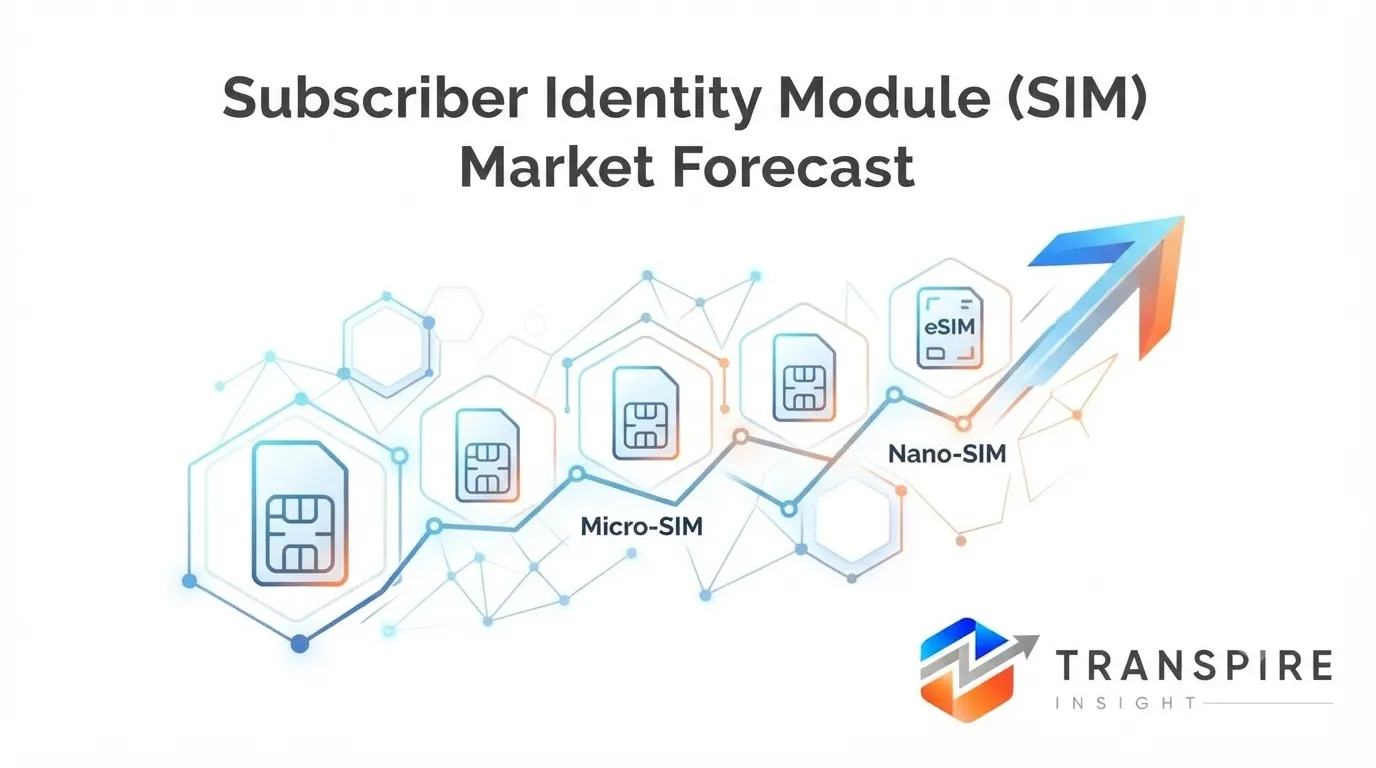
According to a research report published by Transpire Insight, the Subscriber Identity Module (SIM) market size is projected to grow from USD 3.18 billion in 2026 to USD 5.15 billion by 2035, at a CAGR of 9.89% during the forecast period 2027-2035. The market is expanding as a result of the adoption of 5G, the deployment of a massive number of IoT devices, the preference for remote SIM provisioning among consumers, connected vehicle telemetry, and the proliferation of smartphones.
Introduction
Traditional plastic SIMs are making way for the new embedded SIM (eSIM) and integrated SIM (iSIM) architectures in the Subscriber Identity Module (SIM) market. SIM technology is a fundamental component in network authentication and secure digital identification, playing a vital role in telecoms worldwide. The industry is continuing to advance in mobile, enterprise IoT, and automotive platforms to ensure connectivity is frictionless and seamless across the globe.
Recent Development News
February 2026: Telenor IoT officially announced the commercial availability of SGP.32-standardized SIM architecture designed to streamline enterprise-grade IoT deployments globally.
February 2026: Microsoft has announced 5G enterprise management for Windows 11 laptops via Intune, which will enable direct corporate eSIM remote provisioning.
Stay Ahead of Emerging Opportunities with Expert Market Insights by Transpire Insight
Transpire Insight provides comprehensive, data-driven market intelligence to support smarter business decisions. Our research is rooted in comprehensive analysis, authoritative predictions, and industry expertise, enabling organizations to make informed decisions in rapidly evolving markets. We provide in-depth analysis of market segmentation, competitive positioning, regional trends, and emerging investment opportunities in high-growth areas. We blend accuracy with actionable intelligence, helping companies uncover new growth avenues, strengthen strategic decision-making, and stay ahead in a dynamic market.
Subscriber Identity Module (SIM) Market Size & Statistics
The Market Size for Subscriber Identity Module (SIM) Was Estimated to be Worth USD 3.18 Billion in 2026.
The Market Size is Going to Expand at a CAGR of 9.89% between 2026 and 2035.
The Subscriber Identity Module (SIM) Market Size is anticipated to reach USD 5.15 Billion by 2035.
Asia-Pacific is projected to drive the highest demand during the forecast period, accounting for 36% of the Subscriber Identity Module (SIM) market.
Europe is projected to grow the fastest during the forecast period at a CAGR of 27% in the Subscriber Identity Module (SIM) market.
Regional Growth and Demand Analysis by Transpire Insight
Asia Pacific's dominance rests on affordable smartphones, low-cost data plans, and a vast base of price-sensitive consumers across markets like India, China, and Indonesia. Meanwhile, mobile operators like Reliance Jio, Bharti Airtel, and China Mobile keep launching schemes that lure new customers to cellular services with low prices, and Indian government agencies like the Department of Telecommunications and China's MIIT are strengthening SIM registration and KYC requirements to combat fraud. India's telecom regulator recently made public the country's subscriber-identity demand, with more than 1.28 billion wireless connections across the country covering both consumer and M2M SIMs. To further illustrate the way fraud detection is inseparable from growth in the SIM market in Asia Pacific, DoT has introduced an indigenous AI tool, ASTR, which identified and isolated over 82 lakh suspicious mobile connections related to mismatches in identities.
Rising penetration of smartphones, smartwatches, and connected cars, and the accelerating deployment of 4G and 5G are fueling Europe's rapid growth. In the European Union, the European Commission has confirmed that almost 97% of households are now covered by basic 5G service and the early stages of mid-band 5G are proceeding, which is driving the demand for advanced SIM and eSIM modules. Meanwhile, eSIM rollout is growing across the continent as telecom operators and device manufacturers like Vodafone, Orange, and Deutsche Telekom continue to roll it out, and enterprises are rolling it out in vehicle tracking solutions, smart metering, and industrial logistics. Examples of partnerships that are driving transformation in the way cross-border, standards-based provisioning is changing the way businesses at scale handle connected-device fleets across Europe and Asia Pacific include the multi-operator enterprise eSIM connectivity network created by Thales Group, Singtel Group and Bridge Alliance.
Top 15 Trends in the Subscriber Identity Module (SIM) Market
eSIMs let users activate mobile service digitally without inserting a physical card, driving flexibility for consumers and pushing device makers toward soldered, space-saving connectivity modules across smartphones and wearables.
iSIM embeds subscriber-identity functionality directly into a device's processor, saving space and power, making it attractive for smartwatches, connected cars, and compact IoT hardware needing minimal footprint.
Smart meters, industrial sensors, and connected machinery increasingly require always-on mobile connections, pushing operators and SIM vendors to supply ruggedized, remotely manageable modules built for machine-to-machine communication.
Telecom operators now deploy AI to flag unusual SIM activity, such as sudden device changes or location shifts, helping prevent identity theft and unauthorized account takeovers in real time.
Businesses managing large device fleets need to activate, update, or switch network profiles remotely, making standards-based remote provisioning essential for scalable, cross-border IoT and enterprise deployments.
Factories and warehouses are adopting private 5G for fast, secure connectivity, and SIMs play a central role in identifying and managing every device across these dedicated networks.
List of Top 25 Companies Leading the Subscriber Identity Module (SIM) Market
World leader delivering end-to-end digital identity, cybersecurity, and secure SIM products.
Founded: 1968 | HQ: Paris, France.
Why It Ranks: Top market share provider in remote SIM provisioning and secure elements.
Regional Dominance: Strong footprint across Europe, North America, and high-growth Asia-Pacific regions.
Product Line: Classic SIM, eSIM, iSIM solutions, and remote provisioning software engines.
Pioneer in security technology and creator of the first commercial SIM.
Founded: 1852 | HQ: Munich, Germany.
Why It Ranks: Dominates smart card issuance and enterprise-level eSIM management platforms.
Regional Dominance: Deep market presence across Europe, Latin America, and North America.
Product Line: Smart cards, eSIM management ecosystems, AirOn management platforms, iSIM modules.
provider specializing in biometrics, identity verification, and mobile connectivity services.
Founded: 2017 | HQ: Courbevoie, France.
Why It Ranks: Recognized for massive scale in manufacturing automotive and mobile network SIMs.
Regional Dominance: Strong coverage in Europe, North America, the Middle East, and Asia.
Product Line: Smart SIM cards, eSIM solution suites, subscription management, automotive connectivity.
eSIM and iSIM specialist spun out from Arm to drive IoT.
Founded: 2020 | HQ: Cambridge, United Kingdom
Why It Ranks: Leads innovation in low-power integrated SIM architecture for IoT chipsets.
Regional Dominance: Powerful operational presence across North America, Europe, and East Asia.
Product Line: Kigen eSIM OS, iSIM software stack, remote SIM provisioning services.
Fast-growing provider specializing in mobile security, cloud provisioning, and SIM manufacturing.
Founded: 1997 | HQ: Dubai, United Arab Emirates.
Why It Ranks: First provider certified for cloud-based eSIM management by GSMA standards.
Regional Dominance: Leading market share across the Middle East, Africa, and South Asia.
Product Line: SIM cards, eSIM profile management, cloud-hosted subscription platforms, IoT modules.
Major provider of digital identity, payment, and telecommunication connectivity solutions.
Founded: 1957 | HQ: Rio de Janeiro, Brazil.
Why It Ranks: Dominates Latin American SIM supply chains with expanding infrastructure.
Regional Dominance: Leading provider across South America, expanding into North America and Europe.
Product Line: Traditional UICC SIMs, eSIM operating systems, remote subscription management, M2M SIMs.
Prominent Asian smart card and identity solution provider servicing mobile operators.
Founded: 1998 | HQ: Zhuhai, China.
Why It Ranks: Huge volume production capacity supplying Asia’s top telecommunications network carriers.
Regional Dominance: Unmatched market reach within China and Southeast Asian telecom markets.
Product Line: Telecom SIM cards, financial smart cards, eSIM chips, IoT modules.
Established cybersecurity software developer specializing in authentication and smart card OS.
Founded: 1994 | HQ: Singapore.
Why It Ranks: Extensive technical focus on hardware security, cryptographic SIMs, and authentication.
Regional Dominance: Widespread client base across Asia-Pacific, Latin America, and Europe.
Product Line: SIM cards, TimeCOS operating system, eSIM management, secure tokens.
Leading developer of smart cards and digital identity solutions for telecommunications.
Founded: 1999 | HQ: Wuhan, China.
Why It Ranks: Ranks among the highest-volume producers of UICC SIMs globally.
Regional Dominance: Strong market hold in domestic China, expanding across Asia-Pacific.
Product Line: 4G/5G SIM cards, embedded SIM chips, smart payment terminals.
semiconductor giant providing hardware security controllers for SIM and eSIM.
Founded: 1999 | HQ: Neubiberg, Germany.
Why It Ranks: World-leading hardware supplier for secure elements powering automotive/consumer eSIMs.
Regional Dominance: Dominates semiconductor supply chains across Europe, the Americas, and Asia.
Product Line: OPTIGA Connect eSIM hardware, secure controller chips, smart card ICs.
Conclusion
The SIM market is at a turning point, with traditional physical SIM card production and the software-based eSIM and iSIM innovations competing with each other. The industry is buzzing with 5G, connected vehicles, and a proliferation of IoT ecosystems, with cloud-based Remote SIM Provisioning and strong hardware encryption being key priorities. While industry partners work on advancing SGP.32 standards, the SIM market will continue to form the backbone of telecommunications and secure digital identity management.


Send us a brief description of your challenge and we'll get back to you within 24 hours.

 [email protected]
 APAC:+91 7666513636
 Address


