
Oct 12, 2026
By Transpire Insight
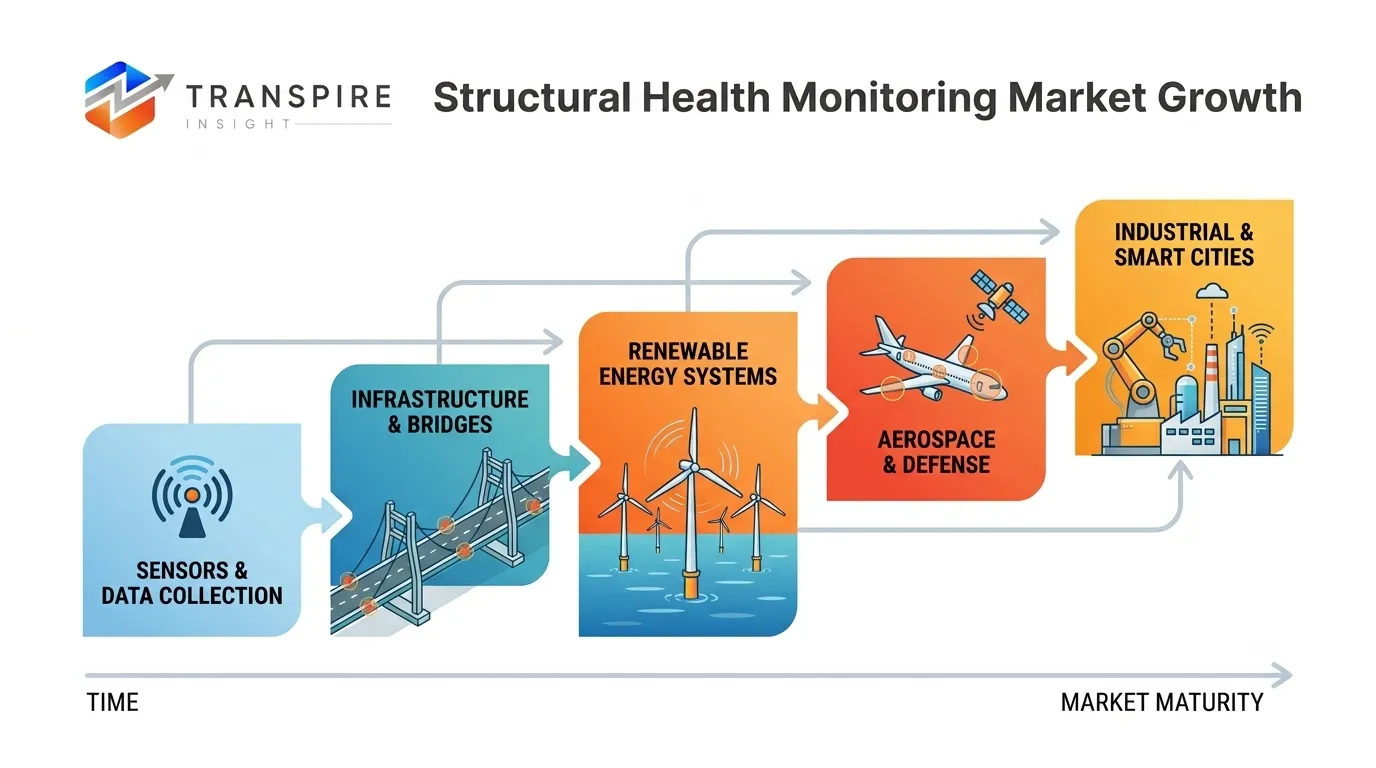
Description
According to a research report published by Transpire Insight, the structural health monitoring market size is projected to grow from USD 5.29 billion in 2026 to USD 18.33 billion by 2035, at a CAGR of 19.51% during the forecast period 2027-2035. Aging civil infrastructure, rapid urbanization, strict safety mandates, and IoT-driven wireless sensor integration compel operators to deploy real-time predictive health monitoring for continuous integrity assessment.
Introduction
Structural Health Monitoring (SHM) involves automated, continuous measurement of civil, aerospace, and energy structures to detect damage, track stress, and prevent catastrophic failures. Utilizing advanced wireless sensors, fiber optics, and data analytics, SHM systems deliver actionable intelligence to optimize maintenance cycles, extend structural lifespans, and safeguard human lives. The market experiences rapid growth driven by severe aging of critical assets and stringent disaster-resilience regulations.
Recent Development News
March 2026: StructHEALTH published a scalable, IoT-driven SHM architecture specifically engineered for real-time post-earthquake rapid assessment, integrating multi-axis MEMS accelerometers with edge computing to stream instant structural drift and stiffness loss analytics.
September 2026: Structural Monitoring Systems Plc reported record FY26 revenue of $32.5 million, boosted by rapid adoption and commercial certification advancements of its comparative vacuum monitoring (CVM™) structural health monitoring systems across commercial aircraft fleets.
Stay Ahead of Emerging Opportunities with Expert Market Insights by Transpire Insight
Transpire Insight provides comprehensive, data-driven market intelligence to support smarter business decisions. Our research is rooted in comprehensive analysis, authoritative predictions, and industry expertise, enabling organizations to make informed decisions in rapidly evolving markets. We provide in-depth analysis of market segmentation, competitive positioning, regional trends, and emerging investment opportunities in high-growth areas. We blend accuracy with actionable intelligence, helping companies uncover new growth avenues, strengthen strategic decision-making, and stay ahead in a dynamic market.
Structural Health Monitoring Market Size & Statistics
The Market Size for Structural Health Monitoring Was Estimated to be Worth USD 5.29 Billion in 2026.
The Market Size is Going to Expand at a CAGR of 19.51% between 2026 and 2035.
The Structural Health Monitoring Market Size is anticipated to reach USD 18.33 Billion by 2035.
North America is projected to drive the highest demand during the forecast period, accounting for 36.3% of the structural health monitoring market.
Asia-Pacific is projected to grow the fastest during the forecast period at a CAGR of 15.2% in the structural health monitoring market.
Regional Growth and Demand Analysis by Transpire Insight
North America leads demand because many U.S. dams, locks, and bridges are operating beyond their intended lifespan. The U.S. Army Corps of Engineers has developed sensor-based systems that continuously track structural condition and give early warning of potential failures. Bridge and tunnel rehabilitation programs under the Infrastructure Investment and Jobs Act are also pushing agencies toward large-scale smart sensor deployment across highways, airports, and dams. Commercial activity is following, with MISTRAS Group partnering with Villari to add wireless fatigue-crack sensors to its monitoring offering for bridges, wind turbines and cranes. Europe is expanding steadily as well. The European Commission announced nearly 2.8 billion euros under the Connecting Europe Facility to modernize railways, inland waterways and transport corridors, and Germany adopted a 500 billion euro special fund for infrastructure and climate neutrality, with large sums earmarked for rail and bridge upgrades.
Asia Pacific is the market's growth engine. Governments in China and South Korea now require monitoring of critical infrastructure such as bridges and buildings, while high-speed rail networks, long-span bridges, urban metros and mega dams in China are increasing the need for continuous real-time monitoring. Smart infrastructure policies are pushing adoption of sensor-based systems integrated with IoT, AI and big data platforms. In India, the National Highways Authority of India formed a Design Division to develop an IT-based system for identifying distressed bridges. The Middle East is also gaining ground, as the UAE and Saudi Arabia are incorporating SHM into major projects such as NEOM and Etihad Rail under their Vision 2030 programs. Latin America is growing more gradually, led by Brazil, where federal transportation and energy agencies are deploying monitoring systems on bridges, dams, and hydroelectric facilities.
Top 15 Trends in the Structural Health Monitoring Market
Wireless sensor networks cut cabling costs and installation time, letting operators instrument large bridges and buildings quickly, which makes wireless the fastest-growing SHM technology segment.
Machine learning models analyze vibration and stress patterns from sensors to automatically flag anomalies, helping engineers detect damage earlier and reduce dependence on manual inspections.
Digital twins combine live sensor data with structural models, letting owners simulate loading scenarios, forecast deterioration, and prioritize repairs across bridges, tunnels, and industrial assets.
Fiber-optic sensors offer distributed, high-sensitivity strain and temperature measurement over long distances, resisting electromagnetic interference, which suits harsh tunnel, pipeline, dam, and long-span bridge environments.
Operators replace calendar-based inspections with condition-driven maintenance, using continuous monitoring data to schedule repairs before failures occur, cutting inspection costs and extending structural service life.
IoT connectivity and cloud platforms stream sensor readings to centralized dashboards, giving engineers remote, real-time visibility and alerts across dispersed assets without frequent site visits.
List of Top 25 Companies Leading the Structural Health Monitoring Market
1. Nova Metrics (Geokon)
A leader in vibrating wire sensing technologies for civil structures.
Founded: 1979 | HQ: Lebanon, New Hampshire, USA
Why It Ranks: Sets world standards for robust, high-precision geotechnical structural health instrumentation.
Regional Dominance: Strong market leadership across North American and European civil infrastructure sectors.
Product Line: Vibrating wire strain gauges, piezometers, settlement systems, inclinometers, dynamic dataloggers.
2. Campbell Scientific
Pioneer in rugged data acquisition systems and real-time remote telemetry instrumentation.
Founded: 1974 | HQ: Logan, Utah, USA
Why It Ranks: Essential provider of reliable controllers for complex structural monitoring globally.
Regional Dominance: Extensive distribution and dominance across North America, Europe, and Asia-Pacific.
Product Line: CR6 and CR1000X dataloggers, wireless sensor networks, automated weather stations.
3. Sixense (Vinci Group)
Specializes in high-end structural risk management, monitoring software, and digitizing infrastructure.
Founded: 2016 | HQ: Nanterre, France
Why It Ranks: Backed by civil leader Vinci, offering unmatched multi-asset monitoring platforms.
Regional Dominance: Dominates the European market while rapidly expanding across Asia and the Americas.
Product Line: Beyond the SHM platform, automated total stations, acoustic emission sensors, tiltmeters.
4. COWI A/S
Leading engineering consulting firm providing end-to-end structural monitoring design.
Founded: 1930 | HQ: Lyngby, Denmark
Why It Ranks: authority in mega-bridge, dam, and offshore wind structural engineering.
Regional Dominance: Massive foothold in Northern Europe with growing operations in North America.
Product Line: Custom SHM digital twins, structural integrity management systems, sensor layout design.
5. Fugro N.V.
World-leading geo-data provider delivering comprehensive offshore and onshore structural integrity monitoring.
Founded: 1962 | HQ: Leidschendam, Netherlands
Why It Ranks: Unrivaled capabilities in marine, energy, and mega-infrastructure structural risk analytics.
Regional Dominance: market leader across Europe, the Middle East, and Asia-Pacific regions.
Product Line: GeoData SHM suites, subsea monitoring platforms, remote asset tracking dashboards.
6. Hottinger Bruel & Kjaer (HBK)
Test and measurement titan providing dynamic fiber optic and electronic monitoring.
Founded: 1950 | HQ: Virum, Denmark
Why It Ranks: Formed by HBM and B&K, commanding vast technical sensing expertise.
Regional Dominance: Deep presence across European industrial base and North American aerospace hubs.
Product Line: Fiber Bragg Grating (FBG) optical sensors, catman software, strain gauge amplifiers.
7. Kinemetrics, Inc.
World leader in earthquake engineering and structural dynamic reaction monitoring systems.
Founded: 1969 | HQ: Pasadena, California, USA
Why It Ranks: Gold standard for seismic structural health monitoring and emergency alert platforms.
Regional Dominance: Dominates seismically active regions across the Americas, Asia-Pacific, and Southern Europe.
Product Line: Oasis SHM software, EpiSensor accelerometers, Rock digital recorders, dynamic telemetry.
8. Advantech Co., Ltd.
leader in industrial IoT gateways and edge computing hardware architectures.
Founded: 1983 | HQ: Taipei, Taiwan
Why It Ranks: Dominates edge computing processing nodes vital for high-speed wireless SHM systems.
Regional Dominance: Strong market control in Asia-Pacific with extensive supply networks.
Product Line: ADAM acquisition modules, WISE wireless sensor gateways, industrial IoT edge servers.
9. Sitemark (Acquisition by Bentley / Systems Focus)
Specializes in drone-based remote sensing and digital twin integration for structural health.
Founded: 2016 | HQ: Leuven, Belgium
Why It Ranks: Key innovator in combining visual AI inspection with real-time SHM sensor networks.
Regional Dominance: Rapidly expanding across European smart-construction and asset management networks.
Product Line: Visual asset digital twin platforms, structural defect analytics, aerial monitoring integrations.
10. Digitexx Data Systems
Focuses exclusively on real-time structural health monitoring systems for complex structures.
Founded: 2000 | HQ: Denver, Colorado, USA
Why It Ranks: Delivers proprietary continuous real-time structural health data processing and alerts.
Regional Dominance: Strong footprint across North American civil infrastructure and commercial building sectors.
Product Line: Real-Time Structural Health Monitoring (RTSHM) software, high-speed acquisition hardware, accelerometers.
Conclusion
The Structural Health Monitoring market is undergoing a pivotal transformation driven by advanced wireless sensing, AI predictive analytics, and strict structural longevity mandates. As civil infrastructure ages and mega-smart cities expand, automated continuous monitoring becomes essential for catastrophe prevention and asset optimization. Market leadership remains defined by companies offering scalable, real-time edge integration and robust optical or wireless sensors, ensuring safety and resilient infrastructure management worldwide.


Send us a brief description of your challenge and we'll get back to you within 24 hours.

 inquiry@transpireinsight.com
 APAC:+91 7666513636
 Address


