
Oct 24, 2026
By Transpire Insight
Description
According to a research report published by Transpire Insight, the servo motors and drives market size is projected to grow from USD 17.8 billion in 2026 to USD 25.11 billion by 2035, at a 5.6% CAGR during the 2027-2035 forecast period. The major factors driving the expansion in the market for servo systems are the growing demand for industrial automation, smart manufacturing, the increasing use of robotics in logistics, and the strict regulations for energy efficiency.
Introduction
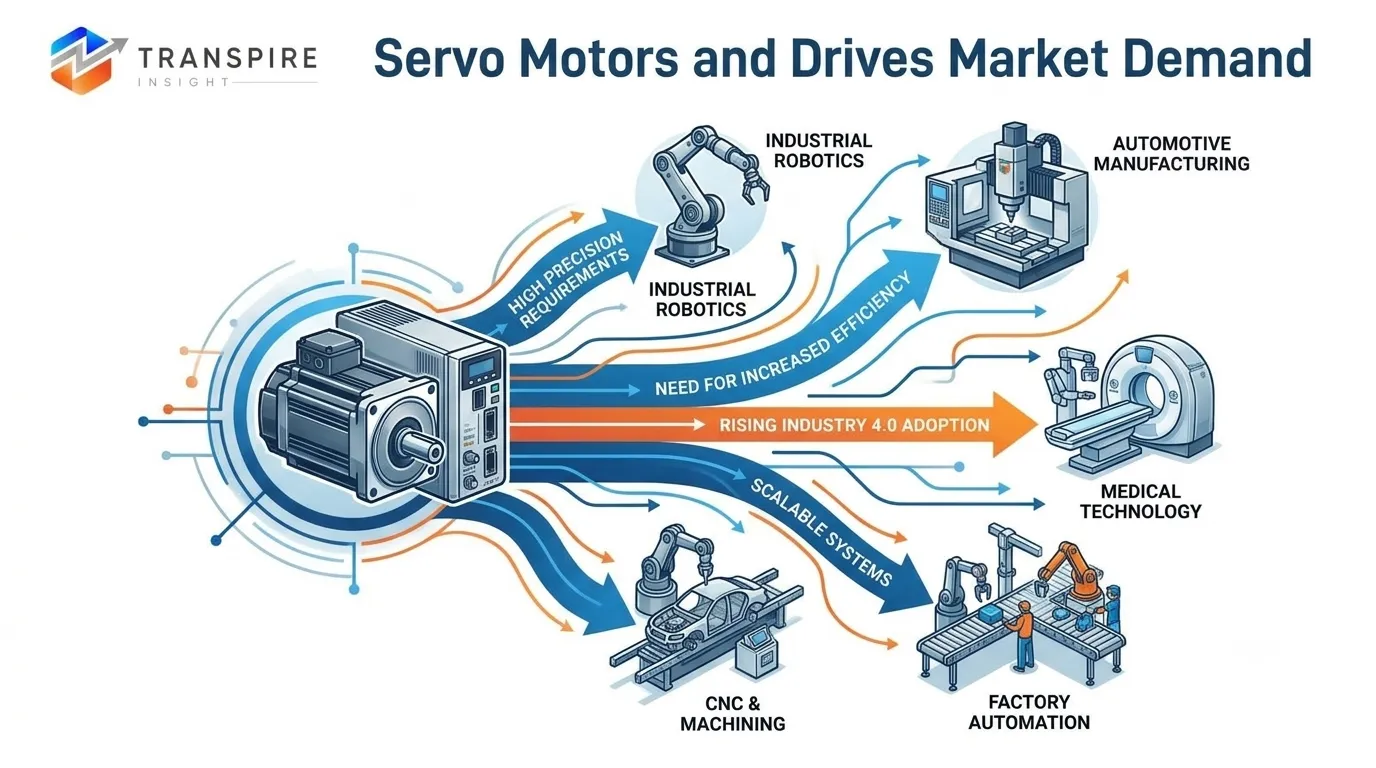
High-accuracy dynamic motion control in automated manufacturing is based on servo motors and drives. These systems offer high torque density, sub-millimeter positioning precision, and real-time motion feedback, allowing them to run seamlessly in industrial robotics, CNC machines, semiconductor manufacturing, and packaging. The need for energy-efficient, multi-axis integrated servo architectures is on the rise, driving the reshaping of motion technology in industrial supply chains as industries move towards Industry 4.0 paradigms.
Recent Development News
June 2026: Elmo Motion Control introduced the company's newest Platinum Cymbal and Jori servo drives that combine Silicon Carbide (SiC) and Gallium Nitride (GaN) power stages for ultra-compact multi-axis motion control drives equipped with certified functional safety features.
June 2026: Inovance unveiled its new IDM series integrated servo motor-drive system, which was developed for packaging and conveyor lines, offering a 450% overload rating for maximum reliability in challenging industrial applications.
Stay Ahead of Emerging Opportunities with Expert Market Insights by Transpire Insight
Transpire Insight provides comprehensive, data-driven market intelligence to support smarter business decisions. Our research is rooted in comprehensive analysis, authoritative predictions, and industry expertise, enabling organizations to make informed decisions in rapidly evolving markets. We provide in-depth analysis of market segmentation, competitive positioning, regional trends, and emerging investment opportunities in high-growth areas. We blend accuracy with actionable intelligence, helping companies uncover new growth avenues, strengthen strategic decision-making, and stay ahead in a dynamic market.
Servo Motors and Drives Market Size & Statistics
The Market Size for Servo Motors and Drives Was Estimated to be Worth USD 17.8 Billion in 2026.
The Market Size is Going to Expand at a CAGR of 5.6% between 2026 and 2035.
The Servo Motors and Drives Market Size is anticipated to reach USD 25.11 Billion by 2035.
Asia-Pacific is projected to drive the highest demand during the forecast period, accounting for 40% of the servo motors and drives market.
North America is projected to grow the fastest during the forecast period at a CAGR of 11% in the servo motors and drives market.
Regional Growth and Demand Analysis by Transpire Insight
Asia Pacific is the biggest region in the servo motors and drives market. It is the number one because businesses continue to invest more in Production. The largest market in Asia Pacific is China, which accounts for the bulk of the region's sales. It's largely due to robotics, as China installs approximately half of the number of robots installed worldwide. Local competition is also good, and obviously, Yaskawa Electric is a market leader in the region.
North America is regarded as the highest growth area. Growth here is due to companies moving manufacturing in-house and more automation being used. The Asia Pacific market is expected to grow at a slower rate than the market. There are a number of factors driving demand higher. The CHIPS and Science Act and the Inflation Reduction Act are bringing manufacturing back to the area, thanks to the support of the US government. Smaller companies are also embracing robots, with servo-controlled models driving them to work more efficiently, and factories are getting smarter and more connected.
Top 15 Trends in the Servo Motors and Drives Market
Manufacturers in automotive, electronics, and packaging automate production to offset labor shortages and improve precision, directly lifting demand for servo motors and drives in robots.
Smart factories link servo drives to networks and analytics platforms, enabling real-time data sharing, remote diagnostics, and flexible production, making connectivity a standard buying requirement.
Space-constrained machines like cobots and packaging lines need smaller, lighter servo systems with high torque density and efficiency, pushing vendors toward compact, energy-saving servo designs.
Drives embedded with AI algorithms analyze vibration, temperature, and current patterns to forecast failures, reducing unplanned downtime and maintenance costs for manufacturers across production lines.
Combining motor, drive, and controller in a single unit simplifies wiring, saves cabinet space, and speeds commissioning, making integrated servo solutions attractive for modular machines.
Collaborative robots need precise, responsive servo motors for safe operation beside humans, and growing adoption by small and medium enterprises expands low-payload servo drive demand.
List of Top 25 Companies Leading the Servo Motors and Drives Market
1. Yaskawa Electric Corporation
World leader in AC servo motor production, exceeding 50 million total units shipped globally.
Founded: 1915 | HQ: Kitakyushu, Japan.
Why It Ranks: Dominates robotic and motion control sectors with its flagship Sigma series.
Regional Dominance: Holds leading market share across the Asia-Pacific region and North America.
Product Line: Sigma-7 and Sigma-X AC servo motors, rotary units, and amplifier drives.
2. Siemens AG
Industry pioneer in integrated industrial automation platforms and digitalization framework architectures.
Founded: 1847 | HQ: Munich, Germany.
Why It Ranks: Sets European standards for digital enterprise motion solutions and CNC integrations.
Regional Dominance: Maintains undisputed market leadership throughout Europe and North America industrial hubs.
Product Line: SINAMICS servo drives, SIMOTICS rotary motors, and integrated motion controllers.
3. Mitsubishi Electric Corporation
technology giant providing ultra-high precision motion controllers and factory automation machinery.
Founded: 1921 | HQ: Tokyo, Japan
Why It Ranks: Leads high-speed automated packaging, automotive assembly, and flat-panel display production systems.
Regional Dominance: Holds substantial market power across Japan, East Asia, and key Western networks.
Product Line: MELSERVO-J5 series, rotary servo motors, linear motors, and multi-axis drives.
4. FANUC Corporation
titan in computer numerical control systems and industrial articulated robot manufacturing.
Founded: 1972 | HQ: Oshino, Japan.
Why It Ranks: Preferred motion control supplier for automotive, aerospace, and precision CNC machine tooling.
Regional Dominance: Dominates industrial manufacturing automation sectors in North America, Asia, and Europe.
Product Line: Alpha i-Series servo motors, Beta i-Series motors, and integrated CNC amplifiers.
5. ABB Ltd.
power and automation leader advancing robotics, electrification, and heavy dynamic automation.
Founded: 1988 | HQ: Zurich, Switzerland.
Why It Ranks: Excellent performance capabilities in high-efficiency industrial dynamic power and motion technology solutions.
Regional Dominance: Commands huge market footprints in Western Europe, the Americas, and APAC regions.
Product Line: eSMART servo motors, MicroFlex e190 servo drives, and dynamic motion drives.
6. Schneider Electric SE
specialist in energy management solutions and smart digitized industrial automation systems.
Founded: 1836 | HQ: Rueil-Malmaison, France.
Why It Ranks: Integrates cybersecure, sustainable motion control architectures directly into digitized eco-smart factory grids.
Regional Dominance: Enjoys wide commercial dominance in Europe and widespread expansion across the Americas.
Product Line: Lexium 32 servo drives, Lexium BMH/BSH brushless motors, and integrated motion units.
7. Rockwell Automation, Inc.
Largest pure-play industrial automation and digital information intelligence solution provider in America.
Founded: 1903 | HQ: Milwaukee, Wisconsin, USA.
Why It Ranks: Commands top position for heavy industrial packaging, food processing, and automotive automation.
Regional Dominance: Represents the primary dominant player across North American industrial machine markets.
Product Line: Kinetix servo drives, VP-Series low-inertia motors, and MP-Series stainless steel motors.
8. Bosch Rexroth AG
Engineering powerhouse offering integrated hydraulic, electric, and direct-drive motion automation control platforms.
Founded: 2001 | HQ: Lohr am Main, Germany.
Why It Ranks: Excels in high-torque heavy engineering, assembly line automation, and advanced mobile machinery.
Regional Dominance: Strong operational presence and market position across Central Europe and Germany.
Product Line: IndraDrive drive systems, MS2N dynamic servo motors, and ctrlX AUTOMATION drives.
9. Delta Electronics, Inc.
Leading Taiwanese multinational provider of high-efficiency power electronics and industrial automation equipment.
Founded: 1971 | HQ: Taipei, Taiwan.
Why It Ranks: Offers cost-effective, high-performance servo motion solutions tailored for mass automation equipment.
Regional Dominance: Captures massive market volume in Greater China, Southeast Asia, and emerging markets.
Product Line: ASDA-A2 and ASDA-A3 servo series, AC motors, and high-resolution optical drives.
10. Panasonic Industry Co., Ltd.
Electronic components giant renowned for high-speed, compact industrial electronics and high-end sensors.
Founded: 1918 | HQ: Osaka, Japan.
Why It Ranks: Key innovator in ultra-compact, high-response servo technology for electronic manufacturing lines.
Regional Dominance: Maintains high penetration across East Asian electronic manufacturing and assembly lines.
Product Line: MINAS A6 and MINAS A5 servo series, compact drives, and encoders.
Conclusion
The servo motors and drives market is gaining momentum with the growing adoption of smart factories, the industrial internet of things (IIoT), and autonomous robotics. New technologies such as wide bandgap semiconductors and AI-based predictive control are propelling unprecedented power density and efficiency. The role of integrated servo technology in future industrial automation scenarios won't change, as key market players continue to reach the limits of performance in the field of high precision.


Send us a brief description of your challenge and we'll get back to you within 24 hours.

 inquiry@transpireinsight.com
 APAC:+91 7666513636
 Address


