
Oct 26, 2026
By Transpire Insight
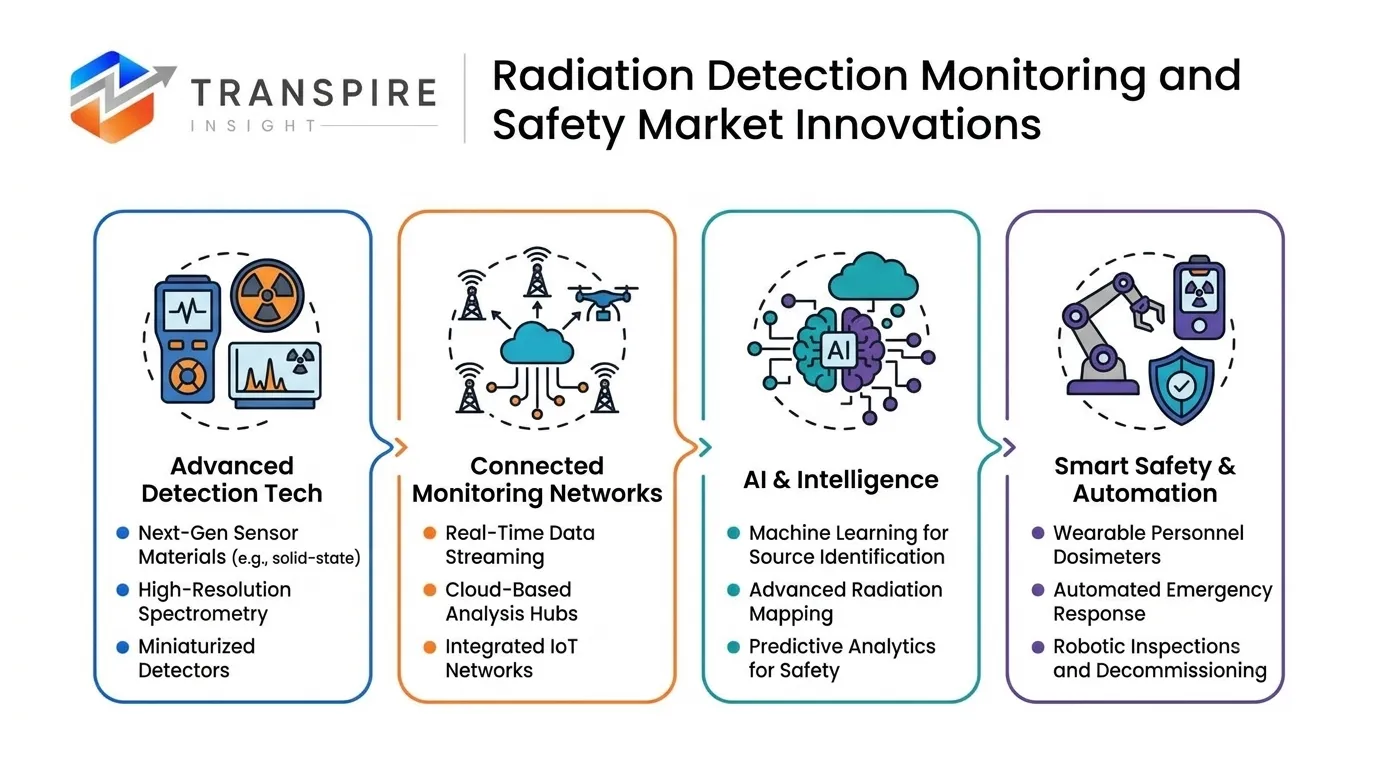
Description
According to a research report published by Transpire Insight, the Radiation Detection Monitoring and Safety Market size is projected to grow from USD 4.12 billion in 2026 to USD 6.57 billion by 2035, at an 8.16% CAGR during the 2027-2035 forecast period. Expanding nuclear medicine procedures and diagnostic imaging across healthcare facilities, combined with rising government expenditures on homeland security and nuclear threat detection infrastructure alongside stringent occupational health regulations, continue to drive rapid market growth.
Introduction
The radiation detection, monitoring, and safety market focuses on protecting human health, critical infrastructure, and the environment from hazardous ionizing radiation. Expanding across healthcare, nuclear power, defense, and industrial sectors, this market utilizes advanced sensors, electronic personal dosimeters, and protective shielding to ensure strict regulatory compliance and occupational safety. Increasing adoption of nuclear medicine and geopolitical homeland security initiatives drive steady demand.
Recent Development News
March 2026: Mirion Technologies introduced an AI-powered personal electronic dosimeter featuring real-time telemetry and wireless cloud reporting for healthcare and nuclear operators.
August 2026: Thermo Fisher Scientific secured a major defense procurement agreement to deploy ruggedized portable radiation monitors for homeland security border checkpoints.
Stay Ahead of Emerging Opportunities with Expert Market Insights by Transpire Insight
Transpire Insight provides comprehensive, data-driven market intelligence to support smarter business decisions. Our research is rooted in comprehensive analysis, authoritative predictions, and industry expertise, enabling organizations to make informed decisions in rapidly evolving markets. We provide in-depth analysis of market segmentation, competitive positioning, regional trends, and emerging investment opportunities in high-growth areas. We blend accuracy with actionable intelligence, helping companies uncover new growth avenues, strengthen strategic decision-making, and stay ahead in a dynamic market.
Radiation Detection Monitoring and Safety Market Size & Statistics
The Market Size for Radiation Detection Monitoring and Safety Was Estimated to be Worth USD 4.12 Billion in 2026.
The Market Size is Going to Expand at a CAGR of 8.16% between 2026 and 2035.
The Radiation Detection Monitoring and Safety Market Size is anticipated to reach USD 6.57 Billion by 2035.
North America is projected to drive the highest demand during the forecast period, accounting for 36.87% of the radiation detection monitoring and safety market.
Asia-Pacific is projected to grow the fastest during the forecast period at a CAGR of 8.23% in the radiation detection monitoring and safety market.
Regional Growth and Demand Analysis by Transpire Insight
North America leads because strong defense spending and border screening keep procurement steady, while heavy investment in healthcare, nuclear energy, and environmental safety adds a second layer of demand. Radiation portal monitors at ports and border crossings are regularly upgraded, and hospitals and diagnostic centers buy dosimeters and area monitors to meet safety rules. Many of these laws require advanced detection and monitoring devices in hospitals, which makes replacement and expansion buying a recurring source of revenue for suppliers in the region.
Asia Pacific is the fastest-growing region because defense modernization and monitoring expansion are happening together. China runs a large national monitoring system, Japan maintains environmental radiation monitoring, and India maintains radiological emergency preparedness, all of which require detectors and monitors. Nuclear build-out adds to this, as China plans to commission 150 reactors before 2060. South Korea’s growing cyclotron network widens the number of hospitals needing radiation safety equipment. A shortage of certified radiation safety officers is the main brake on faster adoption.
Top 15 Trends in the Radiation Detection Monitoring and Safety Market
Hospitals, nuclear plants, and industrial sites are replacing passive badges with electronic dosimeters streaming exposure readings live, helping workers avoid overexposure and simplifying compliance records.
Machine learning models filter background noise, flag unusual spectra, and cut false alarms, letting operators focus on genuine radiological threats at ports, plants, and hospitals.
Connected detectors send radiation readings to cloud dashboards, enabling remote supervision of multiple facilities, automated alerts, and long-term trend analysis without frequent manual site visits.
New reactor construction and life-extension programs, especially across Asia, require fixed area monitors, contamination meters, and personnel monitoring systems throughout plant operation, maintenance, and decommissioning.
Expanding cancer treatment, PET imaging, and cyclotron networks increase staff exposure risks, pushing hospitals to invest more in survey meters, area monitors, and dosimetry services.
Governments continue upgrading radiation portal monitors at borders, seaports, and airports to intercept smuggled radioactive materials, strengthening demand for sensitive, high-throughput, low-false-alarm screening equipment worldwide.
List of Top 25 Companies in the Radiation Detection Monitoring and Safety Market
1. Thermo Fisher Scientific Inc.
Thermo Fisher leads the analytical instrumentation industry with comprehensive radiation safety solutions.
Founded: 1956 | HQ: Waltham, Massachusetts, USA.
Why It Ranks: Market leadership in portable radiation identifiers and comprehensive laboratory measurement systems.
Regional Dominance: Strongest footprint in North America, Europe, and Asia-Pacific healthcare infrastructure.
Product Line: Handheld radiation monitors, dosimeters, survey meters, and automated sample counters.
2. Mirion Technologies, Inc.
Mirion specializes purely in advanced radiation measurement and personal radiation protection solutions.
Founded: 2005 | HQ: Atlanta, Georgia, USA.
Why It Ranks: Recognized as a premier dedicated provider of occupational dosimetry and surveillance.
Regional Dominance: Holds dominant market share across North American and European nuclear facilities.
Product Line: Personal electronic dosimeters, radiation monitoring systems, and gamma spectroscopy software.
3. Fortive Corporation (Fluke Biomedical)
Fortive provides essential radiation measurement tools through its specialized biomedical safety brand.
Founded: 2016 | HQ: Everett, Washington, USA.
Why It Ranks: High reputation for precision quality assurance instruments in medical imaging systems.
Regional Dominance: Dominates diagnostic imaging calibration networks across the Americas and Europe.
Product Line: Radiation survey meters, personal dosimeters, phantom devices, and quality assurance kits.
4. AMETEK, Inc. (ORTEC)
AMETEK ORTEC manufactures ultra-sensitive nuclear radiation detectors for research and defense.
Founded: 1930 | HQ: Berwyn, Pennsylvania, USA.
Why It Ranks: Premier technological developer of high-purity germanium detectors and spectrometry software.
Regional Dominance: Exceptional dominance across North American national laboratories and research institutes.
Product Line: High-purity germanium detectors, multichannel analyzers, and alpha/beta counting equipment.
5. Fuji Electric Co., Ltd.
Fuji Electric is an industrial conglomerate producing critical radiation monitoring systems.
Founded: 1923 | HQ: Tokyo, Japan.
Why It Ranks: Key supplier of large-scale environmental monitoring networks for Asian nuclear installations.
Regional Dominance: Strong market control across Japan, East Asia, and emerging Pacific markets.
Product Line: Area radiation monitors, dust monitors, personal electronic dosimeters, and survey meters.
6. Ludlum Measurements, Inc.
Ludlum produces durable, field-tested radiation detection equipment for first responders globally.
Founded: 1962 | HQ: Sweetwater, Texas, USA.
Why It Ranks: Highly trusted brand for rugged portable radiation survey instruments.
Regional Dominance: Widespread adoption in North America, Latin America, and international emergency services.
Product Line: Geiger-Mueller counters, scintillation detectors, portal monitors, and surface contamination meters.
7. Teledyne FLIR LLC
Teledyne FLIR builds integrated threat detection equipment for military and security personnel.
Founded: 1978 | HQ: Wilsonville, Oregon, USA.
Why It Ranks: Preferred supplier for battlefield and CBRNE emergency radiation identification tools.
Regional Dominance: Unmatched dominance across defense networks in the United States and NATO.
Product Line: Handheld radionuclide identification devices (RID), radiation detectors, and tactical sensors.
8. Kromek Group plc
Kromek specializes in advanced cadmium zinc telluride (CZT) semiconductor radiation detectors.
Founded: 2003 | HQ: Sedgefield, United Kingdom.
Why It Ranks: Pioneer in miniaturized, high-resolution SPECT imaging and homeland security detection devices.
Regional Dominance: Strong market presence in the United Kingdom, Europe, and the US.
Product Line: CZT-based radiation detectors, wearable radiation mappers, and biological threat sensors.
9. Polimaster Holdings Ltd.
Polimaster produces specialized wearable equipment designed for personal radiation safety enforcement.
Founded: 1992 | HQ: Vienna, Austria.
Why It Ranks: Innovator in wristwatch-style radiation detectors and compact electronic personal dosimeters.
Regional Dominance: Strong market penetration across European border security and police enforcement agencies.
Product Line: Personal radiation detectors, search monitors, wrist dosimeters, and radiation portal monitors.
10. Landauer (Fortive)
Landauer is a world leader in passive occupational radiation dosimetry services.
Founded: 1954 | HQ: Glenwood, Illinois, USA.
Why It Ranks: Globally preferred brand for Optically Stimulated Luminescence (OSL) passive personal badges.
Regional Dominance: Widespread leadership across healthcare systems in North America and Latin America.
Product Line: Luxel+ OSL dosimeters, InLight dosimetry readers, and radiation safety compliance reporting.
Conclusion
The radiation detection, monitoring, and safety market plays an indispensable role in safeguarding life and the environment across nuclear, defense, and healthcare sectors. Rapid advancements in wireless telemetry, AI-driven dosimetry, and lightweight lead-free materials continue to modernize safety protocols. Backed by expanding nuclear medicine applications and stringent regulatory standards, industry leaders are well-positioned to drive innovation, delivering higher sensitivity, automated reporting, and enhanced operational protection globally.


Send us a brief description of your challenge and we'll get back to you within 24 hours.

 inquiry@transpireinsight.com
 APAC:+91 7666513636
 Address


