
Oct 19, 2026
By Transpire Insight
Description
According to a research report published by Transpire Insight, the portable medical devices market size is projected to grow from USD 72.06 billion in 2026 to USD 152.8 billion by 2035, at a CAGR of 11.24% during the forecast period 2027-2035. Key market drivers include the rising burden of chronic diseases, increasing preference for home-based healthcare, demographic aging, rapid technological advancements in AI-driven miniaturized sensors, wireless connectivity, and point-of-care diagnostics.
Introduction
The portable medical devices market is experiencing rapid expansion, driven by a structural shift from centralized clinical settings toward decentralized, patient-centric healthcare delivery. Integrating advanced telemetry, micro-electronics, continuous health monitoring, and edge AI, modern portable medical equipment enables real-time diagnostic tracking, remote therapeutic interventions, and personalized continuous care. This technological evolution optimizes hospital workflows, significantly lowers readmission rates, and expands access to quality medical services worldwide.
Recent Development News
News January 2026: Leading medical technology developers expanded commercial access for next-generation portable diagnostic platforms, integrating advanced edge-AI algorithms to deliver real-time, hospital-grade cardiac and respiratory analysis directly within decentralized home-care settings.
August 2026: Industry authorities published updated market surveillance reports highlighting a significant surge in smart wearable continuous monitoring devices, driven by enhanced regulatory frameworks for remote patient monitoring cybersecurity and multi-sensor wireless integration.
Stay Ahead of Emerging Opportunities with Expert Market Insights by Transpire Insight
Transpire Insight provides comprehensive, data-driven market intelligence to support smarter business decisions. Our research is rooted in comprehensive analysis, authoritative predictions, and industry expertise, enabling organizations to make informed decisions in rapidly evolving markets. We provide in-depth analysis of market segmentation, competitive positioning, regional trends, and emerging investment opportunities in high-growth areas. We blend accuracy with actionable intelligence, helping companies uncover new growth avenues, strengthen strategic decision-making, and stay ahead in a dynamic market.
Portable Medical Devices Market Size & Statistics
The Market Size for Portable Medical Devices Was Estimated to be Worth USD 72.06 Billion in 2026.
The Market Size is Going to Expand at a CAGR of 11.24% between 2026 and 2035.
The Portable Medical Devices Market Size is anticipated to reach USD 152.8 Billion by 2035.
North America is projected to drive the highest demand during the forecast period, accounting for 41.78% of the portable medical devices market.
Asia-Pacific is projected to grow the fastest during the forecast period at a CAGR of 11.2% in the portable medical devices market.
Regional Growth and Demand Analysis by Transpire Insight
North America remains the anchor of demand, supported by a heavy chronic disease burden, strong reimbursement, hospital-at-home programs, and broad adoption of remote patient monitoring. Recent launches show the pattern: Medtronic received FDA clearance for MiniMed 780G integration with Abbott’s Instinct sensor and for type 2 diabetes use, Dexcom secured clearance for its G7 15-Day wearable sensor, and GE HealthCare added Caption AI to its Vscan Air SL wireless handheld ultrasound. Europe follows with a projected value of USD 17.95 billion and a 5.5% growth rate, the second-highest globally, as aging populations and health systems that prefer outpatient and home-based care lift demand in Germany, France, the U.K., Italy, Spain, and Scandinavia.
Asia Pacific, projected at about USD 15.90 billion and currently the third-largest market, is drawing demand from large patient populations, rising healthcare spending, and wider access to private care. China is expected to reach around USD 6.21 billion, nearly 9.2% of revenues, while Japan and India are projected at USD 2.71 billion and USD 2.13 billion, with diabetes, cardiovascular, and respiratory disease driving volumes. Field deployments show how portability is closing access gaps: Vietnam is rolling out AI-powered portable ultrasound in mobile clinics to improve maternal health in remote provinces, and Australia and New Zealand are adding portable ultrasound and ECG devices to rural telehealth networks. Latin America, projected near USD 3.09 billion, is led by Brazil and Mexico on diabetes and cardiovascular monitoring needs, while the Middle East and Africa grows from a smaller base, with the GCC (about USD 1.12 billion) leading through healthcare modernization, mandatory insurance expansion, and medical tourism.
Top 15 Trends in the Portable Medical Devices Market
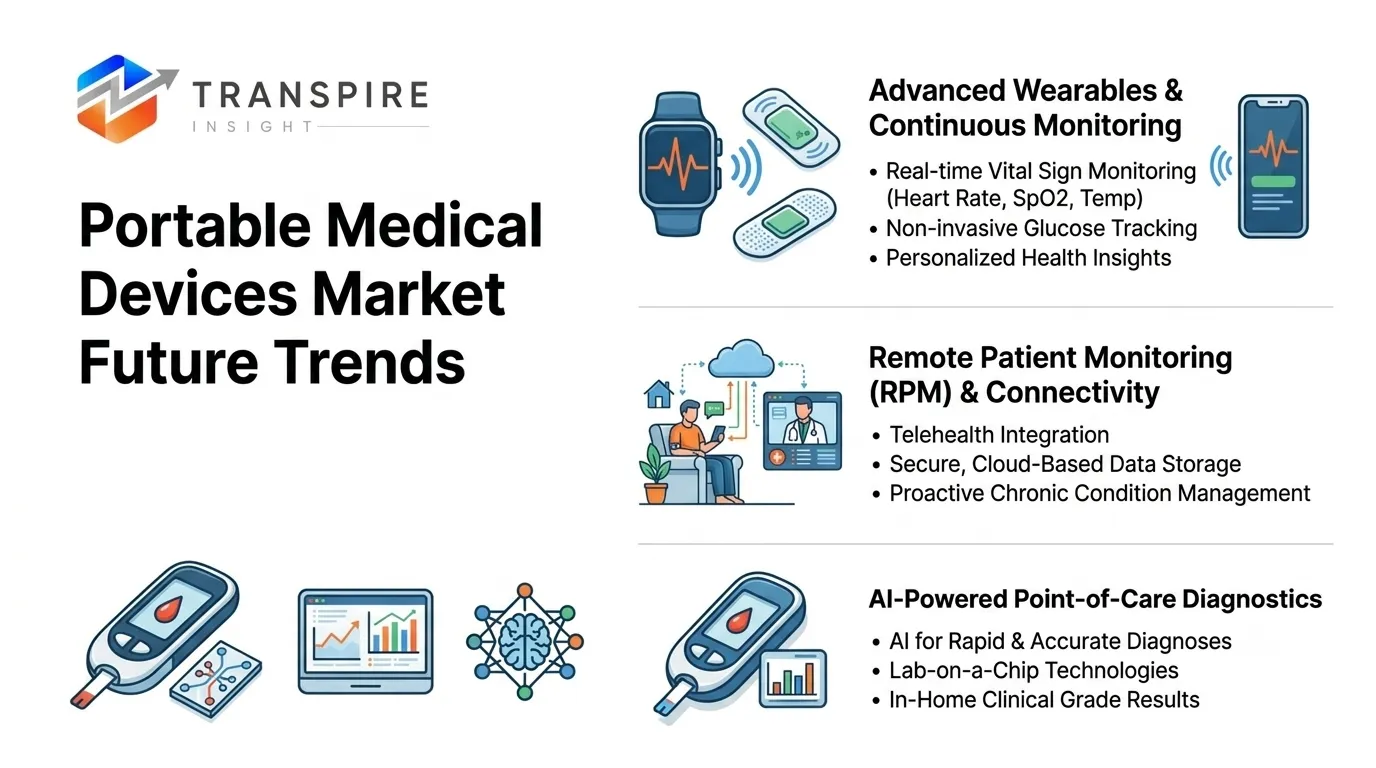
Healthcare systems are moving treatment and monitoring into homes to cut admissions and costs, driving demand for easy-to-use portable monitors, respiratory devices, and therapy equipment.
Longer-wear sensors and broader clearances are making continuous glucose monitoring practical for more diabetes patients, reducing fingerstick dependence and supporting daily self-management outside clinical settings.
Wearable ECG patches and mobile cardiac telemetry let clinicians detect arrhythmias earlier, keeping high-risk cardiac patients monitored continuously without prolonged hospital stays or clinic visits.
Handheld ultrasound probes with AI guidance help non-specialists capture diagnostic-quality images at the bedside, in mobile clinics, and rural settings where radiology access is limited.
Device makers increasingly feed readings into remote monitoring platforms and electronic health records, helping care teams intervene sooner and making interoperability a major competitive differentiator.
Companies are pairing devices with analytics dashboards, cloud reporting, and subscription services, steadily shifting revenue streams from one-time equipment sales toward recurring, data-driven care offerings.
List of Top 25 Companies Leading the Portable Medical Devices Market
1. Medtronic plc
Pioneers connected wearable insulin pumps and advanced portable cardiovascular monitoring systems.
Founded: 1949 | HQ: Dublin, Ireland.
Why It Ranks: Holds market leadership across smart therapeutic and continuous monitoring segments.
Product Line: MiniMed Continuous Glucose Monitors, BioButton Wearables, Portable Pacemaker Programmers, CareLink Telemetry.
2. GE HealthCare
Engineers high-performance portable imaging platforms and point-of-care diagnostic ultrasound units.
Founded: 1892 | HQ: Chicago, Illinois, USA.
Why It Ranks: Unrivaled clinical imaging footprint with deep artificial intelligence diagnostic integration.
Product Line: Vscan Extend Pocket Ultrasound, MAC Portable ECG Systems, CARESCAPE Monitors.
3. Koninklijke Philips N.V.
Pioneers connected home health monitoring, clinical telemetry, and portable respiratory therapy.
Founded: 1891 | HQ: Amsterdam, Netherlands.
Why It Ranks: Dominates personal health informatics, remote patient management, and emergency defibrillation.
Product Line: HeartStart Portable Defibrillators, Respironics Oxygen Concentrators, IntelliVue Mobile Patient Monitors.
4. Siemens Healthineers AG
Develops handheld blood analyzers and ultra-portable point-of-care laboratory diagnostic platforms.
Founded: 1847 | HQ: Erlangen, Germany.
Why It Ranks: Exceptional clinical-grade diagnostic precision in miniaturized, mobile laboratory formats worldwide.
Product Line: epoc Blood Analysis System, ACUSON Freestyle Wireless Ultrasound, Portable X-Ray Systems.
5. Abbott Laboratories
Produces continuous glucose monitors and handheld point-of-care cardiovascular diagnostic platforms.
Founded: 1888 | HQ: Abbott Park, Illinois, USA.
Why It Ranks: consumer leader in continuous sensor technology and quick blood-testing devices.
Product Line: FreeStyle Libre CGM, i-STAT Handheld Blood Analyzer, Confirm Rx Insertable Monitor.
6. Boston Scientific Corporation
Innovates handheld cardiac rhythm diagnostics, neuromodulation controllers, and mobile patient telemetry.
Founded: 1979 | HQ: Marlborough, Massachusetts, USA.
Why It Ranks: Strong portfolio depth in interventional cardiology, electrophysiology, and portable neuromodulation.
Product Line: LATITUDE Patient Management Systems, S-ICD Portable Programmers, WaveWriter Neuromodulation Controllers.
7. DexCom, Inc.
Specializes in real-time continuous glucose monitoring wearables for diabetes health management.
Founded: 1999 | HQ: San Diego, California, USA.
Why It Ranks: Market leader in dedicated wearable metabolic health and automated sensor delivery.
Product Line: Dexcom G7 Continuous Glucose Monitor, Dexcom ONE, Mobile Diabetes Apps.
8. ResMed Inc.
Manufactures compact sleep apnea treatment systems and lightweight portable oxygen concentrators.
Founded: 1989 | HQ: San Diego, California, USA
Why It Ranks: Industry benchmark for digital sleep therapy and outpatient cloud-connected respiratory care.
Product Line: AirMini Portable CPAP, Mobi Portable Oxygen Concentrator, Astral Ventilation Systems.
9. Becton, Dickinson and Company (BD)
Engineers smart ambulatory infusion pumps and miniaturized drug delivery injection platforms.
Founded: 1897 | HQ: Franklin Lakes, New Jersey, USA.
Why It Ranks: Massive worldwide footprint in vascular access management and mobile infusion safety.
Product Line: BD BodyGuard Portable Infusion Pumps, Alaris Systems, PhysioControl Defibrillator Units.
10. Stryker Corporation
Produces portable emergency resuscitation equipment, field monitors, and mobile surgical navigation.
Founded: 1941 | HQ: Kalamazoo, Michigan, USA.
Why It Ranks: Dominates pre-hospital emergency care, surgical transport equipment, and trauma monitoring.
Product Line: LIFEPAK 15 Defibrillator/Monitor, LUCAS Chest Compression Systems, Mobile Surgical Instruments.
Conclusion
The portable medical devices market is experiencing rapid transformation, driven by artificial intelligence integration, miniaturized sensor design, and the expansion of remote patient monitoring frameworks. As healthcare systems continue prioritizing decentralized delivery models, leading manufacturers are advancing diagnostic accuracy, interoperability, and continuous telemetry. Ultimately, connected portable technologies will remain central to lowering healthcare costs, improving chronic disease management, and expanding early clinical diagnostic capabilities worldwide.


Send us a brief description of your challenge and we'll get back to you within 24 hours.

 inquiry@transpireinsight.com
 APAC:+91 7666513636
 Address


