
Oct 23, 2026
By Transpire Insight
Description
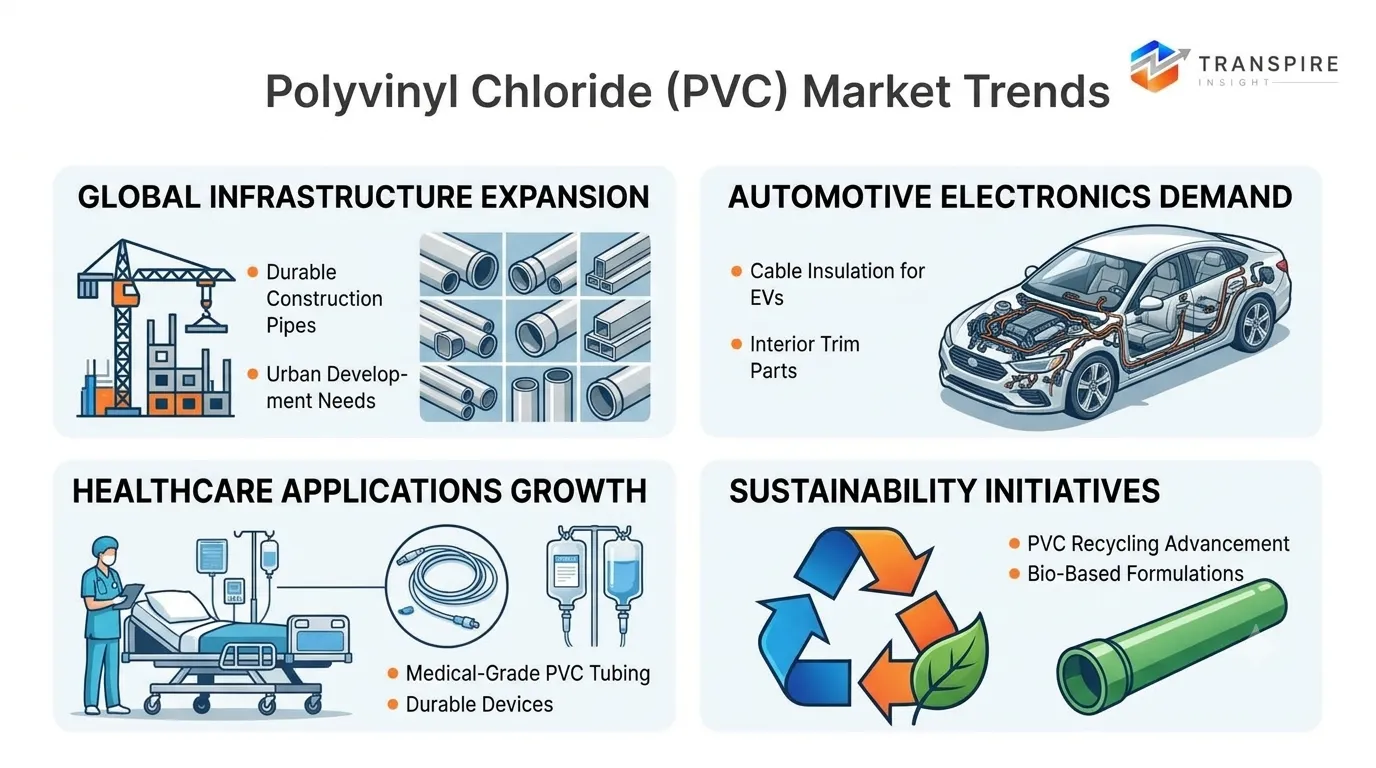
According to a research report published by Transpire Insight, the polyvinyl chloride (PVC) market size is projected to grow from USD 56.14 billion in 2026 to USD 75.3 billion by 2035, at a 4.62% CAGR during the 2027-2035 forecast period. PVC consumption is driven by surging infrastructure modernization, booming urban residential construction, rapid growth in medical-grade packaging, and growing demand for flame-retardant wire and cable insulation.
Introduction
Polyvinyl chloride (PVC) is the third most produced synthetic plastic polymer in the world, valued for its excellent chemical resistance, durability, processability, and low production costs. PVC is used in a variety of rigid and flexible applications across today's infrastructure, healthcare and automotive, packaging, and consumer electronics. Manufacturers are focused on bio-based feedstocks and processes with low emissions to ensure growth as demands for sustainability increase.
Recent Development News
March 2026: Major Asian PVC producers, including Reliance Industries and Chemplast, announced sharp domestic price hikes of up to ₹6,000/MT to mitigate rising naphtha and energy feedstock costs driven by crude market spikes.
May 2026: International PVC export market momentum is growing as the chemical spot market analyses pointed to a "structural change" in the international PVC supply chains, with greater export activity from North American PVC producers and a tightening of the European environmental compliance limits.
Stay Ahead of Emerging Opportunities with Expert Market Insights by Transpire Insight
Transpire Insight provides comprehensive, data-driven market intelligence to support smarter business decisions. Our research is rooted in comprehensive analysis, authoritative predictions, and industry expertise, enabling organizations to make informed decisions in rapidly evolving markets. We provide in-depth analysis of market segmentation, competitive positioning, regional trends, and emerging investment opportunities in high-growth areas. We blend accuracy with actionable intelligence, helping companies uncover new growth avenues, strengthen strategic decision-making, and stay ahead in a dynamic market.
Polyvinyl Chloride (PVC) Market Size & Statistics
The Market Size for Polyvinyl Chloride (PVC) Was Estimated to be Worth USD 56.14 Billion in 2026.
The Market Size is Going to Expand at a CAGR of 4.62% between 2026 and 2035.
The Polyvinyl Chloride (PVC) Market Size is anticipated to reach USD 75.3 billion by 2035.
Asia-Pacific is projected to drive the highest demand during the forecast period, accounting for 36.9% of the Polyvinyl Chloride (PVC) market.
North America is projected to grow the fastest during the forecast period at a CAGR of 4.7% in the Polyvinyl Chloride (PVC) market.
Regional Growth and Demand Analysis by Transpire Insight
Asia Pacific is the major driver of PVC demand as growing urbanization, housing and water infrastructure projects continue to consume significant amounts of resin. China accounts for almost half of PVC demand. India is the most dynamic of the stories in the region. It has been the trade policy that has taken center stage. India's trade remedies authority has made a final finding on the imports of resin from China, Indonesia, Japan, South Korea, Taiwan and the US, which will lead to anti-dumping duties. This is good news as it is encouraging new domestic capacity plans to reduce reliance on imports.
In North America, growth is driven as much by supply discipline as by demand. Moderate demand in the U.S. drove exports to other nations such as India. Westlake's announcement that it would shut one of its PVC plants boosted expectations of a tighter supply.
Top 15 Trends in the Polyvinyl Chloride (PVC) Market
Rising adoption of PVC pipes in water infrastructure
Governments across developing economies are investing in water supply and sanitation networks, and PVC pipes remain preferred because they resist corrosion, cost less, and install quickly.
Shift toward lead-free calcium-zinc stabilizers
Regulations on lead and heavy metals are pushing manufacturers toward calcium-zinc stabilizers, which keep PVC durable while meeting stricter health, safety, and environmental requirements worldwide.
Expansion of recycled and circular PVC programs
Producers and converters are scaling mechanical and chemical recycling of PVC waste, responding to circular-economy targets and buyer demand for lower-carbon, recycled-content materials in construction.
Capacity additions in India to cut import dependence
India relies heavily on imported resin, so planned domestic capacity expansions aim to narrow that gap and give converters a more stable, locally produced supply.
Trade remedies reshaping PVC export flows
Anti-dumping measures and trade disputes are redirecting PVC exports between Asia, North America, Europe, and Latin America, forcing suppliers to rethink pricing, logistics, and customer portfolios.
Oversupply from Chinese capacity pressuring resin prices
Expanding Chinese capacity against soft domestic demand is pushing surplus resin into export markets, pressuring prices, prompting producers elsewhere to cut output or close plants.
List of Top 25 Leading Polyvinyl Chloride (PVC) Companies
Shin-Etsu Chemical Co., Ltd.
Shin-Etsu operates as the world's largest producer of PVC resin.
Founded: 1926 | HQ: Tokyo, Japan.
Why It Ranks: Holds market leadership through vast manufacturing capacity and chemical expertise.
Regional Dominance: Strong operational presence across Asia, North America, and major European markets.
Product Line: Suspension PVC resins, specialty PVC polymers, silicones, and semiconductor materials.
Westlake Corporation
Operates as one of North America's largest fully integrated PVC suppliers.
Founded: 1986 | HQ: Houston, Texas, USA.
Why It Ranks: Maintains vertical integration from chlor-alkali production directly to downstream PVC products.
Regional Dominance: Dominates North American markets with extensive export channels to Latin America.
Product Line: Polyvinyl chloride resins, vinyl compounds, building products, and chlor-alkali chemicals.
Formosa Plastics Corporation
Operates state-of-the-art mega-facilities across Asia and the Gulf Coast region.
Founded: 1954 | HQ: Taipei, Taiwan.
Why It Ranks: Controls massive production volume and robust petrochemical supply chain integration worldwide.
Regional Dominance: Leading market position across Asia-Pacific and the United States petrochemical sectors.
Product Line: PVC resins, caustic soda, liquid chlorine, ethylene dichloride, and VCM.
INEOS Inovyn
Serves as Europe's premier chlor-vinyl producer with a sustainable vinyl focus.
Founded: 2015 | HQ: London, United Kingdom.
Why It Ranks: Unrivaled European footprint and pioneer in bio-attributed PVC product commercialization.
Regional Dominance: Primary supplier and market leader across European industrial and construction sectors.
Product Line: General-purpose PVC, bio-attributed PVC, paste PVC, and chlor-alkali derivatives.
Orbia (Vestolit)
Functions as a leader in specialty and suspension PVC resins.
Founded: 1953 | HQ: Mexico City, Mexico.
Why It Ranks: Expansive portfolio spanning raw vinyl resins to complete water management solutions.
Regional Dominance: Widespread footprint spanning Latin America, North America, Europe, and Asia.
Product Line: Vestolit PVC resins, Alphagary compounds, Wavin piping systems, and fluorinated solutions.
Reliance Industries Limited (RIL)
Dominates India's domestic petrochemical market and polymer manufacturing capacity footprint.
Founded: 1958 | HQ: Mumbai, India.
Why It Ranks: Unmatched domestic market share backed by world-class integrated refinery complexes.
Regional Dominance: Complete market leadership in India and South Asian regional polymer distribution.
Product Line: Suspension PVC resin, emulsion PVC, polypropylene, polyethylene, and polyester intermediates.
Occidental Petroleum (OxyChem)
Major chemical manufacturer specializing in chlorine and vinyl chemistry building blocks.
Founded: 1920 | HQ: Houston, Texas, USA.
Why It Ranks: Essential bulk supplier of vinyl chloride monomer and PVC feedstock resins.
Regional Dominance: Strategic market presence across key industrial regions in North America.
Product Line: PVC resins, vinyl chloride monomer (VCM), ethylene dichloride (EDC), and caustic soda.
Xinjiang Zhongtai Chemical Co., Ltd.
Operates massive coal-to-chemical vinyl manufacturing complexes in western Chinese regions.
Founded: 2001 | HQ: Urumqi, China.
Why It Ranks: Captures scale advantages through vast integrated raw resource access in China.
Regional Dominance: Dominates domestic mainland China supply and exports to neighboring Asian markets.
Product Line: Calcium carbide-based PVC resins, caustic soda, viscose fiber, and industrial chemicals.
Kem One
Key European player focused on low-carbon PVC resin manufacturing processes.
Founded: 2012 | HQ: Lyon, France.
Why It Ranks: Crucial European supplier advancing eco-friendly chlor-vinyl manufacturing and circular economy initiatives.
Regional Dominance: Established market footprint across Western, Southern, and Central European nations.
Product Line: Mass PVC, suspension PVC, paste PVC, and chlor-alkali basic chemicals.
LG Chem
Leading South Korean chemical powerhouse with advanced high-performance polymer capabilities.
Founded: 1947 | HQ: Seoul, South Korea.
Why It Ranks: Combines high-grade industrial PVC manufacturing with cutting-edge materials R&D technology.
Regional Dominance: Broad market influence across South Korea, China, and Southeast Asian countries.
Product Line: PVC resins, plasticizers, ABS, specialty polymers, and advanced electronic materials.
Conclusion
Polyvinyl Chloride (PVC) is an important segment of industrial growth, supported by infrastructure investments and the demand for modern construction around the globe. Strategic positioning of leading market players to manage volatility in feedstock prices and take bold measures toward sustainability.Strategic positioning of the major market players to capture the price volatility of feedstocks and take bold steps towards sustainability. In the future, bio-attributed PVC, advanced recycling technologies, and high-efficiency production processes will be the factors determining market leadership, and PVC will continue to be essential in construction, healthcare, automotive, and technological applications.


Send us a brief description of your challenge and we'll get back to you within 24 hours.

 inquiry@transpireinsight.com
 APAC:+91 7666513636
 Address


