
Oct 01, 2026
By Transpire Insight
Description
According to a research report published by Transpire Insight, the military communications market size is projected to grow from USD 59.12 billion in 2026 to USD 155.23 billion by 2035, at a CAGR of 10.5% during the forecast period 2027-2035. International defense modernization, geopolitical uncertainty, the need for secure SATCOM networks, and the advancement of AI-enabled tactical radios, alongside the shift to interoperable joint all-domain command structures, drive growth.
Introduction
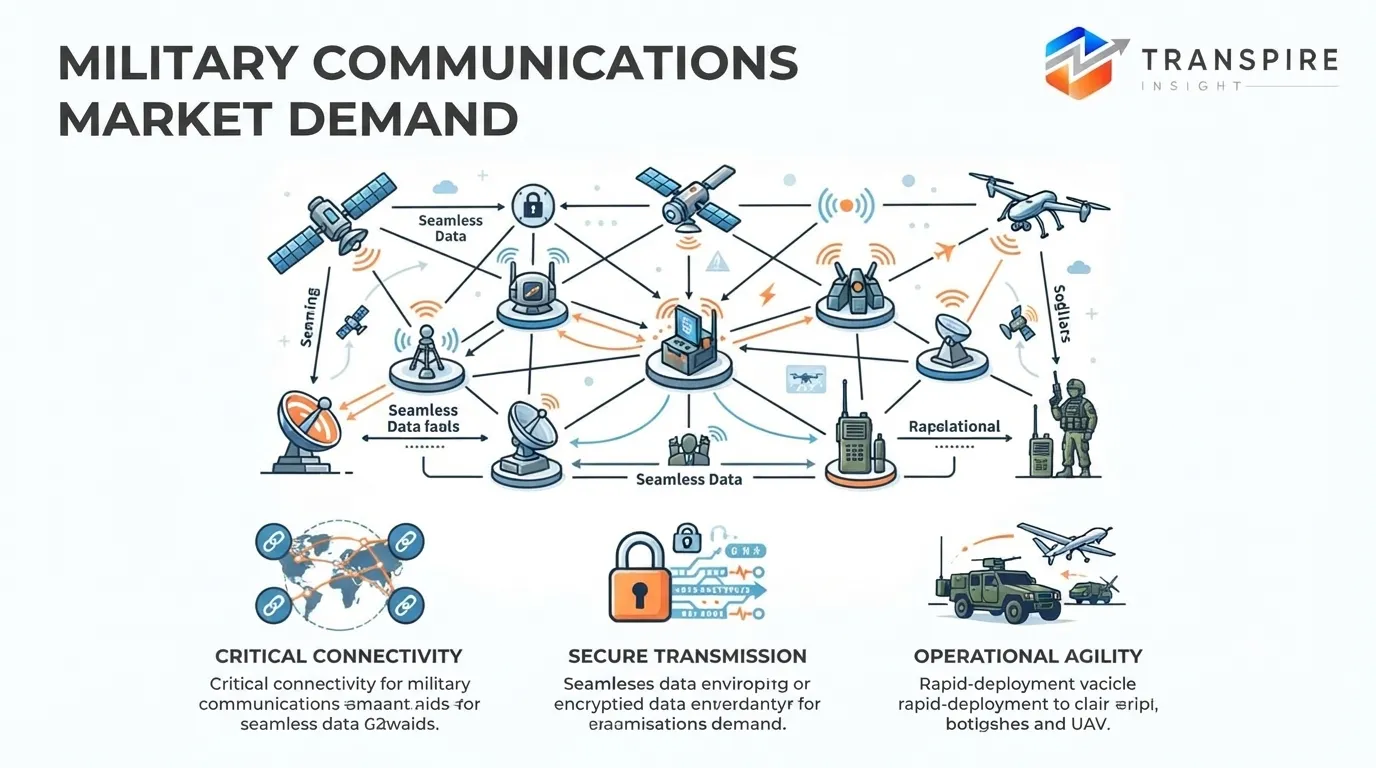
The military communications market is expected to provide secure, real-time voice, data, and video networking solutions for armed forces, which are necessary for modern warfare. This sector is the backbone of network-centric operations with the incorporation of advanced satellite, high-frequency radio, optical and tactical communications systems. The transition to joint command structures, software-defined radio technology, and the integration of unmanned systems into defense forces continues to be a fast-track growth area across the globe, with investments also increasing in the field of encrypted tactical communications and cyber-resilient systems.
Recent Development News
February 2026: L3Harris Technologies secured a major full-rate production contract from the U.S. Navy to deliver advanced integrated communications systems for submarine fleets.
August 2026: BAE Systems was awarded a £5.9 billion UK Ministry of Defence contract to advance critical communication systems and infrastructure for Dreadnought-class submarines.
Stay Ahead of Emerging Opportunities with Expert Market Insights by Transpire Insight
Transpire Insight provides comprehensive, data-driven market intelligence to support smarter business decisions. Our research is rooted in comprehensive analysis, authoritative predictions, and industry expertise, enabling organizations to make informed decisions in rapidly evolving markets. We provide in-depth analysis of market segmentation, competitive positioning, regional trends, and emerging investment opportunities in high-growth areas. We blend accuracy with actionable intelligence, helping companies uncover new growth avenues, strengthen strategic decision-making, and stay ahead in a dynamic market.
Military Communications Market Size & Statistics
The Market Size for Military Communications Was Estimated to be Worth USD 59.12 Billion in 2026.
The Market Size is Going to Expand at a CAGR of 10.5% between 2026 and 2035.
The Military Communications Market Size is anticipated to reach USD 155.23 Billion by 2035.
North America is projected to drive the highest demand during the forecast period, accounting for 41.11% of the military communications market.
Asia-Pacific is projected to grow the fastest during the forecast period at a CAGR of 6.45% in the military communications market.
Regional Growth and Demand Analysis by Transpire Insight
North America commands the largest share of the military communications market, anchored by sustained Pentagon procurement and large-scale modernization contracts. The U.S. Department of Defense's continued rollout of Link 16 tactical data links across joint forces, alongside Lockheed Martin and L3Harris deliveries of resilient SATCOM and software-defined radio systems, underscores the region's dominance. Viasat's wideband SATCOM support for the Bell-Boeing V-22 tiltrotor programme further illustrates how established defense primes and dense supplier networks keep North America ahead in protected, jam-resistant communication infrastructure. Heavy investment in Joint All-Domain Command and Control initiatives, paired with steady congressional defense budgets, continues to reinforce the region's technological lead and its position as the primary revenue base for military communications spending.
Asia-Pacific is registering the fastest regional growth in the military communications market, driven by rising defense budgets and accelerating indigenous modernization programs. India's push to expand tactical communication systems and secure networking for its armed forces, alongside Japan's investment in satellite-based command and control under its evolving defense buildup, reflects the region's momentum. China's rapid fielding of satellite and electronic warfare communication systems, along with South Korea's development of secure tactical radios, further highlights the shift. Growing territorial tensions across the Indo-Pacific, combined with expanding domestic defense industrial bases, are pushing governments across the region to prioritize resilient, interoperable, and cyber-secure communication networks, positioning Asia-Pacific as the market's key growth engine going forward.
Top 15 Trends in the Military Communications Market
Rising adoption of protected SATCOM terminals
Armed forces are deploying anti-jam, encrypted satellite terminals to maintain resilient connectivity in contested environments, driving strong demand for next-generation protected SATCOM hardware and services.
Growth of software-defined radios across forces
Software-defined radios allow militaries to reprogram waveforms instantly, boosting interoperability among allied forces and enabling rapid adaptation to evolving spectrum and electronic warfare threats worldwide.
Expansion of Joint All-Domain Command and Control
JADC2 initiatives connect sensors, shooters, and decision-makers across land, sea, air, space, and cyber domains, pushing sustained investment in resilient, data-centric architectures globally.
Increasing use of AI-enabled battlefield networks
Artificial intelligence now processes sensor and signal data in real time, improving situational awareness, threat detection, and decision speed across increasingly complex, contested battlefield networks.
Shift toward 5G-enabled tactical communication systems
Private 5G networks are being trialed at military bases and forward operating locations to deliver low-latency, high-bandwidth connectivity for sensors, drones, and autonomous battlefield systems.
Rise of low-earth-orbit military satellite constellations
LEO satellite constellations offer lower latency and greater resilience than traditional geostationary systems, prompting defense agencies to fund proliferated architectures for continuous, jam-resistant coverage.
List of Top 25 Companies Leading the Military Communications Market
1. L3Harris Technologies
Industry leader in multi-band software-defined tactical radios and satellite communications systems.
Founded: 1926 | HQ: Melbourne, Florida, USA.
Why It Ranks: Controls unmatched market share in tactical waveforms and resilient battlefield radios.
Regional Dominance: Strongest market footprint across North America, Europe, and Allied defense sectors.
Product Line: Falcon IV Tactical Radios, Lynx Communications Systems, Wideband SATCOM Terminals.
2. Collins Aerospace (RTX Corporation)
Primary supplier of airborne communications and secure networked avionics for defense fleets.
Founded: 1933 | HQ: Charlotte, North Carolina, USA.
Why It Ranks: Dominates military avionics networks and Joint All-Domain Command and Control technology.
Regional Dominance: Holds dominant positions in North American and NATO airborne operational theaters.
Product Line: ARC-210 Airborne Radios, TruNet Tactical Communications, Command-and-Control Data Links.
3. BAE Systems
Provides broad cyber-hardened battlefield electronics, secure datalinks, and naval communication systems.
Founded: 1999 | HQ: London, United Kingdom.
Why It Ranks: Key defense contractor providing end-to-end tactical networks for military forces.
Regional Dominance: Dominates the UK, European, North American, and Asia-Pacific defense markets.
Product Line: Tactical Broadband Radios, Fire Control Datalinks, Submarine Communications Arrays.
4. Thales Group
Leading European provider of secure tactical communications and military satellite networks.
Founded: 2000 | HQ: Paris, France.
Why It Ranks: provider of sovereign communications networks and tactical radio infrastructure solutions.
Regional Dominance: Unrivaled market presence across European Union nations, Africa, and Middle East.
Product Line: Synaps Software-Defined Radios, System21 Networks, Protected Military SATCOM Terminals.
5. General Dynamics Mission Systems
Builds secure network backbones and tactical mobile networks for ground force operations.
Founded: 1952 | HQ: Reston, Virginia, USA.
Why It Ranks: Prime architect behind secure tactical ground networks and encrypted defense backbones.
Regional Dominance: Dominates U.S. Army ground network infrastructure and NATO tactical operations.
Product Line: Tactical Cross Domain Solutions, DeltaNet Systems, Fortress Wireless Mesh Routers.
6. Northrop Grumman
Specializes in airborne gateway communications and interoperable Multi-Domain Command and Control architectures.
Founded: 1994 | HQ: Falls Church, Virginia, USA.
Why It Ranks: Crucial developer of airborne networking nodes linking disparate frontline military platforms.
Regional Dominance: Dominates complex defense communication programs across North America and Australia.
Product Line: Airborne Signals Intelligence Payloads, Battlefield Airborne Communications Node, Integrated Datalinks.
7. Lockheed Martin
Integrates space-based military communication networks and advanced ground-to-satellite secure relays.
Founded: 1995 | HQ: Bethesda, Maryland, USA.
Why It Ranks: Unrivaled capabilities in military satellite communications and Joint All-Domain Operations.
Regional Dominance: Leading market presence in North America, Western Europe, and East Asia.
Product Line: Advanced Extremely High Frequency SATCOM, Mobile User Objective System payloads.
8. Elbit Systems
pioneer in C4I network solutions and software-defined battlefield tactical radios.
Founded: 1966 | HQ: Haifa, Israel.
Why It Ranks: Highly efficient tactical communications systems deployed across multinational defense operations globally.
Regional Dominance: Massive market share across the Middle East, Asia-Pacific, Europe, and Latin America.
Product Line: E-LynX Software Defined Radios, TORCH-X Command Systems, SDR Airborne Terminals.
9. Rheinmetall AG
Key developer of digitized soldier communications and integrated battlefield land equipment systems.
Founded: 1889 | HQ: Düsseldorf, Germany.
Why It Ranks: Prime contractor for European digitized land force communications and combat management.
Regional Dominance: Deep penetration throughout European NATO forces and Allied defense forces worldwide.
Product Line: TacNet Tactical Management Systems, Gladius Soldier Systems, Digital Vehicle Communications.
10. Rohde & Schwarz
Renowned manufacturer of secure radio equipment and military signals intelligence communication gear.
Founded: 1933 | HQ: Munich, Germany.
Why It Ranks: Premier provider of interoperable naval, airborne, and ground software-defined communication radio.
Regional Dominance: Enjoys massive adoption throughout Europe, the Middle East, and Asia-Pacific defense sectors.
Product Line: SOVERON Tactical Radios, NAVICS Naval Integrated Communications Systems, Direction Finding.
Conclusion
The military communications sector is growing at a rapid pace as defence spending increases worldwide and connectivity between the various domains becomes a necessity. The top defense vendors keep driving innovation in software-defined radios, resilient satellite channels and cyber-proof networks. The battlefields of today are becoming increasingly complex, and cloud-based, AI-powered tactical communications will be the key to market growth. The key market players are well placed to benefit from the future opportunities presented by the continuous military network modernization programmes in place around the world.


Send us a brief description of your challenge and we'll get back to you within 24 hours.

 [email protected]
 APAC:+91 7666513636
 Address


