
Oct 17, 2026
By Transpire Insight
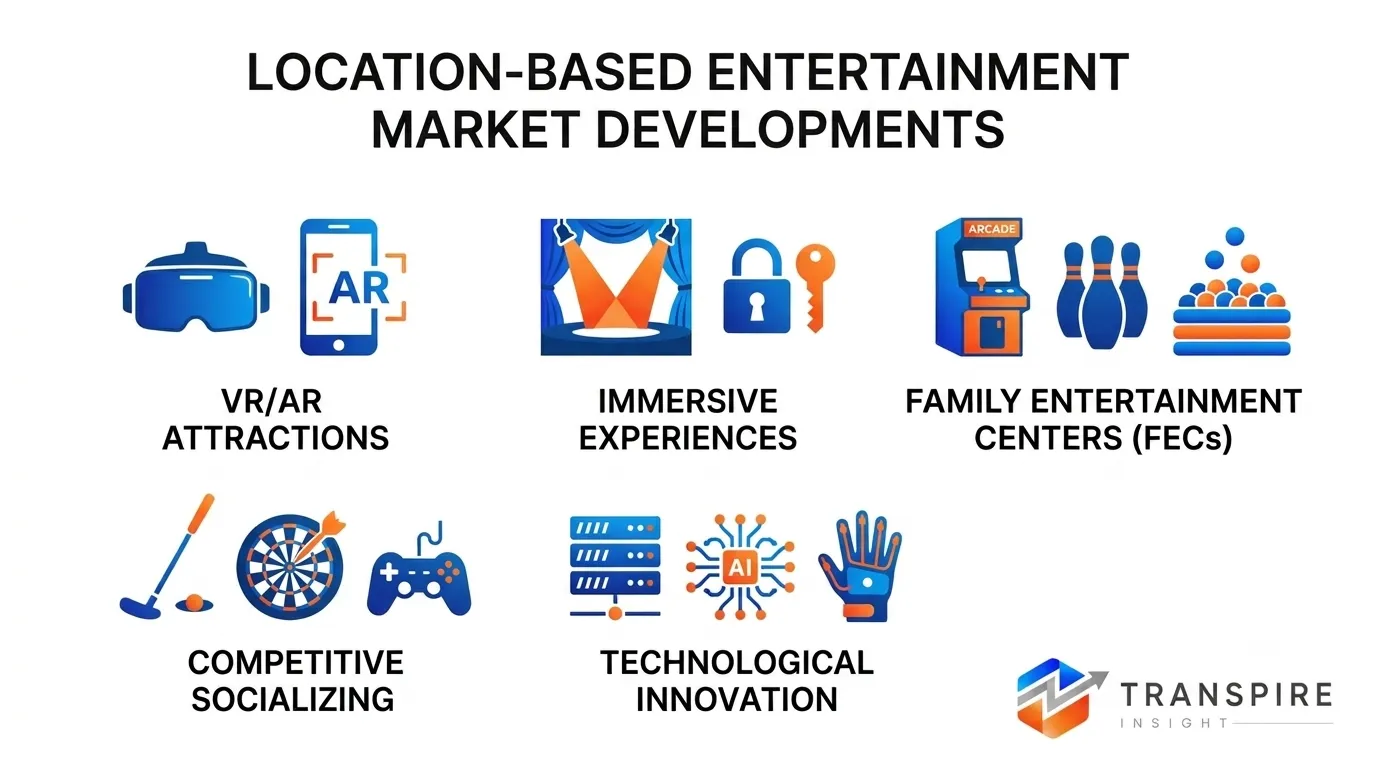
Description
According to a research report published by Transpire Insight, the location-based entertainment market size is projected to grow from USD 9.98 billion in 2026 to USD 44.03 billion by 2035, at a CAGR of 23.64% during the forecast period 2027-2035. Strong growth is seen in out-of-home attractions worldwide, as there is a growing demand for immersive experiential leisure, fast adoption of VR/AR hardware, and strategic studio IP licensing.
Introduction
The Location-Based Entertainment (LBE) market makes physical venues interactive destination spaces through immersive technology, thematic storylines, and family-friendly hardware attractions. The sector spans theme parks, virtual reality arcades, escape rooms, and hybrid family entertainment centers, and connects digital media to real-world settings. As disposable incomes increase and people become more interested in shared experiences than passive media consumption, LBE is a crucial business and revenue growth driver for media companies and venue operators the world over.
Recent Development News
May 2026: Escape Entertainment joined together with C.H.E. Group to quickly roll out location-based entertainment (LBE) experiences throughout Australia and New Zealand with the power of tech.
June 2026: Sony Pictures Entertainment made a strategic investment in Cosm for the same amount to enable further distribution of the next-generation immersive venues and cinematic media experiences.
Stay Ahead of Emerging Opportunities with Expert Market Insights by Transpire Insight
Transpire Insight provides comprehensive, data-driven market intelligence to support smarter business decisions. Our research is rooted in comprehensive analysis, authoritative predictions, and industry expertise, enabling organizations to make informed decisions in rapidly evolving markets. We provide in-depth analysis of market segmentation, competitive positioning, regional trends, and emerging investment opportunities in high-growth areas. We blend accuracy with actionable intelligence, helping companies uncover new growth avenues, strengthen strategic decision-making, and stay ahead in a dynamic market.
Location-Based Entertainment Market Size & Statistics
The Market Size for Location-Based Entertainment Was Estimated to be Worth USD 9.68 Billion in 2026.
The Market Size is Going to Expand at a CAGR of 23.64% between 2026 and 2035.
The Location-Based Entertainment Market Size is anticipated to reach USD 44.03 Billion by 2035.
North America is projected to drive the highest demand during the forecast period, accounting for 39.00% of the location-based entertainment market.
Asia-Pacific is projected to grow the fastest during the forecast period at a CAGR of 19.90% in the location-based entertainment market.
Regional Growth and Demand Analysis by Transpire Insight
North America leads the market because of its dense network of theme parks, arcades, and family entertainment centers, along with strong consumer spending on live, shared experiences. There, they continue to invest in high-fidelity attractions that they cannot duplicate at home. The epic scale of immersive spaces, like Universal's Epic Universe in Orlando and the Sphere in Las Vegas, has helped prove that immersive spaces now attract people to make destinations, while art-based installations have evolved into a repeatable business model at Meow Wolf's Santa Fe, Las Vegas, Denver, and Houston locations. In Europe, demand is steady and is based on the heritage of the country and cultural tourism. Europa-Park, Germany, and the Puy du Fou, France, continue to grow and grow, offering theatrical and story-driven experiences, while London's Frameless demonstrates the possibilities of a digital art venue in filling urban footfall gaps.
Asia Pacific is the growth engine with urbanisation, increasingly disposable incomes, and young people looking for out-of-the-home experiences. The localization of franchises is also demonstrated in Super Nintendo World at Universal Studios Japan and Universal Beijing Resort, and, of course, teamLab Planets in Tokyo is now a benchmark for immersive digital art all over the world. Sandbox VR, which was born and raised in Hong Kong, has brought free-roam virtual reality to many international locations. The Middle East and Africa is developing demand with large-scale projects, such as the Qiddiya development in Saudi Arabia and Warner Bros. World Abu Dhabi. Meanwhile, Latin America is developing at a slower pace, where themed, interactive attractions are found as an added value to local tourism, such as the destination parks of Xcaret (Mexico) and Beto Carrero World (Brazil).
Top 15 Trends in the Location-Based Entertainment Market
Consumers increasingly prefer memorable, shared experiences over passive screen time, pushing operators to build venues where visitors physically step inside stories, games, and interactive worlds.
Multiplayer free-roam VR lets groups walk freely through shared virtual spaces wearing untethered headsets, delivering high-fidelity gameplay that home systems cannot match in physical scale.
Projection mapping transforms walls, domes, and entire buildings into dynamic canvases, enabling operators to create multi-sensory shows without the cost and constraints of wearable devices.
Studios and game publishers license beloved franchises to venue operators, turning familiar characters and worlds into walkable attractions that draw fans, families, and repeat visitors.
Artificial intelligence adapts storylines, difficulty, and pricing to individual visitors in real time, improving satisfaction, increasing dwell time, and helping operators optimize capacity and revenue.
Rising incomes, urbanization, and new shopping malls are driving developers across China, India, and Southeast Asia to open immersive entertainment venues targeting experience-hungry middle-class consumers.
Top 25 Companies Leading the Location-Based Entertainment Market
1. The Walt Disney Company
Operates iconic worldwide theme park resorts featuring cutting-edge media intellectual properties.
Founded: 1923 | HQ: Burbank, California, USA.
Why It Ranks: Unrivaled world-building expertise and massive, globally recognized media content franchise power.
Regional Dominance: Dominates North America, Europe, and key high-growth Asia-Pacific entertainment hubs.
Product Line: Theme parks, immersive lands, dark rides, character meet-and-greets, resorts.
2. Universal Destinations & Experiences
Delivers high-thrill rides and immersive lands centered around blockbuster entertainment franchises.
Founded: 1912 | HQ: Orlando, Florida, USA.
Why It Ranks: Sets benchmarks in technical ride integration and interactive environmental storytelling.
Regional Dominance: Holdsa massive market footprint across North America, Japan, China, and Europe.
Product Line: Theme parks, motion-simulator rides, water parks, resort complexes, retail centers.
3. Merlin Entertainments
Europe's largest visitor attraction operator running over 140 indoor/outdoor destinations.
Founded: 1999 | HQ: Poole, United Kingdom.
Why It Ranks: Expansive portfolio diversity spanning LEGOLAND parks, aquariums, and city-center observation decks.
Regional Dominance: Strong market lead in Western Europe alongside rapid expansion in North America.
Product Line: LEGOLAND parks, Sea Life aquariums, Madame Tussauds, Peppa Pig parks.
4. Six Flags Entertainment Corporation
World's largest regional theme park operator following its landmark merger with Cedar Fair.
Founded: 1961 | HQ: Charlotte, North Carolina, USA.
Why It Ranks: Unmatched footprint of high-thrill coaster parks across major metropolitan geographic catchments.
Regional Dominance: Commands supreme regional theme park presence throughout North America.
Product Line: Roller coasters, water parks, seasonal festivals, family amusement rides, arcades.
5. Oriental Land Company
Owns and operates Tokyo Disney Resort under an official license from Walt Disney.
Founded: 1960 | HQ: Urayasu, Chiba, Japan.
Why It Ranks: Industry-leading guest spending metrics and premier operational execution standards in Asia.
Regional Dominance: Maintains complete commercial leadership within the Japanese theme park sector.
Product Line: Tokyo Disneyland, Tokyo DisneySea, resort hotels, commercial shopping complexes.
6. SeaWorld Parks & Entertainment
Combines thrill rides with marine animal care, conservation, and educational exhibits.
Founded: 1959 | HQ: Orlando, Florida, USA.
Why It Ranks: High destination appeal blending animal encounters with record-breaking coaster engineering installations.
Regional Dominance: Major regional footprint across North America and growing Middle East expansion.
Product Line: Marine parks, coaster attractions, water parks, animal rescue education centers.
7. Bandai Namco Amusement
pioneer in Japanese arcade culture, interactive gaming centers, and anime attractions.
Founded: 1955 | HQ: Tokyo, Japan.
Why It Ranks: Direct access to legendary gaming IP integrated into hardware-centric physical venues.
Regional Dominance: Dominates urban arcade centers and interactive parks across Japan and Asia.
Product Line: Arcade centers, VR zones, gashapon parks, anime-themed active entertainment venues.
8. Dave & Buster's Entertainment
Merges full-service sports bar dining with expansive high-tech adult video arcades.
Founded: 1982 | HQ: Coppell, Texas, USA
Why It Ranks: Leader in adult-oriented eatertainment, generating strong revenues across food and gaming.
Regional Dominance: Holds a dominant market position in the North American eatertainment sub-segment.
Product Line: Video arcades, virtual reality simulators, sports bars, private event spaces.
9. Main Event Entertainment
Family-focused entertainment center operator providing multi-activity dining and active play destinations.
Founded: 1998 | HQ: Plano, Texas, USA.
Why It Ranks: High guest throughput driven by bundled bowling, laser tag, and arcades.
Regional Dominance: Rapidly expanding network across suburban family markets in North America.
Product Line: Bowling alleys, laser tag arenas, ropes courses, arcades, family dining.
10. Sandbox VR
Leading full-body hyper-reality VR operator using motion tracking and haptic gear.
Founded: 2016 | HQ: San Francisco, California, USA
Why It Ranks: Top-tier multiplayer VR software technology paired with aggressive franchise rollout.
Regional Dominance: Strong presence across North America, East Asia, and expanding European sites.
Product Line: Full-body VR gear, haptic suits, proprietary team VR experiences, tracking rooms.
Conclusion
The Location-Based Entertainment market is still in the midst of evolution as operators combine the physical design with sophisticated technology. Leading industry actors are banking on iconic media IPs, scaling up turnkey VR architectures and creating multi-sensory social spaces. Continued hardware innovation and immersive content deployments will anchor LBE as one of the most important aspects of modern entertainment commerce as consumer demand moves fully into the 'premium out-of-home leisure' category.


Send us a brief description of your challenge and we'll get back to you within 24 hours.

 inquiry@transpireinsight.com
 APAC:+91 7666513636
 Address


