
Oct 23, 2026
By Transpire Insight
Description
According to a research report published by Transpire Insight, the lithium-sulfur battery market size is projected to grow from USD 5.10 billion in 2026 to USD 11.35 billion by 2035, at a 13.63% CAGR during the 2027-2035 forecast period. The market is expected to gain traction due to increasing demand for high energy-density and lightweight energy storage solutions, reduced raw material costs, and the availability of abundant sulfur in the market, as well as its use in various applications such as aviation, EVs, and defense.
Introduction
The Lithium-Sulfur (Li-S) battery is a significant advancement over the conventional Lithium-Ion (Li-Ion) battery technology. Li-S batteries provide up to 5 times the theoretical energy density, using sulfur as a cathode material, and have a lower environmental impact and material weight. Defense, aerospace, urban air mobility, and high-performance EVs are all areas of commercial adoption that are showing a strong growth path as researchers tackle cycle-life challenges worldwide.
Recent Development News
February 2026: Next-generation lithium-sulfur cell prototypes achieved an improved cycle life exceeding 1,200 charge-discharge cycles during high-altitude unmanned aerial vehicle (UAV) field testing.
May 2026: A significant automotive and defense alliance launched scalable pilot production lines exclusively aimed at solid-state lithium-sulfur pouch cells for lightweight electric transport.
Stay Ahead of Emerging Opportunities with Expert Market Insights by Transpire Insight
Transpire Insight provides comprehensive, data-driven market intelligence to support smarter business decisions. Our research is rooted in comprehensive analysis, authoritative predictions, and industry expertise, enabling organizations to make informed decisions in rapidly evolving markets. We provide in-depth analysis of market segmentation, competitive positioning, regional trends, and emerging investment opportunities in high-growth areas. We blend accuracy with actionable intelligence, helping companies uncover new growth avenues, strengthen strategic decision-making, and stay ahead in a dynamic market.
Lithium Sulfur Battery Market Size & Statistics
The Market Size for Lithium Sulfur Battery Was Estimated to be Worth USD 5.10 Billion in 2026.
The Market Size is Going to Expand at a CAGR of 13.63% between 2026 and 2035.
The Lithium Sulfur Battery Market Size is anticipated to reach USD 11.35 billion by 2035.
Asia-Pacific is projected to drive the highest demand during the forecast period, accounting for 42% of the lithium sulfur battery market.
North America is projected to grow the fastest during the forecast period at a CAGR of 11.4% in the lithium sulfur battery market.
Regional Growth and Demand Analysis by Transpire Insight
Asia Pacific is the biggest region in the lithium sulfur battery market. In 2025, it held a 41.3% share of revenue. It is the biggest country market, and that is China. There are numerous battery factories, significant electric vehicle production, and developing electronics makers within the region. New battery technology is also a significant investment area for companies. All this continues to drive demand for improved batteries. The local area's robust foundation puts it ahead of others.
North America is expected to grow the fastest in this market through 2035. Significant funds are now being invested domestically in battery production. Batteries that are lightweight and have a high energy density are also required for electric aircraft and defence applications. Lightweight, high-energy-density batteries are also crucial to electric aircraft and defence applications. Lithium-sulfur batteries are suitable for this purpose. The growth is also being boosted by government funding for battery research. All this has resulted in an extremely fast-growing demand in the region.
Top 15 Trends in the Lithium-Sulfur Battery Market
Lithium-sulfur cells deliver high gravimetric energy density, so aerospace and drone makers use them to extend flight endurance where weight matters more than cycle life.
Electric vehicles, wearables, and portable devices need lighter batteries with longer runtime, and lithium-sulfur’s theoretical energy density comfortably exceeds conventional lithium-ion, supporting its commercial appeal.
Carbon composites, porous hosts, and conductive frameworks trap sulfur and improve conductivity, raising capacity retention and enabling higher sulfur loading in practical, commercially viable cathodes.
Interlayers, functional separators, and electrolyte additives limit dissolved polysulfides migrating to the anode, reducing capacity fade and extending cycle life, the technology’s central commercial hurdle.
Governments worldwide back domestic cell manufacturing and alternative chemistries to strengthen energy security, improving commercialization prospects and lowering perceived investment risk for early-stage lithium-sulfur developers.
Sulfur is abundant and inexpensive, and lithium-sulfur cathodes avoid nickel and cobalt, easing exposure to volatile, geopolitically concentrated supply chains, potentially lowering long-term material costs.
List of Top 25 Companies Leading the Lithium-Sulfur Battery Market
1. Lyten, Inc.
Pioneer in 3D Graphene-based lithium-sulfur battery manufacturing for automotive and aerospace.
Founded: 2015 | HQ: San Jose, California, USA.
Why It Ranks: Controls massive patent portfolios and secures extensive commercial flight pilot tests.
Regional Dominance: Holds primary market influence and major pilot production lines across North America.
Product Line: LytCell lithium-sulfur pouch cells and custom aerospace battery packs.
2. Li-S Energy Limited
Utilizes boron nitride nanotubes to enhance cycle stability and energy density.
Founded: 2019 | HQ: Brisbane, Australia.
Why It Ranks: Advanced materials integration significantly resolves long-standing sulfur shuttle effect issues.
Regional Dominance: Dominates advanced energy storage innovation across Australia and Asia-Pacific regions.
Product Line: 10Ah and 20Ah ultra-lightweight lithium-sulfur pouch battery cells.
3. Zeta Energy LLC
Develops pure 3D structured carbon nanotube cathodes paired with lithium anodes.
Founded: 2014 | HQ: Houston, Texas, USA.
Why It Ranks: Proprietary sulfur-carbon cathode designs eliminate costly cobalt and nickel dependencies.
Regional Dominance: Strong commercialization presence in North American automotive and defense sectors.
Product Line: Commercial high-energy density lithium-sulfur battery cells for electric vehicles.
4. NexTech Batteries Inc.
Holds exclusive licenses for Berkeley Lab's core sulfur battery technology patents.
Founded: 2016 | HQ: Carson City, Nevada, USA.
Why It Ranks: Outstanding safety standards and commercial aviation battery prototype performance testing.
Regional Dominance: Prominent supplier across US military, drone, and defense platform applications.
Product Line: Safe, eco-friendly lithium-sulfur cells for aviation and grid storage.
5. PolyPlus Battery Company
Invented and patented groundbreaking protected lithium electrode (PLE) design platforms.
Founded: 1991 | HQ: Berkeley, California, USA.
Why It Ranks: Decades of specialized government contract research and foundational solid-state patents.
Regional Dominance: Key player in defense and marine battery research in North America.
Product Line: Protected lithium-metal and glass-protected lithium-sulfur cell architectures.
6. Sion Power Corporation
Early pioneer in high-density metallic lithium battery and sulfur chemistries.
Founded: 1994 | HQ: Tucson, Arizona, USA.
Why It Ranks: Extensive IP library and transition into ultra-high-density lithium-metal cell platforms.
Regional Dominance: Major market share in high-altitude pseudo-satellite energy systems globally.
Product Line: Licerion lithium-metal and advanced sulfur-based ultra-dense cell configurations.
7. Giner Inc.
Focuses on lightweight, long-duration energy storage systems for aerospace research.
Founded: 1973 | HQ: Newton, Massachusetts, USA.
Why It Ranks: Key contractor for space agencies and high-altitude unmanned aircraft systems.
Regional Dominance: Strong strategic presence across American aerospace and governmental research labs.
Product Line: Specialized lightweight lithium-sulfur battery packs for extreme flight conditions.
8. OXIS Energy (IP Assets / Successors)
Historical pioneer whose IP laid foundations for modern commercial sulfur batteries.
Founded: 2005 | HQ: Abingdon, United Kingdom.
Why It Ranks: Foundational chemistry developments power second-generation European battery startups and licenses.
Regional Dominance: Remains highly influential in historical European battery development and research.
Product Line: High-capacity polymer sulfur cell designs and pouch battery packs.
9. LG Energy Solution
battery titan actively scaling next-generation solid-state lithium-sulfur cell production.
Founded: 2020 | HQ: Seoul, South Korea.
Why It Ranks: Unrivaled manufacturing capacity and massive R&D budgets dedicated to future chemistries.
Regional Dominance: Leading battery technology manufacturer throughout the Asia-Pacific region.
Product Line: Next-gen lightweight lithium-sulfur pouch cells for high-end mobility.
10. Samsung SDI
Investing heavily in solid electrolyte coatings for high-cycle lithium-sulfur designs.
Founded: 1970 | HQ: Yongin, South Korea.
Why It Ranks: World-class consumer electronics integration and solid-state battery manufacturing expertise.
Regional Dominance: Major force in EV supply chains and Asian energy technologies.
Product Line: Advanced lithium-sulfur and solid-state cell prototypes for automotive applications.
Conclusion
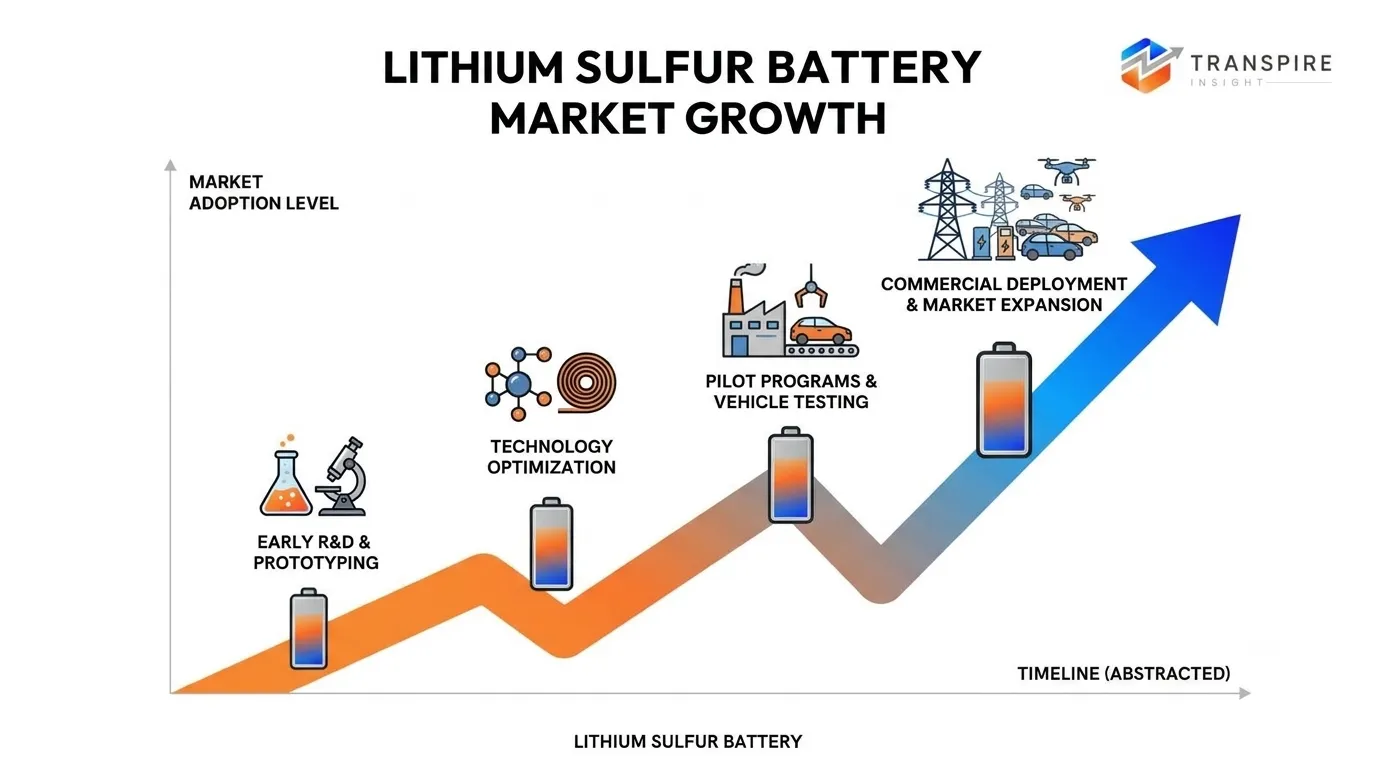
The lithium-sulfur battery market is in a pivotal stage between lab-scale prototypes and commercialization. Key market players are tackling the historic degradation challenges with the help of solid-state electrolytes and innovative carbon nanomaterials to meet the demanding energy density requirements in the aviation, defense, and EV sectors. As the production capacity grows worldwide, lithium-sulfur technology will be a key player in the development of the next decade of sustainable, lightweight energy storage solutions.


Send us a brief description of your challenge and we'll get back to you within 24 hours.

 inquiry@transpireinsight.com
 APAC:+91 7666513636
 Address


