
Oct 28, 2026
By Transpire Insight
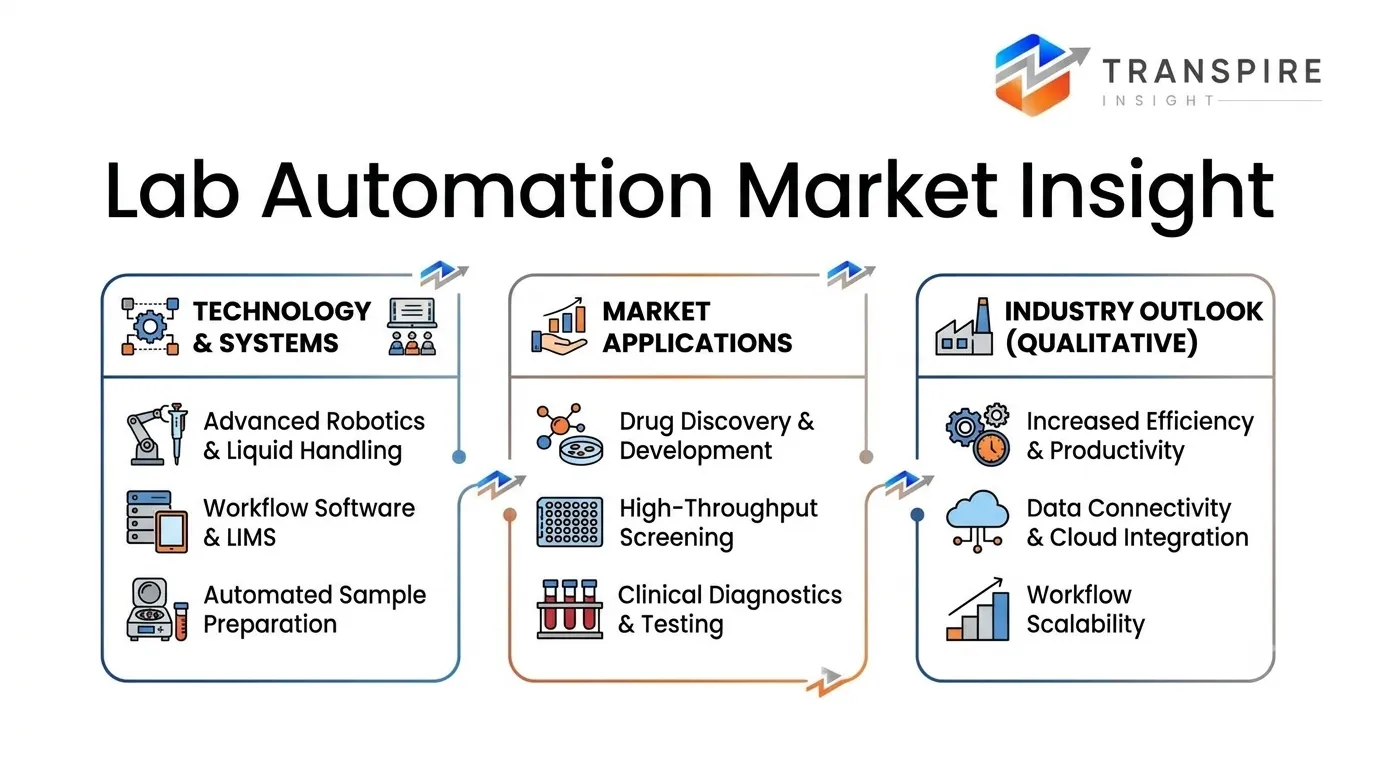
Description
According to a research report published by Transpire Insight, the Lab Automation market size is projected to grow from USD 10.5 billion in 2026 to USD 18.84 billion by 2035, at a 9.53% CAGR during the 2027-2035 forecast period. Surging demand for high-throughput screening, acute diagnostic workforce shortages, and rapid AI-driven robotics integration drive lab automation market expansion across pharmaceutical research, genomics, and clinical diagnostics worldwide.
Introduction
The lab automation market encompasses automated equipment, robotics, sample handling, and software designed to streamline workflow processes and minimize human intervention. Modern laboratories are rapidly adopting automated liquid handling systems and integrated instruments to maximize analytical throughput, improve data reproducibility, and accelerate clinical diagnostic turnaround times. Driven by ongoing digital transformation in drug discovery and molecular research, automated laboratory ecosystems are becoming vital assets across academic, pharmaceutical, and diagnostic facilities globally.
Recent Development News
October 2026: CRB released its Horizons: Life Sciences 2026 report showing that 68% of life science leaders expect AI and robotics to lower production costs despite upfront implementation challenges.
April 2026: Market data revealed that 52% of laboratory automation vendors established strategic collaborations and 47% introduced AI-integrated liquid handling solutions to improve operational precision.
Stay Ahead of Emerging Opportunities with Expert Market Insights by Transpire Insight
Transpire Insight provides comprehensive, data-driven market intelligence to support smarter business decisions. Our research is rooted in comprehensive analysis, authoritative predictions, and industry expertise, enabling organizations to make informed decisions in rapidly evolving markets. We provide in-depth analysis of market segmentation, competitive positioning, regional trends, and emerging investment opportunities in high-growth areas. We blend accuracy with actionable intelligence, helping companies uncover new growth avenues, strengthen strategic decision-making, and stay ahead in a dynamic global market.
Lab Automation Market Size & Statistics
The Market Size for Lab Automation Was Estimated to be Worth USD 10.5 Billion in 2026.
The Market Size is Going to Expand at a CAGR of 9.53% between 2026 and 2035.
The Global Lab Automation Market Size is anticipated to reach USD 18.84 Billion by 2035.
North America is projected to drive the highest demand during the forecast period, accounting for 37% of the Lab Automation market.
Asia-Pacific is projected to grow the fastest during the forecast period at a CAGR of 9.6% in the Lab Automation market.
Regional Growth and Demand Analysis by Transpire Insight
North America leads the lab automation market, backed by strong pharmaceutical and biotech R&D, early adoption of AI-driven analytics and cloud-based laboratory information systems, and supportive regulatory and reimbursement policies. A shortage of skilled laboratory technicians is pushing clinical and research labs toward integrated automation. Recent deals show where investment is flowing. Danaher’s Beckman Coulter Life Sciences partnered with Automata, which closed a USD 45 million Series C round with Danaher Ventures joining its board. Hamilton Company also expanded its scheduling portfolio by acquiring UK Robotics and Trisonic Discovery.
Asia Pacific is the fastest-growing region at a 9.6% CAGR, outpacing global growth as healthcare systems modernize, R&D spending rises, and diagnostic demand increases. Emerging economies are investing heavily in laboratory infrastructure to reduce manual errors and operating costs. Vendors are localizing to capture this demand. Eppendorf has been expanding its R&D and manufacturing hub in China and has opened a subsidiary at Singapore’s Biopolis Science Centre. It also launched a pipette calibration facility in Chennai, India, that uses automated technology to calibrate up to 100,000 pipettes a year.
Top 15 Trends in the Lab Automation Market
Hospitals and reference laboratories are linking pre-analytical, analytical, and post-analytical steps into one track, cutting manual handling, speeding turnaround, and supporting rising test volumes reliably.
Laboratories now pair automated hardware with AI models that plan experiments, flag anomalies, and optimize protocols, reflected in recent Danaher-backed partnerships with software-led automation firms.
Vendors bundle robotic arms, instruments, and scheduling software into flexible custom workcells, as when Tecan acquired Wako Automation’s Director software to strengthen its Labwerx unit.
Laboratories prefer modular systems they can expand stepwise, adding analyzers or liquid handlers as sample volumes grow, which lowers upfront capital costs and eases upgrades.
Pipetting and sample preparation platforms are replacing manual work, improving reproducibility in genomics, drug discovery, and clinical testing while freeing scientists for higher-value analysis.
Cloud-based laboratory information systems let multi-site laboratories centralize data, monitor instruments remotely, and scale software capacity without heavy on-premises infrastructure, supporting faster, connected automated workflows.
List of Top 25 Companies Leading the Lab Automation Market
1. Thermo Fisher Scientific
Global scientific leader providing extensive integrated automated liquid handlers and instruments.
Founded: 1956 | HQ: Waltham, Massachusetts, USA.
Why It Ranks: Market leadership via comprehensive automated sample prep and robotic hardware systems.
Regional Dominance: Strong market presence across North America, Europe, and Asia-Pacific regions.
Product Line: Automated liquid handlers, robotic arms, and laboratory information management systems.
2. Danaher Corporation (Beckman Coulter)
Premier provider of automated liquid handling and clinical diagnostic automation systems.
Founded: 1969 | HQ: Washington, D.C., USA.
Why It Ranks: High market share through innovative Biomek robotic liquid handling platforms.
Regional Dominance: Major market influence throughout North America and Western Europe markets.
Product Line: Biomek liquid handlers, automated centrifuges, and integrated assay workcells.
3. Tecan Group Ltd.
Swiss pioneer specializing in automated liquid handling workstations and microplate readers.
Founded: 1980 | HQ: Männedorf, Switzerland.
Why It Ranks: Exceptional modular workstation designs tailored for genomics and high-throughput screening.
Regional Dominance: Extensive market footprint in European and North American life sciences.
Product Line: Fluent and Freedom EVO liquid workstations, microplate readers, washers.
4. Agilent Technologies, Inc.
Leader in analytical laboratory instruments and automated sample preparation solution workflows.
Founded: 1999 | HQ: Santa Clara, California, USA.
Why It Ranks: Robust integration of automated liquid handling with liquid chromatography instruments.
Regional Dominance: Dominant positions in North America, Europe, and expanding Asian territories.
Product Line: Bravo automated liquid handling platforms, robotic benchtop automation, microplate handlers.
5. F. Hoffmann-La Roche Ltd.
Healthcare giant providing total laboratory automation solutions for high-volume diagnostics.
Founded: 1896 | HQ: Basel, Switzerland.
Why It Ranks: Global standard-setter for automated in vitro diagnostic workflows and sample handling.
Regional Dominance: Widespread clinical diagnostic installation base across European and global hospitals.
Product Line: Cobas connection modules, integrated clinical analyzers, and pre-analytical automation.
6. Siemens Healthineers AG
Medical technology titan renowned for high-throughput total laboratory track automation systems.
Founded: 1847 | HQ: Erlangen, Germany.
Why It Ranks: Expanded market share through continuous innovation in diagnostic track automation.
Regional Dominance: Commanding footprint across European diagnostic centers and North American health systems.
Product Line: Atellica Solution, Aptio Automation track systems, and sample handling software.
7. Becton, Dickinson and Company (BD)
Global innovator driving sample processing and automated microbiology laboratory workflow efficiency.
Founded: 1897 | HQ: Franklin Lakes, New Jersey, USA.
Why It Ranks: Outstanding automation solutions in flow cytometry and diagnostic specimen collection.
Regional Dominance: Deep institutional presence across North American and European healthcare facilities.
Product Line: BD Kiestra microbiology systems, flow cytometers, and automated preparation tools.
8. Abbott Laboratories
Diagnostic giant producing high-speed automated clinical analyzers and sample management tracks.
Founded: 1888 | HQ: Abbott Park, Illinois, USA.
Why It Ranks: High diagnostic throughput capabilities through integrated track systems and software.
Regional Dominance: Strong diagnostic market share across North America, Latin America, and Europe.
Product Line: ACCELERATOR a3600 track automation, ARCHITECT and Alinity diagnostic platforms.
9. PerkinElmer, Inc. (Revvity)
Premier developer of high-throughput drug screening robotics and microplate automation systems.
Founded: 1937 | HQ: Waltham, Massachusetts, USA.
Why It Ranks: High reputation in cell analysis, screening workstations, and assay automation.
Regional Dominance: Extensive presence in pharmaceutical research hubs across North America and Europe.
Product Line: Janus automated workstations, Opera Phenix high-content screeners, plate readers.
10. Hamilton Company
Leader in precision fluidic technology, automated pipetting, and robotic workstations.
Founded: 1947 | HQ: Reno, Nevada, USA.
Why It Ranks: Unrivaled air-displacement pipetting precision and customizable automated biological storage solutions.
Regional Dominance: Leading market presence across North American and European biopharma sectors.
Product Line: Microlab STAR workstations, Vantage liquid handlers, automated sample storage systems.
Conclusion
The lab automation market is undergoing a rapid evolution, shifting from standalone robotic liquid handlers to fully integrated, intelligent ecosystems. Emerging developments in artificial intelligence, machine learning, and advanced software scheduling are allowing facilities to maximize throughput, eliminate manual errors, and scale complex workflows effortlessly. As global diagnostic and life science demands intensify, automated technologies will remain essential to shaping modern research efficiency.


Send us a brief description of your challenge and we'll get back to you within 24 hours.

 inquiry@transpireinsight.com
 APAC:+91 7666513636
 Address


