
Oct 24, 2026
By Transpire Insight
Description
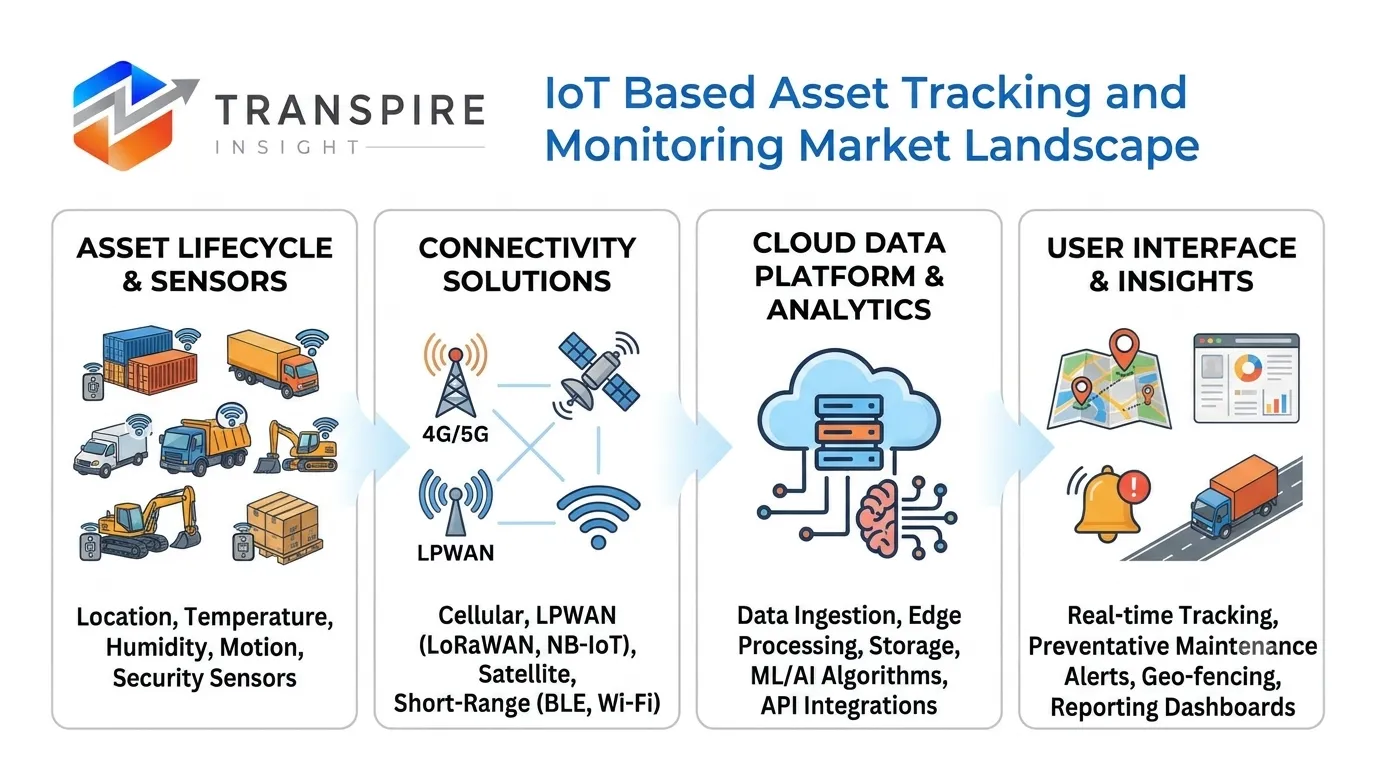
According to a research report published by Transpire Insight, the IoT based asset tracking and monitoring market size is projected to grow from USD 17.10 billion in 2026 to USD 27.9 billion by 2035, at a 6.8% CAGR during the 2027-2035 forecast period. The demand is being fueled by the explosive growth of e-commerce, the digitalization of supply chains, the demand for real-time visibility, and the affordability of 5G/LPWAN networks. AI predictive maintenance is driving 5G networks to be deployed across all industries and regions.
Introduction
With businesses actively striving to maintain visibility and monitor their operations at all times and drive automation for optimizing resources, the asset tracking and monitoring market based on IoT is expanding rapidly. These platforms harness the power of connected sensors, GPS, cellular IoT, and LPWAN connectivity to convert location and condition telemetry into actionable intelligence. The Internet of Things (IoT) monitoring is essential for industries such as logistics, manufacturing, healthcare, and cold-chain supply chains, where asset loss, downtime, and compliance strictness are key concerns.
Recent Development News
February 2026: Quectel Wireless Solutions introduced its next-generation multi-constellation GNSS and satellite-capable IoT tracking module, enhancing intermodal container and logistics monitoring capabilities for real-time coverage.
May 2026: Samsara added edge-computer vision models to its AI-powered asset intelligence platform to enable high-precision asset tracking and environmental condition monitoring of heavy equipment in construction and transport fleets.
Stay Ahead of Emerging Opportunities with Expert Market Insights by Transpire Insight
Transpire Insight provides comprehensive, data-driven market intelligence to support smarter business decisions. Our research is rooted in comprehensive analysis, authoritative predictions, and industry expertise, enabling organizations to make informed decisions in rapidly evolving markets. We provide in-depth analysis of market segmentation, competitive positioning, regional trends, and emerging investment opportunities in high-growth areas. We blend accuracy with actionable intelligence, helping companies uncover new growth avenues, strengthen strategic decision-making, and stay ahead in a dynamic market.
IoT-Based Asset Tracking and Monitoring Market Size & Statistics
The Market Size for IoT-Based Asset Tracking and Monitoring Was Estimated to be Worth USD 17.10 Billion in 2026.
The Market Size is Going to Expand at a CAGR of 6.8% between 2026 and 2035.
The IoT-Based Asset Tracking and Monitoring Market Size is anticipated to reach USD 27.9 Billion by 2035.
North America is projected to drive the highest demand during the forecast period, accounting for 36% of the IoT-based asset tracking and monitoring market.
Asia-Pacific is projected to grow the fastest during the forecast period at a CAGR of 15.08% in the IoT-based asset tracking and monitoring market.
Regional Growth and Demand Analysis by Transpire Insight
North America is the most advanced, with advanced digital infrastructure and high enterprise usage, which makes it the leader. Solution innovations remain central in the region, with early adoption of the technology and the core solution providers including IBM, Cisco, and Honeywell. These systems provide real-time tracking, reduced operating costs, and enhanced security for valuable assets, and their regulation of asset protection and environmental safety promotes the adoption of high-tech tracking systems by businesses. Logistics and manufacturing are the top revenue generators, as is the highest adoption of fleet telematics, warehouse automation, and industrial IoT.
Asia Pacific is the fastest-growing region as electronic device production and consumption are high in the region, and there are considerable investments made in IoT applications in manufacturing and in the monitoring of the cold chain in the region. This expansion will be fueled in part by the growth of manufacturing and logistics industries in countries like China and India, and by the increasing adoption of asset management solutions based on the IoT by companies in these nations. The region's specialization in chips and modules also ensures low hardware costs, contributing to the broader deployment of the region across factories, warehouses, and transport networks.
Top 15 Trends in the IoT-Based Asset Tracking and Monitoring Market
Bluetooth Low Energy and UWB deliver centimeter-to-meter accuracy indoors, where GPS fails, making them preferred for warehouses, factories, and hospitals for tracking tools, pallets, and equipment.
Machine learning analyzes sensor data such as vibration and temperature to forecast equipment failures, reducing unplanned downtime and extending asset life while lowering maintenance costs.
NB-IoT and LTE-M offer wide coverage, deep penetration, and multi-year battery life, enabling affordable tracking of remote or mobile assets across logistics, utilities, and mining.
Pharmaceutical and food shippers use connected sensors to monitor temperature and humidity continuously, ensuring compliance, preventing spoilage, and providing auditable records throughout transportation and storage.
Combining satellite positioning with low-power wide-area networks gives long-range outdoor tracking at low energy cost, suiting containers, trailers, railcars, and agricultural machinery across large geographies.
Cloud platforms centralize tracking data from diverse devices, offering dashboards, alerts, and analytics that let enterprises scale deployments quickly without heavy on-premise infrastructure investment costs.
List of Top 25 Companies in the IoT-Based Asset Tracking and Monitoring Market
1. Samsara Inc.
Samsara manages over one million active connected devices across enterprise fleets.
Founded: 2015 | HQ: San Francisco, California, USA.
Why It Ranks: Leading provider of integrated IoT telematics and real-time operations platforms.
Regional Dominance: Strongest presence across North American commercial transport and industrial sectors.
Product Line: Connected Asset Tags, Vehicle Telematics, Environmental Sensors, Industrial Gateways.
2. Geotab Inc.
Geotab connects more than 4 million vehicles on its unified platform.
Founded: 2000 | HQ: Oakville, Ontario, Canada.
Why It Ranks: Recognized leader in commercial fleet management and open IoT telematics ecosystems.
Regional Dominance: Strong market hold across North America and rapidly expanding European networks.
Product Line: GO Trackers, Asset Tracker Series, ProPlus Telematics, MyGeotab Software.
3. Zebra Technologies Corporation
Zebra manufactures over 50% of industrial ruggedized tracking devices globally.
Founded: 1969 | HQ: Lincolnshire, Illinois, USA.
Why It Ranks: Premier hardware and RFID pioneer transitioning into enterprise IoT location intelligence.
Regional Dominance: Dominant across North American and Western European retail and manufacturing hubs.
Product Line: ZTrak IoT Tags, MotionWorks RTLS, Rugged Scanners, Fixed RFID Readers.
4. Quectel Wireless Solution Co., Ltd.
Quectel supplies cellular IoT modules to over 500 telematics integrators.
Founded: 2010 | HQ: Shanghai, China.
Why It Ranks: World’s largest cellular and GNSS IoT hardware connectivity module manufacturer.
Regional Dominance: Dominates the Asia-Pacific region while maintaining significant market export share.
Product Line: Smart IoT Modules, GNSS Positioning Modules, Smart Antennas, Asset Trackers.
5. Thales Group
Thales secures IoT connections for over one billion devices globally.
Founded: 2000 (IoT division roots) | HQ: Paris, France.
Why It Ranks: Top provider of high-security cellular IoT connectivity and eSIM management solutions.
Regional Dominance: Market leader in Western Europe with strong footprints in Latin America.
Product Line: Cinterion IoT Modules, Cinterion Connect Shield, eSIM Solutions, IoT Cloud.
6. Teltonika Telematics
Teltonika has deployed over 25 million IoT tracking devices worldwide.
Founded: 1998 | HQ: Vilnius, Lithuania.
Why It Ranks: Major high-volume European manufacturer of versatile GPS and BLE tracker hardware.
Regional Dominance: Dominant supplier across European Union and Eastern European commercial fleets.
Product Line: FMC Series Trackers, Autonomous BLE Beacons, Asset Tracker Pro, Routers.
7. Cisco Systems, Inc.
Cisco manages billions of daily enterprise IoT network telemetry data points.
Founded: 1984 | HQ: San Jose, California, USA.
Why It Ranks: Dominates industrial network edge connectivity and enterprise IoT device security infrastructure.
Regional Dominance: infrastructure footprint with North America as its largest primary market.
Product Line: Catalyst Industrial Routers, Industrial Sensor Suite, Cisco Kinetic, DNA Center.
8. IBM Corporation
IBM Maximo monitors over 100 million critical industrial assets globally.
Founded: 1911 | HQ: Armonk, New York, USA.
Why It Ranks: Pioneer in enterprise asset management combined with AI analytics and IoT.
Regional Dominance: Strong presence across enterprise sectors in North America, Europe, and Asia.
Product Line: IBM Maximo Application Suite, Watson IoT Platform, Asset Performance Management.
9. Semtech Corporation
Semtech is the creator and owner of fundamental LoRa wireless technology.
Founded: 1960 | HQ: Camarillo, California, USA.
Why It Ranks: Essential provider of low-power, long-range IoT chips for asset tracking.
Regional Dominance: Strong positioning across North America, Europe, and Asia-Pacific smart cities.
Product Line: LoRa Edge Transceivers, Sierra Wireless Gateways, AirLink Routers, Location Services.
10. Nordic Semiconductor ASA
Nordic powers over 40% of the Bluetooth Low Energy market.
Founded: 1983 | HQ: Trondheim, Norway.
Why It Ranks: leader in ultra-low-power short-range and cellular IoT microcontrollers.
Regional Dominance: Leading component supplier across Europe, North America, and Asian manufacturing hubs.
Product Line: nRF91 Cellular IoT SiP, nRF53 Series BLE System-on-Chips, Location SDKs.
Conclusion
The Internet of Things (IoT) is a fundamental part of the current revolution in industrial digitalization, specifically the market of asset tracking and monitoring. The combination of cutting-edge sensor hardware, 5G/LPWAN connectivity, and cloud-native analytics allows businesses to gain unparalleled visibility into the supply chain. In the future, enhanced integration with edge AI and predictive maintenance will make asset tracking an essential investment for improving operational efficiency and enterprise growth.


Send us a brief description of your challenge and we'll get back to you within 24 hours.

 inquiry@transpireinsight.com
 APAC:+91 7666513636
 Address


