
Oct 28, 2026
By Transpire Insight
Description
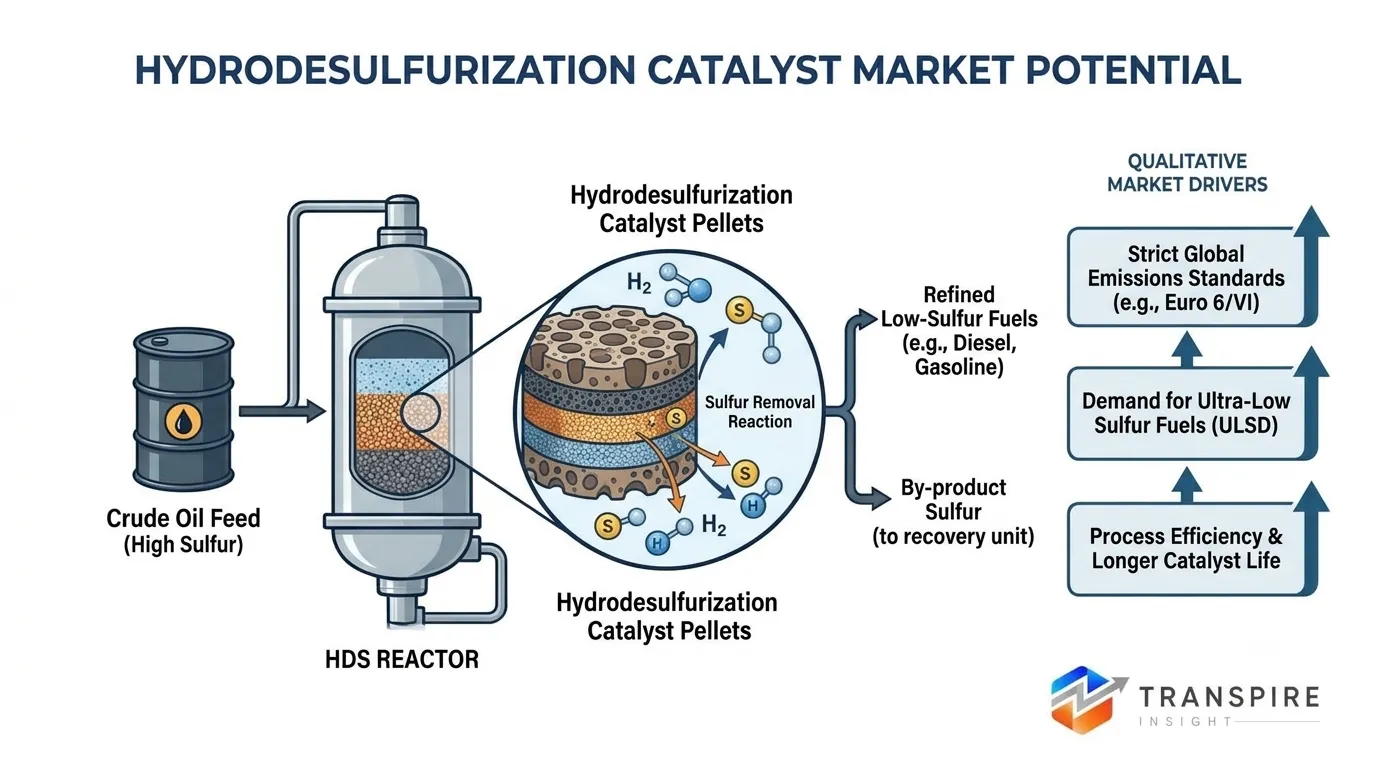
According to a research report published by Transpire Insight, the hydrodesulfurization catalyst market size is projected to grow from USD 4.56 billion in 2026 to USD 6.27 billion by 2035, at a 5.73% CAGR during the 2027-2035 forecast period. Strict environmental mandates forcing lower sulfur levels in transportation fuels globally drive catalyst demand, alongside processing heavier crude slates and bio-based feedstock processing requirements in modern refineries.
Introduction
The Hydrodesulfurization (HDS) Catalyst Market is vital for refining operations, enabling the extraction of harmful sulfur compounds from crude oil fractions, diesel, gasoline, and naphtha. Driven by ultra-low sulfur fuel regulations and refinery upgrades to process heavy crudes, the market is expanding steadily. Leading chemical and energy corporations continue to innovate advanced active-metal and eco-friendly regenerable formulations to optimize sulfur removal efficiency.
Recent Development News
June 2026: Shell Catalysts & Technologies finalized a major commercial licensing agreement with ENGIE to supply next-generation hydrotreating and hydroprocessing catalyst technologies for advanced fuel processing.
April 2026: Unicat Catalyst Technologies published a technical advancement framework addressing catalyst poisoning prevention and life-extension strategies in high-severity hydroprocessing operations.
Stay Ahead of Emerging Opportunities with Expert Market Insights by Transpire Insight
Transpire Insight provides comprehensive, data-driven market intelligence to support smarter business decisions. Our research is rooted in comprehensive analysis, authoritative predictions, and industry expertise, enabling organizations to make informed decisions in rapidly evolving markets. We provide in-depth analysis of market segmentation, competitive positioning, regional trends, and emerging investment opportunities in high-growth areas. We blend accuracy with actionable intelligence, helping companies uncover new growth avenues, strengthen strategic decision-making, and stay ahead in a dynamic market.
Hydrodesulfurization Catalyst Market Size & Statistics
The Market Size for Hydrodesulfurization Catalyst Was Estimated to be Worth USD 4.56 Billion in 2026.
The Market Size is Going to Expand at a CAGR of 5.73% between 2026 and 2035.
The Hydrodesulfurization Catalyst Market Size is anticipated to reach USD 6.27 Billion by 2035.
North America is projected to drive the highest demand during the forecast period, accounting for 32.40% of the hydrodesulfurization catalyst market.
Asia-Pacific is projected to grow the fastest during the forecast period at a CAGR of 8.62% in the hydrodesulfurization catalyst market.
Regional Growth and Demand Analysis by Transpire Insight
North America stands as the dominant regional market for hydrodesulfurization catalysts, holding the largest revenue share in the latest assessment. The region emerged as the largest regional market in 2026. Its leadership rests on a mature refining base and consistently high fuel consumption. The United States is the world's largest consumer of diesel across transportation, industrial, and commercial uses, which keeps refiners reliant on high-performance catalysts to meet strict low-sulfur fuel standards.
Asia-Pacific is the fastest-growing region, with the strongest growth outlook of all regions over the forecast period. The region is projected to record the highest regional growth rate. This momentum comes from robust refinery infrastructure in countries such as China and India, along with rising urbanization. Expanding refining capacity, growing fuel demand, and tightening sulfur regulations are expected to keep catalyst demand rising steadily across the region.
Top 15 trends in the Hydrodesulfurization Catalyst Market
Stricter ultra-low sulfur limits for diesel and naphtha force refiners to deploy hydrodesulfurization catalysts, creating consistent, structural rather than cyclical demand across major refining regions.
Refinery expansions and modernization in China, India, and the Middle East add hydrotreating units, supporting steady catalyst demand from rising domestic consumption and fuel exports.
Refiners are increasingly processing heavier, sour crudes with higher sulfur content, requiring more active catalysts and larger loadings to meet ultra-low sulfur product specifications reliably.
Non-load type catalysts deliver 2.5 to 3 times the activity of supported catalysts and are forecast to grow fastest, at about 6.2% CAGR to 2030.
IMO 2020 mandate aims to cut sulfur emissions from ocean vessels by 80 percent, pushing refiners to desulfurize marine fuels and widening catalyst demand.
Renewable and bio-based fuels are reshaping the market, creating opportunities for catalyst innovation and prompting suppliers to develop new formulations suited to changing refinery feedstocks.
List of Top 25 Companies Leading the Hydrodesulfurization Catalyst Market
1. Albemarle Corporation
World leader in specialized hydroprocessing and ultra-clean hydrodesulfurization catalyst technology solutions.
Founded: 1994 | HQ: Charlotte, North Carolina, USA.
Why It Ranks: Holds a massive refining market share via cutting-edge catalyst technological advancements.
Regional Dominance: North America and Europe across major refining infrastructure networks.
Product Line: Nebula, Reventis, and STAX hydrotreating and hydrodesulfurization performance catalyst series.
2. W. R. Grace & Co.
Premier provider of polyolefin catalysts and advanced hydroprocessing refining catalyst systems.
Founded: 1854 | HQ: Columbia, Maryland, USA.
Why It Ranks: Expanded HDS capabilities significantly by acquiring the ART Hydroprocessing technology portfolio.
Regional Dominance: Strong presence across North America, Latin America, and European markets.
Product Line: Smart, ApART, and specialized residual hydrotreating and hydrodesulfurization catalyst suites.
3. Honeywell UOP
Industry benchmark provider for process licensing, hydroprocessing, and refinery desulfurization systems.
Founded: 1914 | HQ: Des Plaines, Illinois, USA.
Why It Ranks: Unmatched footprint in process technology licensing and high-activity catalyst sales.
Regional Dominance: North America, Middle East, and rapidly growing Asia-Pacific refining hubs.
Product Line: Unity hydrotreating catalysts, Unionfining process solutions, and ultra-low sulfur systems.
4. Topsoe A/S
pioneer in energy-efficient carbon reduction solutions and high-performance refining catalysts.
Founded: 1940 | HQ: Lyngby, Denmark.
Why It Ranks: Recognized worldwide for state-of-the-art TK catalyst series for deep desulfurization.
Regional Dominance: Europe, North America, and key refining corridors in the Middle East.
Product Line: TK-569 HySwell, TK-611 HyBRiD, and specialized ultra-clean diesel HDS catalysts.
5. Shell Catalysts & Technologies
Leverages owner-operator refining expertise to manufacture highly active desulfurization catalyst technologies.
Founded: 1907 | HQ: Houston, Texas, USA / London, UK.
Why It Ranks: Combines extensive commercial operating feedback with industry-leading hydroprocessing catalyst research.
Regional Dominance: leadership across Europe, Asia-Pacific, North America, and the Middle East.
Product Line: CENTERA, Sentry, and CANSOLV hydrotreating and sulfur removal catalyst technologies.
6. Axens
Major international provider of refining, petrochemical, and hydroprocessing technology license solutions.
Founded: 2001 | HQ: Rueil-Malmaison, France.
Why It Ranks: Offers complete solutions spanning process design, high-activity catalysts, and technical services.
Regional Dominance: Europe, Middle East, Africa, and extensive Asia-Pacific refining markets.
Product Line: HR Series, Impulse hydrotreating catalysts, and Prime-G+ naphtha desulfurization solutions.
7. BASF SE
Largest chemical producer worldwide delivering advanced base-metal and precious desulfurization catalysts.
Founded: 1865 | HQ: Ludwigshafen, Germany.
Why It Ranks: Broad material science capabilities and chemical distribution infrastructure network strength.
Regional Dominance: Europe, North America, and major industrial centers across Asia-Pacific.
Product Line: Sorbead adsorbents, PuriStar desulfurization catalysts, and custom hydroprocessing material systems.
8. Clariant AG
specialty chemical leader producing customized desulfurization and gas purification catalysts.
Founded: 1995 | HQ: Muttenz, Switzerland.
Why It Ranks: Specialized chemical synthesis capabilities designed for targeted sulfur and impurity removal.
Regional Dominance: Strong presence across Europe, North America, and Latin American refiners.
Product Line: HDMax hydrotreating series, ShiftMax, and EnviCat desulfurization catalyst technologies.
9. Sinopec (China Petroleum & Chemical Corp.)
World's largest oil refining corporation manufacturing proprietary hydrotreating and HDS catalysts.
Founded: 2000 | HQ: Beijing, China.
Why It Ranks: Massive internal demand and dominant market share in domestic Chinese refining.
Regional Dominance: China and expanding downstream refining ventures across Asia-Pacific markets.
Product Line: RINS, FSI, and specialized diesel and naphtha deep desulfurization catalysts.
10. PetroChina Company Limited
State-owned oil major producing advanced catalysts for internal refinery desulfurization programs.
Founded: 1999 | HQ: Beijing, China.
Why It Ranks: Controls massive domestic processing capacity and extensive catalyst manufacturing research facilities.
Regional Dominance: China, East Asia, and targeted Central Asian downstream operational markets.
Product Line: PHF series hydrotreating catalysts and heavy crude desulfurization processing materials.
Conclusion
The Hydrodesulfurization Catalyst Market remains indispensable for refiners adjusting to clean fuel standards and processing heavy crudes. Key players continue to expand through strategic acquisitions, technical partnerships, and regenerated catalyst formulations. Supported by ongoing refinery modernization across North America and Asia-Pacific, the market will experience steady expansion as demand for ultra-low sulfur fuels and bio-feedstock processing accelerates worldwide.


Send us a brief description of your challenge and we'll get back to you within 24 hours.

 inquiry@transpireinsight.com
 APAC:+91 7666513636
 Address


