
Oct 17, 2026
By Transpire Insight
Description
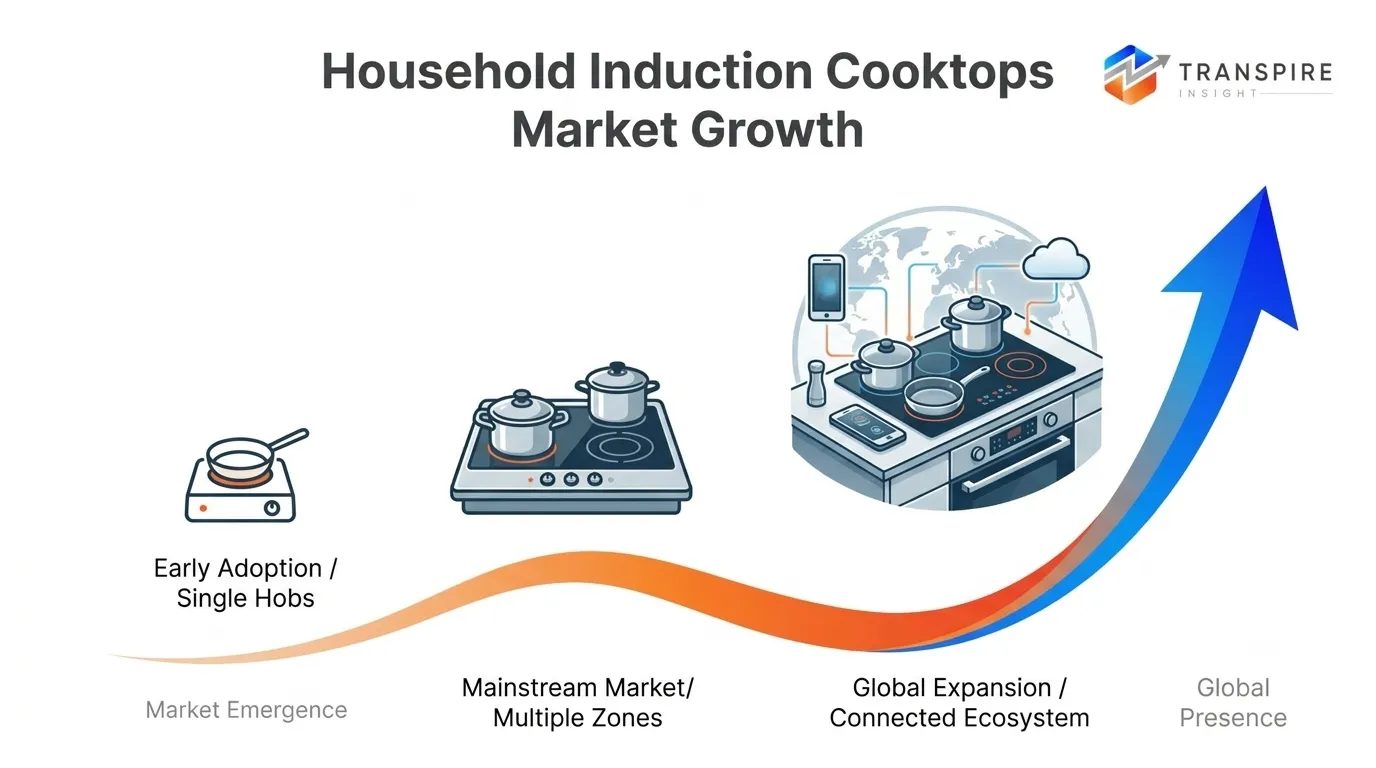
According to a research report published by Transpire Insight, the household induction cooktops market size is projected to grow from USD 21.3 billion in 2026 to USD 34.11 billion by 2035, at a CAGR of 11.60% during the forecast period 2027-2035. Accelerating clean energy transition policies, stringent gas ban regulations, rising electricity access, superior thermal efficiency, and growing consumer preference for safe, rapid, and smart kitchen electrification drive market expansion.
Introduction
The household induction cooktops market is expanding rapidly, fueled by the shift toward residential electrification and energy-efficient kitchen solutions. Consumers and regulators increasingly prefer induction technology over traditional gas and coil stoves due to its precise temperature control, faster heating times, enhanced safety features, and lower carbon footprint. Key appliance manufacturers continue to advance smart connectivity, sleek glass-ceramic aesthetics, and modular designs.
Recent Development News
January 2026: Hisense launched its next-generation smart induction range line at CES 2026, integrating an AI-driven cooking assistant for real-time precise temperature regulation.
March 2026: Electrolux announced an expanded strategic partnership with premium cabinetry manufacturers to roll out ultra-slim, invisible under-counter induction surfaces across Europe.
Stay Ahead of Emerging Opportunities with Expert Market Insights by Transpire Insight
Transpire Insight provides comprehensive, data-driven market intelligence to support smarter business decisions. Our research is rooted in comprehensive analysis, authoritative predictions, and industry expertise, enabling organizations to make informed decisions in rapidly evolving markets. We provide in-depth analysis of market segmentation, competitive positioning, regional trends, and emerging investment opportunities in high-growth areas. We blend accuracy with actionable intelligence, helping companies uncover new growth avenues, strengthen strategic decision-making, and stay ahead in a dynamic market.
Household Induction Cooktops Fertilizer Market Size & Statistics
The Market Size for Household Induction Cooktops Was Estimated to be Worth USD 21.3 Billion in 2026.
The Market Size is Going to Expand at a CAGR of 11.60% between 2026 and 2035.
The Household Induction Cooktops Market Size is anticipated to reach USD 34.11 Billion by 2035.
North America is projected to drive the highest demand during the forecast period, accounting for 40% of the household induction cooktops market.
Asia-Pacific is projected to grow the fastest during the forecast period at a CAGR of 8.7% in the household induction cooktops market.
Regional Growth and Demand Analysis by Transpire Insight
North America leads demand because of high adoption rates and a strong sustainability focus. Manufacturers and retailers have actively promoted induction's efficiency and safety, which has raised consumer awareness. Strict energy-efficiency regulations and replacement demand for older, less efficient appliances sustain growth there.
Asia-Pacific is the growth engine, powered by urbanization, rising disposable incomes, and a growing middle class that is spending more on modular kitchens. China dominates regional revenue by the end of the forecast period. Space-efficient, sleek designs suit the region's high-rise apartments. Whirlpool of India's share purchase agreement with Elica S.p.A., a maker of induction hobs, shows how manufacturers are strengthening their built-in cooking portfolios. Whirlpool's glass touch controls reflect the same push toward modern, premium induction models.
Top 15 Trends in the Household Induction Cooktops Market
Smart cooktops let users monitor and control cooking through mobile apps, appealing to connected-home buyers and helping manufacturers differentiate premium models in urban retail markets.
Rising middle-class spending on modular kitchens, especially in China and India, is lifting demand for integrated induction hobs that blend seamlessly into modern kitchen countertops.
Higher fuel prices for conventional gas cooktops push households toward induction, which cooks faster, wastes less heat, and lowers running costs for energy-conscious urban consumers.
Strict energy-efficiency regulations, particularly in Europe, accelerate replacement of older appliances, as consumers and builders choose induction to cut energy consumption and reduce health concerns.
Frameless glass surfaces and minimalist profiles have become key purchase drivers, particularly among urban apartment dwellers who want space-efficient appliances that complement contemporary kitchen aesthetics.
E-commerce platforms are expanding induction cooktop reach through wider choice, price comparison, and doorstep delivery, helping the online channel steadily outpace traditional offline retail stores.
List of Top 25 Companies Leading the Household Induction Cooktops Market
1. Midea Group
World’s largest producer of residential induction heating appliances by volume output.
Founded: 1968 | HQ: Foshan, China.
Why It Ranks: Mass manufacturing efficiency and dominant export volume across all tiers.
Regional Dominance: Strongest in Asia-Pacific with major market presence across Europe.
Product Line: Single-burner portables, built-in multi-zone hobs, and affordable tabletop cooktops.
2. BSH Hausgeräte GmbH (Bosch / Siemens)
Europe’s premier home appliance manufacturer known for high-end German engineering.
Founded: 1967 | HQ: Munich, Germany.
Why It Ranks: Market leadership in Europe with premium design and high reliability reputation.
Regional Dominance: Holds top market share across Western Europe and Central Europe.
Product Line: Premium glass-ceramic induction cooktops, flexInduction hobs, and integrated ventilation ranges.
3. Whirlpool Corporation
Operates extensive manufacturing facilities worldwide across major home appliance core segments.
Founded: 1911 | HQ: Benton Harbor, Michigan, USA.
Why It Ranks: Unmatched North American brand awareness and deeply established multi-channel distribution.
Regional Dominance: Dominates North America with strong retail footprints in Latin America.
Product Line: Built-in electric induction cooktops, slide-in induction ranges, and double ovens.
4. Electrolux AB
Pioneer in Scandinavian functional design and low-emission kitchen appliance development.
Founded: 1919 | HQ: Stockholm, Sweden.
Why It Ranks: Early adoption of sustainable manufacturing and smart-connected induction cooking tech.
Regional Dominance: Strong presence across Western Europe, Australia, and North America.
Product Line: Bridge-zone induction hobs, totalflex surfaces, and integrated downdraft induction units.
5. Haier Smart Home Co., Ltd.
white goods leader integrating full IoT smart ecosystem connectivity across ranges.
Founded: 1984 | HQ: Qingdao, China.
Why It Ranks: Massive scale combined with aggressive smart appliance tech innovation.
Regional Dominance: Dominant in East Asia with rapidly expanding North American footprint.
Product Line: Casarte luxury induction series, smart multi-zone cooktops, and portable units.
6. Samsung Electronics Co., Ltd.
Integrates proprietary SmartThings IoT infrastructure into every modern kitchen appliance line.
Founded: 1969 | HQ: Suwon, South Korea.
Why It Ranks: High consumer adoption of connected household devices and premium kitchen tech.
Regional Dominance: Strong footprint anchored across South Korea and North America.
Product Line: Smart Wi-Fi induction cooktops, virtual flame hobs, and dual cook ranges.
7. LG Electronics Inc.
Prominent developer of energy-efficient direct-drive and advanced inverter induction units.
Founded: 1958 | HQ: Seoul, South Korea.
Why It Ranks: Leading position in ultra-premium smart appliances and clean minimalist designs.
Regional Dominance: Leading market presence across North America and South Korea.
Product Line: UltraHeat induction cooktops, Studio series ranges, and smart radiant units.
8. Panasonic Holdings Corporation
Pioneer in high-frequency power electronics and ultra-precise sensor heating technologies.
Founded: 1918 | HQ: Kadoma, Osaka, Japan.
Why It Ranks: Renowned Japanese reliability standards combined with high energy-efficiency ratings.
Regional Dominance: Commands significant market share across Japan and Southeast Asia.
Product Line: Econavi smart induction hobs, IR-sensor cooktops, and compact built-ins.
9. GE Appliances (a Haier company)
One of North America’s most trusted household appliance brands for over a century.
Founded: 1905 | HQ: Louisville, Kentucky, USA.
Why It Ranks: High market saturation in American suburban single-family home developments.
Regional Dominance: Strongest market position in the United States and Canada.
Product Line: Profile series induction cooktops, Cafe luxury ranges, and touch-control hobs.
10. Smeg S.p.A.
Renowned Italian manufacturer blending iconic retro-aesthetic designs with modern technology.
Founded: 1948 | HQ: Guastalla, Italy.
Why It Ranks: Strong pull in luxury architectural kitchen designs and boutique residential spaces.
Regional Dominance: Dominates Southern Europe with boutique distribution networks.
Product Line: Aesthetic line induction hobs, Dolce & Gabbana ranges, and compact units.
Conclusion
The household induction cooktops market is poised for robust long-term growth as decarbonization mandates and urban electrification push gas stoves out of modern kitchens. Key industry leaders continue to capture market share by integrating AI-driven cooking assistance, flexible heating zones, and sleek under-counter form factors. As production costs drop, induction technology will solidify its status as the residential cooking standard.


Send us a brief description of your challenge and we'll get back to you within 24 hours.

 inquiry@transpireinsight.com
 APAC:+91 7666513636
 Address


