
Oct 27, 2026
By Transpire Insight
Description
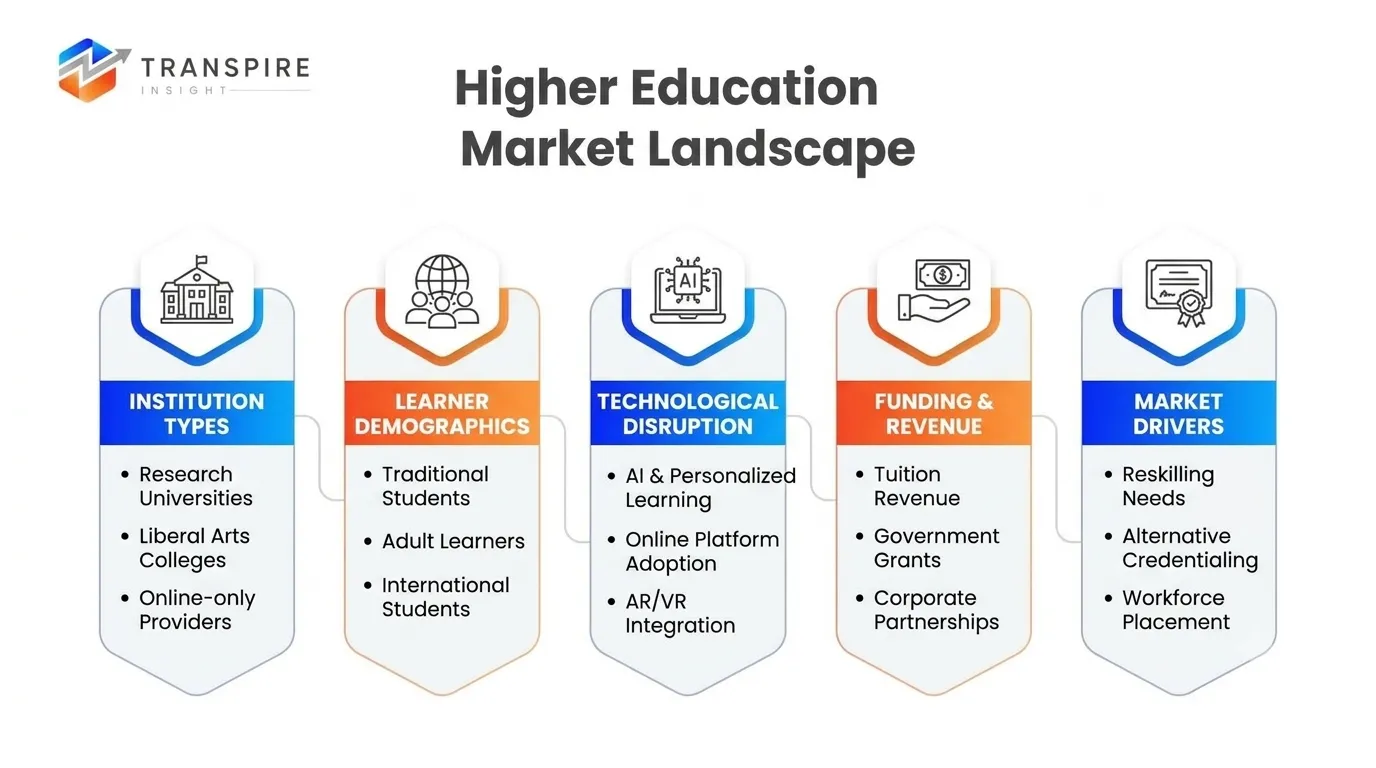
According to a research report published by Transpire Insight, the higher education market size is projected to grow from USD 899.5 billion in 2026 to USD 1647.23 billion by 2035, at a 9.10% CAGR during the 2027-2035 forecast period. Rising demand for career mobility, skill-aligned digital upskilling, rapid integration of enterprise AI models, and government policy initiatives expand student enrollments across hybrid and online learning channels.
Introduction
The higher education market is undergoing a structural transition driven by digital infrastructure, hybrid degree delivery models, and international institutional expansion. With growing youth demographics across emerging regions and shifting workforce skill requirements, universities and education providers are modernizing administrative frameworks, upgrading campus technological systems, and expanding accessible online credentials. This market evolution fosters strategic public-private technology integration, international university partnerships, and continuous adult learning platforms worldwide.
Recent Development News
March 2026: Anthology completed its Chapter 11 corporate restructuring, emerging as the independent, debt-free Blackboard company dedicated strictly to LMS, learning analytics, and higher education teaching software.
March 2026: Google successfully enabled Gemini for Education across all 20 public universities in Malaysia, expanding AI-driven digital research and administrative tools to higher education institutions nationwide.
Stay Ahead of Emerging Opportunities with Expert Market Insights by Transpire Insight
Transpire Insight provides comprehensive, data-driven market intelligence to support smarter business decisions. Our research is rooted in comprehensive analysis, authoritative predictions, and industry expertise, enabling organizations to make informed decisions in rapidly evolving markets. We provide in-depth analysis of market segmentation, competitive positioning, regional trends, and emerging investment opportunities in high-growth areas. We blend accuracy with actionable intelligence, helping companies uncover new growth avenues, strengthen strategic decision-making, and stay ahead in a dynamic market.
Higher Education Market Size & Statistics
The Market Size for Higher Education Was Estimated to be Worth USD 899.5 Billion in 2026.
The Market Size is Going to Expand at a CAGR of 9.10% between 2026 and 2035.
The Higher Education Market Size is anticipated to reach USD 1647.23 billion by 2035.
North America is projected to drive the highest demand during the forecast period, accounting for 30.5% of the higher education market.
Asia-Pacific is projected to grow the fastest during the forecast period at a CAGR of 8.7% in the higher education market.
Regional Growth and Demand Analysis by Transpire Insight
North America leads on the strength of the world’s highest concentration of globally ranked universities, strong research funding, and early adoption of digital learning technologies, with the United States at the center and Canada following steadily on favorable international student policies. Industry tie-ups keep deepening this lead. Caltech partnered with Meta to launch an on-campus lab focused on smart wearables, and Columbia University joined the Ethereum Foundation to set up a blockchain research center. Such collaborations show how institutions in the region turn research capacity into commercial and talent pipelines, which keeps both domestic and international demand high.
Asia Pacific is the growth engine. China, India, and Australia are driven by a surge in the youth population, government reforms, EdTech adoption, and expanding international student enrollment. China alone reports more than 47.63 million higher-education students, which creates a very large base for digital campus platforms. The growing middle-class population across Asia Pacific and Africa also gives families the financial capability to pursue tertiary education. Meanwhile, Europe sustains steady demand through research alliances, such as the long-running Imperial College London and MIT Seed Fund collaboration in AI, sustainability, and bioengineering.
Top 15 Trends in the Higher Education Market
Online and hybrid degrees let universities scale enrollment beyond campus capacity, offering working adults flexible, affordable pathways while institutions reach new learners across borders worldwide.
AI-powered platforms tailor content, pacing, and assessments to each student, helping universities improve engagement, reduce dropout rates, and deliver measurable academic outcomes at institutional scale.
Short, stackable credentials let learners build job-ready skills quickly, giving employers verifiable proof of competence and giving universities a new revenue stream beyond traditional degrees.
Cloud-based learning management systems cut infrastructure costs, support remote access, and integrate student data, enabling institutions to deploy courses faster and manage large, distributed cohorts.
Students increasingly cross borders for globally ranked programs, and universities in North America, Europe, and Asia Pacific compete through scholarships, partnerships, and post-study work pathways.
Universities co-design curricula with employers and technology firms, aligning programs to workforce needs, improving graduate employability, and funding applied research through close, sustained, industry-backed partnerships.
List of Top 25 Companies Leading the Higher Education Market
1. Blackboard Inc.
Serves millions of higher education learners through specialized academic software platforms.
Founded: 1997 | HQ: Boca Raton, Florida, United States.
Why It Ranks: Holds market leadership in core learning management software and student accessibility solutions.
Regional Dominance: Dominates higher education institutions across North America and key European academic markets.
Product Line: Blackboard Learn LMS, Ally accessibility software, Illuminate analytics, and Evaluate platforms.
2. Coursera Inc.
Partners with over 300 leading universities to deliver online degrees.
Founded: 2012 | HQ: Mountain View, California, United States.
Why It Ranks: Drives scale in accredited online higher education degrees and professional certificates.
Regional Dominance: Holds a leading presence, particularly across North America, Latin America, and Asia-Pacific.
Product Line: Coursera for Campus, Degree Programs, Professional Certificates, and Enterprise Skill Hubs.
3. Pearson plc
Operates as a major educational publisher and digital assessment provider.
Founded: 1844 | HQ: London, United Kingdom.
Why It Ranks: Supplies essential courseware, digital textbooks, and high-stakes qualifications to universities.
Regional Dominance: Strong operational presence across Europe, North America, Australia, and key Asian markets.
Product Line: Pearson MyLab, Mastering, Revel, Virtual Learning, and PTE Academic assessments.
4. Instructure, Inc.
Creator of Canvas, a dominant higher education learning management system worldwide.
Founded: 2008 | HQ: Salt Lake City, Utah, United States.
Why It Ranks: Commands top market share in modern cloud-based university learning platform deployments.
Regional Dominance: Holds primary footprint in North America with rapid expansion across Asia and Europe.
Product Line: Canvas LMS, Canvas Studio, Canvas Catalog, MasteryConnect, and Impact analytics.
5. D2L Corporation
Delivers cloud-based learning management software known for robust personalized learning paths.
Founded: 1999 | HQ: Kitchener, Ontario, Canada.
Why It Ranks: Provides highly configurable digital learning solutions to major universities and college systems.
Regional Dominance: Strong core user base in North America, United Kingdom, and Australia.
Product Line: Brightspace LMS, Brightspace Portfolio, Creator+ course creation, and Performance Plus analytics.
6. Blackbaud, Inc.
Facilitates billions in financial management and donor fundraising for educational institutions.
Founded: 1981 | HQ: Charleston, South Carolina, United States.
Why It Ranks: Leads specialized administrative, financial, and advancement software for higher education systems.
Regional Dominance: Commands major market share across North American and Western European higher education.
Product Line: Financial Management, Raiser's Edge NXT, Grantmaking, and Higher Education Management solutions.
7. Ellucian Company L.P.
Powers higher education administrative operations for thousands of institutions globally.
Founded: 1968 | HQ: Reston, Virginia, United States.
Why It Ranks: Premier provider of specialized student information and enterprise resource planning software.
Regional Dominance: Dominates higher education student administrative systems in North America and Latin America.
Product Line: Ellucian Banner, Ellucian Colleague, Degree Works, and Experience administrative portals.
8. Google LLC (Alphabet Inc.)
Provides collaborative cloud platforms deployed across thousands of major universities.
Founded: 1998 | HQ: Mountain View, California, United States.
Why It Ranks: Supplies essential cloud productivity, hardware, and generative AI platforms to academia.
Regional Dominance: Unmatched reach across university campuses in North America, Europe, and Asia.
Product Line: Google Workspace for Education, Gemini for Education, NotebookLM, and Chromebooks.
9. Microsoft Corporation
Empowers university infrastructure through enterprise cloud computing and productivity suites.
Founded: 1975 | HQ: Redmond, Washington, United States.
Why It Ranks: Delivers foundational operating systems, cloud services, and collaboration tools to universities.
Regional Dominance: Broad worldwide penetration across higher education institutions in over 190 countries.
Product Line: Microsoft 365 Education, Microsoft Teams, Azure for Higher Education, and Copilot.
10. Oracle Corporation
Supports enterprise database, finance, and human capital software for higher education.
Founded: 1977 | HQ: Austin, Texas, United States.
Why It Ranks: Provides critical cloud ERP and campus management systems to major university networks.
Regional Dominance: Dominant enterprise software provider across North America, Europe, and Asia-Pacific universities.
Product Line: Oracle Student Cloud, Cloud ERP, Cloud HCM, and Oracle Database Cloud.
Conclusion
The higher education market is rapidly transforming as traditional academic frameworks adapt to digital delivery, enterprise cloud integration, and skill-based curricula. Key corporate players continue to shape institutional outcomes through advanced learning management platforms, administrative software, and AI-enabled instructional tools. Moving forward, sustained investments in flexible credentialing, international university collaborations, and scalable technology infrastructure will remain essential drivers for sustainable institutional growth globally.


Send us a brief description of your challenge and we'll get back to you within 24 hours.

 inquiry@transpireinsight.com
 APAC:+91 7666513636
 Address


