
Oct 21, 2026
By Transpire Insight
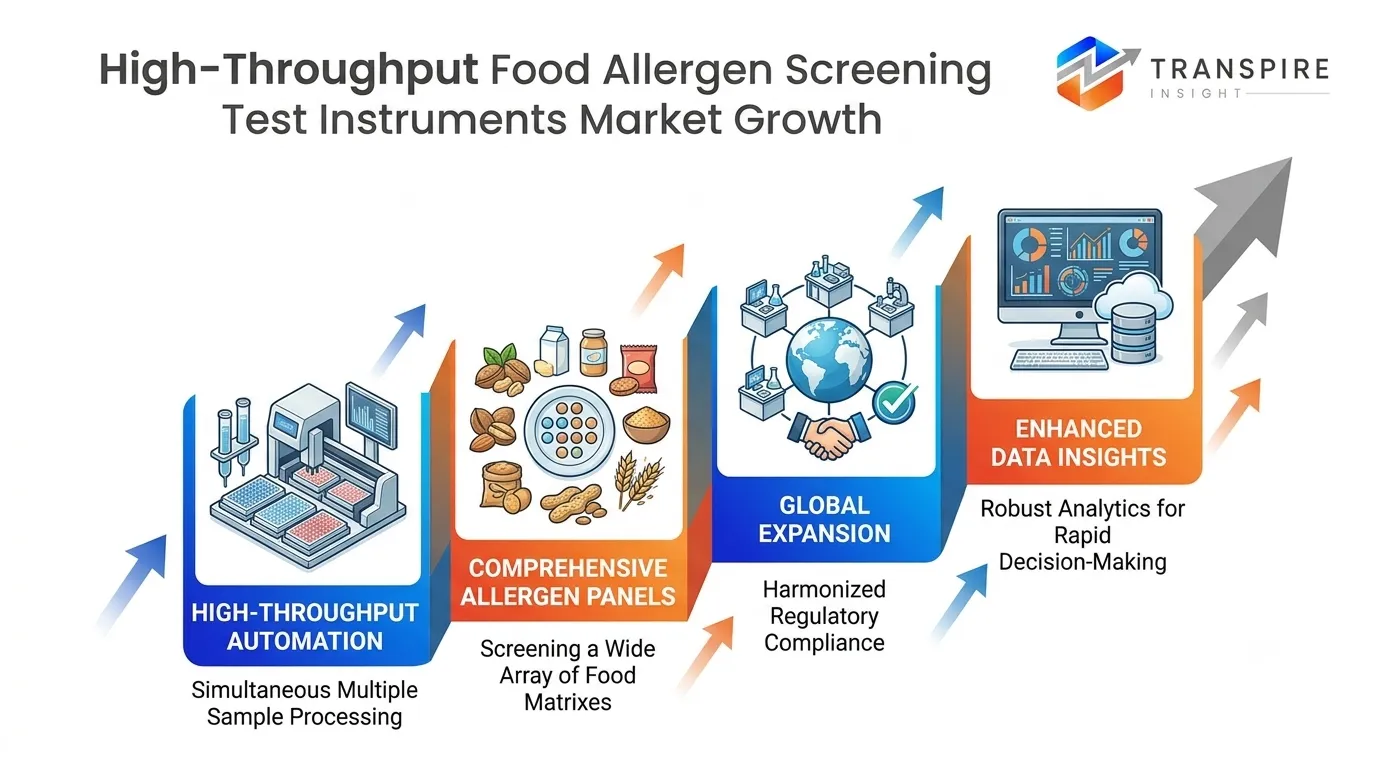
Description
According to a research report published by Transpire Insight, the high-throughput Food allergen screening test instruments market size is projected to grow from USD 208.5 billion in 2026 to USD 468.9 billion by 2035, at an 8.5% CAGR during the 2027-2035 forecast period. Demand for automated, high-throughput screening instruments for rapid batch safety and compliance is growing as a result of strict regulatory requirements and a growing awareness of consumers regarding allergens and increasing food recalls.
Introduction
The market for high-throughput food allergen screening test instruments is growing rapidly due to the enforcement of stringent food safety laws such as FSMA Section 204 and Codex Alimentarius food allergen guidelines. With ever-entangled food supply chains, large volumes of raw ingredients and finished products are screened for trace cross-contaminants using automated PCR, ELISA plate readers, and mass spectrometry platforms to ensure public safety and brand integrity.
Recent Development News
January 2026: U.S. FDA launched mandatory compliance with Section 204 of the FSMA, which mandated implementation of automated, high-throughput screening systems using PCR and ELISA.
July 2026: Allergen threshold values and precautionary labelling are harmonised globally, and commercial testing laboratories implement fully automated, high-throughput screening platforms.
Stay Ahead of Emerging Opportunities with Expert Market Insights by Transpire Insight
Transpire Insight provides comprehensive, data-driven market intelligence to support smarter business decisions. Our research is rooted in comprehensive analysis, authoritative predictions, and industry expertise, enabling organizations to make informed decisions in rapidly evolving markets. We provide in-depth analysis of market segmentation, competitive positioning, regional trends, and emerging investment opportunities in high-growth areas. We blend accuracy with actionable intelligence, helping companies uncover new growth avenues, strengthen strategic decision-making, and stay ahead in a dynamic market.
High-Throughput Food Allergen Screening Test Instruments Market Size & Statistics
The Market Size for High-Throughput Food Allergen Screening Test Instruments Was Estimated to be Worth USD 208.5 Billion in 2026.
The Market Size is Going to Expand at a CAGR of 7.52% between 2026 and 2035.
The High-Throughput Food Allergen Screening Test Instruments Market Size is anticipated to reach USD 468.9 Billion by 2035.
North America is projected to drive the highest demand during the forecast period, accounting for 41% of the high-throughput food allergen screening test instruments market.
Asia-Pacific is projected to grow the fastest during the forecast period at a CAGR of 9.3% in the high-throughput food allergen screening test instruments market.
Regional Growth and Demand Analysis by Transpire Insight
North America remains the reference point for routine allergen bench discipline, as packaged-food plants operate under constant label exposure and treat screening as part of everyday release decisions. The steady demand for complying with allergen labelling requirements issued by the FDA continues, while Bio-Rad's strategy to purchase Bio-Rad Technologies Inc.-Stilla Technologies, which will give the company multiplex digital PCR capabilities, offers a sign of depth in confirmation among suppliers to labs across the region. Measured measures are in evidence in Europe, with Germany at 7.8% CAGR and the United Kingdom at 7.7% CAGR, due to the audit culture and cross-border exposure to supply, which helps to make dependable records and repeatable interpretations easier. With the double whammy of depth in Germany's manufacturing practices and close to daily guidance from the UK Food Standards Agency for food businesses on allergen labelling, it is hardly surprising that the issues persist. In both regions, buyers are looking for automation that reduces handling time, not review time: Workflow-oriented platforms like R-Biopharm’s ThunderBolt, which process two ELISA plates and up to 192 samples at a time, are a good indicator of the direction buyers are taking in both regions.
But the biggest upside lies in Asia Pacific, where the formalization of the bench is spreading across big branded-food companies, export-oriented processors, and independent, contract laboratories. Large packaged-food plants are driving covered countries towards in-house allergen screening, with China at the front, and branded food production is shifting laboratories from limited testing procedures towards repeatable, plate-based testing in India. In the region, PCR systems and 96-well formats continue to be the top choice for purchases due to their integration with existing extraction and plate-handling workflows, while semi-automated benches are still favored for workflow space constraints and validation requirements. The standardization of methods within the laboratory at each site will benefit instrument suppliers like Thermo Fisher Scientific, QIAGEN, Bio-Rad, and Hygiena.
Top 15 Trends in the 3D Printing in Medical Applications Market
Hospitals are installing in-house printing labs so surgeons can produce anatomical models and guides within days, improving collaboration and coordination between radiology and operating teams.
Surgeons order implants and prostheses designed from individual CT scans, improving anatomical fit, reducing operating time, and supporting better recovery for orthopedic and craniofacial cases.
Researchers print living cell-laden structures to build tissue models for drug testing and, eventually, transplantable tissues, reducing reliance on animal studies and easing donor shortages.
Dental laboratories use printers to produce aligners, crowns, bridges, and dentures from digital scans, delivering faster turnaround and significantly lower labor costs than conventional methods.
Material suppliers are launching medical-grade polymers, titanium alloys, and ceramics validated for implantation and sterilization, broadening the range of clinically approved applications for additive manufacturing.
Artificial intelligence automates segmentation of scan data and generates optimized anatomical designs, cutting preparation time and enabling clinicians without engineering expertise to produce print-ready models.
Top 25 Companies Leading the Market
1. Thermo Fisher Scientific Inc.
Leading provider of premier mass spectrometry and qPCR food analysis systems.
Founded: 1956 | HQ: Waltham, Massachusetts, United States.
Why It Ranks: Dominates high-throughput food testing with its comprehensive analytical instrument portfolio.
Regional Dominance: Strongest market footprint in North America and Western Europe.
Product Line: QuantStudio PCR Systems, Orbitrap Mass Spectrometers, TaqMan Assay Kits.
2. Agilent Technologies, Inc.
Offers high-performance chromatography and mass spectrometry platforms for allergen detection.
Founded: 1999 | HQ: Santa Clara, California, United States.
Why It Ranks: Unmatched accuracy in complex quantitative allergen profiling using LC-MS technology.
Regional Dominance: Holds major market share across North America and Asia-Pacific.
Product Line: 6400 Series Triple Quad LC/MS, Ultivo LC/TQ Systems.
3. Waters Corporation
Specializes in advanced liquid chromatography and mass spectrometry for multi-allergen screening.
Founded: 1958 | HQ: Milford, Massachusetts, United States.
Why It Ranks: Sets industry standards in multi-target quantitative liquid chromatography mass spectrometry.
Regional Dominance: High adoption across Europe and North American food laboratories.
Product Line: ACQUITY UPLC Systems, Xevo TQ-XS Triple Quadrupole Mass Spectrometry.
4. PerkinElmer, Inc.
Pioneer in microplate readers and high-throughput automated lab workstations.
Founded: 1937 | HQ: Waltham, Massachusetts, United States.
Why It Ranks: Preferred provider for high-volume automated ELISA microplate processing platforms.
Regional Dominance: Strong presence in Europe and North American testing centers.
Product Line: EnSight Multimode Plate Reader, JANUS G3 Automated Workstations.
5. Bio-Rad Laboratories, Inc.
developer of digital PCR and quantitative PCR testing solutions.
Founded: 1952 | HQ: Hercules, California, United States.
Why It Ranks: Leads in ultra-sensitive target DNA detection via digital PCR technology.
Regional Dominance: Strong market distribution across North America and Western Europe.
Product Line: QX200 AutoDG Droplet Digital PCR System, CFX96 Real-Time PCR.
6. Neogen Corporation
Focuses entirely on food safety testing kits, reader instruments, and diagnostics.
Founded: 1982 | HQ: Lansing, Michigan, United States.
Why It Ranks: Exceptional specialization in turn-key commercial food factory allergen diagnostic platforms.
Regional Dominance: Leading market position in North America and Latin America.
Product Line: Reveal 3-D Readers, Veratox ELISA Microplate Reader Platforms.
7. Hygiena LLC
Delivers rapid food safety diagnostics, microplate readers, and swabbing systems.
Founded: 2001 | HQ: Camarillo, California, United States.
Why It Ranks: Key innovator in integrated environmental swabbing and high-throughput microplate workflows.
Regional Dominance: Widespread footprint in North America, Europe, and Asia-Pacific.
Product Line: EnSURE Touch Monitoring System, Alertox ELISA Reader Systems.
8. R-Biopharm AG
German diagnostic leader specializing in certified food and feed allergen analysis.
Founded: 1988 | HQ: Darmstadt, Germany.
Why It Ranks: Top European supplier of validated allergen ELISA test automation instruments.
Regional Dominance: Dominates the European Union market with expanding Asian operations.
Product Line: RIDASCREEN ELISA Kits, RIDA SMART APP, i-Mark Microplate Reader.
9. Eurofins Scientific SE
bioanalytical testing leader that designs proprietary high-throughput screening workflows.
Founded: 1987 | HQ: Luxembourg City, Luxembourg.
Why It Ranks: Operates the world's largest food safety network utilizing high-capacity analytical platforms.
Regional Dominance: Market leader in European testing services and North America.
Product Line: Express Allergen PCR Profiling Systems, Mass Spectrometry Screening Assays.
10. Shimadzu Corporation
Japanese precision manufacturer of high-speed mass spectrometers and optical detectors.
Founded: 1875 | HQ: Kyoto, Japan.
Why It Ranks: Advanced optical hardware and high-throughput LC-MS/MS instrumentation for screening.
Regional Dominance: Dominant across Asia-Pacific with strong growth in North America.
Product Line: LCMS-8060RX Triple Quadrupole Mass Spectrometer, Prominence HPLC Systems.
Conclusion
The market for high-throughput food allergen screening test instruments is getting into a new phase of growth with strict regulations and enforcement milestones. Key market players are investing in connected automated solutions as 96-well formats and PCR platforms continue to dominate the market thanks to their repeatability and speed. These innovations demonstrate food safety compliance, significantly minimize the risk of contamination, and guarantee food security in international markets.


Send us a brief description of your challenge and we'll get back to you within 24 hours.

 inquiry@transpireinsight.com
 APAC:+91 7666513636
 Address


