
Global High-Throughput Food Allergen Screening Test Instruments Market Summary:
According to Transpire Insights,a detailed research report on the market, the Global High-Throughput Food Allergen Screening Test Instruments Market is dominated by the 96-well throughput format, which holds about 58.0% of the global share. With an estimated 10–15% global market share and annual revenue exceeding USD 43.8 billion, Thermo Fisher Scientific is the industry leader, driving substantial market growth.
Market Snapshot
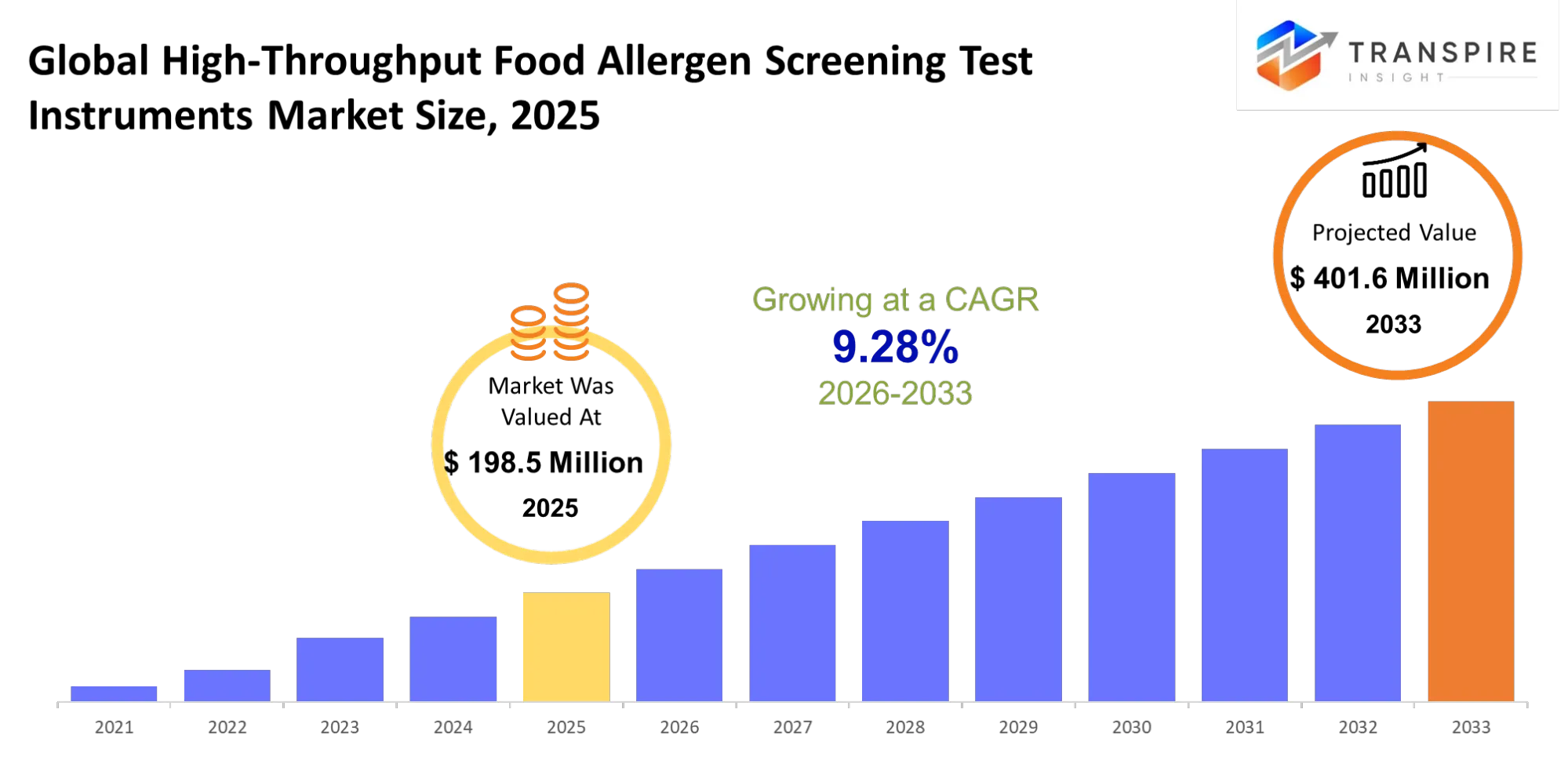
- Market Value (2025): USD 198.5 Million.
- Expected Market Value (2026): USD 215.8 Million.
- Estimated Market Value (2033): USD 401.6 Million.
- Forecast CAGR (2026–2033): 9.28%.
- Leading Region in 2025: North America
- Second-largest Region: Europe
- Fastest Growing Region: Asia-Pacific
Introduction
The Global high-throughput food allergen screening test instruments market refers to the industry sector manufacturing and supplying automated, robotic laboratory devices designed to rapidly detect and quantify multiple food allergens (e.g., peanuts, gluten, milk, soy) across massive daily caseloads, supporting safety, labeling compliance, and quality assurance in food supply chain high-throughput food allergen screening test instruments are analytical devices used in laboratories to rapidly process and detect trace amounts of allergenic proteins across a large volume of food samples simultaneously. These automated and semi-automated systems are essential for the food and beverage industry to ensure compliance with strict labelling regulations and to prevent severe allergic reactions in consumers. high-throughput food allergen screening instruments provide rapid processing, allowing food manufacturers to analyze large volumes of samples quickly to meet strict safety regulations. these systems offer multiplexing capabilities for detecting several allergens simultaneously, higher sensitivity to prevent recalls, and streamlined lab operations that reduce per-test costs.
- For instance: The North American food allergen testing market is the largest in the world for high-throughput screening equipment, with a market value of over USD 340 million. Growth is being driven by strict FDA regulations, automated procedures, and large investments in portable molecular sensors intended to scale throughput for processed meals.
Key Market Highlights: –
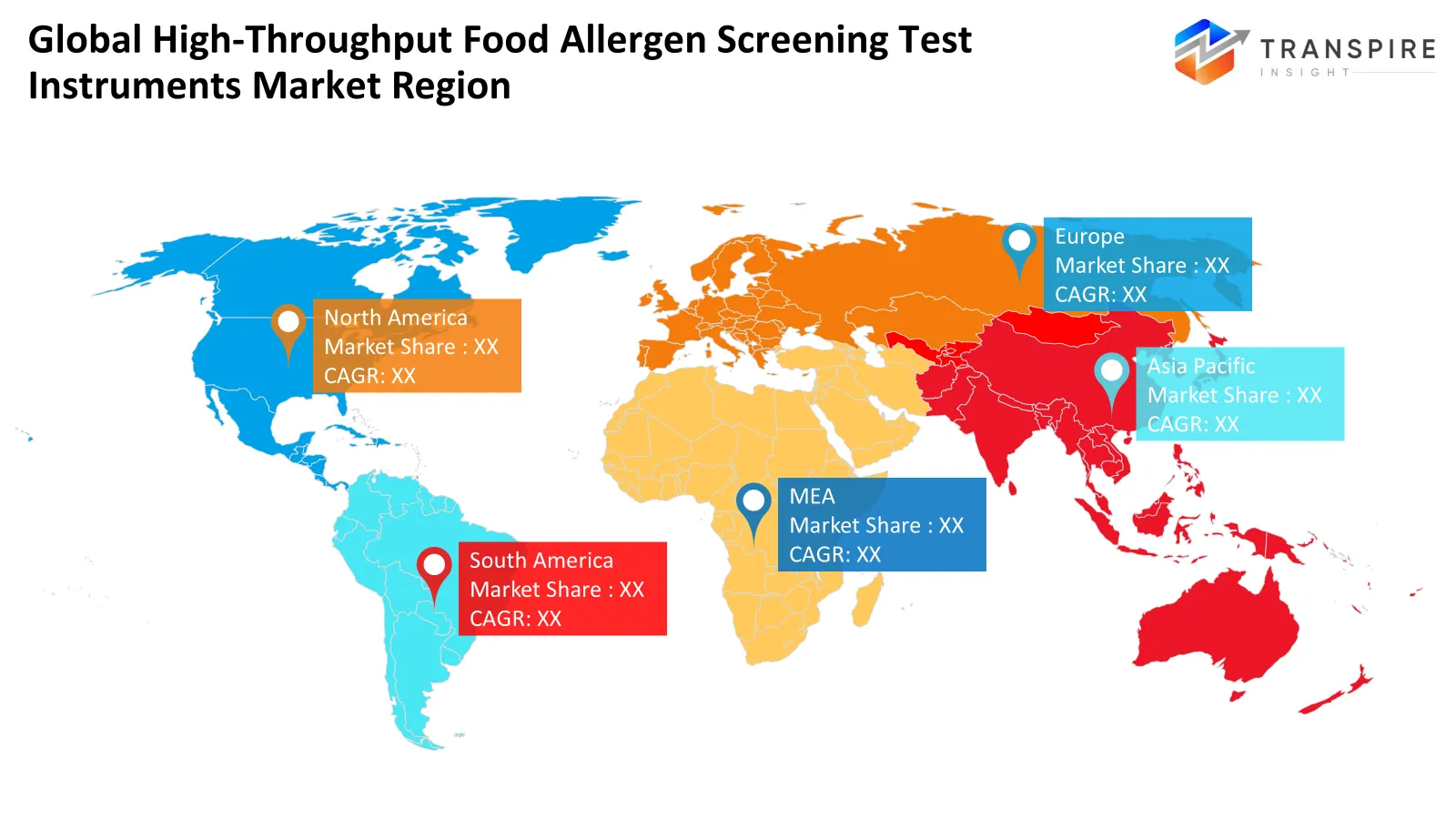
- North America is anticipated to hold approximately a 40% share of the Global High-Throughput Food Allergen Screening Test Instruments Market over the forecast period.
- Europe is expected to hold around29% of the Global High-Throughput Food Allergen Screening Test Instruments Market over the forecast period.
- Asia-Pacificis expected to grow at a rapid CAGR in the Global High-Throughput Food Allergen Screening Test Instruments Market, holding approximately23% share during the forecast period.
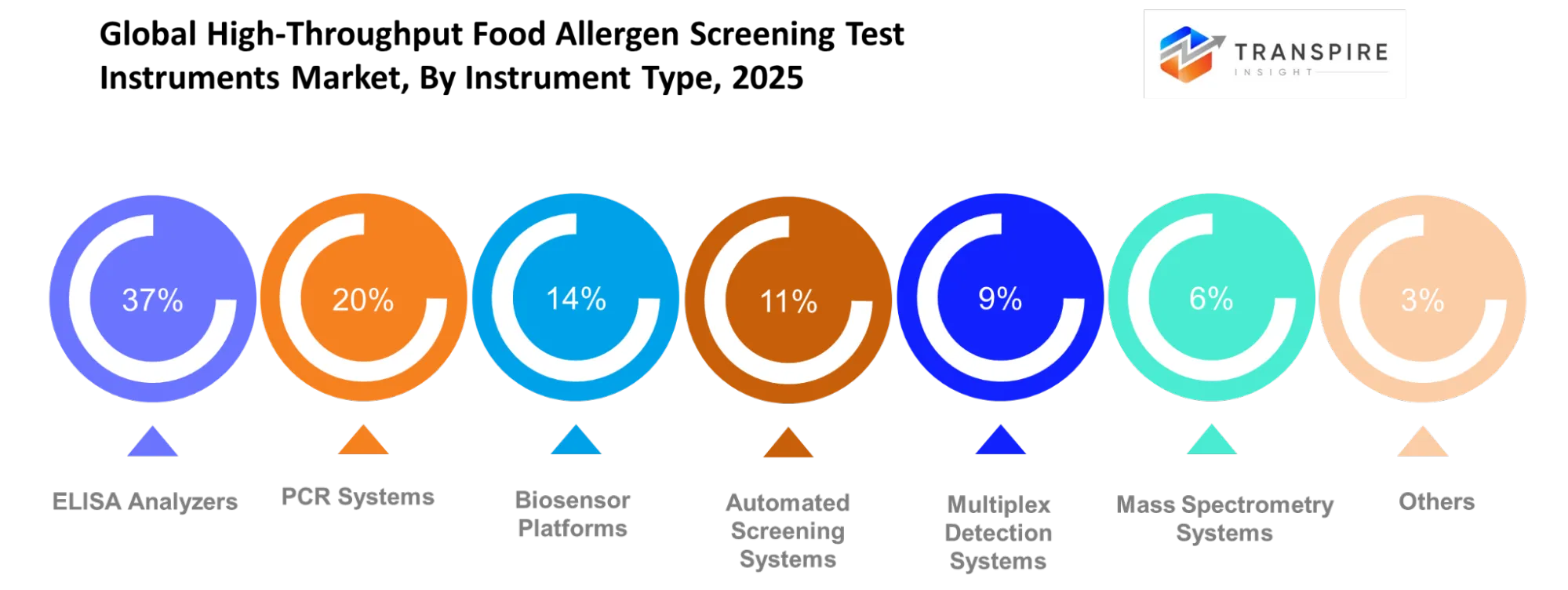
- By instrument, the PCR Systemssegment dominated the market, holding approximately 40% share in 2025, and is projected to grow at a substantial CAGR during the forecast period.
- By end user, the Food Manufacturers segment dominated the market, holding around 45% share in 2025, and is projected to grow at a substantial CAGR during the forecast period.
- By application, the Dairy Products segment dominated the market, holding expectedly 42% share in 2025, and is projected to grow at a substantial CAGR during the forecast period.
- Government support through regulatory frameworks such as the U.S. Food Safety Modernization Act (FSMA) and strict allergen labeling requirements is further accelerating the adoption of advanced food allergen screening instruments across the food industry.
How is Technology Driving Growth in the Global High-Throughput Food Allergen Screening Test Instruments Market?
Technology is playing a crucial role in the growth of the Global high-throughput food allergen screening test instruments marketby improving the speed, accuracy, and efficiency of food allergen detection. Advanced automation enables laboratories to process a large number of food samples simultaneously, significantly reducing testing time while maintaining high accuracy. Artificial intelligence (AI) and machine learning enhance data analysis by identifying allergen patterns, minimizing false positives, and supporting faster decision-making. High-throughput screening platforms integrated with robotics streamline sample preparation and analysis, reducing manual intervention and increasing laboratory productivity. Cloud-based data management systems facilitate secure storage, real-time monitoring, and regulatory compliance across multiple testing facilities. Additionally, innovations in immunoassay, PCR, and biosensor technologies provide highly sensitive and reliable detection of trace allergens in complex food products. These technological advancements are driving widespread adoption of high-throughput allergen screening instruments across food manufacturers, testing laboratories, and regulatory agencies, ensuring improved food safety and compliance with global standards.
Market Drivers
The Global high-throughput food allergen screening test instruments market is experiencing significant growth due to the rising prevalence of food allergies, increasing consumer awareness regarding food safety, and the implementation of stringent food safety regulations worldwide. Growing demand for processed, packaged, and ready-to-eat foods has increased the need for rapid and accurate allergen detection to ensure regulatory compliance and consumer protection. Food manufacturers and testing laboratories are increasingly adopting high-throughput screening instruments to improve testing efficiency, reduce turnaround time, and enhance quality control. Technological advancements in immunoassay, PCR, biosensor, and automated screening platforms have further improved the sensitivity, speed, and reliability of allergen detection. Additionally, government initiatives promoting food safety standards, expanding food exports, and the growing emphasis on quality assurance across the food supply chain continue to drive demand for advanced high-throughput food allergen screening test instruments, supporting sustained market growth.
- For instance, the US food allergen testing market is expected to reach between $330–500 million, growing at a ~6–7% CAGR. High-throughput immunoassay (ELISA) and molecular (PCR/NGS) equipment are being heavily invested in to enable food processors comply with strict batch-testing regulations and prevent recalls.
- The market size of more than USD 340 million, the North American food allergen testing industry leads the world in demand for high-throughput screening devices. Strict FDA regulations, automated processes, and significant investments in portable molecular sensors that aim to scale throughput for processed meals are driving growth.
Restrain
The Global high-throughput food allergen screening test instruments market is primarily restrained by the high capital cost of advanced screening instruments, the complexity of accurately detecting multiple allergens in highly processed and complex food matrices, and the lack of standardized global testing
Behaviour Analysis of Prices and Consumer
Global High-throughput food allergen screening test instruments dominate the market, contributing approximately68% of total revenue due to increasing demand from food manufacturers, contract testing laboratories, research institutions, and regulatory agencies. Advanced automated and AI-integrated screening systems are priced approximately 35% higher than conventional instruments because of their high-throughput sample processing, multiplex allergen detection capabilities, robotic automation, cloud-based data management, and real-time analytical features. Benchtop and compact screening instruments account for nearly 45% of unit sales, driven by routine laboratory testing, food quality assurance, and regulatory compliance requirements. Approximately 70% of overall demand originates from the food processing and food testing industries, where rapid and accurate allergen detection is essential. Consumer purchasing behavior indicates that nearly 55% of buyers prioritize testing accuracy, high sensitivity, operational efficiency, and faster turnaround times,while approximately 33% prefer leasing or subscription-based procurement models to reduce upfront capital investment and improve operational flexibility.
Top Companies in the High-Throughput Food Allergen Screening Test Instruments Market
- Thermo Fisher Scientific
- Bio-Rad Laboratories, Inc.
- Agilent Technologies, Inc.
- PerkinElmer, Inc.
- Romer Labs Division Holding GmbH
- Neogen Corporation
- Merck KGaA
- Eurofins Scientific
- 3M Food Safety
- R-Biopharm AG
Global High-Throughput Food Allergen Screening Test Instruments Market Segmentation
The GlobalHigh-Throughput Food Allergen Screening Test Instruments Market share is divided into five categories: Instrument Type, Allergen Type, End User, Application, and Technology.
ThePCR Systems dominated the market, accounting for nearly 40% in 2025, and is expected to rise at a significant CAGR during the forecast period.
The high-throughput food allergen screening test instruments are segmented by instrument into ELISA Analyzers, PCR Systems, Lateral Flow Readers, Mass Spectrometry Systems, Biosensor Platforms, Automated Screening Systems, Multiplex Detection Systems, and Others. Among these, the PCR system segment dominated the market, accounting for nearly 40% in 2025 and is expected to increase at a significant CAGR during the forecast period. Because of their high accuracy, rapid results, and extensive use in genetic testing, infectious disease detection, and molecular diagnostics, PCR systems have dominated the market. Significant market growth is anticipated due to increased disease prevalence, expanding research efforts, and growing need for sophisticated diagnostic technologies.
The Food Manufacturers segmentheld the largest share, at approximately 42%, in 2025 and is expected to grow at a substantial CAGR over the forecast period.
The global high-throughput food allergen screening test end user is segmented into Food Manufacturers, Food Testing Laboratories, Regulatory Agencies, Research Institutes, Contract Testing Organizations, Beverage Manufacturers, Food Retailers, Others. Among these, the Food Manufacturers segment held the largest share, at approximately46% in 2025, and is expected to grow at a substantial CAGR over the forecast period. Due to growing customer preferences for convenience, expanding food production facilities, increased adoption of modern manufacturing technologies, and rising demand for packaged and processed foods, the Food Manufacturers segment maintained the largest share. Strong market growth and a significant CAGR are anticipated for these reasons.
The Dairy Products segmentheld the greatest share of approximately 45% in 2025 and is expected to increase at a substantial CAGR over the forecast period.
The global high-throughput food allergen screening test application is segmented by application into, Processed Foods, Dairy Products, Bakery Products, Snacks, Beverages, Infant Nutrition, Ready-to-Eat Foods, Others. Among these, the Food Manufacturers segment held the largest share, at approximately45% in 2025, and is expected to grow at a substantial CAGR over the forecast period.Due to growing customer demand for wholesome food, rising awareness of high-protein diets, increasing global dairy consumption, and product developments such as functional dairy beverages, the Dairy Products category dominated. Significant market growth is anticipated to be further fueled by population growth and improved distribution systems.
Regional Segment Analysis of the Global High-Throughput Food Allergen Screening Test Instruments Market
- North America (U.S., Canada, Mexico)
- Europe (Germany, France, U.K., Italy, Spain, Rest of Europe)
- Asia-Pacific (China, Japan, India, Rest of APAC)
- South America (Brazil and the Rest of South America)
- The Middle East and Africa (UAE, South Africa, Rest of MEA)
North America is expected to grow at a rapid CAGR in the high-throughput food allergen screening test instruments market, holding approximately 40% of the share during the forecast period.
North America is expected to grow at a rapid CAGR in the High-Throughput Food Allergen Screening Test Instruments Market, holding approximately 40% share during the forecast period. The region’s growth is driven by stringent food safety regulations, the increasing prevalence of food allergies, the growing demand for processed and packaged foods, and the rising adoption of automated food testing technologies. The presence of leading food manufacturers, contract testing laboratories, and major life science companies, along with continuous investments in laboratory automation and high-throughput diagnostic technologies, further strengthens market growth.
Europe is the fastest-growing region in the high-throughput food allergen screening test instruments market during the forecast period, holding approximately 29% share.
Europe is the fastest-growing region in the High-Throughput Food Allergen Screening Test Instruments Marketduring the forecast period, holding approximately 29% share. The region’s growth is driven by stringent food safety regulations, mandatory allergen labelling requirements, and increasing consumer awareness regarding food allergies and food quality. Additionally, European Union regulations, including strict allergen labeling and food quality standards, are accelerating the demand for high-throughput food allergen screening test instruments. Increasing research and development activities, laboratory automation, and the growing emphasis on ensuring regulatory compliance and consumer safety further strengthen Europe’s position as a key high-growth market globally.
Asia Pacific is anticipated to hold approximately 23% share of the globalhigh-throughput food allergen screening test instruments market over the predicted timeframe.
Asia Pacific is anticipated to hold approximately 23% share of the global high-throughput food allergen screening test instrument market. Because this demand is driven by a growing regional food processing industry, rapid urbanization, and increased consumer awareness of food allergies. Furthermore, manufacturers in nations like China and India are required by stringent international food safety and labeling standards to regularly test exported food items.
Strategies for Market Growth in Non-Leading Regions:
Growth in non-leading regions can be accelerated by deploying cost-effective, scalable, high-throughput food allergen screening solutions tailored to the needs of small- and medium-sized food manufacturers and regional testing laboratories. Establishing social manufacturing, distribution, and service centers can reduce import dependency, lower equipment costs, and improve after-sales support. Strategic partnerships with food manufacturers, contract testing laboratories, research institutions, and regulatory agencieswill enhance market penetration and increase awareness of advanced allergen screening technologies. Training programs and technical skill development initiatives are essential to address the shortage of skilled laboratory professionals and ensure efficient instrument operation. Flexible financing, leasing, and subscription-based procurement models can improve affordability and encourage adoption among smaller organizations. Additionally, government collaborations, stronger food safety regulations, investments in laboratory infrastructure, and digital sales and service platforms will improve accessibility and drive sustainable market expansion across emerging economies.
Future Market Trends for the Global High-Throughput Food Allergen Screening Test Instruments Market
1. AI-Driven Data Analysis and Predictive Food Safety: AI-driven data analysis is transforming food allergen screening by improving the accuracy and speed of allergen detection. Machine learning algorithms analyze large datasets to identify allergen patterns, reduce false positives and false negatives, and support predictive food safety measures. These technologies enhance laboratory efficiency, improve quality control, and enable faster regulatory compliance across the food processing industry.
2. Laboratory Automation and Cloud-Based Data Management: Automation and cloud-based data management systems are increasingly being integrated into high-throughput food allergen screening instruments. Automated sample preparation, robotic handling, and real-time cloud connectivity enable laboratories to process large sample volumes with minimal manual intervention. Cloud platforms facilitate secure data storage, remote monitoring, regulatory reporting, and seamless collaboration between food manufacturers, testing laboratories, and regulatory authorities.
3. Expansion of High-Throughput Food Safety Testing Infrastructure: The expansion of food safety testing infrastructure is driven by increasing food production, growing international food trade, and stricter food safety regulations worldwide. Food manufacturers, contract testing laboratories, and regulatory agencies are investing in advanced high-throughput allergen screening technologies to improve testing capacity, ensure regulatory compliance, and deliver safe food products to consumers.
4. Adoption of Multiplex and Portable Allergen Screening Technologies: Multiplex and portable food allergen screening instruments are gaining significant adoption due to their ability to detect multiple allergens simultaneously while providing rapid and accurate results. Portable screening systems enable on-site food safety testing at manufacturing facilities, food processing plants, and inspection points, reducing testing turnaround time and improving operational efficiency. These innovations support faster decision-making and strengthen food quality assurance throughout the global food supply chain.
Recent Developments
- In April 2025, Thermo Fisher Scientific introduced advanced automated food allergen testing workflows integrated with high-throughput laboratory automation, enabling faster sample processing, improved detection accuracy, and enhanced laboratory productivity for food safety testing.
- In February 2025, Neogen Corporation expanded its food allergen detection portfolio with next-generation rapid immunoassay solutions designed to improve multiplex allergen screening, reduce testing turnaround time, and strengthen food quality assurance across the food industry.
- In October 2024, Bio-Rad Laboratories, Inc. introduced enhanced multiplex PCR-based food allergen detection solutions, providing greater sensitivity, faster analysis, and improved workflow efficiency for high-throughput food testing laboratories.
- In June 2024, Romer Labs Division Holding GmbH expanded its food allergen testing solutions by introducing advanced ELISA-based screening kits optimized for high-throughput laboratory applications, enabling reliable detection of multiple food allergens while supporting global food safety and regulatory compliance.
Global High-Throughput Food Allergen Screening Test Instruments Market Segment
This study forecasts revenue at the global, regional, and country levels from 2020 to 2033. Transpire Insights has segmented the high-throughput food allergen screening test instruments Market based on the below-mentioned segments:
Global High-Throughput Food Allergen Screening Test Instruments MarketBy Instrument Type
- ELISA Analyzers
- PCR Systems
- Lateral Flow Readers
- Mass Spectrometry Systems
- Biosensor Platforms
- Automated Screening Systems
- Multiplex Detection Systems
Global High-Throughput Food Allergen Screening Test Instruments Market, By Allergen Type
- Peanut Allergens
- Milk Allergens
- Egg Allergens
- Gluten Allergens
- Soy Allergens
- Tree Nut Allergens
- Seafood Allergens Food Manufacturers
- Contract Testing Laboratories
- Research & Academic Institutes
Global High-Throughput Food Allergen Screening Test Instruments Market, By End User
- Food Manufacturers
- Food Testing Laboratories
- Regulatory Agencies
- Research Institutes
- Contract Testing Organizations
- Beverage Manufacturers
- Food Retailers
- Others
Global High-Throughput Food Allergen Screening Test Instruments Market, By Application
- Processed Foods
- Dairy Products
- Bakery Products Snacks
- Beverages
- Infant Nutrition
- Ready-to-Eat Foods
- Others
Global High-Throughput Food Allergen Screening Test Instruments Market, By Technology
- Immunoassay-based Testing
- PCR-based Testing
- Biosensor Technology
- Chromatography-based Testing
- AI-assisted Analysis
- Multiplex Assays
- Rapid Detection Technology Others
Global High-Throughput Food Allergen Screening Test Instruments Market, By Regional Analysis
North America
- United States
- Canada
- Mexico
Europe
- Germany
- United Kingdom
- France
- Italy
- Spain
- Russia
- Rest of Europe
Asia Pacific
- China
- Japan
- India
- South Korea
- Australia
- Rest of Asia Pacific
South America
- Brazil
- Argentina
- Rest of South America
Middle East & Africa
- Saudi Arabia
- United Arab Emirates
- Qatar
- South Africa
- Rest of the Middle East & Africa
Frequently Asked Questions
Find quick answers to common questions.
Growth is driven by rising food allergy cases, stricter food safety regulations, increasing processed food consumption, laboratory automation, AI-based testing, and growing demand for rapid, accurate, and high-throughput allergen detection solutions.
The PCR Systems segment dominates with approximately 40% market share in 2025 due to superior accuracy, rapid detection, high sensitivity, multiplex testing capabilities, and widespread adoption across food testing laboratories.
North America leads with approximately 40% market share, supported by strict FDA regulations, advanced laboratory infrastructure, widespread automation, growing food safety awareness, and strong presence of leading industry participants.
Leading companies include Thermo Fisher Scientific, Bio-Rad Laboratories, Agilent Technologies, PerkinElmer, Neogen Corporation, Romer Labs, Merck KGaA, Eurofins Scientific, 3M Food Safety, and R-Biopharm AG.
The market is expected to grow from USD 198.5 million in 2025 to USD 401.6 million by 2033, registering a CAGR of 9.28% due to increasing global food safety requirements.
- Thermo Fisher Scientific
- Bio-Rad Laboratories, Inc.
- Agilent Technologies, Inc.
- PerkinElmer, Inc.
- Romer Labs Division Holding GmbH
- Neogen Corporation
- Merck KGaA
- Eurofins Scientific
- 3M Food Safety
- R-Biopharm AG
About the Authors

Pankaj Ghogare Patil
I am Pankaj Ghogare Patil, a Senior Research Analyst at Transpire Insight, specializing in the Pharmaceutical, Chemicals & Materials, Healthcare IT, and Biotechnology industry. My expertise lies in conducting comprehensive market research, analyzing industry trends, evaluating competitive landscapes, and translating complex data into actionable insights. At Transpire Insight, I closely follow emerging technologies, regulatory developments, and market innovations to create accurate, well-researched, and informative content that helps businesses and professionals make informed decisions. I am committed to producing credible, evidence-based articles that reflect industry best practices while making technical topics accessible and valuable for a broad audience.

Chakradhar Khansole
Chakradhar serves as the Research Director at Transpire Insight, bringing over 8 years of experience in technology, innovation, and strategic market intelligence. He specializes in transforming complex market data into actionable business insights that enable organizations to make informed, growth-oriented decisions. Recognized for his strategic vision and analytical expertise, Chakradhar leads high-impact research initiatives, delivering comprehensive market assessments, competitive intelligence, and forward-looking industry analysis.
Recently Published Reports
-
Apr 2026
AI in Diabetic Retinopathy Market
AI in Diabetic Retinopathy Market Size, Share & Analysis Report By Type (Screening AI Systems, Diagnostic AI Systems, and Predictive AI Models), By Application Segment (Hospitals, Ophthalmology Clinics, Diagnostic Centers, and Research and Development), and Geography (North America, Europe, Asia-Pacific, Middle East and Africa, South and Central America), 2021 - 2031
-
Apr 2026
Psychometric Tests Market
Psychometric Tests Market Size, Share & Analysis Report By Type (Personality Tests, Ability/Aptitude Tests, Skill/Knowledge Tests, and Others), By Application (Talent Acquisition and Talent Management), and Geography (North America, Europe, Asia-Pacific, Middle East and Africa, South and Central America), 2021 – 2031
-
Apr 2026
Rare Biological Sample Collection Market
Rare Biological Sample Collection Market Size, Share & Analysis Report By Type (Isolation Kits & Reagent, Blood Collection Tubes, and Others), By Application (Oncology, Transcriptomics, Pharmacogenomics, and Others), and Geography (North America, Europe, Asia-Pacific, Middle East and Africa, South and Central America), 2021 – 2031
-
Jul 2026
Diabetic Retinopathy Market
Diabetic Retinopathy Market Size, Share & Analysis Report By Type (Proliferative Diabetic Retinopathy, and Diabetic Macular Edema (DME)), By Treatment Type (Anti VEGF Drug, Steroid Implants, Laser Surgeries, and Vitrectomy), and Geography (North America, Europe, Asia-Pacific, Middle East and Africa, South and Central America), 2021 – 2031
Our Clients







