
Oct 23, 2026
By Transpire Insight
Description
According to a research report published by Transpire Insight, the hard carbon anode market size is projected to grow from USD 7.12 billion in 2026 to USD 12.15 billion by 2035, at an 8.22% CAGR during the 2027-2035 forecast period. As the commercial success of sodium-ion batteries creates an increased demand for widening the gap between the layers of carbon, and the demand for bio-based, cost-effective grid storage solutions, the market for hard carbon anodes is rapidly growing.
Introduction
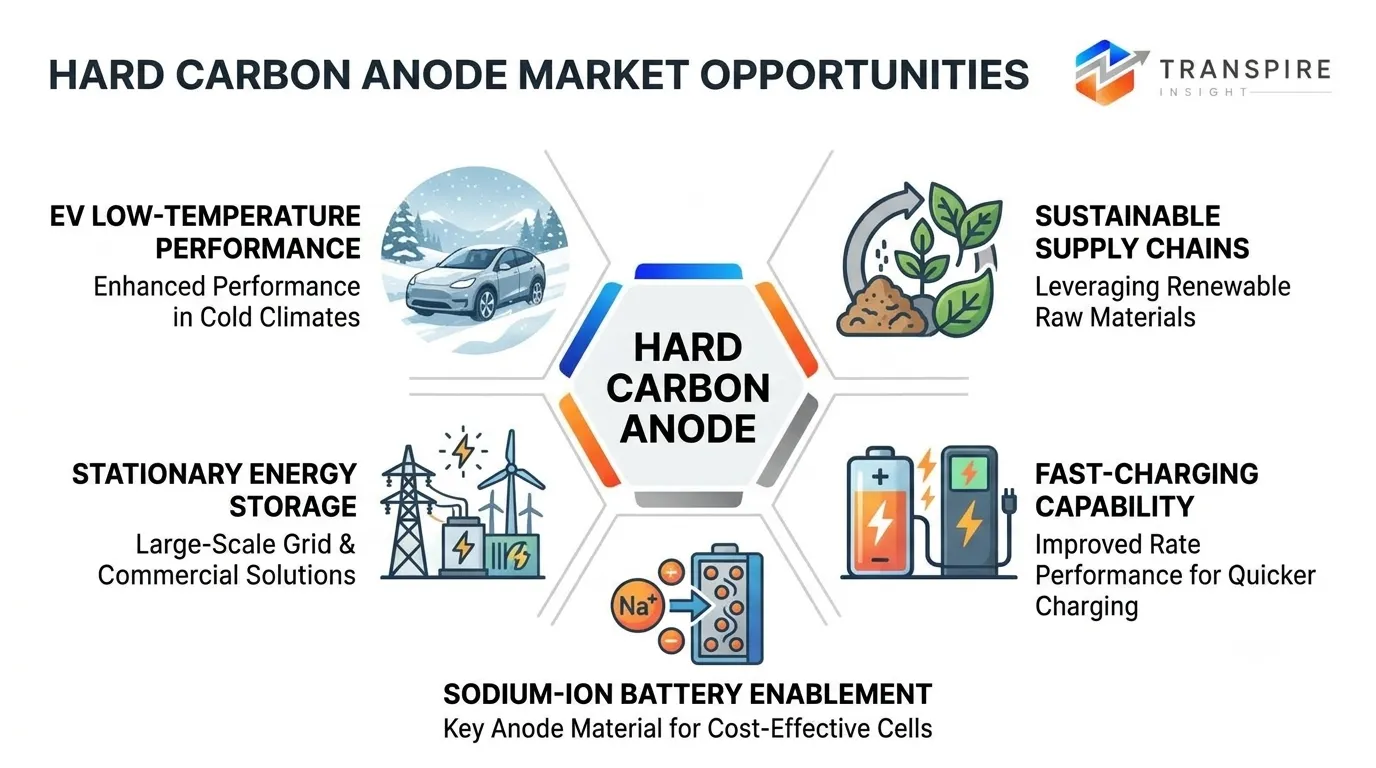
Non-graphitizing carbon materials are a must-have for next-generation energy storage, namely, hard carbon anodes. Their disordered atomic structure and microporosity enable the easy intercalation of larger alkali ions in these materials, and currently their use in the anode is the sole option for sodium-ion batteries and high-rate charging applications. The development of hard carbon materials is a key strategy for energy suppliers as markets shift towards sustainable, low-cost battery chemistries for EVs and stationary storage.
Recent Development News
May 2026: Epsilon Advanced Materials launched a sustainable hard carbon anode material derived from coconut shell waste. Designed specifically for sodium-ion energy storage systems (ESS), it reduces carbon emissions by up to 50% compared to traditional graphite synthesis.
April 2026: CATL signed a major 3-year, 60 GWh sodium-ion battery supply agreement with HyperStrong, which is also a world first in terms of the amount of demand signal.
Stay Ahead of Emerging Opportunities with Expert Market Insights by Transpire Insight
Transpire Insight provides comprehensive, data-driven market intelligence to support smarter business decisions. Our research is rooted in comprehensive analysis, authoritative predictions, and industry expertise, enabling organizations to make informed decisions in rapidly evolving markets. We provide in-depth analysis of market segmentation, competitive positioning, regional trends, and emerging investment opportunities in high-growth areas. We blend accuracy with actionable intelligence, helping companies uncover new growth avenues, strengthen strategic decision-making, and stay ahead in a dynamic market.
Hard Carbon Anode Market Size & Statistics
The Market Size for Hard Carbon Anode Was Estimated to be Worth USD 7.12 Billion in 2026.
The Market Size is Going to Expand at a CAGR of 8.22% between 2026 and 2035.
The Hard Carbon Anode Market Size is anticipated to reach USD 12.15 billion by 2035.
Asia-Pacific is projected to drive the highest demand during the forecast period, accounting for 56.8% of the hard carbon anode market.
North America is projected to grow the fastest during the forecast period at a CAGR of 15.4% in the hard carbon anode market.
Regional Growth and Demand Analysis by Transpire Insight
Asia Pacific is the driving force of the demand as China has the most comprehensive sodium-ion value chain, encompassing precursor processing, pyrolysis and cell assembly. Battery manufacturers like CATL have commercialized sodium-ion batteries, which rely exclusively on a hard carbon anode. Sodium-ion batteries rely only on a hard carbon anode, as there is no effective capacity for sodium in graphite. In addition to regional suppliers, Japanese suppliers provide a premium layer; in the case of Kuraray, plant-based KURANODE hard carbon for secondary batteries.
North America is the largest region, representing 15.4% of revenue and is also the fastest-growing region, despite the fact that the market is still small, and policy support is pushing it forward. Alternative battery chemistries are supported by U.S. Department of Energy programs and domestic OEMs are partnering with suppliers from Asia as local capacity expands. The demand is primarily for stationary storage projects, which are paired with solar generation; that's where sodium-ion is cheaper to help adoption.
Top 15 Trends in the Hard Carbon Anode Market
Sodium-ion batteries cannot use graphite, so manufacturers depend on hard carbon anodes. Growth in storage systems and affordable vehicles directly converts into structural anode demand.
Producers convert coconut shells, wood, and agricultural residues into hard carbon. Renewable feedstock lowers costs, strengthens sustainability credentials, and appeals to increasingly eco-conscious battery makers.
Lignin-based precursors from pulp and paper side streams offer scalable, low-carbon hard carbon supply. Nordic producers are advancing commercial lines for European sodium-ion cell developers.
Improved carbonization and surface treatment reduce irreversible sodium loss during first charge. Higher initial coulombic efficiency raises usable cell capacity and strengthens overall commercial competitiveness.
Manufacturers are shifting toward inexpensive precursors and simplified pyrolysis to cut production costs. Lower prices are essential for hard carbon to reach mass-market electric vehicles.
Governments and OEMs in North America and Europe are funding domestic anode capacity. Localization reduces dependence on Asian imports and shields battery producers from disruptions.
List of Top 25 Companies Leading the Hard Carbon Anode Market
Offers high-performance BHC series hard carbon anodes engineered for rapid sodium intercalation.
Founded: 2000 | HQ: Shenzhen, China.
Why It Ranks: World’s largest battery anode material producer by sheer volume and capacity.
Regional Dominance: Dominates East Asia through massive scale and established battery gigafactory partnerships.
Product Line: BHC hard carbon series, synthetic graphite, and silicon-carbon anode materials.
Pioneers plant-derived bio-hard carbon materials using sustainable hardwood precursors for batteries.
Founded: 1926 | HQ: Tokyo, Japan.
Why It Ranks: leader in eco-friendly plant-based hard carbon anode commercial material technologies.
Regional Dominance: Strong presence in Japan, Europe, and North American clean-tech supply networks.
Product Line: KURANODE™ bio-based hard carbon, activated carbon, and specialized chemical resins.
Develops high-density synthetic and biomass hard carbons for commercial sodium-ion power cells.
Founded: 1999 | HQ: Shanghai, China.
Why It Ranks: Key pioneer in scaling integrated continuous carbonization lines for advanced anodes.
Regional Dominance: Holds extensive industrial market share across East Asia’s battery supply chain.
Product Line: Hard carbon anodes, high-power artificial graphite, and silicon-based battery composites.
Produces ultra-pure carbon-based anode materials optimized for high-capacity industrial battery storage applications.
Founded: 1992 | HQ: Wiesbaden, Germany.
Why It Ranks: Premier European specialist in industrial carbon matrix manufacturing and thermal processing.
Regional Dominance: Anchors the Western European advanced materials market and automotive supply chains.
Product Line: Specialty synthetic graphite, hard carbon materials, and carbon fiber composites.
Utilizes bio-refinery resin and crop waste precursors to yield carbon-neutral battery anodes.
Founded: 1979 | HQ: Jinan, China.
Why It Ranks: World leader in biomass refinement yielding high-density bio-hard carbon anode materials.
Regional Dominance: Drives sustainable precursor development across Asian and eco-battery sectors.
Product Line: Bio-based hard carbon powders, biomass resins, and renewable bio-chemical products.
Engineers precision hard carbon powders tailored for long-cycle energy storage and capacitors.
Founded: 1934 | HQ: Tokyo, Japan.
Why It Ranks: Massive chemical conglomerate with deep proprietary research in structural carbon materials.
Regional Dominance: Commands significant supply influence in Japan, North America, and East Asia.
Product Line: Specialty hard carbons, battery electrolytes, and performance synthetic graphite materials.
Spearheads South Korean development of next-generation non-graphitic carbon anodes for sodium cells.
Founded: 1971 | HQ: Pohang, South Korea.
Why It Ranks: Vertically integrated steel and chemical giant driving Korean battery material innovation.
Regional Dominance: Primary domestic power in South Korea with growing North American manufacturing investments.
Product Line: Hard carbon anodes, synthetic/natural graphite, and high-nickel cathode active materials.
Focuses on fast-charging, low-temperature hard carbon anode materials for sodium-ion applications.
Founded: 2002 | HQ: Shenzhen, China.
Why It Ranks: Innovator in custom powder engineering for high-rate battery and capacitor performance.
Regional Dominance: Key supplier to major Chinese battery cell manufacturers and energy storage markets.
Product Line: Hard carbon series, fast-charging synthetic graphite, and silicon anode materials.
Pioneered early hard carbon commercialization (Carbotron) for high-power lithium and sodium applications.
Founded: 1944 | HQ: Tokyo, Japan.
Why It Ranks: Early historical innovator with extensive patent portfolios in non-graphitizing carbon materials.
Regional Dominance: Maintains strong supply tier status in Japan, North America, and Europe.
Product Line: Carbotron® hard carbon, PVDF battery binders, and advanced specialty chemicals.
Transforms coal tar and pitch precursors into highly structured hard carbon powders.
Founded: 1931 | HQ: Osaka, Japan.
Why It Ranks: Expert in pitch-based material processing for thermal stability and high tap density.
Regional Dominance: Leading specialty provider in Japan with export networks across markets.
Product Line: Pitch-derived hard carbon, activated carbon fibers, and coal-chemical performance products.
Conclusion
With the rapid market commercialization of sodium-ion batteries around the world, the market for hard carbon anodes is at the beginning of an unprecedented growth period. Security and sustainability of raw materials are gaining importance, and industry leaders are increasingly turning to bio-based biomass precursors and energy-efficient carbonisation technologies. In the future, manufacturers that are able to produce stationary storage systems at high yields at low costs and low carbon emissions will shape the energy storage market, including electric mobility.


Send us a brief description of your challenge and we'll get back to you within 24 hours.

 inquiry@transpireinsight.com
 APAC:+91 7666513636
 Address


