
Oct 17, 2026
By Transpire Insight
Description
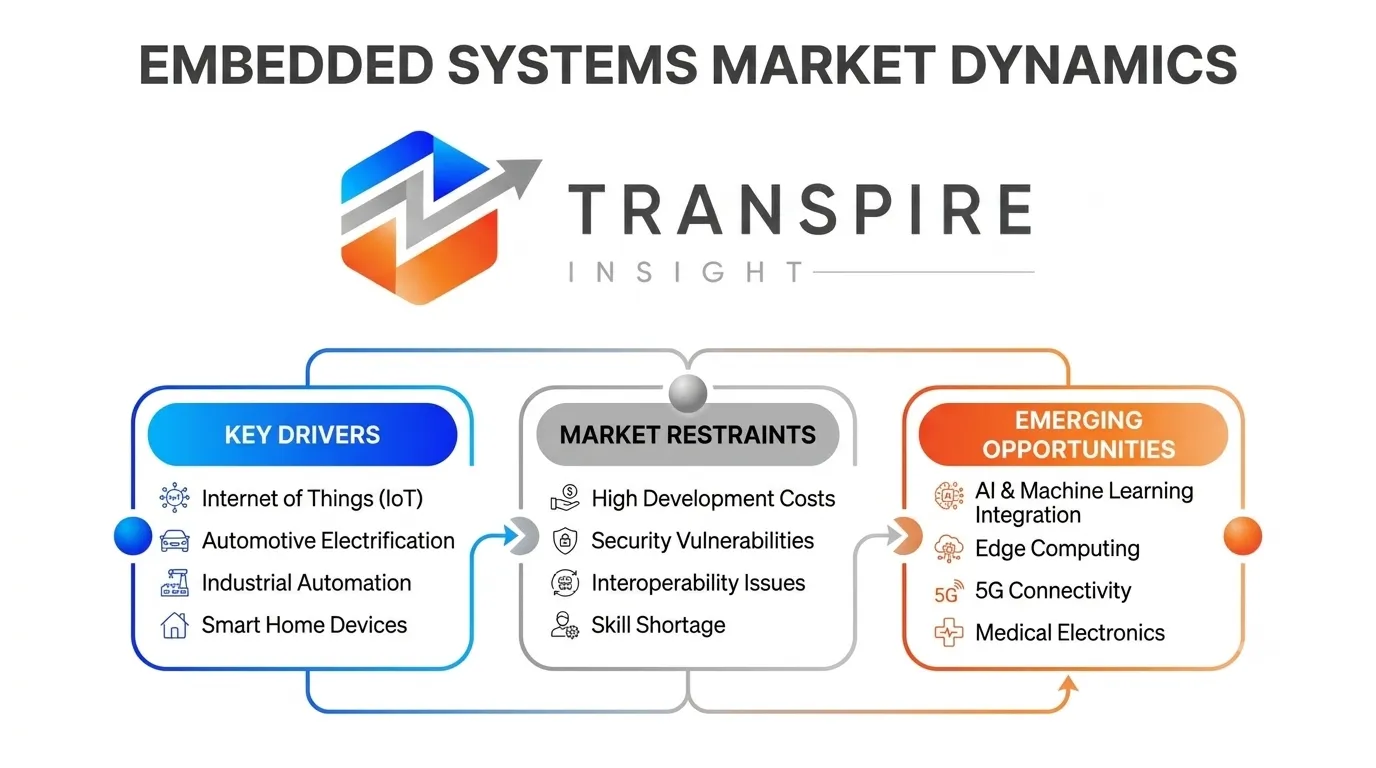
According to a research report published by Transpire Insight, the embedded systems market size is projected to grow from USD 130.23 billion in 2026 to USD 218.27 billion by 2035, at a CAGR of 8.21% during the forecast period 2027-2035. growth is fueled by surging demand for real-time edge processing, rapid automotive electrification, growing acceptance of IoT devices, and the ongoing miniaturization and power efficiency of microcontrollers.
Introduction
However, embedded systems are the backbone of modern technology, where a specific microprocessor controls local electronic functions with customized software. They are vital in a wide range of industries, such as automotive, industrial automation, healthcare, aerospace, and consumer electronics, where they are used to improve system efficiency, reduce energy usage, and provide real-time processing. With the surge of edge AI and smart connected infrastructure, the market is growing quickly globally.
Recent Development News
February 2026: India has given the go-ahead to the HCL-Foxconn semiconductor assembly unit for manufacturing special display driver chips and embedded processing chips, making the move.
June 2026: Intel inked a huge strategic agreement to establish an advanced semiconductor substrate packaging unit in Odisha to boost embedded chip manufacturing in the world.
Stay Ahead of Emerging Opportunities with Expert Market Insights by Transpire Insight
Transpire Insight provides comprehensive, data-driven market intelligence to support smarter business decisions. Our research is rooted in comprehensive analysis, authoritative predictions, and industry expertise, enabling organizations to make informed decisions in rapidly evolving markets. We provide in-depth analysis of market segmentation, competitive positioning, regional trends, and emerging investment opportunities in high-growth areas. We blend accuracy with actionable intelligence, helping companies uncover new growth avenues, strengthen strategic decision-making, and stay ahead in a dynamic market.
Embedded Systems Market Size & Statistics
The Market Size for Embedded Systems Was Estimated to be Worth USD 130.23 Billion in 2026.
The Market Size is Going to Expand at a CAGR of 8.21% between 2026 and 2035.
The Embedded Systems Market Size is anticipated to reach USD 218.27 Billion by 2035.
North America is projected to drive the highest demand during the forecast period, accounting for 39.18% of the embedded systems market.
Asia-Pacific is projected to grow the fastest during the forecast period at a CAGR of 8.24% in the embedded systems market.
Regional Growth and Demand Analysis by Transpire Insight
North America holds the leading position in the embedded systems market, supported by deep semiconductor expertise and heavy investment in advanced computing. Federal investment in the CHIPS and Science Act has facilitated companies to ramp up domestic manufacturing, such as Texas Instruments' large facility in Sherman, Texas, which will benefit the local supply of analog chips and microcontrollers in embedded designs. AI-powered robotics and edge computing platforms continue to drive demand, with NVIDIA's Jetson Thor module for humanoid and industrial robots and high-reliability embedded solutions in the aerospace, defense, and medical device sectors.
Asia Pacific will grow fastest due to the dominance of the region in electronics manufacturing and the fast growth of the semiconductor industry in Asia Pacific. The demand for advanced chips comes from Taiwan and South Korea, which are both home to semiconductor manufacturers, Taiwan Semiconductor Manufacturing Co. Ltd. (TSMC) and Samsung Electronics Co. Ltd., while China's huge consumer electronics and electric vehicle production provides ongoing demand for the microcontrollers and system-on-chip platforms. India is becoming a new manufacturing hub, with Tata Electronics setting up a fabrication plant in Dholera, Gujarat, and Micron establishing an assembly and test plant in Sanand. The automotive and robotics industries are other areas of demand for embedded software and controllers in Japan.
Top 15 Trends in the Embedded Systems Market
Manufacturers embed neural processing units directly into microcontrollers, enabling local inference for voice, vision, and predictive maintenance while reducing latency, cloud dependence, and privacy risks.
Open-standard RISC-V cores let designers customize instruction sets, avoid licensing fees, and diversify supply chains, attracting automotive, industrial, and consumer chipmakers seeking flexible, cost-efficient designs.
Software-defined vehicles consolidate dozens of electronic control units into centralized computers, increasing embedded software content, enabling feature upgrades after sale, and supporting driver assistance functions.
Smart factories deploy connected sensors, controllers, and gateways to monitor equipment, optimize production, and reduce downtime, steadily raising demand for rugged embedded hardware and software.
Cyberattacks on connected devices push vendors to build secure boot, encryption, and hardware root of trust into chips, protecting firmware integrity and meeting regulatory requirements.
Over-the-air updates let manufacturers patch vulnerabilities, fix bugs, and add features remotely, extending product lifespans, lowering recall and service costs, and improving overall customer experience.
List of Top 25 Companies Leading the Embedded Systems Market
1. Texas Instruments
Texas Instruments powers electronics with thousands of versatile analog and embedded chips.
Founded: 1930 | HQ: Dallas, Texas, USA.
Why It Ranks: Leading market share in broad-based industrial microcontroller platforms and analog circuits.
Regional Dominance: Strong manufacturing and commercial dominance across North America, Europe, and Asia-Pacific.
Product Line: MSP430 MCUs, C2000 real-time microcontrollers, Sitara processors, and analog integrated ICs.
2. Intel Corporation
Intel designs high-performance microprocessors that power complex embedded computing environments worldwide.
Founded: 1968 | HQ: Santa Clara, California, USA.
Why It Ranks: Dominates edge computing, high-end industrial processing, and server-class embedded hardware.
Regional Dominance: Holds massive market influence across North America, Europe, and Asia-Pacific enterprise sectors.
Product Line: Intel Atom processors, Core embedded chips, Xeon processors, and FPGA solutions.
3. NXP Semiconductors
NXP specializes in secure connectivity and automotive processing engines for smart vehicles.
Founded: 2006 | HQ: Eindhoven, Netherlands.
Why It Ranks: Premier supplier of automotive processing platforms and secure microcontrollers.
Regional Dominance: Extensive market reach spanning Europe, North America, and major Asian automotive hubs.
Product Line: i.MX application processors, S32 automotive platforms, Kinetis MCUs, and NFC chips.
4. STMicroelectronics
STMicroelectronics produces industry-standard microcontrollers for consumer, smart industrial, and automotive applications.
Founded: 1987 | HQ: Plan-les-Ouates, Switzerland.
Why It Ranks: Creator of the world-renowned STM32 family, setting embedded design standards.
Regional Dominance: Massive footprints across Western Europe, Asia-Pacific electronics hubs, and North America.
Product Line: STM32 32-bit MCUs, SPC5 automotive controllers, MEMS sensors, and power ICs.
5. Microchip Technology
Microchip provides reliable, low-power embedded control solutions for diverse industrial markets worldwide.
Founded: 1989 | HQ: Chandler, Arizona, USA.
Why It Ranks: Unrivaled market presence with popular PIC and AVR microcontroller architecture families.
Regional Dominance: Broad market influence throughout North America, Asia-Pacific, and European industrial centers.
Product Line: PIC and AVR microcontrollers, SAM ARM-based MCUs, and PolarFire FPGAs.
6. Qualcomm
Qualcomm drives wireless edge connectivity and high-performance mobile system-on-chip innovations globally.
Founded: 1985 | HQ: San Diego, California, USA.
Why It Ranks: Dominates mobile processing engines and connected IoT embedded computing hardware solutions.
Regional Dominance: market leader with dominant supply chains in North America and Asia-Pacific.
Product Line: Snapdragon processors, RB5 robotics platforms, cellular modems, and Wi-Fi chipsets.
7. Renesas Electronics
Renesas delivers advanced semiconductor solutions for automotive, industrial, and infrastructure applications globally.
Founded: 2002 | HQ: Tokyo, Japan.
Why It Ranks: Top provider of specialized automotive controllers and industrial smart microcontrollers.
Regional Dominance: Dominant across Asia-Pacific while maintaining strong market positions in Europe.
Product Line: RA, RX, and RL78 MCUs, R-Car automotive SoCs, and industrial MPUs.
8. Infineon Technologies
Infineon leads power semiconductor innovation and secure microcontroller solutions for intelligent mobility.
Founded: 1999 | HQ: Neubiberg, Germany.
Why It Ranks: World leader in automotive power electronics, security chips, and industrial microcontrollers.
Regional Dominance: Core leadership in Europe with expanding market dominance across Asian manufacturing.
Product Line: AURIX automotive microcontrollers, PSoC controllers, OPTIGA security hardware, and power ICs.
9. Advanced Micro Devices (AMD)
AMD delivers flexible adaptive computing platforms and high-performance embedded processing chip architectures.
Founded: 1969 | HQ: Santa Clara, California, USA.
Why It Ranks: Major force in adaptive embedded computing following the acquisition of Xilinx.
Regional Dominance: Strong commercial presence throughout North America, Western Europe, and key Asian markets.
Product Line: Versal ACAPs, Zynq SoC platforms, Spartan FPGAs, and Ryzen Embedded processors.
10. Analog Devices (ADI)
ADI bridges physical and digital domains with high-precision signal processing and sensors.
Founded: 1965 | HQ: Wilmington, Massachusetts, USA.
Why It Ranks: Unmatched leadership in precision analog, signal conditioning, and edge sensing architectures.
Regional Dominance: Robust market share across North American, European, and East Asian industrial sectors.
Product Line: Blackfin DSPs, SHARC audio processors, precision converters, and smart edge sensors.
Conclusion
Embedded systems continue to move into a software-defined, hyper-connected, and edge-AI era. Increased automotive electrification, industrial automation, and smart consumer technologies have driven growth among leading semiconductor manufacturers and software vendors as they expand their low-power microcontrollers and processing units. The market is expected to continue expanding in these critical areas, driven by the increasing need for real-time edge computing and comprehensive security solutions.


Send us a brief description of your challenge and we'll get back to you within 24 hours.

 inquiry@transpireinsight.com
 APAC:+91 7666513636
 Address


