
Oct 13, 2026
By Transpire Insight
Description
According to a research report published by Transpire Insight, the district energy services market size is projected to grow from USD 168.6 million in 2026 to USD 287.6 billion by 2035, at a CAGR of 8.02% during the forecast period 2027-2035. Municipalities and industrial clusters are being driven by various factors such as rapid urbanisation, carbon reduction requirements, and increased demand for sustainable, energy-efficient heating and cooling systems to convert from decentralised to centralised systems.
Introduction
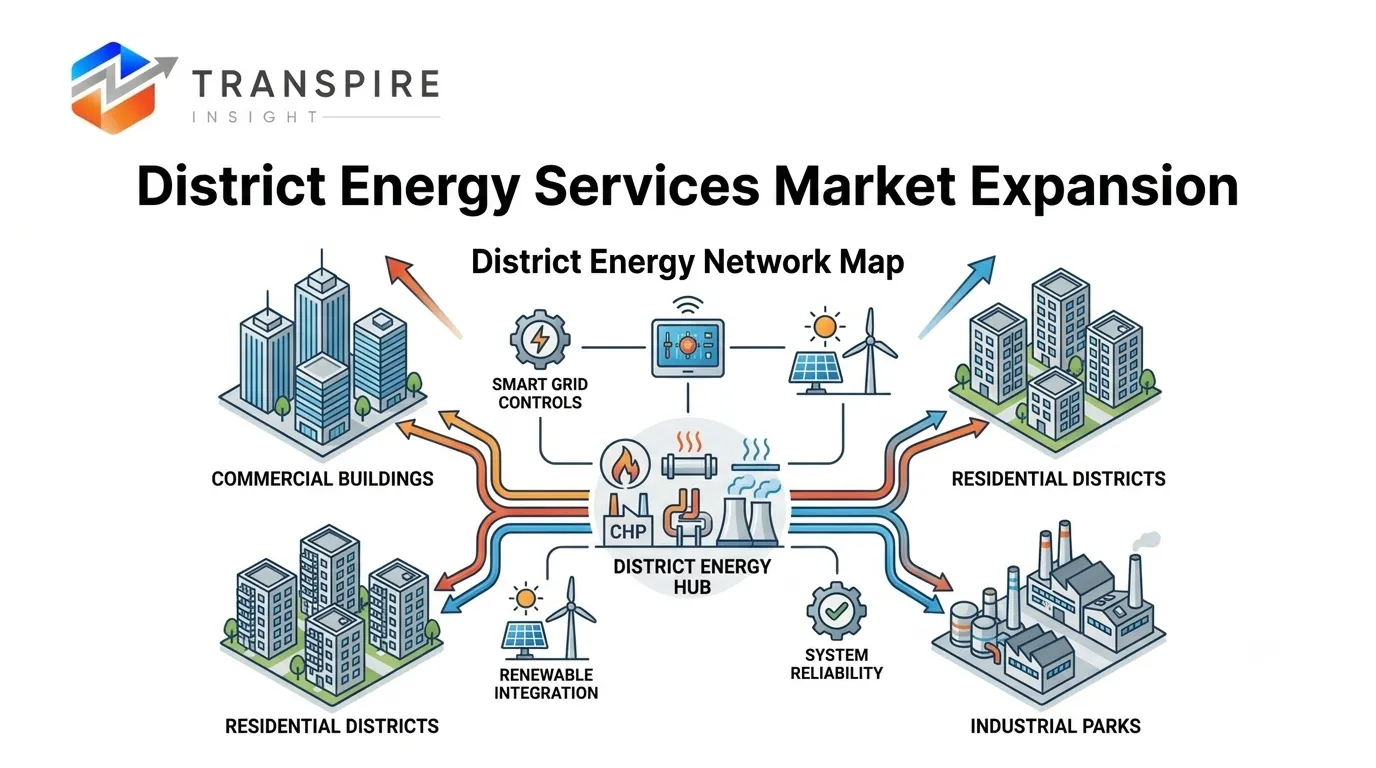
District energy services are an important part of modern urban building infrastructure as they transport thermal energy, heating, hot water, or chilled water from a central (distributed) production location straight to commercial, industrial, and residential buildings. These networks can significantly decrease primary energy use, minimize GHGs, and integrate renewables such as geothermal and industrial waste heat. The world is expanding, and key urban centers focus on grid resilience and sustainable urbanization.
Recent Development News
January 2026: Market Insights released its updated industry report detailing that the district cooling market expanded to USD 140.2 billion in 2026. The sector is experiencing rapid acceleration driven by rising adoption of Build-Operate-Transfer (BOT) models and modular cooling plants tailored for expanding urban hubs.
September 2026: The International Energy Agency (IEA) issued its flagship report, Renewables in District Energy, highlighting that district heating networks currently supply over 10% of final energy consumption for heat across more than one million kilometers of pipeline. The report emphasized new municipal mandates accelerating low-temperature renewable integrations across European and Asian grids.
Stay Ahead of Emerging Opportunities with Expert Market Insights by Transpire Insight
Transpire Insight provides comprehensive, data-driven market intelligence to support smarter business decisions. Our research is rooted in comprehensive analysis, authoritative predictions, and industry expertise, enabling organizations to make informed decisions in rapidly evolving markets. We provide in-depth analysis of market segmentation, competitive positioning, regional trends, and emerging investment opportunities in high-growth areas. We blend accuracy with actionable intelligence, helping companies uncover new growth avenues, strengthen strategic decision-making, and stay ahead in a dynamic market.
District Energy Services Market Size & Statistics
The Market Size for District Energy Services Was Estimated to be Worth USD 168.6 Million in 2026.
The Market Size is Going to Expand at a CAGR of 8.02% between 2026 and 2035.
The District Energy Services Market Size is anticipated to reach USD 287.6 Billion by 2035.
Europe is projected to drive the highest demand during the forecast period, accounting for 40% of the district energy services market.
Asia-Pacific is projected to grow the fastest during the forecast period at a CAGR of 8.1% in the district energy services market.
Regional Growth and Demand Analysis by Transpire Insight
Europe accounts for about 40% of market revenues, with Veolia and Vattenfall investing in renewables-based district energy infrastructure. Demand here is retrofit-led, where cities replace their old heating networks with the aim of decarbonization. In Berlin, a highly efficient distributed energy infrastructure is planned and operated, for example, by ENGIE and GASAG, which provide mobility and energy supply services. Fortum and Microsoft have also demonstrated the region's appetite for circular energy by providing district heating services to their new data centre region to warm households, services, and businesses, using waste heat from the data centre. By contrast, campus and urban service models exist in North America, in which universities, hospitals, or downtown clusters contract the operation, maintenance, and billing of thermal plants to specialized service providers.
In contrast to the retrofitting-driven model in Europe, the Asia-Pacific region has the fastest growth due to the construction of new cities, the growing power demand in the region, and the emergence of new industrial projects. The district energy field is also leading in the region, with the Chinese Government incorporating it into sustainable urban development and climate targets, and with centralised district heating reducing urban air pollution. Growth drivers include urbanisation in China, India, and the Southeast Asia, where centralised thermal supply is being driven by rapid urbanisation and industrialization. The district cooling market is further boosted by the growth of district cooling networks and smart city projects, which are seeking efficient and shared energy infrastructure in dense new districts.
Top 15 Trends in the District Energy Services Market
Heat Pump Integration
Large heat pumps are replacing gas and coal boilers, drawing on ambient, wastewater and industrial heat sources to deliver efficient, low-carbon supply across thermal networks.
Waste Heat Recovery
Utilities capture surplus heat from data centres, factories and power plants, feeding it into networks, cutting fuel use and giving operators a cheaper, cleaner supply.
Renewable District Energy
Biomass, solar thermal and geothermal sources are displacing fossil fuels in network plants, supported by decarbonization targets and growing utility investment in cleaner heat generation.
District Cooling Growth
Rising temperatures, dense commercial construction and megaprojects are driving centralized chilled-water networks, which cut building-level electricity demand and reduce refrigerant use compared with air-conditioning units.
Thermal Energy Storage
Large hot and cold water tanks store energy during low-demand periods and release it at peak times, smoothing demand loads and absorbing surplus renewable power.
AI-Enabled Energy Management
Machine learning forecasts demand, adjusts supply temperatures, and detects leaks early, helping operators cut network losses, reduce fuel consumption, and improve service reliability for customers.
List of Top 25 Companies Leading the District Energy Services Market
Veolia Environnement SA
Veolia operates thousands of district thermal networks globally, driving urban decarbonization.
Founded: 1853 | HQ: Aubervilliers, France
Why It Ranks: Unrivaled operational scale in municipal water, waste, and thermal energy services.
Regional Dominance: Dominates European municipal markets with growing footprints across North America and Asia.
Product Line: District heating networks, industrial waste heat recovery, and cooling distribution systems.
ENGIE SA
ENGIE manages extensive low-carbon district energy networks and centralized utility cooling infrastructures.
Founded: 2008 | HQ: Courbevoie, France.
Why It Ranks: Pioneer in integrating renewable geothermal and biomass into urban heating networks.
Regional Dominance: Strong hold in Europe, Southeast Asia, and expanded Middle Eastern utilities.
Product Line: Geothermal district heating, sea-water air conditioning, and urban cooling networks.
Vattenfall AB
Vattenfall is actively fossil-decarbonizing major Northern European city-wide district heating grids.
Founded: 1909 | HQ: Solna, Sweden.
Why It Ranks: Major leader in large-scale Nordic thermal storage and heat pump integration.
Regional Dominance: Strong market leadership across Sweden, Germany, the Netherlands, and Northern Europe.
Product Line: Municipal district heating networks, industrial steam, and thermal energy storage.
Fortum Corporation
Fortum operates high-efficiency combined heat and power systems across Northern Europe.
Founded: 1998 | HQ: Espoo, Finland.
Why It Ranks: Deep expertise in sustainable Nordic district heating and waste-to-energy heat recovery.
Regional Dominance: Leading operator across Finland, Sweden, Poland, and the Baltic region.
Product Line: District heat distribution, waste-to-heat solutions, and smart grid thermal optimization.
Emirates Central Cooling Systems Corporation (Empower)
Empower is recognized as the world's largest district cooling services provider.
Founded: 2003 | HQ: Dubai, United Arab Emirates.
Why It Ranks: Controls massive cooling capacity serving iconic residential, commercial, and financial districts.
Regional Dominance: Absolute market dominance across the United Arab Emirates and Gulf region.
Product Line: Centralized district cooling plants, chilled water distribution, and thermal storage.
National Central Cooling Company (Tabreed)
Tabreed powers critical infrastructure across the Middle East with high-efficiency cooling.
Founded: 1998 | HQ: Abu Dhabi, United Arab Emirates.
Why It Ranks: Rapidly expanding through mega-concessions and multi-billion-dollar regional infrastructure acquisitions.
Regional Dominance: Dominates the Middle East, including UAE, Saudi Arabia, Oman, and India.
Product Line: District cooling concessions, deep seawater cooling, and chilled water networks.
Danfoss A/S
Danfoss supplies essential hardware and control components for worldwide district energy systems.
Founded: 1933 | HQ: Nordborg, Denmark.
Why It Ranks: Essential technology supplier enabling digital, low-temperature, highly efficient thermal distribution networks.
Regional Dominance: footprint spanning Europe, North America, China, and Asia-Pacific regions.
Product Line: Heat exchangers, district energy substations, control valves, and software tools.
E.ON SE
E.ON delivers innovative low-carbon energy solutions and local district network management.
Founded: 2000 | HQ: Essen, Germany.
Why It Ranks: Key player transforming traditional urban heating networks into low-temperature smart grids.
Regional Dominance: Dominates Western and Central European distribution infrastructure and community utility networks.
Product Line: ectogrid decentralized heating/cooling, local heat networks, and energy management services.
Statkraft AS
Statkraft supplies renewable district heating generated predominantly from local bio-energy sources.
Founded: 1895 | HQ: Oslo, Norway.
Why It Ranks: Leading European producer of renewable energy with clean thermal grid operations.
Regional Dominance: Strong operational presence throughout Norway, Sweden, and the wider Scandinavian region.
Product Line: Bio-based district heating, urban hot water networks, and industrial heat.
LOGSTOR A/S (Kingspan Group)
LOGSTOR is the leading manufacturer of pre-insulated pipe systems for district networks.
Founded: 1960 | HQ: Logstor, Denmark.
Why It Ranks: Core supplier of energy-efficient thermal transport infrastructure vital for loss reduction.
Regional Dominance: Worldwide presence with major manufacturing hubs across Europe and North America.
Product Line: Pre-insulated district heating pipes, cooling pipes, joints, and leak detection.
Conclusion
The district energy services market is rapidly changing to meet urban sustainability requirements, fuel-source diversification, and digital network optimization. District systems provide an unmatched pathway to municipal decarbonization by replacing conventional fossil fuels with waste heat recovery, large-scale heat pumps and deep water cooling. Central thermal networks will continue to be an important component of the smart, low-carbon urban infrastructure in the future, supported by innovative utility operators and equipment manufacturers.


Send us a brief description of your challenge and we'll get back to you within 24 hours.

 inquiry@transpireinsight.com
 APAC:+91 7666513636
 Address


