

Global District Energy Services Market Size & Forecast:
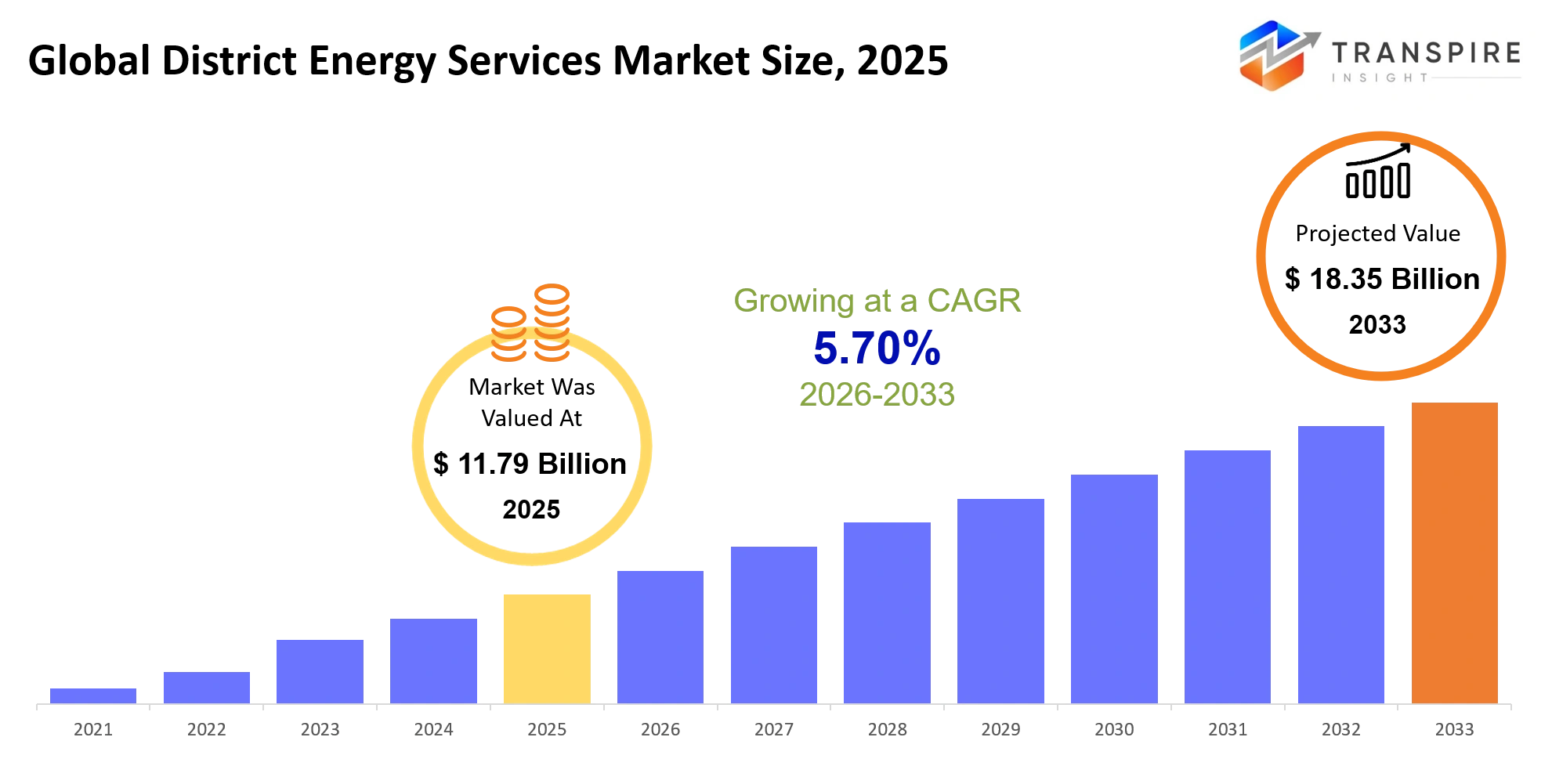
- Global District Energy Services Market Size 2025: USD 11.79 Billion
- Global District Energy Services Market Size 2033: USD 18.35 Billion
- Global District Energy Services Market CAGR: 5.70%
- Global District Energy Services Market Segments: By Type (District Heating, District Cooling, Combined Heat & Power, Renewable District Energy, Smart Energy Networks, Others); By Application (Residential Complexes, Commercial Buildings, Industrial Facilities, Government Infrastructure, Others); By End-User (Utilities, Municipalities, Industrial Operators, Real Estate Developers, Others); By Energy Source (Natural Gas, Biomass, Solar Thermal, Waste Heat Recovery, Others).
Global District Energy Services Market Summary:
As per Transpire Insight Analysis, the Global District Energy Services Market size is estimated at USD 11.79 Billion in 2025 and is anticipated to reach USD 18.35 Billion by 2033, growing at a CAGR of 5.70% from 2026 to 2033.
The global district energy services market is the provision of centralized heating, cooling and energy management solutions to residential, commercial, industrial and public facilities. Over the last five years, there have been fundamental market developments from traditional utility-operated systems to smart and integrated low-carbon solutions, facilitated by digital and renewable technology. The structural change has been evident in the shift from fossil fuel networks to systems which take advantage of waste heat recovery, biomass, thermal storage and digital energy management systems. A real-world market trigger for growth was the security issues arising from fluctuations in global fuel prices, increasing the incentive to build cost-efficient localized energy. The market's growth trend continues in the push for reduced emissions, enhanced energy efficiency in cities and greater security of energy supply driven by governments, municipalities, and developers building larger, integrated district energy solutions.
Key Global District Energy Services Market Insights:
Today's district energy services market is much more about decarbonization, digitalization, and modernization of urban infrastructure than about traditional utility expansion. Market leaders are taking steps to solidify competitive positions by building municipal partnerships and smart network management, while integrating renewables.
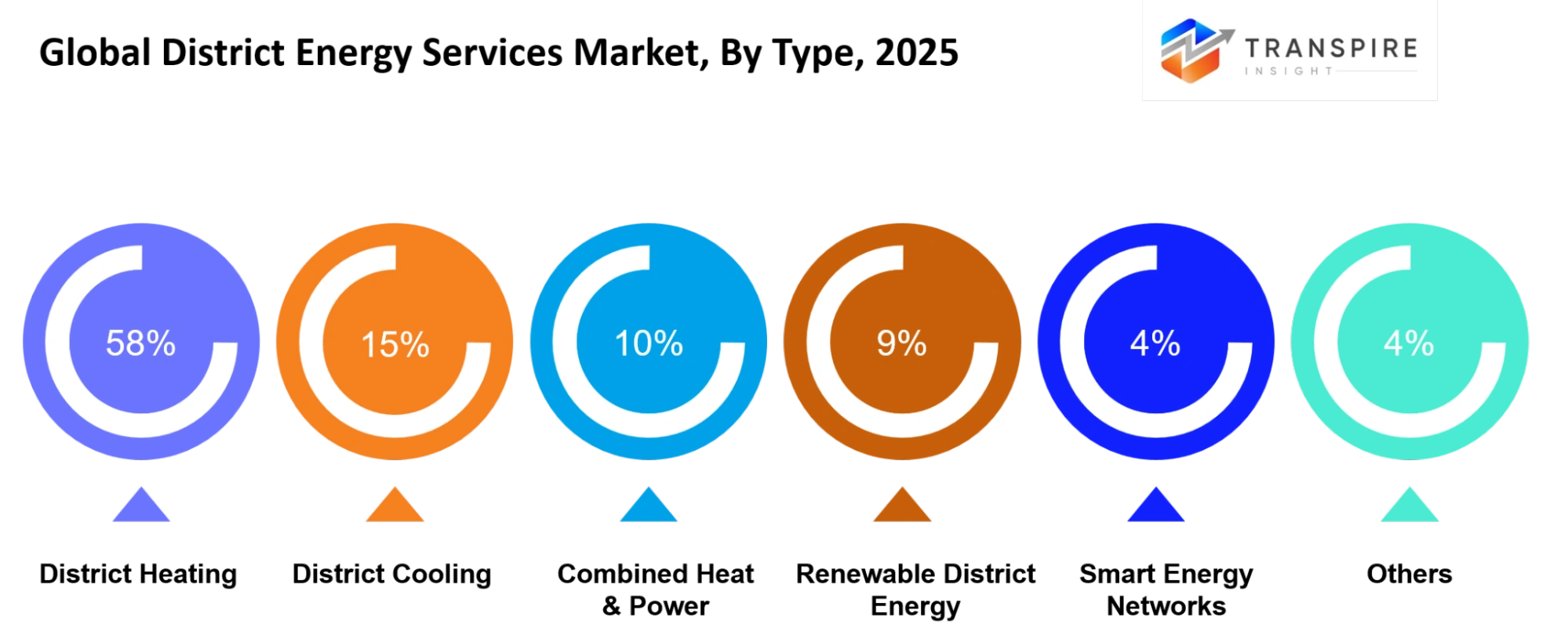
- District Heating owns 58%, and companies like ENGIE and Fortum are modernizing networks with low-carbon heat sources and digital controls.
- Europe makes up 40% of market revenues, with Veolia and Vattenfall investing in renewables-based infrastructure for district energy.
- District Cooling accounts for 15% of the market, and Tabreed and Emicool are increasing the footprint of high-efficiency cooling in large urban developments.
- Renewable District Energy is growing at 14.2% CAGR due to initiatives for waste heat recovery and biomass integration by the key utilities.
- Siemens Energy and Danfoss are developing AI-based monitoring platforms as part of the transition towards predictive and automatic network optimization.
- Smart Energy Networks are gaining ground (4%) as real-time analytics and intelligent energy balancing technologies are being adopted.
- District energy solutions are advancing in the context of smart cities and mixed-use infrastructure projects with Keppel DHCS and Enwave Energy.
- Through innovative pipeline technology and engineering solutions to enhance efficiency and sustainability, LOGSTOR and Ramboll are helping to develop next-generation networks.
What are the Key Drivers, Restraints, and Opportunities in the Global District Energy Services Market?
Driver:
The rapid push to develop low-carbon urban infrastructure has resulted in substantial growth within the district energy services market. Several government policies – mandating stricter greenhouse gas emissions standards, net zero energy initiatives and improved efficiency requirements – have paved the way for investment across centralized and distributed heating and cooling networks. Growing concerns around energy security and fluctuating fossil fuel prices have helped accelerate these initiatives, as municipalities look to decarbonize concentrated centres of population and generate revenue streams throughout the lifespan of their facilities. In March 2026, the European Commission funded the LIFE ENABLE DHC project to transform traditional systems into highly efficient networks. This funding rollout accelerates the modernization of obsolete urban grid infrastructure across Europe to guarantee compliance with tightening regional net-zero standards.
Restraint:
A principal bottleneck is the enormous amount of capital that development and upgrade require to build a network. Underground distribution requires long project lead times to develop, construction and, to put it mildly, difficult orchestration between many disparate interests. It remains so in retrofit for two key reasons: both technically difficult and extremely costly, and these delays also limit deployment.
Opportunity:
The biggest opportunity lies in the use of both renewable and recovered energy in future districts. The recovery of waste heat, thermal storage, and the use of an AI to optimize the supply of energy within district networks is already a strong candidate for the new business models, and the market is growing extremely fast, especially in the Middle East, and the Asia-Pacific, as cities with Smart City visions and the urban expansion within there drive demand in renewable and sustainable district energy supply.
In February 2026, Empower commenced the engineering design contract for its fifth district cooling plant in Business Bay, Dubai. This massive 44,000 refrigeration tons expansion leverages deep infrastructure design scalability to meet the rapid commercial demand generated by the region's expanding smart urban sectors, International District Energy Association (IDEA).
What Has the Impact of Artificial Intelligence Been on the Global District Energy Services Market?
AI is being integrated into the district energy services market to act as a fundamental enabler of performance – this ensures efficient operation. Through intelligent software systems connected to all available sensors, smart meters, and real-time data feeds (including the weather forecast and power network demand), operations are being automated and heating & cooling are intelligently distributed. These systems deliver heat & cooling precisely when and where it is needed whilst identifying and rectifying heat & cooling loss across the extensive distributed network.
One of AI’s most powerful strengths is its forecasting capabilities. Machine learning models can predict thermal demand, detect performance problems in equipment, or anticipate equipment maintenance needs ahead of the curve, minimizing unplanned downtime, increasing asset productivity, and extending the life of equipment. AI also powers digital twin technology, which can allow operators to model network performance and assess strategy options virtually before deployment. Beyond these opportunities, the operational advantages of AI also increase load balancing, energy storage optimization, renewables integration, and carbon management performance as cities and utilities deploy intelligent energy management systems, optimizing reliability and reducing operational costs. Nevertheless, some challenges need to be addressed, most notably, the integration of AI with the old in systems where poor-quality data systems and the high initial costs can make it impossible to predict accurately or implement it at scale.
In January 2026, Karman Industries launched its modular 10MW Heat Processing Unit (HPU) thermal platform to address energy infrastructure strains caused by AI hyperscalers. This high-density system eliminates water consumption while optimizing energy efficiency, enabling immediate reuse of data centre waste heat directly for city-scale district heating networks, Karman Industries.
Key Global District Energy Services Market Trends:
This District Energy Services market is transforming traditional utility systems into intelligent, low-carbon energy systems. Flexibility, digitalization, and resource efficiency are becoming more important for the market participants in order to meet the sustainability and energy security goals of the cities.
- The global pressure to decarbonize and move away from fossil fuels continues to drive District energy networks into the renewable and recovered energy domain.
- Waste heat from industrial processes and information technology data centres is being incorporated by utilities and harnessed as a useful heat source.
- Network operators are transitioning from traditional fixed infrastructure systems to a more flexible energy system with thermal storage.
- From digital monitoring to AI-driven optimization, predictive maintenance, real-time load balancing, and enhanced operational efficiency have become the reality.
- More and more municipalities are opting for district energy planning as a solution for long-term carbon reduction targets rather than individual building systems.
- Public-private partnerships have emerged as a preferred delivery method of projects as a means to limit investment risk and speed up the deployment of infrastructure.
- The development of smart cities is pushing for connected energy platforms that enable heating and cooling and energy management.
- Customer expectations are evolving and are pushing providers to use advanced analytics and sustainability measurement tools.
Global District Energy Services Market Segmentation
By Type:
District Heating was the market driver at 58%, particularly in densely populated areas where energy efficiency, carbon emissions reduction, and security of supply were paramount. District Cooling held the second largest market share with 15%, with increasing demand in temperate climate regions and commercial construction. CHP was valued at 10%, due to higher operational efficiencies and greater utilization of fuels. Renewable District Energy recorded 9% market share and was expected to be the fastest-growing segment by CAGR of 14.2%, fueled by increasing concerns regarding climate change, increasing investments into smart energy, biomass, solar thermal, and waste heat recovery. Smart Energy Networks & Others held the remaining respective shares of 4%, with growth correlated to digital energy management solutions.
By Application:
Residential Complexes continue to be the most attractive to adopters because of the large-scale adoption driven by new residential complexes within urban centres. Government and commercial buildings' adoption is spurred by sustainability requirements and the pursuit of lower operating cost goals. District energy systems in industrial buildings are becoming more important for business resiliency objectives.
By End-User:
The position is occupied by Utilities and Municipalities due to the management of energy infrastructure related to the public sector. Industrial Operators and Real Estate Developers continue the growth to enable their sustainability-related investments.
By Energy source:
Natural Gas is the preferred fuel option for many end-users, while Biomass, Solar Thermal energy and Waste heat recovery technologies gain increased attention as an indication for the long-term transition to low-carbon systems.
What are the Key Use Cases Driving the Global District Energy Services Market?
Centralized heating and cooling for residential, commercial, healthcare and institutional building operators to enhance building efficiency, reduce lifecycle costs and achieve stricter environmental goals represent the major driver for district energy services.
Sectors and applications of district heating and cooling continue to expand beyond the initial application of combined heat and power in large industrial areas. Today, it also applies to industrial parks, airports, university campuses, mixed-use developments and large business districts due to increasing urban concentration and demand for sustainable energy infrastructures.
New applications include Smart city energy networks, datacenters, renewable-based urban energy networks, and are further driving demand with value streams enabled by waste heat capture, storage, and smart control by AI.
|
Report Metrics |
Details |
|
Market size value in 2025 |
USD 11.79 Billion |
|
Market size value in 2026 |
USD 12.45 Billion |
|
Revenue forecast in 2033 |
USD 18.35 Billion |
|
Growth rate |
CAGR of 5.70% from 2026 to 2033 |
|
Base year |
2025 |
|
Historical data |
2021 - 2024 |
|
Forecast period |
2026 - 2033 |
|
Report coverage |
Revenue forecast, competitive landscape, growth factors, and trends |
|
Regional scope |
United States; Canada; Mexico; United Kingdom; Germany; France; Italy; Spain; Denmark; Sweden; Norway; China; Japan; India; Australia; South Korea; Thailand; Brazil; Argentina; South Africa; Saudi Arabia; United Arab Emirates |
|
Key company profiled |
ENGIE, Veolia, Fortum, Danfoss, Siemens Energy, ADC Energy Systems, Tabreed, Ramboll, NRG Energy, Shinryo Corporation, Keppel DHCS, Enwave Energy, Emicool, Vattenfall, LOGSTOR. |
|
Customization scope |
Free report customization (country, regional & segment scope). Avail customized purchase options to meet your exact research needs. |
|
Report Segmentation |
By Type (District Heating, District Cooling, Combined Heat & Power, Renewable District Energy, Smart Energy Networks, Others); By Application (Residential Complexes, Commercial Buildings, Industrial Facilities, Government Infrastructure, Others); By End-User (Utilities, Municipalities, Industrial Operators, Real Estate Developers, Others); By Energy Source (Natural Gas, Biomass, Solar Thermal, Waste Heat Recovery, Others). |
Which Regions are Driving the Global District Energy Services Market Growth?
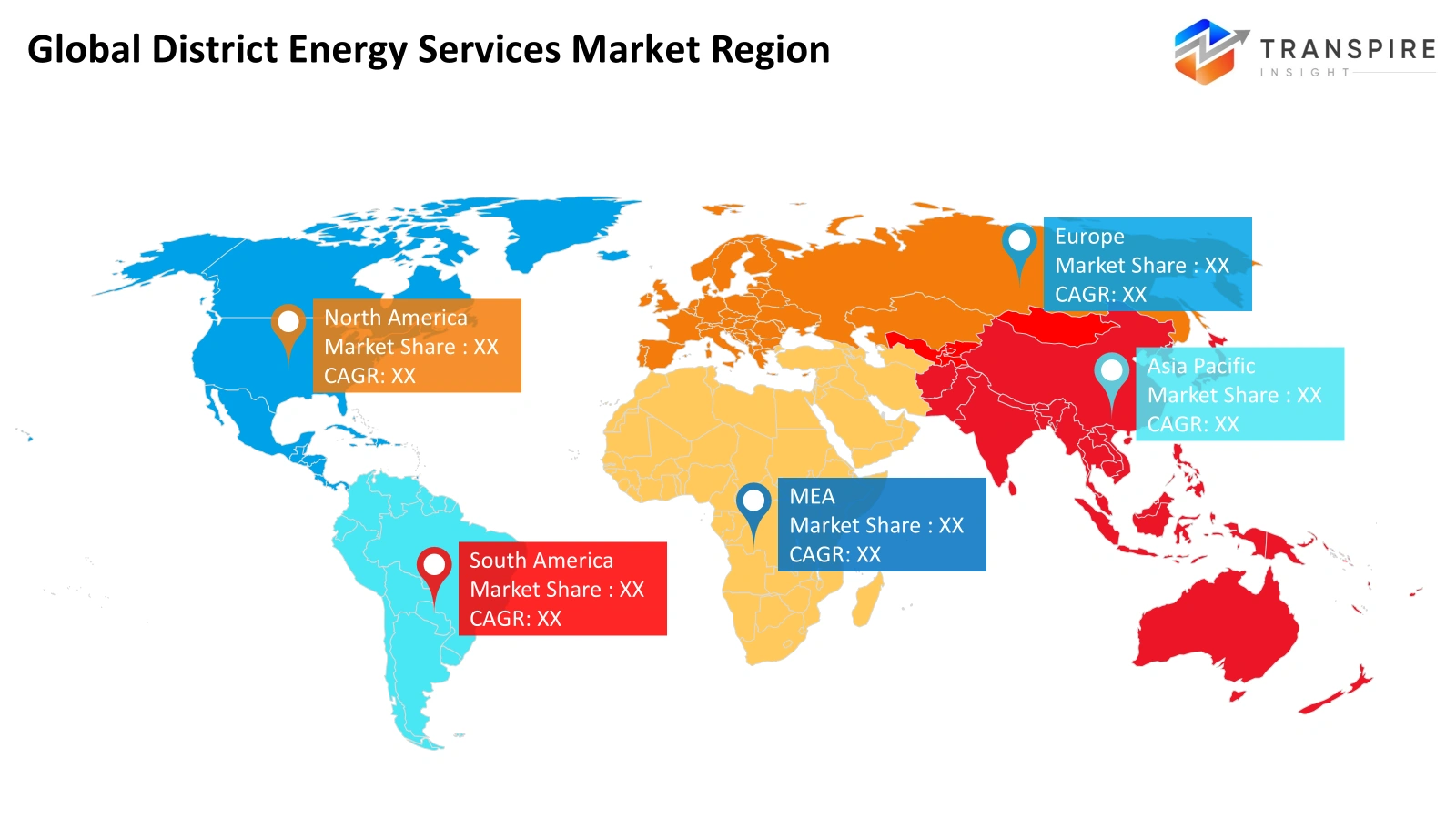
Europe commanded the biggest slice of the worldwide district energy services market with an approximate 40% share of the overall revenue, and this dominance is fueled by policies that facilitate rapid decarbonization, the ubiquity of existing district heating and high levels of waste and renewable heat integration. Large areas of Northern and Western Europe already operate complex energy grids capable of heating large urban communities. Existing policies that favour the long-term use of public finance also facilitate this market’s sustained growth in low-carbon solutions.
The Asia Pacific region accounts for 22% of the world market and is expected to make a substantial contribution to the growth, owing to the increase in the pace of urbanization and the expansion of infrastructure on a massive scale. The market in the Asia Pacific is characterized by new city construction, increased demand for power and new industrial projects, unlike Europe, which has a retrofitting-oriented model. Large-scale development in sustainable urban design and infrastructure driven by city-wide smart city policy, the market is poised for steady growth and in demand for new projects, particularly energy-efficient building development.
In March 2026, the Andhra Pradesh Capital Region Development Authority (APCRDA) issued an official development tender to construct a large-scale District Cooling System for the Amaravati Government Complex under a Public-Private Partnership (PPP) model. This infrastructure initiative introduces centralized cooling plants directly into the backbone of a major new administrative smart city development.
The Middle East & Africa market is the fastest-growing market with 12% share and has a CAGR of 13.3%. District cooling systems, megaprojects and the drive towards sustainability will fuel the growth in this region. Due to its climatic extremes, centralized cooling would be advantageous as this system increases efficiency and sustainability. The ongoing trend of smart cities, expansion of tourism, and rapid increase in commercial real estate in the region in the coming years shall be favourable. In June 2026, Empower (Emirates Central Cooling Systems Corporation) advanced its regional alignment by entering a multilateral memorandum of understanding with GCC District Cooling Operators during the IDEA 2026 conference. This partnership establishes a shared international framework to accelerate clean energy transitions and synchronize operational best practices for high-capacity cooling plants.
Who are the Key Players in the Global District Energy Services Market and how do they Compete?
District energy services globally are moderately consolidated, and the competition focus is more about the ability to decarbonise, network efficiency, and building long-term infrastructure relationships, than on the price of the service alone. Players are distinguishing themselves by offering integration of renewable heat, district cooling competencies, digital energy management solutions and urban-scale energy infrastructure projects, and the growth is being achieved through partnerships with city authorities, large industrial clients, and smart city developers. Competitive Landscape global players ENGINET, Veolia, Fortum, Vattenfall, and NRG Energy are competing on strategies leveraging energy transition, renewables integration and smart heat networks. Siemens Energy and Danfoss are competing on technology and automation solutions. LOGSTOR on thermal infrastructure, focused on renovating and expanding district heating and cooling systems to support net-zero objectives. Others include Tabreed, Emicool, Keppel DHCS, ADC Energy Systems, Enwave Energy and Shinryo Corporation on district cooling and urban infrastructure, Ramboll on engineering and advisory on the district heating and cooling sector.
Key players are:
- ENGIE
- Veolia
- Fortum
- Danfoss
- Siemens Energy
- ADC Energy Systems
- Tabreed
- Ramboll
- NRG Energy
- Shinryo Corporation
- Keppel DHCS
- Enwave Energy
- Emicool
- Vattenfall
- LOGSTOR
Recent Development News
In January 2026, Voltus, Inc. announced a strategic partnership with CenTrio Energy. This partnership integrates Voltus’s AI-powered distributed energy platform with CenTrio’s centralised thermal energy infrastructure to monetise ice battery systems and deliver responsive grid flexibility resources.
Source: https://www.globenewswire.com
In June 2026, Gren Tartu partnered with Valmet to deploy an engineered environmental solution utilising flue gas heat recovery and large-scale industrial heat pumps. This deployment expands local district heating capacity in Estonia by capturing low-temperature industrial waste heat to strengthen the overarching security of the municipal thermal supply.
Source: http://prnewswire.com
What Strategic Insights Define the Future of the Global District Energy Services Market?
District Energy has moved away from fossil fuel-heating-cooling systems towards urban systems that embrace renewables, waste-heat recovery, thermal storage, and smart, artificial intelligence (AI) fueled energy management systems. The growth of these district energy systems will increasingly be driven by the development of urban settings trying to fulfil bold targets to decarbonise the economy, invest wisely, protect infrastructure and use low-carbon district heat sources. A largely unknown opportunity exists in industrial process and data-centre waste heat, making this unutilized thermal capacity another asset to generate revenues from a scalable and more efficient energy grid. The delays in modernising infrastructure may risk making fossil-fuel-powered infrastructure stranded assets, while exposing service providers to a higher regulatory risk and costs associated with ever-tightening carbon regulations. Service providers should strategically focus on building and operating fully digital, adaptable energy grids with the capacity to incorporate multiple heat sources, given that performance and competitiveness will increasingly rely on the intelligence embedded in energy systems.
Key Segmentations are:
By Type
- District Heating
- District Cooling
- Combined Heat & Power
- Renewable District Energy
- Smart Energy Networks
- Others
By Application
- Residential Complexes
- Commercial Buildings
- Industrial Facilities
- Government Infrastructure
- Others
By End-User
- Utilities
- Municipalities
- Industrial Operators
- Real Estate Developers
- Others
By Energy Source
- Natural Gas
- Biomass
- Solar Thermal
- Waste Heat Recovery
- Others
Regional Outlook
North America
- United States
- Canada
- Mexico
Europe
- Germany
- United Kingdom
- France
- Spain
- Italy
- Rest of Europe
Asia Pacific
- Japan
- China
- Australia & New Zealand
- South Korea
- India
- Rest of Asia Pacific
South America
- Brazil
- Argentina
- Rest of South America
Middle East & Africa
- Saudi Arabia
- United Arab Emirates
- South Africa
- Rest of the Middle East & Africa
Frequently Asked Questions
Find quick answers to common questions.
The global district energy services market size was valued at USD 11.79 Billion in 2025 and is poised to reach USD 18.35 Billion by 2033, expanding at a 5.70% CAGR.
Key segments for the global district energy services market are By Type (District Heating, District Cooling, Combined Heat & Power, Renewable District Energy, Smart Energy Networks, Others); By Application (Residential Complexes, Commercial Buildings, Industrial Facilities, Government Infrastructure, Others); By End-User (Utilities, Municipalities, Industrial Operators, Real Estate Developers, Others); By Energy Source (Natural Gas, Biomass, Solar Thermal, Waste Heat Recovery, Others).
Growth is primarily driven by increasing investments in low-carbon urban infrastructure, stricter emissions regulations, energy security initiatives, smart city development, and the adoption of renewable and waste heat-based district energy networks.
The global district energy services market is led by major manufacturers, including ENGIE, Veolia, Fortum, Danfoss, Siemens Energy, ADC Energy Systems, Tabreed, Ramboll, NRG Energy, Shinryo Corporation, Keppel DHCS, Enwave Energy, Emicool, Vattenfall, LOGSTOR.
Europe holds 40% of the global market, supported by advanced district heating infrastructure, strong decarbonization policies, renewable energy integration, public investment programs, and widespread adoption of energy-efficient urban energy systems.
Opportunities exist in renewable district energy projects, waste heat recovery systems, AI-enabled energy management, thermal energy storage deployment, smart city developments, and expanding district cooling networks across the Middle East and Asia-Pacific.
- ENGIE
- Veolia
- Fortum
- Danfoss
- Siemens Energy
- ADC Energy Systems
- Tabreed
- Ramboll
- NRG Energy
- Shinryo Corporation
- Keppel DHCS
- Enwave Energy
- Emicool
- Vattenfall
- LOGSTOR
About the Authors

Avinash Kumar
I’m Avinash Kumar, a Senior Research Analyst at Transpire Insight, with expertise in the Electronics and Semiconductor and Energy & Power industry. My work focuses on analyzing emerging technologies, market trends, industry developments, and innovation across these sectors. I specialize in transforming complex technical and market insights into clear, research-backed content that helps professionals, businesses, and decision-makers stay informed. Through continuous industry research and data-driven analysis, I strive to deliver accurate, reliable, and practical perspectives on the latest advancements shaping the semiconductor and energy landscape.

Chakradhar Khansole
Chakradhar serves as the Research Director at Transpire Insight, bringing over 8 years of experience in technology, innovation, and strategic market intelligence. He specializes in transforming complex market data into actionable business insights that enable organizations to make informed, growth-oriented decisions. Recognized for his strategic vision and analytical expertise, Chakradhar leads high-impact research initiatives, delivering comprehensive market assessments, competitive intelligence, and forward-looking industry analysis.
Recently Published Reports
-
Apr 2026
Active Power Filter Market
Active Power Filter Market Size, Share & Analysis Report By Type (Shunt Active Power Filters, Series Active Power Filter, Hybrid Active Power Filter), By Application (Harmonics Mitigation, Reactive Power Compensation, Voltage Regulation, Power Factor Correction), By Phase (Single Phase, Three Phase), By End-User Industry (Manufacturing, Healthcare, Commercial, Automotive, Oil and Gas, Others), and Geography (North America, Europe, Asia-Pacific, Middle East and Africa, South and Central America), 2021 - 2031
-
Apr 2026
Electrical Transformer Market
Electrical Transformer Market Size, Share & Analysis Report By Core (Closed, Shell, and Berry), By Insulation (Gas, Oil, Solid, Air, and Other), By Phase (Single, and Three), By Rating (100 MVA to 500 MVA, 501 MVA to 800 MVA, and 801 MVA to 1200 MVA), and Geography (North America, Europe, Asia-Pacific, Middle East and Africa, South and Central America), 2021 – 2031
-
Apr 2026
Hydraulic Piston Pumps Market
Hydraulic Piston Pumps Market Size, Share & Analysis Report By Type (Axial Piston Pumps, Radial Piston Pumps), By Operating Pressure (Low Pressure, Medium Pressure, High Pressure), By Application (Construction, Mining, Agriculture, Automotive, Oil & Gas, Industrial Machinery, Others), By End-User (OEMs, Aftermarket), and Geography (North America, Europe, Asia-Pacific, Middle East and Africa, South and Central America), 2021 – 2031
-
Apr 2026
Laboratory Gas Generators Market
Laboratory Gas Generators Market Size, Share & Analysis Report By Product (Nitrogen Gas Generator, Hydrogen Gas Generator, Zero Air Gas Generator, Purge Gas Generator, TOC Gas Generators, Others), By Application (Gas Chromatography, Liquid Chromatography-mass Spectrometry (LC-MS), Gas Analyzers, Others), By End-user (Life Science, Chemical & Petrochemical, Food & Beverage, Others), and Geography (North America, Europe, Asia-Pacific, Middle East and Africa, South and Central America), 2021 – 2031