
Global Chemical Waste Heat Recovery Systems Market Size & Forecast:
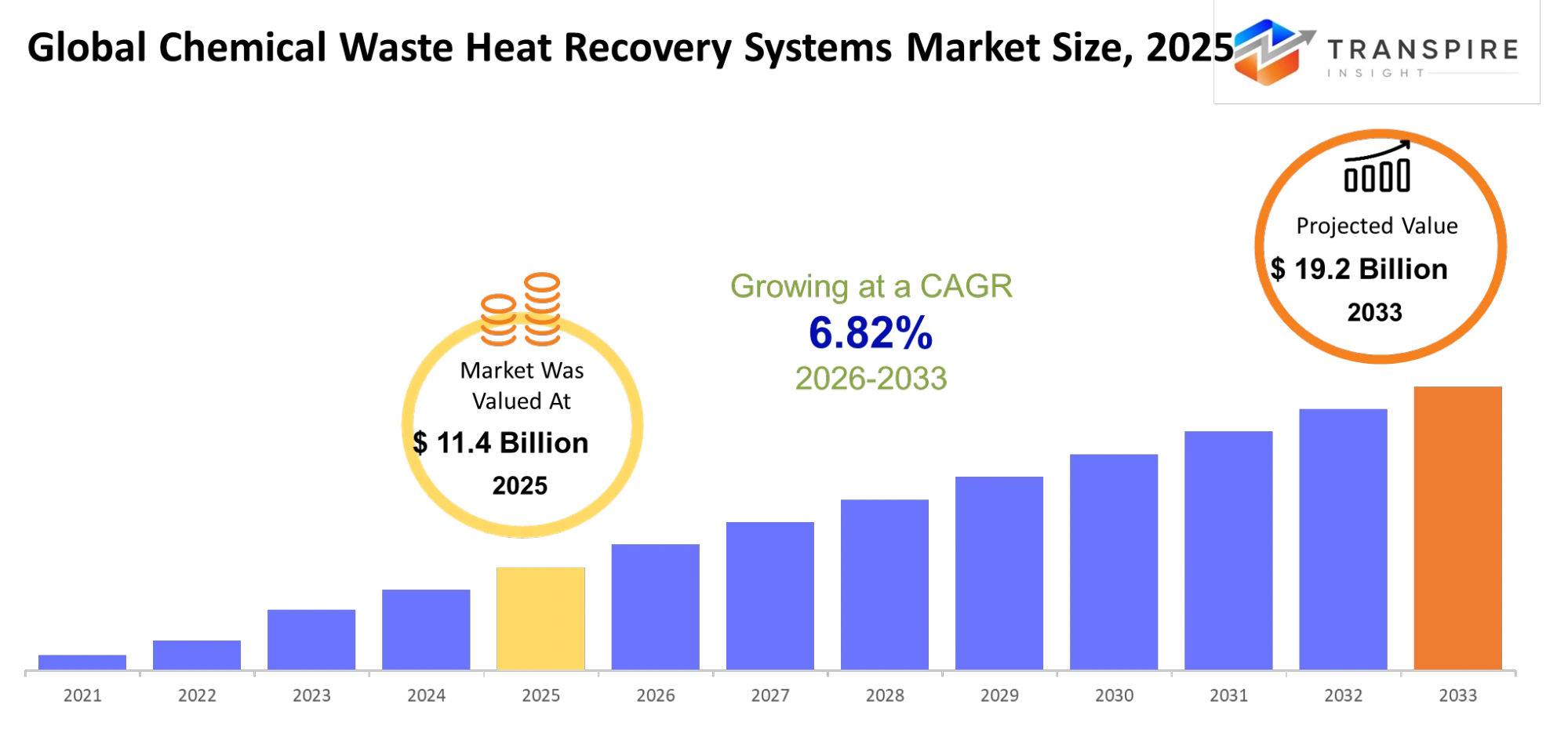
Global Chemical Waste Heat Recovery Systems Market Size 2025: USD 11.4 Billion
Global Chemical Waste Heat Recovery Systems Market Size 2033: USD 19.2 Billion
Global Chemical Waste Heat Recovery Systems Market CAGR: 6.82%
Global Chemical Waste Heat Recovery Systems Market Segments: By Technology (Steam Rankine Cycle, Organic Rankine Cycle, Kalina Cycle), By Application (Petrochemical Plants, Refineries, Chemical Manufacturing), By End-User (Chemical Industry, Oil & Gas Industry)
To learn more about this report,  Download Free Sample Report
Global Chemical Waste Heat Recovery Systems Market Summary:
The global chemical waste heat recovery systems market was valued at USD 11.4 billion in 2025. It will reach USD 19.2 billion by 2033. The CAGR over this period is 6.82%.
Chemical plants and refineries are among the world's most energy-hungry industrial facilities. Many of us know this - quite a lot of their energy is squandered as waste heat. Recovering it is nothing new. What is new is the economic and regulatory drive to finally do so.
Carbon pricing, set industrial emissions targets, and escalating energy prices are altering the calculations around waste heat investment. Projects that were marginal just five years ago now cross internal rate-of-return thresholds. Chemical manufacturers in Europe, North America, and certain areas of Asia are really greenlighting capital plans for heat recovery - plans they'd previously put off.
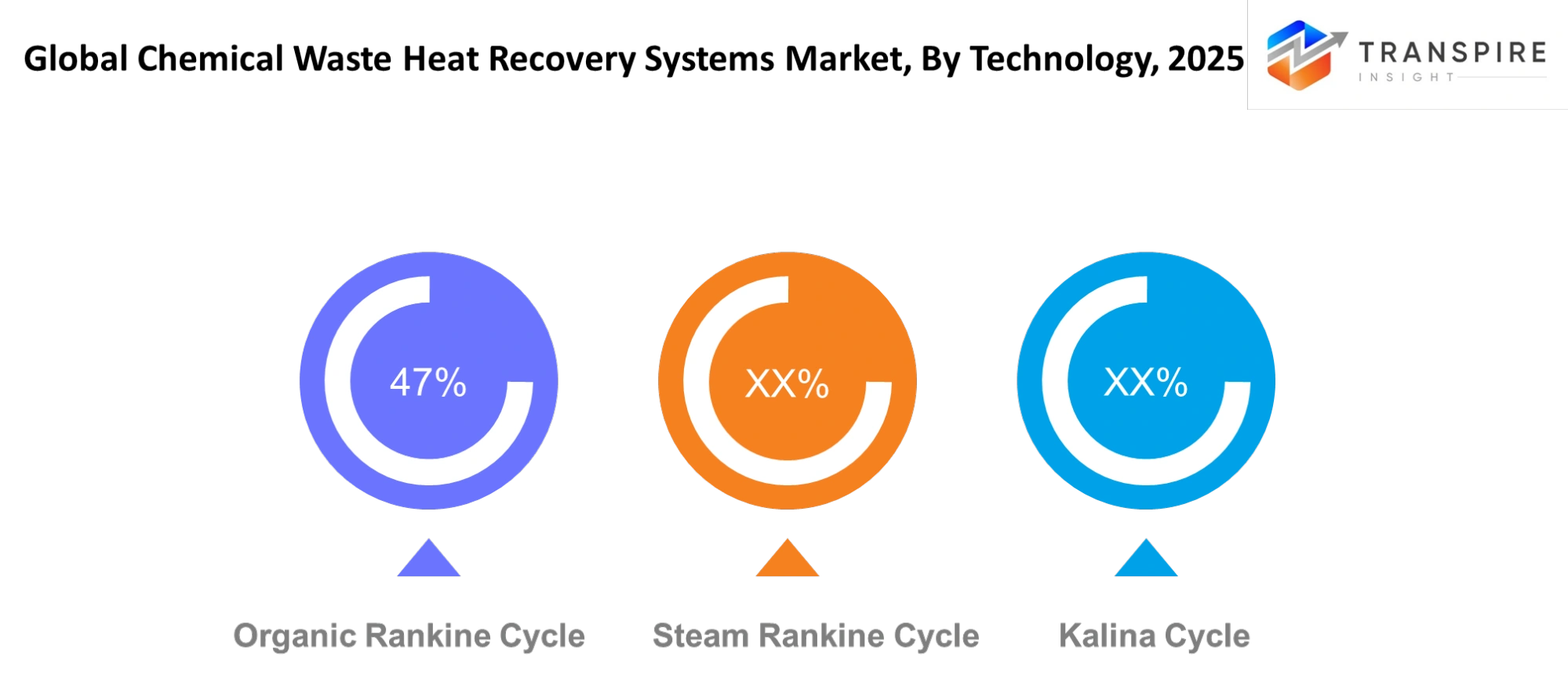
Organic Rankine Cycle technology has a 47% market share of the global chemical waste heat recovery systems market. ORC systems perform quite well with lower-temperature heat sources - a commonality in chemical and petrochemical processes. The adaptability of ORC technology gives it a much wider addressable base compared to steam Rankine options. Several large-scale ORC installations have come online at European refineries in the last three years.
The oil and gas industry is really generating a significant amount of demand. Refineries produce vast quantities of flue gas and process heat. Recovering that energy lessens both fuel costs and emissions all at once. Regulatory compliance with increasingly stricter industrial emission requirements really makes heat recovery a practical priority rather than an optional enhancement.
The global chemical waste heat recovery systems market also benefits from very long equipment service lifespans. Systems set up today will run for 20 to 30 years. That durability really means procurement cycles are long, yet once you establish a supplier relationship, it tends to persist. Aftermarket support, maintenance contracts, and spare parts provision create consistent recurring revenue streams.
What Has the Impact of Artificial Intelligence Been on the Global Chemical Waste Heat Recovery Systems Market?
Artificial intelligence is profoundly altering how operators manage waste heat recovery systems all over the global chemical waste heat recovery systems market. Predictive maintenance algorithms are now constantly monitoring the performance of heat exchangers in real-time. These tools alert us to fouling and losses in thermal efficiency before they lead to unplanned shutdowns. As a result, we see higher system availability - and lower maintenance costs per recovered megawatt-hour.
AI-driven process optimisation is also very much altering plant-level energy management. Machine learning models examine temperature gradients, mass flow rates, and the demands of the downstream process all at once. They adjust the output of our heat recovery systems dynamically rather than sticking to fixed setpoints. This ability is especially valuable in chemical manufacturing, where process conditions really do change quite often during production campaigns.
Our supply chain and project development have also greatly benefited. Engineering firms employing AI-assisted design tools can create models of ORC and steam Rankine configurations a lot faster - and more accurately. This slashes the cost of the front-end engineering work and significantly shortens project timelines. For customers evaluating new installations in the global chemical waste heat recovery systems market, faster feasibility studies really do lower the barrier to committing our capital.
Key Market Trends & Insights:
- Organic Rankine Cycle systems are dominant - with roughly 47% technology share in 2025 - highly favored for their capacity to recover heat from lower-temperature process streams that steam Rankine systems really can't manage very well.
- Asia-Pacific has the largest regional share of the global chemical waste heat recovery systems market, driven by China's enormous industrial base and government-mandated energy efficiency programs focused on heavy industry.
- The US dominated the North American market, making some USD 3. 3 billion in waste heat to power revenue in 2025 and holding 70% of the regional share, supported by extremely energy-hungry industries and federal clean energy policy incentives itself.
- Petrochemical plants account for the largest share of applications, as continuous, high-temperature process streams in ethylene, methanol, and ammonia production generate recoverable heat commercially year-round.
- Refineries are the second-largest application, with heat recovery systems integrated into crude distillation, fluid catalytic cracking, and hydroprocessing units to reduce fuel gas consumption and further decrease per-barrel operating costs.
- The Chemical Industry end-user segment leads demand, driven by rising energy prices that are forcing chemical manufacturers to treat waste heat as a recoverable resource rather than an operating byproduct.
- Ormat Technologies really led the whole waste heat to power market with over 12. 5% share in 2025, while Turboden, Atlas Copco, Exergy International, and Alfa Laval collectively held about 36% of market activity itself.
- Carbon pricing mechanisms in the EU Emissions Trading System and voluntary net-zero commitments are really forcing petrochemical operators to monetize waste heat that was previously vented or dissipated through cooling towers itself.
- Supercritical CO₂ (sCO₂) based Rankine cycles are starting to appear as the next-generation alternative itself. Siemens Energy's pilot with TC Energy showed that sCO₂ systems can interact much more directly with heat sources - eliminating secondary thermal loops really needed in conventional ORC and steam Rankine setups itself.
- Strategic acquisitions and portfolio restructuring among major players are changing competitive dynamics quite a lot. ABB's October 2025 agreement to sell off its robotics division to SoftBank for USD 5. 375 billion really signals the company's plan to focus even more on electrification and process automation, areas really directly relevant to industrial heat recovery integration itself.
- Modular and skid-mounted heat recovery units are getting a lot of traction lately, allowing chemical plants to set up systems with barely any process disruption and much shorter commissioning windows compared to traditional site-built configurations itself.
Global Chemical Waste Heat Recovery Systems Market Segmentation
By Technology:
Steam Rankine Cycle systems are currently the most well-established technology worldwide in the chemical waste heat recovery systems market. These systems use very hot steam produced by recovering heat to run turbines - and produce power. They work especially well wherever there is process heat available at temperatures over 300°C. Big oil refineries and heavy chemical plants - with consistently extremely high-temperature exhaust streams - are really the main customers.
Organic Rankine Cycle technology addresses a much broader temperature range. ORC systems make use of organic working fluids with slightly lower boiling points than water. This lets them recover heat from process streams between 80°C and 300°C - a range that actually covers quite a significant portion of chemical plant exhaust. ORC's 47% market share really shows its wider compatibility with the actual heat profiles of chemical processing facilities itself.
Kalina Cycle systems make use of an ammonia-water mixture as the working fluid. This allows the working fluid temperature to match the heat source profile way more closely than single-component fluids. The result is even higher thermodynamic efficiency in certain temperature ranges. Kalina Cycle adoption in the global chemical waste heat recovery systems market remains a bit smaller than ORC or steam Rankine, though its use in geothermal and some industrial applications has really shown real performance advantages.
To learn more about this report, Download Free Sample Report
By Application:
Petrochemical plants represent the largest application area. Ethylene crackers, ammonia synthesis loops, methanol converters, and other continuous chemical processes generate a very large volume of high-grade heat as a byproduct itself. These facilities operate day and night consistently generating a lot of heat - which really makes waste heat recovery quite economically viable. The size of petrochemical plants in the Middle East, China, and the U. S. Gulf Coast region actually give this sector its number one position.
Refineries make up our second big application area. Crude distillation units, fluid catalytic crackers, and hydrotreaters all release a very significant amount of thermal energy. Refinery operators really have a strong financial incentive to recover this heat since it will directly reduce the fuel gas they have to burn to power their own processes themselves. A 1% increase in energy efficiency at a very large refinery really equates to millions of dollars in annual savings. That's some pretty good math that really justifies significant investment in heat recovery equipment.
Chemical manufacturing covers a wide range of both batch and continuous processes beyond petrochemicals. Specialty chemical producers, fertilizer plants, and industrial gas manufacturers all generate recoverable heat at various temperature ranges. This segment is a bit more fragmented than the petrochemical and refinery segments. Customers often tend to be smaller, with less predictable heat availability, which has actually held back adoption over time. ORC technology's modularity and ability to handle variable heat inputs is gradually opening up market penetration here even further.
By End-User:
The Chemical Industry really holds the top spot as the biggest end-user group in the global chemical waste heat recovery systems market. Chemical manufacturers are under constant pressure because of increasing energy input costs and much stricter emissions regulations. Treating waste heat like a recoverable resource rather than just another operational expense really improves both the energy efficiency and the carbon footprint of chemical facilities. These factors all combine to make heat recovery capital expenses quite justified in almost all internal investment plans.
The Oil & Gas Industry ranks as the second major end-user. Refineries, LNG plants, and upstream processing facilities all produce heat as a byproduct of their core functions. The oil and gas sector has traditionally had very long capital cycles and quite conservative technology adoption habits. However, that's changing since operators are facing carbon pricing, mandatory emissions disclosure, and pressure from investors on their scope 1 emissions. Heat recovery projects that really boost energy efficiency now also offer a great reputation boost - something they didn't have before.
Both end-user groups actually share one particular procurement trait: decisions really take their time, need multiple engineering and financial approvals, and tend to focus on a very small set of known equipment suppliers. This dynamic greatly rewards suppliers with well-established track records at similar facilities. It also sets up barriers for new entrants that don't have actual reference installations at comparable scale in the global chemical waste heat recovery systems market.
What Are the Main Challenges for the Global Chemical Waste Heat Recovery Systems Market Growth?
High upfront capital costs remain the biggest hurdle. Waste heat recovery systems demand huge investments in heat exchangers, turbines, condensers, and control systems. For many chemical plant operators, the payback period stretches well beyond typical internal project approval limits. This is particularly true at older facilities - installing heat recovery into existing process layouts would add both engineering complexity and additional cost.
Process integration challenges also slow our progress. Chemical plants were never really designed with waste heat recovery in mind. Adding heat exchangers and power generation equipment to existing process lines demands very careful thermal and hydraulic analysis. Any modification that affects process temperatures, pressures, or flow rates carries some level of operational risk. Engineering firms and plant operators really have to invest quite a bit of time in initial engineering studies before construction even begins, which extends overall project timelines.
Technology selection complexity also holds back our adoption. Steam Rankine, ORC, and Kalina Cycle systems each have their own unique performance features at different temperature ranges and heat availability profiles. Choosing the wrong technology for your specific application will result in suboptimal energy recovery and poor financial returns. Operators without an in-house team of engineers experienced in heat recovery technology may need third-party consultants - which adds both cost and time to project development.
Regional Insights
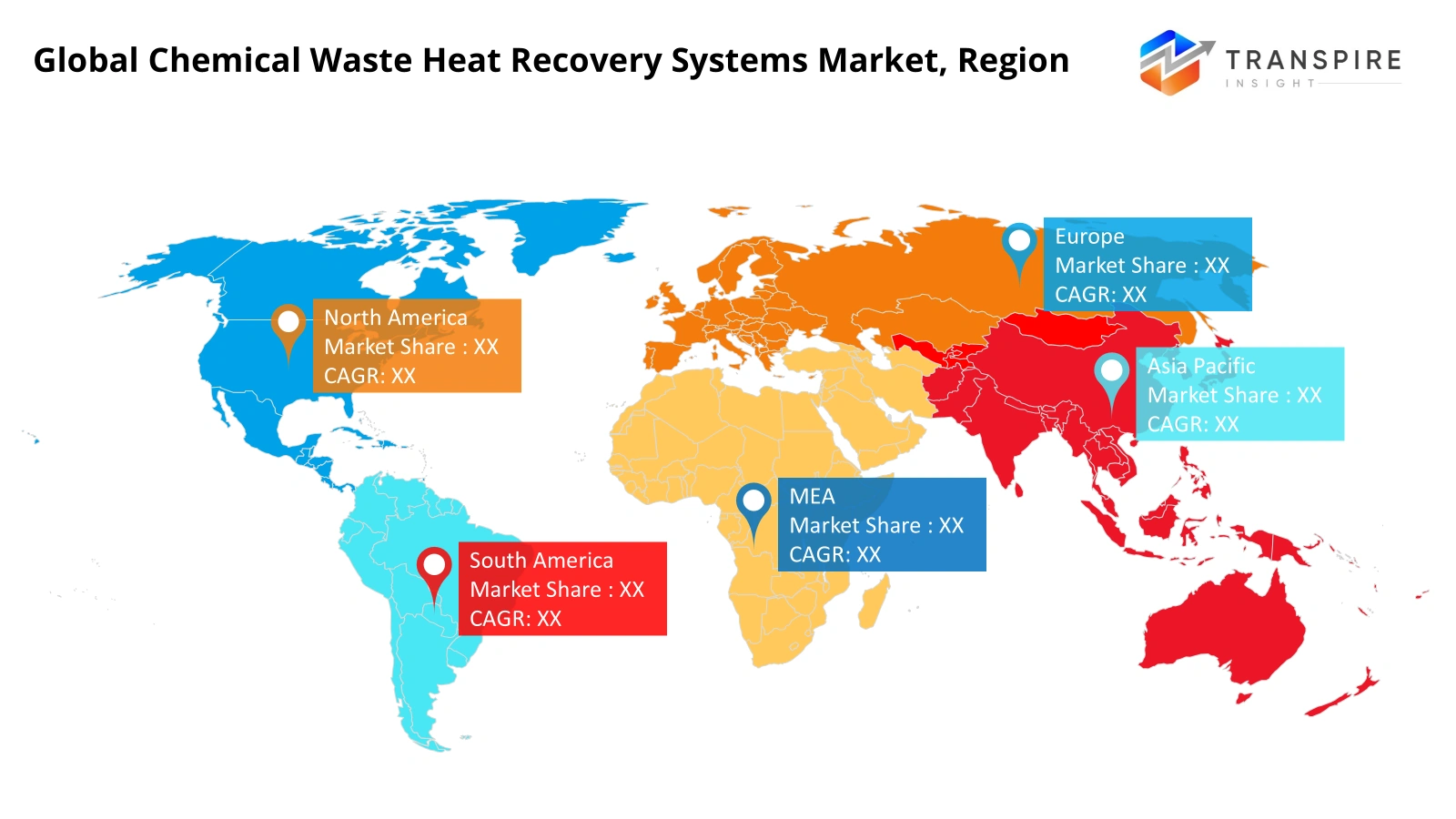
Asia-Pacific really drives the global chemical waste heat recovery systems market. China is the biggest player - it's got a huge industrial base and the government really pushes for energy efficiency through various programs aimed at heavy chemical producers and refinery operators. State-owned enterprises in China's petrochemical sector are actually required by law to meet specific energy consumption targets, so there's quite a lot of demand for waste heat recovery systems, even beyond those who'd voluntarily adopt them. Japan and South Korea also contribute significantly with their very advanced refinery and specialty chemical sectors, where energy efficiency has always been a major focus in plant design.
North America is the second-largest market. The United States generated USD 3. 3 billion in waste heat-to-power revenue in 2025, accounting for 70% of the North American share. The US Gulf Coast petrochemical complex - one of the world's largest - really represents a massive base of potential waste heat recovery applications. Federal Inflation Reduction Act incentives for industrial energy efficiency and clean energy production are really speeding up project approvals that might otherwise have stayed in development for years.
Europe sees significant regulatory support for waste heat recovery. The EU Emissions Trading System puts a clear price on carbon emissions, making the financial case for heat recovery at refineries and chemical plants across Germany, France, the Netherlands, and Belgium much stronger. Germany is actually home to several of the world's biggest chemical producers - including BASF - which has really invested a lot in energy efficiency infrastructure.
The Middle East is a growing but really underutilized opportunity. The region is home to some of the world's largest petrochemical complexes - mainly in Saudi Arabia, the UAE, and Qatar. Historically, quite low domestic energy prices really made waste heat recovery less financially appealing. But that equation is changing as governments in the Gulf Cooperation Council really redirect domestic energy resources toward exports and diversify their economies.
To learn more about this report, Download Free Sample Report
Recent Development News
In October 2025, ABB announced it had agreed to divest its Robotics division to SoftBank Group for USD 5.375 billion, abandoning an earlier plan to spin it off as a separately listed company. The deal, reported by CNBC, is expected to close in mid-to-late 2026. The divestiture signals ABB’s intent to concentrate capital and engineering resources on electrification and process automation — areas that include waste heat recovery integration for industrial customers. ABB CEO Morten Wierod stated the company has increased firepower to pursue further acquisitions aligned with its core industrial technology strategy. https://www.cnbc.com
In June 2025, Ormat Technologies closed its acquisition of the Blue Mountain geothermal power plant in Nevada from Cyrq Energy for USD 88 million, as reported in its SEC filing and confirmed. The 20 MW facility was originally built using Ormat’s own ORC technology and carries a Power Purchase Agreement with NV Energy through 2029. Ormat plans to upgrade capacity by 3.5 MW and add a 13 MW solar facility, with product segment revenues rising 55.2% for the full year 2025, signalling strong momentum across its recovered-energy and ORC technology platform. investor.ormat.com.
Report Metrics
|
Report Metrics |
Details |
|
Market size value in 2025 |
USD 11.4 Billion |
|
Market size value in 2026 |
USD 12.1 Billion |
|
Revenue forecast in 2033 |
USD 19.2 Billion |
|
Growth rate |
CAGR of 6.82% from 2026 to 2033 |
|
Base year |
2025 |
|
Historical data |
2021 – 2024 |
|
Forecast period |
2026 – 2033 |
|
Report coverage |
Revenue forecast, competitive landscape, growth factors, and trends |
|
Regional scope |
United States; Canada; Mexico; United Kingdom; Germany; France; Italy; Spain; Denmark; Sweden; Norway; China; Japan; India; Australia; South Korea; Thailand; Brazil; Argentina; South Africa; Saudi Arabia; United Arab Emirates |
|
Key company profiled |
Siemens Energy AG, General Electric Company, Mitsubishi Heavy Industries Ltd., ABB Ltd., Ormat Technologies Inc., Exergy International Srl, Turboden S.p.A., Thermax Limited, Bosch Industriekessel GmbH, Cochran Ltd., Kawasaki Heavy Industries Ltd., MAN Energy Solutions SE, Alfa Laval AB, Climeon AB, Enogia SAS |
|
Customization scope |
Free report customization (country, regional & segment scope). Avail customized purchase options to meet your exact research needs. |
|
Report Segmentation |
By Technology (Steam Rankine Cycle, Organic Rankine Cycle, Kalina Cycle), By Application (Petrochemical Plants, Refineries, Chemical Manufacturing), By End-User (Chemical Industry, Oil & Gas Industry) |
How Can New Companies Establish a Strong Foothold in the Global Chemical Waste Heat Recovery Systems Market?
Rivaling Siemens Energy or GE head-on on big-scale refinery heat recovery contracts isn't really where a new player should start out. Big-name companies have decades of project references all over the world, a huge service network, and engineering groups that take many years to replicate. A much more intelligent approach would be to aim at middle-sized chemical manufacturers - they really need heat recovery solutions, yet get less attention from the established leaders. These customers are often quite open to working with a newer supplier if the technical proposal is very solid.
Modular ORC systems designed for a quicker installation and simpler integration offer a genuine product differentiation opportunity. Most old heat recovery systems demand quite extensive site design and long installation timelines. Chemical plant operators will really appreciate anything that cuts downtime during the installation process. Smaller, pre-engineered skid-mounted units that can be set up in weeks instead of months truly addresses a real headache in the global chemical waste heat recovery systems market.
Partnerships with engineering procurement, and construction companies speed up market entry much faster. EPC companies have built relationships with the chemical plant owners themselves and manage the capital project selection process altogether. A new heat recovery equipment supplier that qualifies as an approved vendor with just two or three major EPC firms gets access to a whole pipeline of projects they might not be able to get otherwise through direct sales alone. These partnerships do take time to build, but they're really worth the investment.
After-sales service is not optional in this market. Chemical plant operators require guaranteed uptime and a very quick response whenever equipment fails. New entrants who commit to setting up regional service capabilities and spare parts inventory even before they secure their first major contract really show their commitment to procurement teams. That dedication to service is often what separates a supplier that makes it onto the approved vendor list from one that doesn't.
Key Global Chemical Waste Heat Recovery Systems Market Company Insights
The competitive structure of the global chemical waste heat recovery systems market really separates into very large integrated energy technology companies and specialized ORC and heat recovery equipment makers. The top five players in the much broader waste heat to power space - Ormat Technologies, Turboden, Atlas Copco, Exergy International, and Alfa Laval - collectively held about 36% of market activity in 2025. That leaves quite a lot of room for both local and specialist competitors.
Siemens Energy holds pretty strong positions across steam Rankine and advanced cycle technologies. Its deal with TC Energy to construct a supercritical CO₂ waste heat-to-power pilot facility demonstrates active investment in the next-generation heat recovery configurations. This patented sCO₂ approach actually eliminates the secondary thermal loop required in regular systems, lessening plant footprint and improving efficiency even more. Siemens Energy's size and engineering resources make it credible for really large-scale refinery and petrochemical projects.
Turboden, now part of Mitsubishi Heavy Industries, specializes in ORC systems for industrial waste heat applications. Its purchase by Mitsubishi really gave it access to bigger project opportunities and a world-wide service infrastructure. Turboden competes right up against Ormat and Exergy International on medium-scale ORC installations at refineries and chemical plants, where selecting the working fluid and designing heat exchangers is all a matter of performance differentiators.
ABB's sale of its robotics division to SoftBank for USD 5. 375 billion in October 2025 sets free a whole lot of capital for reinvesting in its electrification and process automation core. ABB's CEO pointed out the company has increased its ability to buy other companies following the deal. This strategic realignment might just increase ABB's investment in industrial energy efficiency solutions, including heat recovery integration, which really falls under its process automation business.
Climeon and Enogia represent the smaller-scale, lower-temperature end of the global chemical waste heat recovery systems market. Climeon's HeatPower 300 units are really designed for waste heat streams in the 70°C to 120°C range. Enogia handles micro-scale ORC applications. Both companies focus on customers and heat sources that bigger equipment makers don't typically design products for. Their market positions really depend on ongoing cost reductions and performance improvements in low-temperature ORC working fluids.
Company List
- Siemens Energy AG
- General Electric Company
- Mitsubishi Heavy Industries Ltd.
- ABB Ltd.
- Ormat Technologies Inc.
- Exergy International Srl
- Turboden S.p.A.
- Thermax Limited
- Bosch Industriekessel GmbH
- Cochran Ltd.
- Kawasaki Heavy Industries Ltd.
- MAN Energy Solutions SE
- Alfa Laval AB
- Climeon AB
- Enogia SAS
What Are the Key Use-Cases Driving the Growth of the Global Chemical Waste Heat Recovery Systems Market?
Ethylene and ammonia production generate continuous, high-temperature heat as a direct byproduct of the reaction process. Recovering this heat and converting it to steam or electricity reduces the net energy cost per unit of chemical output. For a world-scale ethylene cracker running 8,000 hours per year, a well-designed heat recovery system can generate tens of megawatts of electricity. That output offsets grid power purchases and reduces the carbon intensity of chemical production.
Fluid catalytic cracking units at refineries are a high-value use-case for waste heat recovery. FCC regenerators operate at temperatures above 700°C and release large volumes of flue gas. Waste heat boilers and steam turbines integrated into FCC units recover this energy at commercial scale. The financial case is compelling: energy recovered from FCC off-gas at a large refinery can reduce external energy purchases by 10 to 15 percent across the facility.
Natural gas processing and LNG liquefaction facilities generate significant heat from compression and refrigeration cycles. Waste heat recovery in these settings supports both onsite power generation and direct process heat reuse. As LNG export capacity expands in North America, Australia, and Qatar, the installed base of natural gas processing equipment that can benefit from heat recovery is growing. The global chemical waste heat recovery systems market is expanding alongside this infrastructure build.
Power-to-heat integration is an emerging use-case. Chemical plants that install waste heat recovery systems often discover that recovered electricity or steam can displace grid power purchases or boiler fuel across the facility. As chemical manufacturers pursue electrification of their heating processes to reduce fossil fuel dependence, waste heat recovery becomes a partial offset that reduces the total volume of grid power they need to purchase. This circular logic strengthens the investment case for heat recovery installations in the global chemical waste heat recovery systems market.
Global Chemical Waste Heat Recovery Systems Market Report Segmentation
By Technology
- Steam Rankine Cycle
- Organic Rankine Cycle
- Kalina Cycle
By Application
- Petrochemical Plants
- Refineries
- Chemical Manufacturing
By End-User
- Chemical Industry
- Oil & Gas Industry
By Regional Outlook
North America
- U.S.
- Canada
- Mexico
Europe
- UK
- Germany
- France
- Italy
- Spain
- Denmark
- Sweden
- Norway
Asia Pacific
- Japan
- China
- India
- Australia
- South Korea
- Thailand
Latin America
- Brazil
- Argentina
Middle East & Africa
- South Africa
- Saudi Arabia
- UAE
- Kuwait
Frequently Asked Questions
Find quick answers to common questions.
The Global Chemical Waste Heat Recovery Systems Market is expected to reach approximately USD 19.2 billion by 2033.
Key segments include Technology (Steam Rankine Cycle, Organic Rankine Cycle, Kalina Cycle), Application (Petrochemical Plants, Refineries, Chemical Manufacturing), and End-User (Chemical Industry, Oil & Gas Industry).
Major players include Siemens Energy AG, General Electric Company, Mitsubishi Heavy Industries Ltd., ABB Ltd., Ormat Technologies Inc., Exergy International Srl, Turboden S.p.A., Thermax Limited, Bosch Industriekessel GmbH, Cochran Ltd., Kawasaki Heavy Industries Ltd., MAN Energy Solutions SE, Alfa Laval AB, Climeon AB, and Enogia SAS.
The Global Chemical Waste Heat Recovery Systems Market size is approximately USD 11.4 billion in 2025.
The Global Chemical Waste Heat Recovery Systems Market is expected to grow at a CAGR of 6.82% from 2026 to 2033.
- Siemens Energy AG
- General Electric Company
- Mitsubishi Heavy Industries Ltd.
- ABB Ltd.
- Ormat Technologies Inc.
- Exergy International Srl
- Turboden S.p.A.
- Thermax Limited
- Bosch Industriekessel GmbH
- Cochran Ltd.
- Kawasaki Heavy Industries Ltd.
- MAN Energy Solutions SE
- Alfa Laval AB
- Climeon AB
- Enogia SAS
Recently Published Reports
-
Dec 2024
Healthcare Polymer Packaging Market
Healthcare Polymer Packaging Market Size, Share & Analysis Report By Packaging Type (Syringes, IV Bottles and Pouches, Clamshells, Blisters, Bottles & Jars, Containers, Tubes, IV Parental Packaging, Others), By Type (Regulated, Non-regulated), By Polymer Type (LDPE (Low-Density Polyethylene), HDPE (High-Density Polyethylene), Homo-polymer (Homo), Random Copolymer (Random), Block Copolymer (Block), PET, Polystyrene, Polyvinyl Chloride, Polyamide/EVOH, Others), and Geography (North America, Europe, Asia-Pacific, Middle East and Africa, South and Central America), 2021 - 2031
-
Jan 2025
Hydrophilic Tape (Waterstop) Market
Hydrophilic Tape (Waterstop) Market Size, Share & Analysis Report By Type (Bentonite-Based Hydrophilic Tape, Rubber-Based Hydrophilic Tape), By Application (Residential Buildings, Commercial Buildings, Infrastructure Projects), and Geography (North America, Europe, Asia-Pacific, Middle East and Africa, South and Central America), 2021 - 2031
-
Jan 2025
Metalens Market
Metalens Market Size, Share & Analysis Report By Type (Visible Light Metalens, and Infrared Metalens), By Application (Consumer Electronics, Automotive Electronics, Industrial, Medical, and Others), and Geography (North America, Europe, Asia-Pacific, Middle East and Africa, South and Central America), 2021 - 2031
-
Jan 2025
PBT Resin Market
PBT Resin Market Size, Share & Analysis Report By Type (Reinforced PBT Resin, Unreinforced PBT Resin), By Processing Method (Injection Molding, Extrusion, Blow Molding, Others), By End-User (Automotive, Electrical & Electronics, Consumer Appliances, Industrial Machinery, Medical Devices, Packaging, Others), and Geography (North America, Europe, Asia-Pacific, Middle East and Africa, South and Central America), 2021 - 2031