
Oct 15, 2026
By Transpire Insight
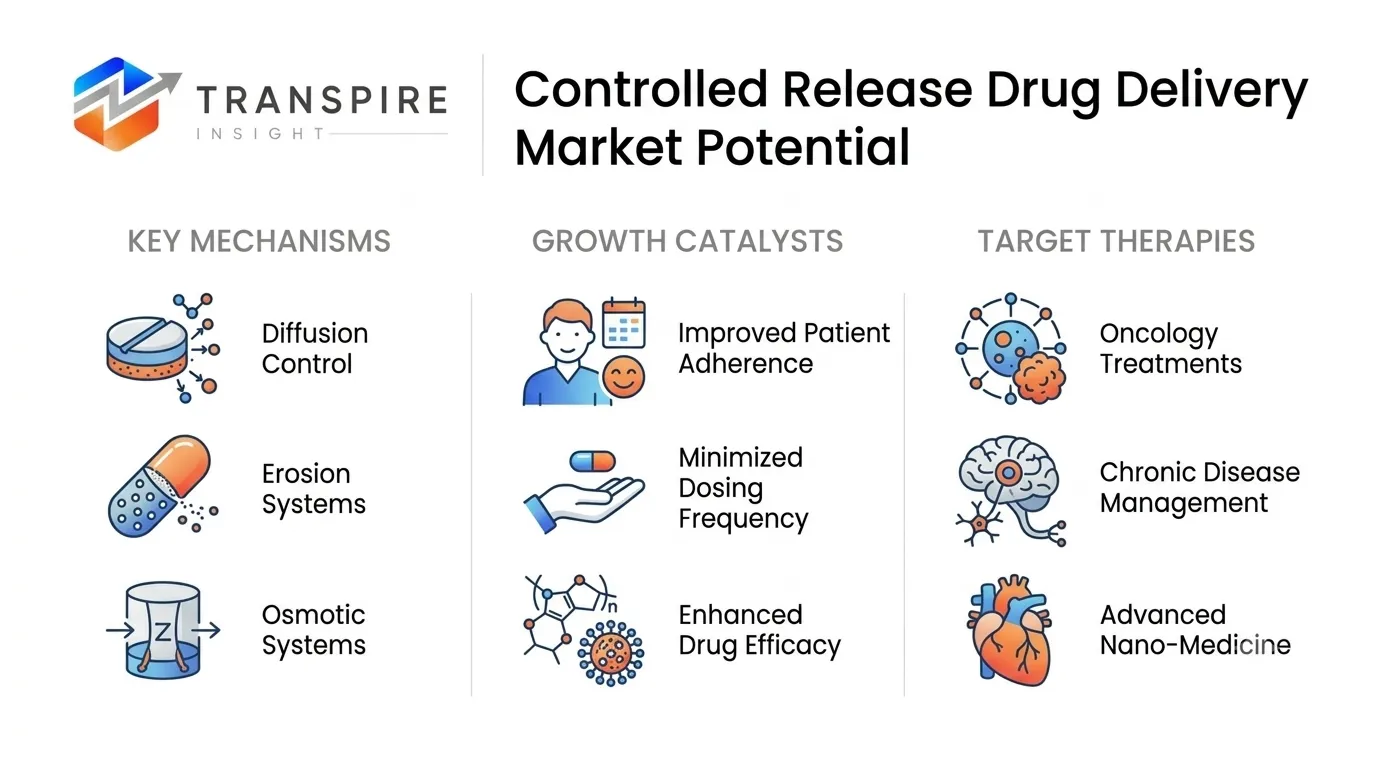
Description
According to a research report published by Transpire Insight, the Controlled Release Drug Delivery Market size is projected to grow from USD 37,104 million in 2026 to USD 61,043.2 million by 2035, at a CAGR of 8.3% during the forecast period 2027-2035. Rising prevalence of chronic diseases, demand for targeted therapeutic drug delivery, technological advances in polymer chemistry, and the clinical shift toward extended-release formulations to enhance patient compliance drive market expansion.
Introduction
Controlled-release drug delivery systems deliver therapeutic molecules to maintain target biological concentrations over extended timeframes. By altering pharmacokinetic and pharmacodynamic profiles, these delivery platforms optimize systemic exposure, reduce dosing frequency, minimize off-target toxicity, and improve patient adherence. These controlled drug architectures, spanning liposomal, polymeric, transdermal, and nanoparticle matrices, are crucial across oncology, neurology, and endocrinology, representing a critical bridge between formulation chemistry and targeted therapeutics.
Recent Development News
March 2026: Regulatory approvals expanded for long-acting once-weekly basal insulin formulations, leveraging novel acylation controlled-release technologies to enhance glycemic stability in type 2 diabetes management.
September 2026: Advanced once-weekly extended-release subcutaneous peptide platforms achieved FDA clearance, delivering sustained therapeutic concentration for metabolic and endocrine clinical indications.
Stay Ahead of Emerging Opportunities with Expert Market Insights by Transpire Insight
Transpire Insight provides comprehensive, data-driven market intelligence to support smarter business decisions. Our research is rooted in comprehensive analysis, authoritative predictions, and industry expertise, enabling organizations to make informed decisions in rapidly evolving markets. We provide in-depth analysis of market segmentation, competitive positioning, regional trends, and emerging investment opportunities in high-growth areas. We blend accuracy with actionable intelligence, helping companies uncover new growth avenues, strengthen strategic decision-making, and stay ahead in a dynamic market.
Oral Controlled Release Drug Delivery Market Size & Statistics
The market size for the oral controlled release drug delivery technology is estimated to be worth USD 37,104 million in 2026.
The market is going to expand at a CAGR of 8.3% between 2026 and 2035.
The oral Controlled Release Drug Delivery Market size is anticipated to reach USD 61,043.2 million by 2035.
North America is estimated to generate the highest demand during the forecast period, with a market share of 41.3% in the hemodialysis membrane market.
Asia-Pacific is projected to grow the fastest during the forecast period at a CAGR of 5.5% in the hemodialysis membrane market.
Regional Growth and Demand Analysis by Transpire Insight:
The Controlled Release Drug Delivery Market is estimated to be the highest during the forecast period in North America. Meanwhile. The growth is supported by abundant pharmaceutical R&D activity, the regulatory approval process for complex generics is more established in the FDA, and the diffusion, osmotic, and matrix platforms are widely used in the region. However, growth here is comparatively mature; the U.S. oral Controlled Release Drug Delivery Market will have the largest share within North America, albeit the share would be less than what it is today, with a well-established pharmaceutical compounding and formulation-science ecosystem supporting this leadership. Major formulation science and excipient suppliers based in the area are also continuing to provide North American manufacturers with early access to the new and innovative polymer and coating technologies that are coming to market.
Asia-Pacific is expected to be the fastest-growing market for the oral Controlled Release Drug Delivery Market over the forecast period. This trend is being reinforced by generic manufacturers and CDMO manufacturing base growth and by the fact that the region has a large treatment-seeking chronic disease base as well as low production cost, making it an attractive market for sponsors who are outsourcing complex oral formulation work. Meanwhile, India and China are becoming major bases for controlled and extended-release generics, and South Korea is developing as a hotspot for cutting-edge delivery-platform research and development. The market is driven by continued investments in domestic formulation capabilities and regulatory modernization.
Top 15 Trends in the Controlled Release Drug Delivery Market
Osmotic-controlled release systems
Osmotic pump technologies deliver zero-order, pH-independent drug release, improving dosing precision and patient compliance, making them increasingly preferred for chronic-disease, once-daily oral therapies.
Multiparticulate and pellet-based forms
Pellet and bead-based dosage forms allow flexible dose combinations and predictable gastrointestinal transit, supporting improved bioavailability and easier administration for pediatric and elderly patients.
Once-daily extended-release formulations
Manufacturers increasingly favor once-daily dosing to boost adherence and reduce pill burden, particularly for chronic conditions like diabetes, cardiovascular disease, and psychiatric disorders.
3D-printed oral dosage forms
Additive manufacturing enables complex, patient-specific release profiles and multi-drug combinations within a single tablet, opening new possibilities for personalized and flexible-dose therapy.
AI-driven formulation design
Machine learning models now predict drug-release kinetics and optimize excipient selection, shortening development timelines and reducing costly trial-and-error formulation cycles for manufacturers.
Generic CR/ER manufacturing expansion in Asia
India and China are becoming growing hubs for controlled-release and extended-release generic manufacturing and API-excipient integration, lowering production costs and expanding supply capacity.
Top 25 Companies Leading Controlled Release Drug Delivery
Johnson & Johnson
Pioneered early long-acting injectable and osmotic release technology platforms, maintaining a vast commercialized portfolio of extended-release therapies across oncology and neuropsychiatry.
Founded: 1886 | HQ: New Brunswick, New Jersey, USA
Why It Ranks: Holds landmark patents and vast market share in long-acting delivery modalities.
Regional Dominance: Strong commercial presence across North America, Europe, and Asia-Pacific markets.
Product Line: Long-acting atypical antipsychotics, depot formulations, and targeted oncology injectables.
Pfizer Inc.
Utilizes state-of-the-art lipid nanoparticle and microfluidic technologies to optimize drug stability and controlled systemic availability across diverse therapeutic areas.
Founded: 1849 | HQ: New York, New York, USA.
Why It Ranks: Industry leader in complex nanoparticle formulation and large-scale clinical delivery.
Regional Dominance: Dominates North America and maintains extensive commercial infrastructure.
Product Line: Lipid nanoparticle formulations, modified-release tablets, and depot injectable platforms.
Novartis AG
Invests heavily in targeted microparticle and implantable drug release matrices to maintain sustained drug levels in ophthalmology and oncology indications.
Founded: 1996 | HQ: Basel, Switzerland
Why It Ranks: High-impact innovator in biodegradable polymer matrices and ocular implants.
Regional Dominance: Dominant footprint across Europe with expansive international market reach.
Product Line: Long-acting somatostatin analogues, ocular release implants, and polymer microspheres.
F. Hoffmann-La Roche Ltd
Integrates controlled-release platforms with biologic entities, focusing on subcutaneous fixed-dose drug combinations and sustained oncology therapeutics.
Founded: 1896 | HQ: Basel, Switzerland
Why It Ranks: Unmatched pipeline integration of biopharmaceuticals with extended-release administration technologies.
Regional Dominance: Robust clinical and commercial stronghold in Western Europe and the Americas.
Product Line: Subcutaneous co-formulations, targeted antibody conjugates, and extended-release oncology delivery.
Eli Lilly and Company
Pioneers peptide acylation and long-acting depot chemistry to extend the half-life of key metabolic and endocrine therapeutic platforms.
Founded: 1876 | HQ: Indianapolis, Indiana, USA
Why It Ranks: Market leader in extended-release peptide and once-weekly metabolic therapeutics.
Regional Dominance: Dominant market position across North America and growing Asian markets.
Product Line: Extended-release peptide injectables, once-weekly metabolic platforms, and depot insulins.
GlaxoSmithKline plc (GSK)
Focuses on modified-release oral dosage technologies and targeted pulmonary delivery platforms that provide continuous, long-term therapeutic relief.
Founded: 2000 | HQ: London, United Kingdom
Why It Ranks: Established category leader in inhalable and oral controlled-release drug technologies.
Regional Dominance: Exceptional market access across the United Kingdom, Europe, and Asia.
Product Line: Multi-stage release tablets, dry powder inhalers, and long-acting antivirals.
Merck & Co., Inc.
Advances implantable, extended-release polymer technologies and sustained-release anti-infective delivery mechanisms across worldwide markets.
Founded: 1891 | HQ: Rahway, New Jersey, USA
Why It Ranks: Key innovator in subdermal implants and long-acting infectious disease therapeutics.
Regional Dominance: Expansive supply networks anchored by strong North American sales.
Product Line: Subdermal contraceptive implants, long-acting antiviral regimens, and depot formulations.
AbbVie Inc.
Leverages specialized gel matrices, micro-encapsulation, and extended-release oral techniques to offer sustained relief in immunology and neuroscience.
Founded: 2013 | HQ: North Chicago, Illinois, USA
Why It Ranks: Comprehensive commercial portfolio leveraging extended-release oral and injectable technology.
Regional Dominance: Commanding market share in the United States and high-growth developed nations.
Product Line: Extended-release oral tablets, sustained-release eye implants, and depot suspensions.
AstraZeneca plc
Engineers biodegradable polymer microspheres and long-acting subcutaneous implants for targeted release in cardiovascular and oncology applications.
Founded: 1999 | HQ: Cambridge, United Kingdom
Why It Ranks: Recognized leader in biodegradable PLGA microspheres and depot injection technology.
Regional Dominance: Strong commercial foothold across Europe, China, and North American regions.
Product Line: Goserelin depot implants, sustained-release GLP-1 formulations, and oncology micro-particles.
Sanofi S.A.
Focuses on basal long-acting insulin delivery and advanced polymer matrix systems to maximize glycemic control and treatment compliance.
Founded: 1973 | HQ: Paris, France
Why It Ranks: Top provider of long-acting basal release therapeutics and bioconjugates.
Regional Dominance: Major market share in Continental Europe and Latin American clinical networks.
Product Line: Extended-duration basal insulins, modified-release injectables, and nanomedicine carrier systems.
Conclusion
Controlled-release drug delivery platforms continue transforming patient care by converting complex dose regimens into convenient, long-acting therapeutics. As polymer science, nanotechnology, and drug-device integration mature, market leaders will increasingly focus on targeted biological delivery and patient-centric administration formats. Moving forward, these controlled-release innovations will remain vital in reducing healthcare burdens, enhancing clinical efficacy, and driving the next generation of precision medicine across diverse therapeutic landscapes.


Send us a brief description of your challenge and we'll get back to you within 24 hours.

 inquiry@transpireinsight.com
 APAC:+91 7666513636
 Address


