
Oct 23, 2026
By Transpire Insight
Description
According to a research report published by Transpire Insight, the biopreservation media storage equipment market size is projected to grow from USD 7.14 billion in 2026 to USD 14.56 billion by 2035, at a 11.3% CAGR during the 2027-2035 forecast period. Surging commercialization of cell and gene therapies, expanding biobanking networks, rapid advances in regenerative medicine, and stringent regulatory requirements for cold-chain sample integrity are driving robust adoption of biopreservation.
Introduction
The biopreservation media and storage equipment market underpins modern life sciences, biobanking, and clinical logistics. It encompasses biopreservation media formulations, such as nutrient media, serum-free solutions, and cryoprotectants, alongside critical hardware including ultra-low temperature (ULT) freezers, automated storage modules, and liquid nitrogen cryogenic systems. As advanced therapies transition from research laboratories to commercial pipelines, reliable, compliant, and cold-chain biopreservation infrastructure is essential for maintaining cellular viability and specimen integrity globally.
Recent Development News
January 2026: Leading biopreservation provider CaseBioscience unveiled its next-generation CaseCryo CTG DMSO and CaseStor HSS preservation solutions at Advanced Therapies Week 2026, targeting Drug Master File positioning and seamless clinical workflow integration.
February 2026: International regulatory bodies released updated ISO 20012:2026 standards, establishing standardized biobanking, transport, and cryopreservation mandates for human natural killer (NK) cells derived from pluripotent stem cells.
Stay Ahead of Emerging Opportunities with Expert Market Insights by Transpire Insight
Transpire Insight provides comprehensive, data-driven market intelligence to support smarter business decisions. Our research is rooted in comprehensive analysis, authoritative predictions, and industry expertise, enabling organizations to make informed decisions in rapidly evolving markets. We provide in-depth analysis of market segmentation, competitive positioning, regional trends, and emerging investment opportunities in high-growth areas. We blend accuracy with actionable intelligence, helping companies uncover new growth avenues, strengthen strategic decision-making, and stay ahead in a dynamic market.
Biopreservation Media Storage Equipment Market Size & Statistics
The Market Size for Biopreservation Media Storage Equipment Was Estimated to be Worth USD 7.14 Billion in 2026.
The Market Size is Going to Expand at a CAGR of 11.3% between 2026 and 2035.
The Biopreservation Media Storage Equipment Market Size is anticipated to reach USD 14.56 billion by 2035.
North America is projected to drive the highest demand during the forecast period, accounting for 38.12% of the biopreservation media storage equipment market.
Asia-Pacific is projected to grow the fastest during the forecast period at a CAGR of 22.8% in the biopreservation media storage equipment market.
Regional Growth and Demand Analysis by Transpire Insight
North America leads demand for biopreservation media and storage equipment because of its dense network of biobanks, academic medical centers, and cell and gene therapy developers. Large-scale programs such as the NIH-backed All of Us Research Program rely on ultra-low temperature freezers and automated sample stores. Commercial CAR-T therapies need validated cryogenic storage from manufacturing sites to treatment centers. Suppliers such as Thermo Fisher Scientific, Azenta Life Sciences, and Chart Industries (through its MVE cryogenic brand) are based in or heavily focused on the region, which shortens procurement cycles for hospitals and contract research organizations. Regulatory expectations around sample traceability also push buyers toward monitored, audit-ready systems.
Asia-Pacific is expanding fastest as governments and private operators build national biobanks, stem cell repositories, and cord blood banks. Japan’s Tohoku Medical Megabank, China’s growing genomics and biobank infrastructure, and India’s rising investment in stem cell research and clinical trials are lifting demand for freezers, cryogenic tanks, and serum-free media. Europe remains a steady, quality-driven market. UK Biobank and the pan-European BBMRI-ERIC network keep demand high for standardized, energy-efficient storage. Latin America and the Middle East and Africa are earlier-stage but are adding capacity as hospitals and research centers set up cryostorage for transplantation and regenerative medicine.
Top 15 Trends in the Biopreservation Media Storage Equipment Market
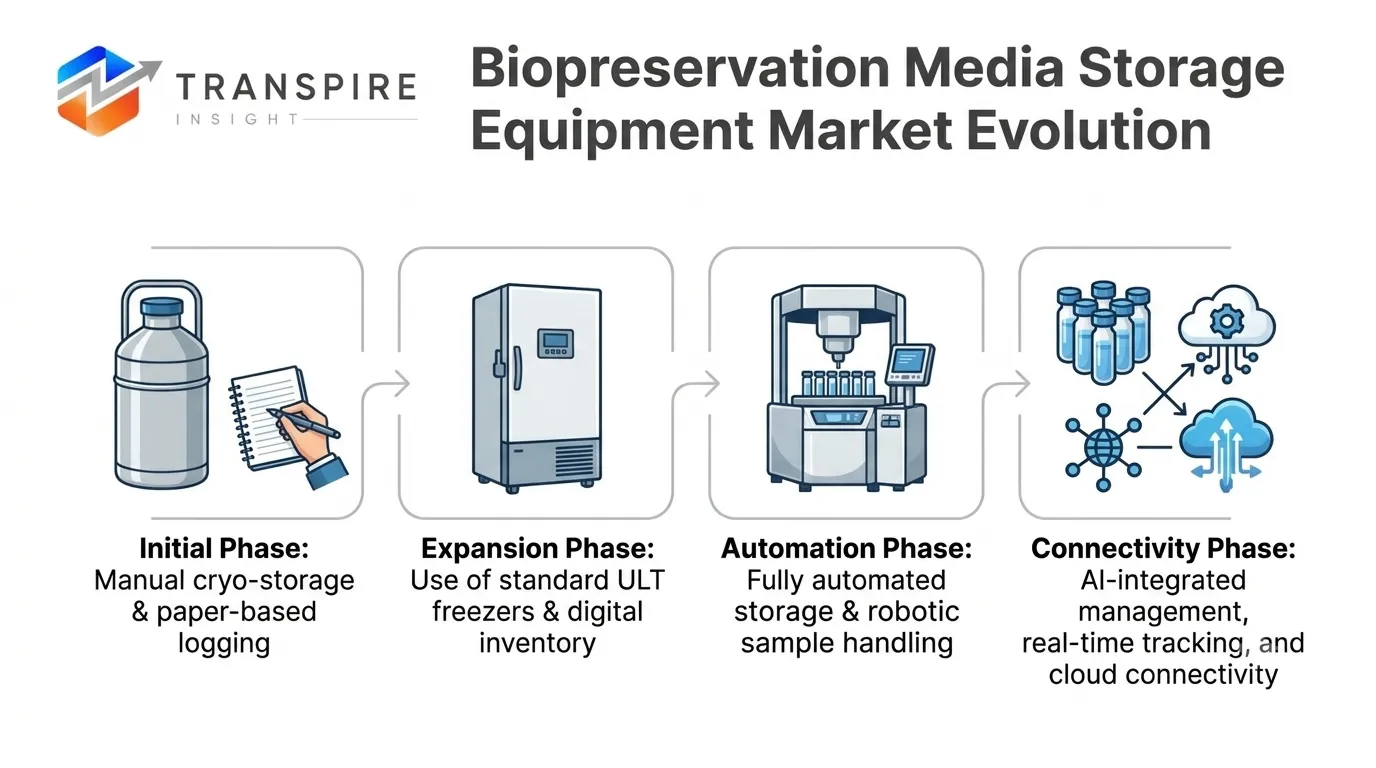
Automated ultra-low temperature storage systems reduce manual handling, limit freeze-thaw cycles, and protect sample integrity, prompting biobanks and labs to replace conventional freezers with modern software-controlled units.
Cryogen-free storage platforms eliminate dependence on liquid nitrogen supply, lower operating costs, and improve laboratory safety, making them attractive for clinical facilities facing logistics constraints.
Connected sensors and cloud dashboards deliver continuous temperature tracking, instant alarms, and audit-ready records, helping biorepositories prevent sample loss and satisfy regulatory expectations for traceability.
Serum-free and xeno-free cryopreservation media improve post-thaw viability and reduce contamination risk, becoming the preferred choice for cell therapy developers who require consistent, regulatory-friendly formulations.
Expanding cell and gene therapy pipelines require validated cold-chain storage from manufacturing to bedside, driving purchases of controlled-rate freezers, vapor-phase cryotanks, and compatible media worldwide.
Robotic sample handling automates retrieval, inventory, and cherry-picking at minus eighty degrees, protecting adjacent samples from warming while improving throughput for large, high-volume biobanks worldwide.
Top 25 Companies Leading the Biopreservation Media Storage Equipment Market
1. Thermo Fisher Scientific
Industry pioneer delivering end-to-end automated cold chain storage and specialized cryopreservation solutions.
Founded: 1956 | HQ: Waltham, Massachusetts, USA.
Why It Ranks: Unmatched distribution footprint and comprehensive portfolio across hardware, media, and consumables.
Regional Dominance: Holds dominant market share across North America, Europe, and Asia-Pacific hubs.
Product Line: Ultra-low freezers, cryogenic storage systems, specialized biopreservation media, and biobanking consumables.
2. PHC Holdings Corporation
leader in precision lab equipment renowned for VIP series ultra-low freezers.
Founded: 1969 | HQ: Tokyo, Japan.
Why It Ranks: Market leadership in energy-efficient biomedical freezers and reliable sample preservation technologies.
Regional Dominance: Dominates the Asia-Pacific market while maintaining deep market penetration in North America.
Product Line: Ultra-low temperature freezers, cryogenic freezers, automated specimen storage, and cell incubators.
3. Azenta Life Sciences
Specialized provider of automated sample management solutions and sample exploration repository services.
Founded: 2021 (spun off from Brooks Automation) | HQ: Chelmsford, Massachusetts, USA.
Why It Ranks: Market-leading position in automated cryogenic sample management and comprehensive biobanking software.
Regional Dominance: Strongly established presence in North America and Western European biopharmaceutical centers.
Product Line: Automated cryogenic storage systems, biobank management software, and sample containment consumables.
4. BioLife Solutions, Inc.
Innovation leader in bioproduction tools and proprietary biopreservation media for cell therapies.
Founded: 1987 | HQ: Bothell, Washington, USA.
Why It Ranks: Industry-standard hypothermic and cryopreservation media formulations powering clinical-stage cell therapy pipelines.
Regional Dominance: Strong leadership in North America with rapid adoption across European cell therapy sites.
Product Line: HypoThermosol, CryoStor, Stirling Ultracold freezers, and evo cold chain management systems.
5. Merck KGaA
Diversified life science titan providing high-purity biopreservation reagents and pharmaceutical cold storage.
Founded: 1668 | HQ: Darmstadt, Germany.
Why It Ranks: Deep regulatory expertise combined with top-tier GMP-grade chemical and media production capabilities.
Regional Dominance: Commanding market presence in Europe with massive reach in emerging markets.
Product Line: Cryoprotectants, cell culture media, biobanking reagents, and controlled temperature storage supplies.
6. Eppendorf SE
Renowned premium laboratory instrument manufacturer known for eco-friendly green ultra-low freezers.
Founded: 1945 | HQ: Hamburg, Germany.
Why It Ranks: Recognized excellence in laboratory hardware engineering, ergonomics, and sustainable refrigeration systems.
Regional Dominance: Holds robust market share in Europe, North America, and expanding Asian labs.
Product Line: Innova and CryoCube ULT freezers, storage racks, bio-vials, and laboratory automation equipment.
7. Chart Industries (MVE Biological Solutions)
World leader in liquid nitrogen storage systems and biological specimen cryogenic preservation.
Founded: 1992 | HQ: Ball Ground, Georgia, USA.
Why It Ranks: Dominates heavy-duty cryogenic storage infrastructure and vapor-phase liquid nitrogen freezer systems globally.
Regional Dominance: infrastructure footprint with strong dominance in Americas and Europe biobanks.
Product Line: MVE cryogenic freezers, liquid nitrogen dewars, vapor shippers, and monitoring systems.
8. Cryoport, Inc.
Premier provider of end-to-end temperature-controlled supply chain solutions for the life sciences.
Founded: 1999 | HQ: Nashville, Tennessee, USA.
Why It Ranks: Essential clinical-stage supply chain logistics partner for advanced cell and gene therapies.
Regional Dominance: North American market leader with growing specialized cryogenic logistics networks across Europe.
Product Line: Cryoport Express dry shippers, cryogenic storage equipment, biostorage facilities, and tracking systems.
9. Lonza Group AG
CDMO giant manufacturing specialized cell culture and bio-preservation media for therapies.
Founded: 1897 | HQ: Basel, Switzerland.
Why It Ranks: Key enabler of commercial regenerative medicine through scalable cGMP biomanufacturing and media platforms.
Regional Dominance: Leading market presence across Europe, North America, and major Asian biopharma hubs.
Product Line: TheraPEAK preservation media, cell processing systems, and cGMP cell culture reagents.
10. Becton, Dickinson and Company (BD)
medical technology pioneer providing advanced biological sample collection and preservation products.
Founded: 1897 | HQ: Franklin Lakes, New Jersey, USA.
Why It Ranks: Universal adoption of biospecimen collection tools and cell preservation standard operating accessories.
Regional Dominance: Extensive market reach spanning North America, Latin America, Europe, and Asia-Pacific regions.
Product Line: BD Vacutainer specimen tubes, cell preservation solutions, flow cytometry sample storage systems.
Conclusion
The biopreservation media and storage equipment market plays an indispensably vital role in advancing healthcare, biobanking, and life science research. As regulatory mandates intensify and commercial cell therapies demand ultra-reliable cold chains, market leaders continue to innovate with green cryogenic freezers, automated biobanking, and serum-free media. Sustained investments in sustainable, automated, and standardized preservation technologies will ultimately secure the future of regenerative medicine and personalized therapeutic delivery.


Send us a brief description of your challenge and we'll get back to you within 24 hours.

 inquiry@transpireinsight.com
 APAC:+91 7666513636
 Address


