
Oct 01, 2026
By Transpire Insight
Description
According to a research report published by Transpire Insight, the automotive navigation system market size is projected to grow from USD 27.15 billion in 2026 to USD 43.19 billion by 2035, at a CAGR of 6.86% during the forecast period 2027-2035. Rising consumer demand for connected vehicles, real-time traffic updates, automated safety compliance mandates, high-definition mapping for autonomous driving, and factory-fitted smart infotainment systems drive market growth.
Introduction
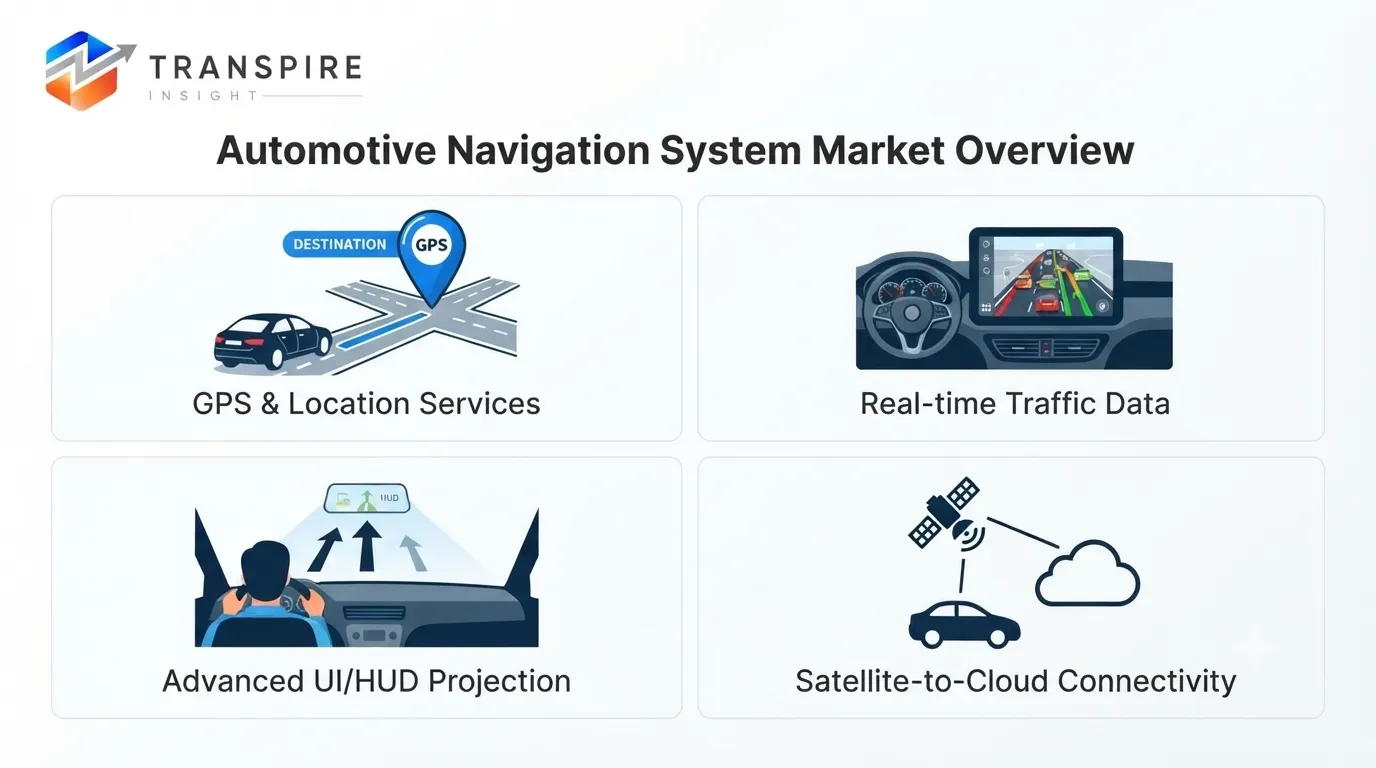
The automotive navigation system market has evolved from static location guidance into an interconnected ecosystem powering modern mobility. Combining GPS, AI-driven real-time analytics, cloud telematics, and high-definition mapping, these systems optimize routing, improve fuel efficiency, and ensure vehicle safety. As electric and autonomous vehicles gain adoption globally, intelligent in-dash navigation functions as the core digital backbone for next-generation vehicle architecture and advanced driver-assistance systems.
Recent Development News
February 2026: TomTom announced a strategic expansion of its cloud-native High Definition (HD) Map platform with automated live-road updates for Level 2+ autonomous driving applications.
May 2026: HERE Technologies partnered with a leading EV automaker to integrate dynamic, real-time battery range prediction and automated charge-point routing into their next-generation digital cockpits.
Stay Ahead of Emerging Opportunities with Expert Market Insights by Transpire Insight
Transpire Insight provides comprehensive, data-driven market intelligence to support smarter business decisions. Our research is rooted in comprehensive analysis, authoritative predictions, and industry expertise, enabling organizations to make informed decisions in rapidly evolving markets. We provide in-depth analysis of market segmentation, competitive positioning, regional trends, and emerging investment opportunities in high-growth areas. We blend accuracy with actionable intelligence, helping companies uncover new growth avenues, strengthen strategic decision-making, and stay ahead in a dynamic market.
Automotive Navigation System Market Size & Statistics
The Market Size for Automotive Navigation System Was Estimated to be Worth USD 27.15 Billion in 2026.
The Market Size is Going to Expand at a CAGR of 6.86% between 2026 and 2035.
The Automotive Navigation System Market Size is anticipated to reach USD 43.19 Billion by 2035.
Asia-Pacific is projected to drive the highest demand during the forecast period, accounting for 43% of the automotive navigation system market.
Europe is projected to grow the fastest during the forecast period at a CAGR of 9% in the automotive navigation system market.
Regional Growth and Demand Analysis by Transpire Insight
Asia-Pacific's dominance is rooted in scale and policy support. China's OEMs continue to push smart-vehicle rollouts at volume, while suppliers such as Magna have ramped up driver monitoring system production out of Chinese facilities, signaling deeper integration between navigation, sensing, and cockpit intelligence in the region. India adds further momentum through government subsidies aimed at NavIC-compatible receivers, which are helping domestic suppliers scale indigenous positioning hardware and reduce reliance on imported GPS modules. Together, these forces are cementing Asia-Pacific as both the largest revenue base and the innovation testing ground for next-generation in-vehicle navigation.
Europe's growth trajectory, by contrast, is being shaped by regulation and safety mandates rather than raw volume. The European Committee for Standardization and the European Telecommunications Standards Institute have jointly issued specifications for cooperative intelligent transportation systems, effectively pushing automakers toward mandatory GPS and connectivity provisions in new vehicles. Automakers are responding with deeper software partnerships, Mercedes-Benz's collaboration with Google to embed mapping and location services directly into its infotainment stack is one visible example, reflecting a broader shift toward regulator-driven, software-defined navigation architecture across the region.
Top 15 Trends in the Automotive Navigation System Market
AI-powered predictive routing analyzes traffic, weather, and driver behavior in real time, suggesting optimal paths that reduce travel time and fuel consumption across road networks.
Cloud-connected navigation platforms stream live traffic, incident, and road-condition data continuously, enabling dynamic rerouting and improved routing accuracy for both individual drivers and connected fleets.
Navigation systems increasingly integrate with ADAS features such as lane-keeping and collision avoidance, sharing map and sensor data to enable safer, more predictive semi-autonomous driving.
Countries are promoting indigenous satellite systems like India's NavIC alongside GPS and Galileo, reducing dependence on foreign infrastructure while improving positioning accuracy in dense areas.
EV-specific navigation tools now factor in battery range, charging station availability, and real-time energy consumption, helping drivers plan routes that avoid range anxiety on trips.
High-definition mapping provides centimeter-level accuracy essential for advanced driver assistance and autonomous features, capturing lane markings, road geometry, and traffic signage with far greater precision.
List of Top 25 Companies Leading the Automotive Navigation System Market
World’s largest automotive technology supplier pioneering integrated multi-modal mobility solutions.
Founded: 1886 | HQ: Gerlingen, Germany.
Why It Ranks: Market leadership in comprehensive vehicle system integration and sensor technology.
Regional Dominance: Strongest in Europe with expansive manufacturing operations across North America.
Product Line: Integrated cockpit domain controllers, connected navigation software, automated driving maps.
Major innovator in smart hardware components and automated vehicle safety architectures.
Founded: 1871 | HQ: Hanover, Germany.
Why It Ranks: High penetration rate for OEM instrument clusters and displays.
Regional Dominance: Europe and North America lead their revenue generation and deployments.
Product Line: Smart cockpits, heads-up displays, connected infotainment platforms, chassis domain systems.
Primary mobility supplier closely associated with Toyota's advanced automotive platforms.
Founded: 1949 | HQ: Kariya, Aichi, Japan.
Why It Ranks: Unrivaled Tier-1 footprint across Asian automobile manufacturers and exports.
Regional Dominance: Massive market share throughout Japan and the wider Asia-Pacific region.
Product Line: In-vehicle infotainment systems, telematics control units, vehicle safety navigation modules.
Premier provider of connected car technology and high-end automotive audio systems.
Founded: 1953 | HQ: Stamford, Connecticut, USA.
Why It Ranks: Dominates luxury OEM digital cockpit and cloud-connected infotainment deployment contracts.
Regional Dominance: Leading market presence across North America, Europe, and Asia-Pacific regions.
Product Line: Digital Cockpit platforms, Ready Vision AR displays, Ignite cloud services.
Independent location technology specialist providing mapping services for top automakers.
Founded: 1991 | HQ: Amsterdam, Netherlands.
Why It Ranks: pioneer in real-time traffic data and high-definition autonomous mapping.
Regional Dominance: Commands significant mapping footprint in Europe and major Western markets.
Product Line: TomTom Orbis Maps, automotive navigation SDKs, dynamic traffic intelligence applications.
Map data enterprise jointly owned by a consortium of major German automakers.
Founded: 1985 | HQ: Eindhoven, Netherlands.
Why It Ranks: Preferred location data engine for advanced driver assistance systems.
Regional Dominance: Strong presence across Western Europe, North America, and automotive hubs.
Product Line: HERE SDK, HD Live Map, automated location platform, routing APIs.
Architecture specialist focused on making vehicles safer, greener, and more connected.
Founded: 2017 | HQ: Dublin, Ireland.
Why It Ranks: Pioneer in integrating navigation data directly into vehicle compute domain architecture.
Regional Dominance: Balanced operational dominance spanning North America, Europe, and Asia.
Product Line: Connected infotainment software, user experience platforms, smart vehicle architecture compute.
Technology leader supplying advanced electronic equipment for commercial and passenger vehicles.
Founded: 1921 | HQ: Tokyo, Japan.
Why It Ranks: Strong vertical integration of automotive electronics and satellite communications systems.
Regional Dominance: Exceptional market share across Japan, East Asia, and North America.
Product Line: In-vehicle infotainment, high-precision positioning receivers, automotive heads-up displays.
Consumer electronics giant with a massive automotive infotainment and display division.
Founded: 1918 | HQ: Kadoma, Osaka, Japan.
Why It Ranks: Top supplier of automotive cockpit displays and battery management technology.
Regional Dominance: Highly influential across the Asia-Pacific region and North American markets.
Product Line: SkipGen infotainment systems, augmented reality heads-up displays, cockpit domain controllers.
Audio and guidance trailblazer with decades of aftermarket and OEM leadership.
Founded: 1938 | HQ: Tokyo, Japan.
Why It Ranks: Household name for high-performance aftermarket head units and car audio.
Regional Dominance: Widespread distribution network spanning Asia-Pacific, North America, and Europe.
Product Line: In-dash receivers, smart mobile mapping integration systems, OEM car navigation.
Conclusion
The automotive navigation system market is transitioning from standalone guidance tools into essential central intelligence hubs for software-defined vehicles. Fueled by cloud connectivity, AI-driven traffic optimization, and high-definition mapping required for autonomous driving, OEMs and tech leaders are reshaping the driving experience. As software integration deepens, strategic partnerships between mapping providers, silicon makers, and automakers will define the future of connected mobility.


Send us a brief description of your challenge and we'll get back to you within 24 hours.

 inquiry@transpireinsight.com
 APAC:+91 7666513636
 Address


