
Oct 01, 2026
By Transpire Insight
Description
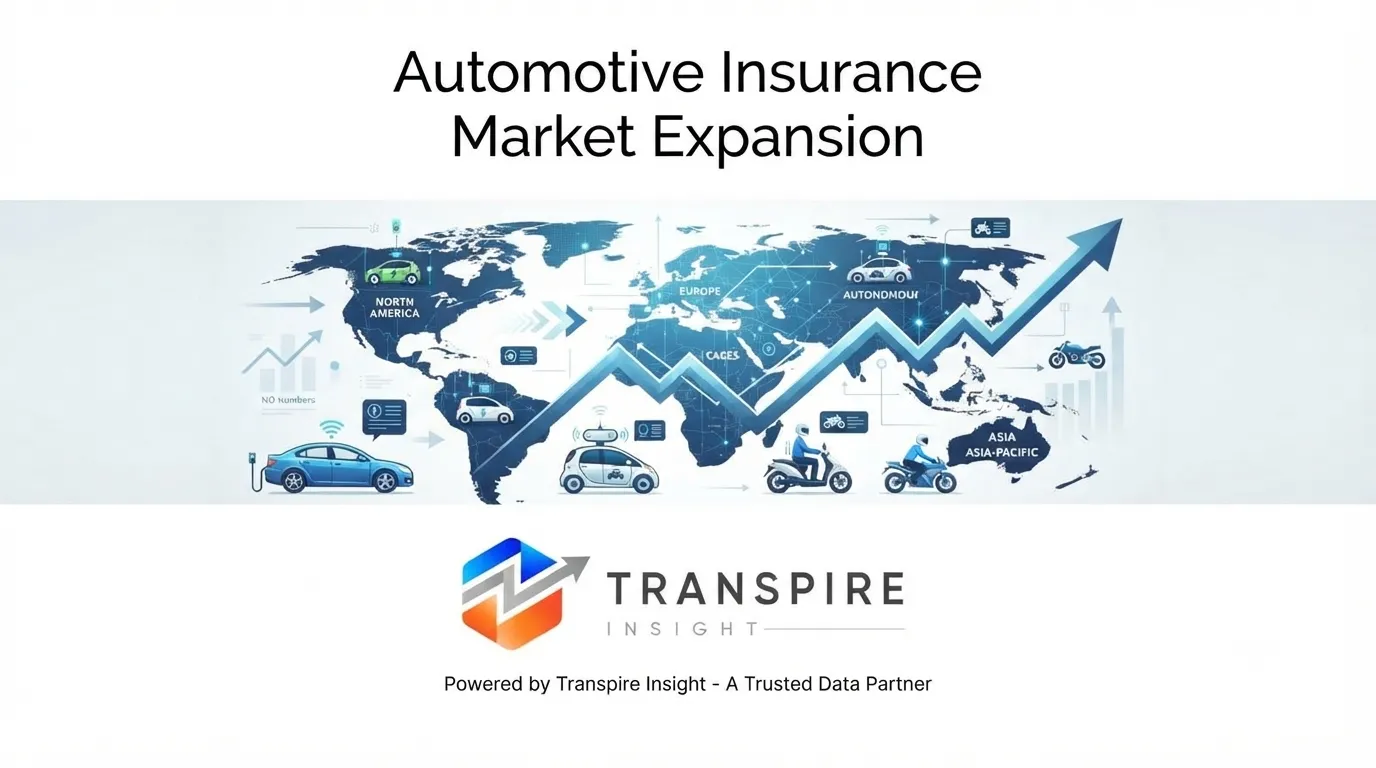
According to a research report published by Transpire Insight, the automotive insurance market size is projected to grow from USD 770.2 billion in 2026 to USD 1006.55 billion by 2035, at a CAGR of 3.27% during the forecast period 2027-2035. Some of the prominent drivers for the automotive insurance market are mandatory governmental regulations, the growing volume of vehicles on the road, and the growing penetration of usage-based telematics, along with the severity of repair costs stemming from the advanced technologies being introduced to vehicles.
Introduction
The automotive insurance sector is growing at a rapid pace worldwide. Insurers are modernizing their operations fuelled by legal requirements, growing vehicle fleets and changing consumer policy preferences. Insurers are investing in the modernization of their operations due to legal obligations, growth in vehicle fleets, and personalised policy preferences. As repair expenses continue to increase and underwriting processes grow more efficient, the deployment of AI, real-time telematics data, and automated claims processing has become essential throughout all areas of personal and commercial auto claims management around the world.
Recent Development News
March 2026: The market is powered by telematics integration and increased use of artificial intelligence-driven underwriting systems for 80% of customer interactions.
May 2026: It was projected that the usage-based auto insurance models and private passenger vehicle policies would make up more than 60% of the market, with the fastest growth seen in emerging Asia-Pacific economies.
Stay Ahead of Emerging Opportunities with Expert Market Insights by Transpire Insight
Transpire Insight provides comprehensive, data-driven market intelligence to support smarter business decisions. Our research is rooted in comprehensive analysis, authoritative predictions, and industry expertise, enabling organizations to make informed decisions in rapidly evolving markets. We provide in-depth analysis of market segmentation, competitive positioning, regional trends, and emerging investment opportunities in high-growth areas. We blend accuracy with actionable intelligence, helping companies uncover new growth avenues, strengthen strategic decision-making, and stay ahead in a dynamic market.
Automotive Insurance Market Size & Statistics
The Market Size for Automotive Insurance Was Estimated to be Worth USD 770.2 Billion in 2026.
The Market Size is Going to Expand at a CAGR of 3.27% between 2026 and 2035.
The Automotive Insurance Market Size is anticipated to reach USD 1006.55 Billion by 2035.
North America is projected to drive the highest demand during the forecast period, accounting for 33% of the automotive insurance market.
Asia-Pacific is projected to grow the fastest during the forecast period at a CAGR of 17% in the automotive insurance market.
Regional Growth and Demand Analysis by Transpire Insight
North America's dominance is based on both scale and innovation. Commercial fleet operators are also driving the growth of fleet electrification, as Harbinger electric trucks were recently ordered by dozens of FedEx, and established carriers like Progressive and State Farm are leading the region's premium pool. As connected vehicle data becomes more prevalent in the U.S., insurers are continuing to increase the sophistication of telematics-based underwriting by being able to better tailor commercial and personal policies to the data, and the high severity of claims activity and the growing expense of repairing vehicles equipped with ADAS increase premiums in the region.
Asia-Pacific's rapid ascent is being driven by structural shifts in vehicle ownership and technology adoption. China's new-energy vehicle boom is a major driver, with Ping An Insurance Co. reporting excellent year-over-year growth in new-energy-vehicle (NEV) insurance premium income and stable underwriting profitability. As in the case of Japan, telematics-based motor insurance is moving forward in partnership with companies like Sompo Holdings' recent strategic cooperation with Zego, and as with India and Southeast Asia, telematics insurance is gaining momentum as car sales increase, disposable incomes grow, and government regulations call for coverage. Asia-Pacific is set to be the spear that drives growth in the market as insurers continue to build AI-powered underwriting and mobile-first policy platforms.
Top 15 Trends in the Automotive Insurance Market
Insurers increasingly use telematics devices and connected car data to accurately price policies based on actual driving behavior, rewarding safer drivers with lower premium discounts.
Rising electric vehicle sales are pushing insurers to design specialized coverage addressing battery replacement costs, higher repair complexity, and unique charging infrastructure risks for owners.
Insurance companies are deploying AI-powered tools to streamline underwriting, automate claims processing, and improve customer policy recommendations, reducing operational costs while accelerating approval turnaround times.
Asia-Pacific is expanding fastest, driven by rising vehicle ownership, growing middle-class incomes, mandatory insurance regulations, and rapid digital insurance platform adoption across China, India, and Japan.
Rising repair costs from advanced sensors, complex electronics, and ADAS-equipped vehicles are driving premium inflation, forcing insurers to reassess pricing models and claims-handling strategies broadly.
Fleet operators are shifting toward electric commercial vehicles, prompting insurers to launch specialized coverage products addressing battery risk, charging infrastructure, and evolving fleet-electrification-related claims patterns.
List of Top 25 Companies Leading the Automotive Insurance Market
State Farm is the largest auto insurer operating across the United States.
Founded: 1922 | HQ: Bloomington, Illinois, USA.
Why It Ranks: Commands the largest market share in the U.S. personal auto line.
Regional Dominance: Dominates the North American market through extensive exclusive local agent networks.
Product Line: Personal auto, motorcycle, commercial fleet, rideshare, and classic car insurance.
Progressive pioneered telematics tracking software through its signature Snapshot mobile usage program.
Founded: 1937 | HQ: Mayfield Village, Ohio, USA.
Why It Ranks: Industry leader in direct-to-consumer digital distribution and competitive underwriting technology.
Regional Dominance: Strong market penetration across the United States and selected markets.
Product Line: Usage-based auto, commercial auto, personal vehicle, and boat coverages.
GEICO operates as a wholly owned subsidiary of Warren Buffett’s Berkshire Hathaway.
Founded: 1936 | HQ: Chevy Chase, Maryland, USA.
Why It Ranks: Second-largest auto insurer in the U.S., known for direct marketing.
Regional Dominance: Exceptional brand scale and customer penetration across all U.S. states.
Product Line: Direct personal auto, mechanical breakdown, commercial vehicle, and rideshare policies.
Allstate offers nationwide comprehensive vehicle insurance through independent and captive insurance agents.
Founded: 1931 | HQ: Glenview, Illinois, USA.
Why It Ranks: Major standard carrier leveraging multi-channel sales and advanced telematics pricing.
Regional Dominance: Widespread presence across the United States and Canadian auto markets.
Product Line: Personal motor, Milewise pay-per-mile, commercial auto, and roadside assistance.
USAA exclusively serves current U.S. military personnel, veterans, and their family members.
Founded: 1922 | HQ: San Antonio, Texas, USA.
Why It Ranks: Retains the highest customer satisfaction and retention rates in the sector.
Regional Dominance: Serves military members nationwide and across international military base locations.
Product Line: Military personal auto, specialized vehicle, rideshare, and collector car policies.
Liberty Mutual ranks among the largest property and casualty insurance companies.
Founded: 1912 | HQ: Boston, Massachusetts, USA.
Why It Ranks: Multinational presence combining direct sales, corporate fleets, and broker distribution.
Regional Dominance: Strong market positions in North America, Europe, and Latin America.
Product Line: Personal passenger auto, commercial vehicle fleet, and custom liability protections.
Allianz is Europe’s largest general insurance and financial services multinational corporation.
Founded: 1890 | HQ: Munich, Germany
Why It Ranks: underwriting giant with immense capital assets and deep carrier relationships.
Regional Dominance: Dominates European auto insurance while expanding across Asia and the Americas.
Product Line: Comprehensive motor, electric vehicle specialized coverage, and commercial fleet insurance.
AXA operates across major economic regions, delivering diversified motor policy coverages.
Founded: 1817 | HQ: Paris, France.
Why It Ranks: Leading brand driving telematics innovation and climate-conscious vehicle coverage.
Regional Dominance: Strong footprint in Western Europe, Asia-Pacific, and Middle Eastern markets.
Product Line: Comprehensive auto insurance, electric car plans, and commercial fleet policies.
Ping An is China’s largest motor insurer, leveraging advanced AI policy processing.
Founded: 1988 | HQ: Shenzhen, China
Why It Ranks: Dominates the world's largest vehicle market with tech-driven claims processing.
Regional Dominance: Complete market dominance across Greater China and the broader Asia-Pacific region.
Product Line: Smart personal motor, commercial auto, EV protection, and accident coverage.
PICC is a major state-owned insurer holding massive Chinese vehicle policy assets.
Founded: 1949 | HQ: Beijing, China.
Why It Ranks: Historically foundational insurer holding massive market share in domestic passenger cars.
Regional Dominance: Unmatched distribution network and policy dominance across Mainland China.
Product Line: Compulsory traffic liability, commercial auto liability, and motor physical damage.
Conclusion
The automotive insurance industry is poised for a radical transformation, with traditional insurance being replaced by digital-first, data-driven insurance. The increase in vehicle complexity, connected cars, and telematics is essentially changing the way insurers evaluate risk and handle claims. Going forward, companies that combine cutting-edge technology with EV policy expertise, including automated underwriting, real-time tracking, and specialized electric vehicle policies, will be successful in maintaining market leadership in this fast-growing, fiercely competitive sector.


Send us a brief description of your challenge and we'll get back to you within 24 hours.

 inquiry@transpireinsight.com
 APAC:+91 7666513636
 Address


