
Oct 26, 2026
By Transpire Insight
Description
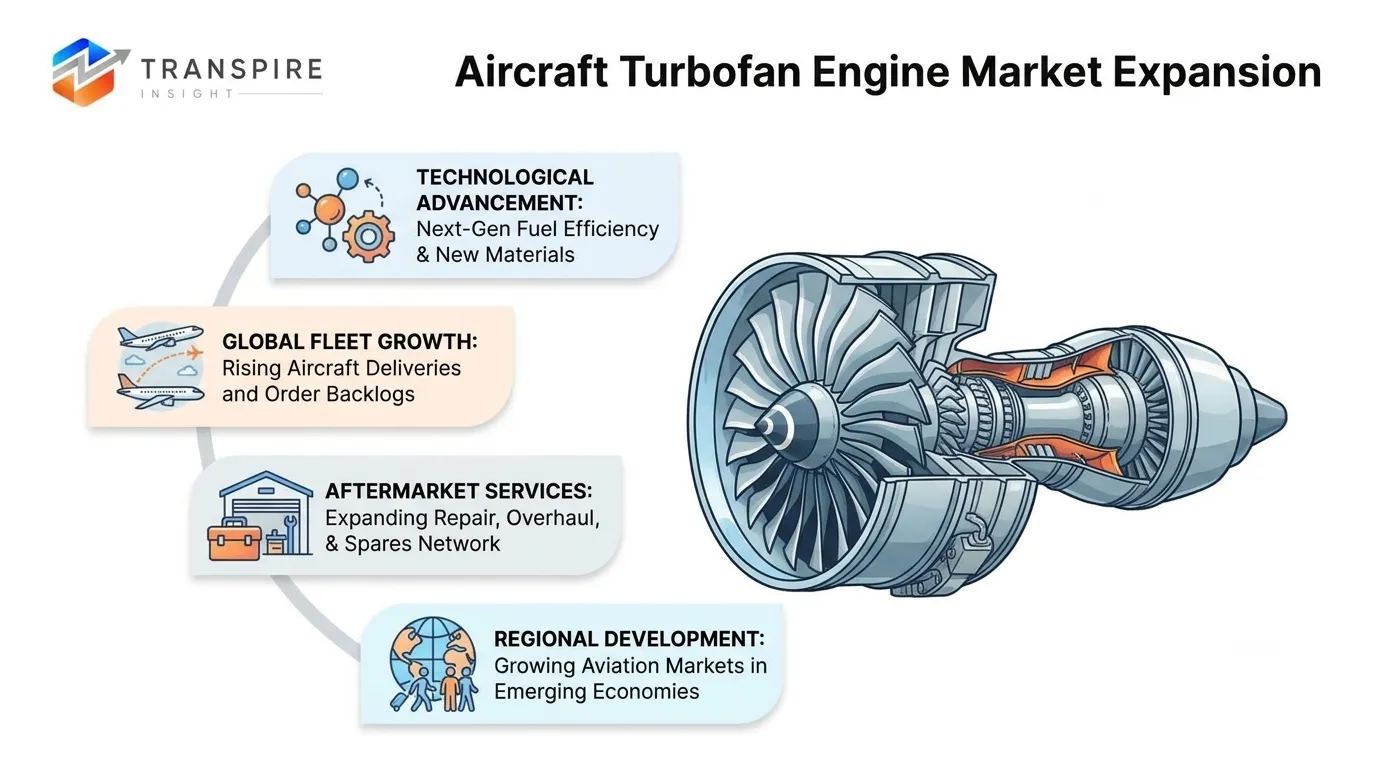
According to a research report published by Transpire Insight, the aircraft turbofan engine market size is projected to grow from USD 118.8 billion in 2026 to USD 167.15 billion by 2035, at a 5.09% CAGR during the 2027-2035 forecast period. Rising air passenger traffic, expanding commercial airline fleets, and increasing defense spending on modern combat aircraft drive rapid growth in the high-bypass and military turbofan engine market.
Introduction
The aircraft turbofan engine market plays a critical role in commercial aviation and military defense. High-bypass turbofans dominate commercial fleets by delivering superior fuel efficiency, lower emissions, and the low noise levels required for long-range and narrow-body aircraft. Meanwhile, low-bypass engines power advanced supersonic fighter jets. Technological innovations in open-fan architectures, geared turbofans, and sustainable aviation fuel (SAF) compatibility continue to drive next-generation propulsion developments.
Recent Development News
October 2026: Pratt & Whitney officially entered its GTF Advantage turbofan engine into commercial service with United Airlines on an Airbus A321XLR, delivering enhanced fuel efficiency and improved durability.
September 2026: In September 2026, Rolls-Royce was awarded funding under the European Union’s Clean Aviation initiative to advance its UltraFan 30 demonstrator, targeting a 20% fuel efficiency improvement for future narrow-body aircraft engines.
Stay Ahead of Emerging Opportunities with Expert Market Insights by Transpire Insight
Transpire Insight provides comprehensive, data-driven market intelligence to support smarter business decisions. Our research is rooted in comprehensive analysis, authoritative predictions, and industry expertise, enabling organizations to make informed decisions in rapidly evolving markets. We provide in-depth analysis of market segmentation, competitive positioning, regional trends, and emerging investment opportunities in high-growth areas. We blend accuracy with actionable intelligence, helping companies uncover new growth avenues, strengthen strategic decision-making, and stay ahead in a dynamic market.
Aircraft Turbofan Engine Market Size & Statistics
The Market Size for Aircraft Turbofan Engine Was Estimated to be Worth USD 118.8 Billion in 2026.
The Market Size is Going to Expand at a CAGR of 5.09% between 2026 and 2035.
The Aircraft Turbofan Engine Market Size is anticipated to reach USD 167.15 Billion by 2035.
North America is projected to drive the highest demand during the forecast period, accounting for 37% of the aircraft turbofan engine market.
Asia-Pacific is projected to grow the fastest during the forecast period at a CAGR of 5.8% in the aircraft turbofan engine market.
Regional Growth and Demand Analysis by Transpire Insight
North America leads demand because it is home to the most influential turbofan makers, including GE Aerospace and Pratt & Whitney, and to major airframers such as Boeing. Steady narrow-body replacement cycles, fleet modernization programs, and a deep aftermarket service base keep engine production and overhaul activity high across commercial aviation. Defense-backed research and military fighter and transport programs add a second layer of demand. They support continuous investment in higher-thrust, more efficient propulsion and a large installed base that needs regular maintenance and upgrades.
Asia-Pacific is scaling quickly as airlines expand their fleets to serve fast-growing passenger traffic. A clear example is IndiGo’s memorandum of understanding for 1,000 LEAP engines, announced at the Farnborough International Airshow. It is the largest single order in the LEAP program and includes support for the airline’s planned engine MRO facility and a long-term material services contract. Low-cost carriers across the region keep ordering fuel-efficient narrow-body aircraft. Growing government investment in aerospace infrastructure and the emergence of regional engine manufacturers are widening the region’s long-term demand base.
Top 15 Trends in the Aircraft Turbofan Engine Market
Airlines prioritize lower fuel burn per flight hour, so high-bypass turbofans with larger fans and improved cores are winning orders across narrow-body and wide-body aircraft.
Gearing lets the fan and turbine spin at separate optimal speeds, cutting fuel consumption and noise, so airlines increasingly choose geared designs for narrow-body fleets.
Engine makers are certifying turbofans for higher sustainable aviation fuel blends, helping airlines cut lifecycle carbon emissions without replacing existing aircraft or costly engine hardware.
Sensors and analytics platforms monitor engine performance in real time, predicting component wear early, reducing unscheduled removals, and improving aircraft availability for airline operators worldwide.
Aging fleets and high engine utilization are expanding demand for overhaul, spare parts, and service contracts, making aftermarket revenue a core profit driver for manufacturers.
Low-cost carriers across Asia-Pacific are placing large narrow-body orders to serve rising passenger traffic, directly boosting demand for new-generation turbofan engines and associated maintenance facilities.
List of Top 25 Companies Leading the Aircraft Turbofan Engine Market
1. GE Aerospace
Leading supplier of commercial high-bypass and defense jet engines.
Founded: 1917 | HQ: Cincinnati, Ohio, USA.
Why It Ranks: Commands top market share through massive airline and defense contracts.
Regional Dominance: Strongest across North America and commercial airline long-haul routes.
Product Line: GE9X, GEnx, GE90, F110, and CFM LEAP (via JV).
2. Pratt & Whitney
Pioneer of geared turbofan technology driving modern narrow-body efficiency.
Founded: 1925 | HQ: East Hartford, Connecticut, USA.
Why It Ranks: Powers major commercial fleets and military aircraft like the F-35.
Regional Dominance: Dominates North America and expands significantly across European commercial fleets.
Product Line: PW1000G GTF, PW4000, F135, and F119 turbofan engines.
3. Rolls-Royce plc
Premier manufacturer of high-thrust engines for wide-body commercial aircraft.
Founded: 1906 | HQ: London, United Kingdom.
Why It Ranks: Leads wide-body airliner propulsion with its renowned Trent engine family.
Regional Dominance: Holds structural leadership across Western Europe and transatlantic flight networks.
Product Line: Trent 7000, Trent XWB, Trent 1000, and UltraFan demonstrator.
4. Safran Aircraft Engines
Major French aerospace firm specializing in commercial and military propulsion systems.
Founded: 1905 | HQ: Paris, France.
Why It Ranks: Key partner in the world’s most widely produced narrow-body engines.
Regional Dominance: Strongest in Europe with wide deployment across regional fleets.
Product Line: M88, CFM56, LEAP (via CFM), and Silvercrest turbofans.
5. CFM International
World's largest commercial engine joint venture between GE and Safran.
Founded: 1974 | HQ: West Chester, Ohio, USA.
Why It Ranks: Powers the single-aisle Airbus A320neo and Boeing 737 MAX fleets.
Regional Dominance: dominance spanning North America, Europe, and Asia-Pacific airlines.
Product Line: CFM56 series, LEAP-1A, LEAP-1B, and LEAP-1C turbofans.
6. MTU Aero Engines AG
Germany’s premier engine manufacturer providing low-pressure turbines and compressors.
Founded: 1934 | HQ: Munich, Germany.
Why It Ranks: Vital partner in major European and North American engine consortia.
Regional Dominance: Strong presence in Western Europe with extensive MRO networks.
Product Line: PW1100G-JM components, EJ200 modules, and TP400 turbine assemblies.
7. Honeywell Aerospace
Leading developer of auxiliary power units and business jet turbofans.
Founded: 1906 | HQ: Phoenix, Arizona, USA.
Why It Ranks: Dominates the light-to-medium business aviation and military trainer aircraft market.
Regional Dominance: Massive market share in North America and corporate aviation.
Product Line: TFE731, HTF7000, and ALF502/LF507 turbofan engine series.
8. International Aero Engines (IAE)
Multinational consortium producing high-reliability engines for narrow-body airliners.
Founded: 1983 | HQ: East Hartford, Connecticut, USA.
Why It Ranks: Legacy supplier with thousands of engines active in fleets.
Regional Dominance: Maintained a wide operational footprint across Asia-Pacific and European commercial carriers.
Product Line: V2500 turbofan engine family for Airbus A320ceo aircraft.
9. Aero Engine Corporation of China (AECC)
State-owned Chinese enterprise developing domestic military and commercial jet propulsion.
Founded: 2016 | HQ: Beijing, China.
Why It Ranks: Key player driving China's aerospace self-reliance and domestic turbofan independence.
Regional Dominance: Dominates Chinese commercial aviation programs and national military defense procurement.
Product Line: CJ-1000A (for C919), WS-10, WS-15, and WS-20.
10. United Engine Corporation (UEC)
State corporation bringing together Russia's military and civil engine manufacturers.
Founded: 2008 | HQ: Moscow, Russia.
Why It Ranks: Core propulsion supplier for Russian air force fighters and commercial transport.
Regional Dominance: Dominates Eastern Europe, Russia, and strategic defense export markets globally.
Product Line: PD-14, PD-8, AL-31F, AL-41F1, and PS-90A.
Conclusion
The aircraft turbofan engine market continues to expand dynamically, driven by rising commercial passenger volumes and aggressive military fleet modernization. Tier-1 manufacturers like GE Aerospace, Pratt & Whitney, and Rolls-Royce lead innovation through geared turbofans and sustainable propulsion systems. As airframers maintain high delivery targets, the turbofan market will remain a fundamental pillar of aerospace growth.


Send us a brief description of your challenge and we'll get back to you within 24 hours.

 inquiry@transpireinsight.com
 APAC:+91 7666513636
 Address


