
Oct 02, 2026
By Transpire Insight
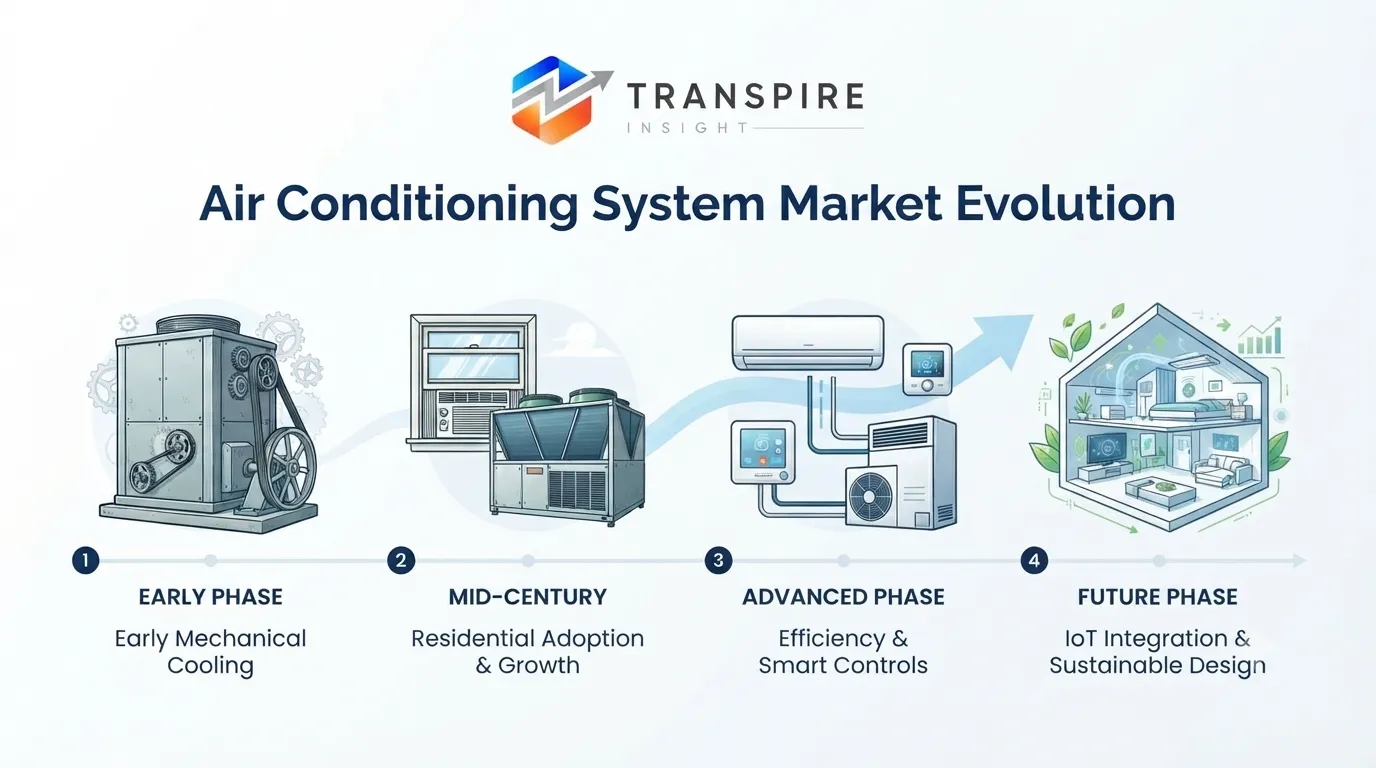
Description
According to a research report published by Transpire Insight, the air conditioning system market size is projected to grow from USD 207.12 billion in 2026 to USD 362.23 billion by 2035, at a CAGR of 8.32% during the forecast period 2027-2035. Accelerating temperatures, rapid urbanization, rising disposable incomes, and strict regulatory transitions toward energy-efficient, low-GWP A2L refrigerants (like R-32) drive widespread adoption across residential, commercial, and data-center sectors globally.
Introduction
The air conditioning system market has transformed into a critical sector powered by environmental policies, smart building integration, and heat pump expansion. The industry is witnessing rapid adoption of AI-enabled inverter compressors, eco-friendly cooling solutions, and IoT connectivity. Demand is shifting significantly from simple cooling capacity toward energy-efficient, sustainable thermal management solutions.
Recent Development News
January 2026: India's Ministry of Power expanded its mandatory star-labeling standards and temperature setting range mandates (20°C to 28°C) for all commercial and residential air conditioners to optimize grid efficiency.
March 2026: Trane Technologies reported a record commercial HVAC backlog surpassing $10.7 billion, demonstrating elevated investment in energy-efficient central cooling and commercial thermal management.
Stay Ahead of Emerging Opportunities with Expert Market Insights by Transpire Insight
Transpire Insight provides comprehensive, data-driven market intelligence to support smarter business decisions. Our research is rooted in comprehensive analysis, authoritative predictions, and industry expertise, enabling organizations to make informed decisions in rapidly evolving markets. We provide in-depth analysis of market segmentation, competitive positioning, regional trends, and emerging investment opportunities in high-growth areas. We blend accuracy with actionable intelligence, helping companies uncover new growth avenues, strengthen strategic decision-making, and stay ahead in a dynamic market.
Air Conditioning System Market Size & Statistics
The Market Size for Air Conditioning System Was Estimated to be Worth USD 207.12 Billion in 2026.
The Market Size is Going to Expand at a CAGR of 8.32% between 2026 and 2035.
The Air Conditioning System Market Size is anticipated to reach USD 362.23 Billion by 2035.
Asia-Pacific is projected to drive the highest demand during the forecast period, accounting for 60% of the air conditioning system market.
Europe is projected to grow the fastest during the forecast period at a CAGR of 8% in the air conditioning system market.
Regional Growth and Demand Analysis by Transpire Insight
Asia-Pacific's dominance rests on a combination of climate pressure and industrial scale. Northern India regularly sees summer temperatures cross 50°C, pushing air conditioning from a discretionary purchase into a basic necessity across both urban and semi-urban households. India's production-linked incentive schemes have simultaneously lowered retail prices and pulled in fresh factory investment, strengthening domestic supply even as demand climbs. The region's commercial and infrastructure buildout reinforces this: in Qatar, the redevelopment of Old Doha Port's Mina District introduced open-air district cooling using energy-efficient chilled-water circulation to keep public promenades comfortable through peak summer, an example of how Asia-Pacific-adjacent Gulf markets are embedding cooling infrastructure directly into urban planning rather than treating it as an afterthought.
Europe's growth is earlier-stage but accelerating quickly, since only about a fifth of European households currently own a cooling system, leaving substantial headroom. Daikin Central Europe has pointed to households increasingly choosing energy-efficient air conditioning as heatwaves grow more frequent and electricity costs rise. Regulatory pressure is compounding this shift: the EU Green Deal's F-Gas quotas and the REPowerEU push toward 60 million installed heat pumps are steering manufacturers toward low-GWP refrigerants and reversible heating-cooling units. Supply is adjusting in step, Aira's roughly €300 million factory in Wrocław, Poland, will produce 500,000 units annually, shortening lead times into Central and Eastern Europe and giving the region a manufacturing base to match its rising demand.
Top 15 Trends in the Air Conditioning System Market
Manufacturers worldwide are rapidly replacing fixed-speed compressors with inverter and variable-speed technology, reducing energy consumption and improving comfort control amid tightening efficiency mandates.
Manufacturers are recently transitioning to low-GWP refrigerants such as R-32 and R-454B under tightening F-Gas rules, causing supply tightness on major commercial cooling projects.
Smart, IoT-connected air conditioning systems with app-based controls and predictive diagnostics are gaining traction across residential and commercial spaces, supported by rising smart-home adoption.
Governments across major economies are offering tax credits and production-linked incentives to boost adoption of energy-efficient air conditioners, lowering retail prices in emerging regions.
Reversible heat pump-integrated air conditioning systems, offering combined heating and cooling, are gaining strong momentum across Europe as households seek energy-efficient, dual-purpose comfort solutions.
Stricter F-Gas quotas and energy-efficiency mandates, including EU Green Deal targets, are rapidly pushing manufacturers toward natural refrigerants and higher-efficiency compressor technology across Europe.
List of Top 25 Companies Leading the Air Conditioning System Market
World’s largest HVAC manufacturer pioneering advanced variable refrigerant volume (VRV) systems.
Founded: 1924 | HQ: Osaka, Japan.
Why It Ranks: Unmatched revenue share and leadership in low-GWP refrigerant innovation.
Regional Dominance: Asia-Pacific and Europe, with massive operational expansion across North America.
Product Line: Split systems, VRV multi-splits, commercial chillers, and industrial air handling.
Invented modern air conditioning and leads globally in intelligent climate solutions.
Founded: 1915 | HQ: Palm Beach Gardens, Florida, USA.
Why It Ranks: Dominant commercial footprint and continuous technical patents in climate infrastructure.
Regional Dominance: North America and Europe, supported by strong distribution networks.
Product Line: Residential split ACs, rooftop units, centrifugal chillers, and building controls.
Renowned for high-durability commercial building management and high-efficiency chillers.
Founded: 1913 | HQ: Swords, Ireland / Davidson, North Carolina, USA.
Why It Ranks: Leader in large-scale commercial HVAC systems and sustainable building upgrades.
Regional Dominance: North America, with expanding footprints across Western Europe and Asia.
Product Line: Central air conditioners, heat pumps, water-cooled chillers, and controls.
World’s largest residential air conditioner manufacturer by volume output and capacity.
Founded: 1991 | HQ: Zhuhai, Guangdong, China
Why It Ranks: Tremendous production scale, cost competitiveness, and high Asian market penetration.
Regional Dominance: China and broader Asia-Pacific, with high export volumes globally.
Product Line: Wall-mounted split ACs, window units, portable chillers, and commercial VRF.
Major appliance conglomerate producing over 60 million air conditioners annually.
Founded: 1968 | HQ: Foshan, Guangdong, China
Why It Ranks: Exceptional manufacturing vertical integration and competitive smart inverter technology deployment.
Regional Dominance: Asia-Pacific, South America, and growing market presence across Europe.
Product Line: Smart inverter split ACs, ductless mini-splits, and central multi-zone units.
leader in integrated smart building solutions, automated infrastructure, and HVAC.
Founded: 1885 | HQ: Cork, Ireland / Milwaukee, Wisconsin, USA
Why It Ranks: Premier provider of industrial chillers and fully integrated smart building software.
Regional Dominance: North America and Europe, with heavy commercial institutional presence globally.
Product Line: York commercial chillers, variable refrigerant flow systems, and air handlers.
benchmark for ultra-quiet operating split air conditioners and ductless technology.
Founded: 1921 | HQ: Tokyo, Japan
Why It Ranks: High product reliability ratings, advanced inverter technology, and brand premium power.
Regional Dominance: Asia-Pacific, Japan, North America, and high premium European market share.
Product Line: City Multi VRF systems, Mr. Slim mini-splits, and heat pumps.
Major innovator in AI-powered smart HVAC integration and sleek residential units.
Founded: 1958 | HQ: Seoul, South Korea
Why It Ranks: Strong dual presence in residential smart ACs and commercial VRF technology.
Regional Dominance: Asia-Pacific, North America, and high growth across Middle Eastern markets.
Product Line: DUAL Inverter split ACs, Multi V VRF, and commercial chillers.
Key developer of nanoe™ air purification technologies integrated inside cooling systems.
Founded: 1918 | HQ: Osaka, Japan
Why It Ranks: Trusted reputation for energy efficiency, indoor air quality, and eco-refrigerants.
Regional Dominance: Japan, Southeast Asia, India, and an established presence in Europe.
Product Line: Residential split ACs, commercial VRF systems, and air-to-water heat pumps.
Pioneer in high-efficiency residential heat pumps and solar-assisted air conditioning units.
Founded: 1895 | HQ: Richardson, Texas, USA.
Why It Ranks: High brand loyalty and dominant market share in North American residential replacement.
Regional Dominance: North America, with selective commercial distribution networks across Australia.
Product Line: Daikin Lennox Signature ACs, heat pumps, packaged units, and air handlers.
Conclusion
The air conditioning system market is undergoing a structural transformation driven by decarbonization policies, digitisation, and rapid urbanization. Industry leaders are strategically competing on energy efficiency, AI integration, and low-GWP refrigerant compliance rather than pure cooling power. As climate volatility fuels growing demand, key players with strong variable-speed inverter technologies, smart building connectivity, and robust supply chains will dictate the industry's sustainable future.


Send us a brief description of your challenge and we'll get back to you within 24 hours.

 [email protected]
 APAC:+91 7666513636
 Address


