
Oct 24, 2026
By Transpire Insight
Description
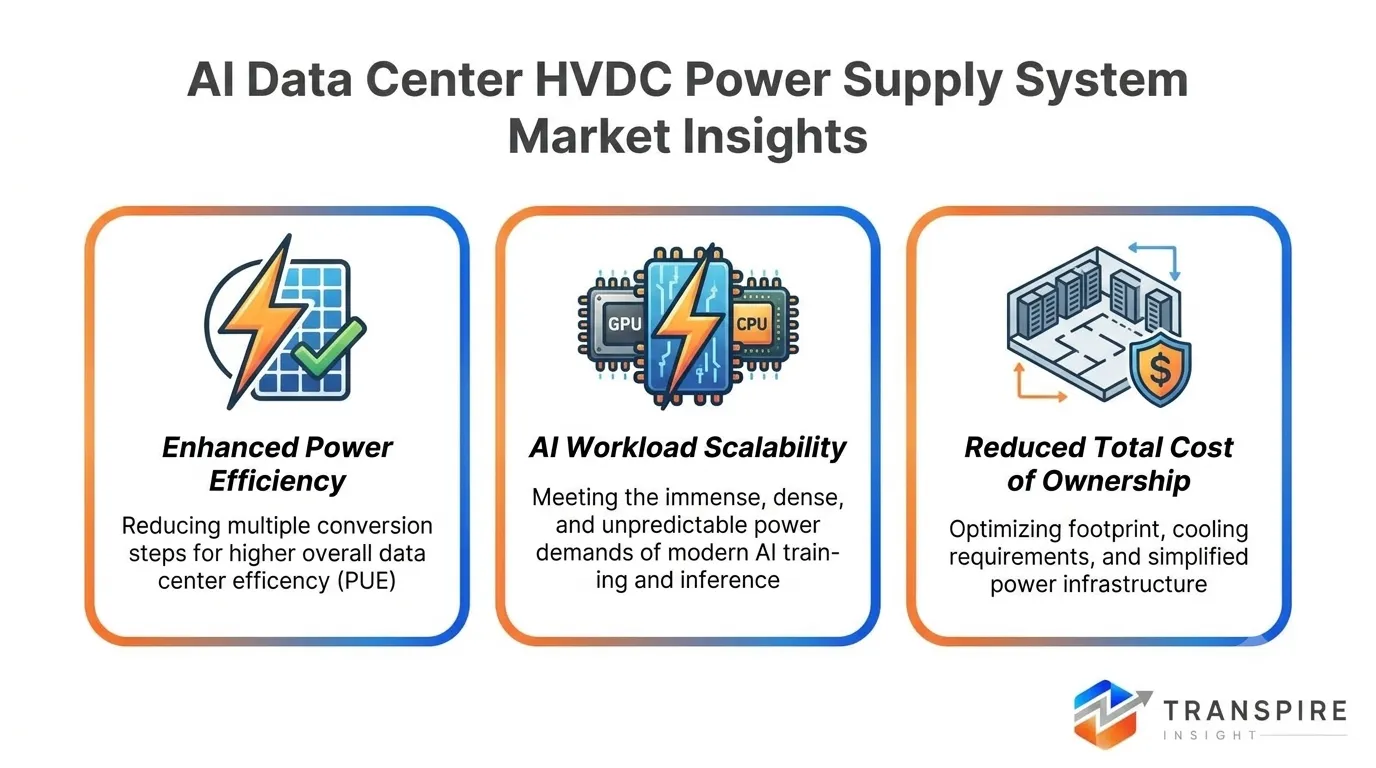
According to a research report published by Transpire Insight, the AI data center HVDC power supply system market size is projected to grow from USD 1.71 billion in 2026 to USD 3.64 billion by 2035, at a 11.55% CAGR during the 2027-2035 forecast period. Exponential growth in AI computers demands massive power density per rack. High-Voltage Direct Current (HVDC) architectures eliminate redundant AC-DC conversion stages, reducing energy losses, footprint, thermal dissipation, and total infrastructure costs.
Introduction
The AI Data Center HVDC Power Supply System market is rapidly expanding as hyper-scalers transition from legacy AC distribution to 240V/336V/800V DC power architectures. High-density GPU racks powering large language models require gigawatt-scale infrastructure with minimal efficiency losses. HVDC systems deliver higher energy efficiency, enhanced power reliability, seamless integration with renewable microgrids, and reduced physical space requirements, making them foundational for next-generation AI data center deployment worldwide.
Recent Development News
June 2026: At COMPUTEX 2026, Delta Electronics debuted its prefabricated modular AI data center solution featuring an 800VDC In-Row Power architecture. Designed to bypass traditional AC distribution limits, the system pairs direct-chip liquid cooling with 800V DC power racks to support next-generation megawatt computing nodes.
September 2026: ABB officially unveiled its Infinitus DC power platform engineered for ultra-high-density AI data centers. The system integrates solid-state circuit protection with direct HVDC distribution, delivering enhanced fault detection and maximizing operational uptime for megawatt-level AI GPU clusters.
Stay Ahead of Emerging Opportunities with Expert Market Insights by Transpire Insight
Transpire Insight provides comprehensive, data-driven market intelligence to support smarter business decisions. Our research is rooted in comprehensive analysis, authoritative predictions, and industry expertise, enabling organizations to make informed decisions in rapidly evolving markets. We provide in-depth analysis of market segmentation, competitive positioning, regional trends, and emerging investment opportunities in high-growth areas. We blend accuracy with actionable intelligence, helping companies uncover new growth avenues, strengthen strategic decision-making, and stay ahead in a dynamic market.
AI Data Center HVDC Power Supply System Market Size & Statistics
The Market Size for AI Data Center HVDC Power Supply System Was Estimated to be Worth USD 1.71 Billion in 2026.
The Market Size is Going to Expand at a CAGR of 11.55% between 2026 and 2035.
The AI Data Center HVDC Power Supply System Market Size is anticipated to reach USD 3.64 billion by 2035.
North America is projected to drive the highest demand during the forecast period, accounting for 39% of the AI data center HVDC power supply system market.
Asia-Pacific is projected to grow the fastest during the forecast period at a CAGR of 11.62% in the AI data center HVDC power supply system market.
Regional Growth and Demand Analysis by Transpire Insight
North America leads because hyperscale operators there are the first to build racks that outgrow conventional power distribution. NVIDIA’s Kyber rack architecture, which draws up to 1.4 megawatts per rack and is shipping in early-access form to Microsoft and Oracle, is a clear example of demand moving toward high-voltage DC. Power vendors such as Vertiv have also joined NVIDIA’s 800 V DC partner ecosystem, which keeps equipment orders concentrated in the region. The main constraint is grid capacity, since large-scale 800 V DC deployment is heavily concentrated in the United States, which is facing grid infrastructure shortages. This pushes operators to invest in efficient on-site power conversion.
Asia Pacific is the fastest-growing region because AI data center builds and local power electronics manufacturing are advancing together. Foxconn’s 40 MW Kaohsiung-1 data center in Taiwan already uses 800 VDC technology, which shows the architecture moving from pilot to live operation. Regional suppliers are also building the ecosystem. Delta Electronics has shown a portfolio of 800 V converters, and Hitachi has launched an 800 V DC simulation platform for gigawatt-scale AI factories.
Top 15 Trends in the AI Data Center HVDC Power Supply System Market
Operators are replacing 54V DC rack distribution with 800 VDC because higher voltage cuts current, copper, and conversion stages, making megawatt-class AI racks technically feasible.
NVIDIA’s Kyber architecture, drawing up to 1.4 megawatts per rack with Vera Rubin Ultra, is now pushing hyperscalers decisively toward high-voltage DC rack power distribution.
Silicon carbide and gallium nitride devices are scaling because they handle high voltages efficiently, shrinking power shelves and lifting conversion efficiency inside 800 VDC systems.
Solid-state transformers convert medium-voltage grid power directly to DC at the facility perimeter, removing bulky AC equipment stages and improving end-to-end efficiency for AI campuses.
Hybrid AC-to-800 VDC sidecar systems let operators upgrade existing facilities incrementally, bridging legacy infrastructure and native 800 VDC deployments expected later as adoption broadens further.
Grid availability limits many projects, so operators pair 800 VDC with on-site generation, fuel cells, and storage to secure power and reduce dependence on utilities.
List of Top 25 Companies Leading the AI Data Center HVDC Power Supply System Market
1. Vertiv
Delivers high-efficiency critical power solutions optimized for high-density computing infrastructure.
Founded: 1965 | HQ: Westerville, Ohio, USA.
Why It Ranks: Market leader in scalable, rack-integrated HVDC power modules for hyperscalers.
Regional Dominance: Strongest footprint across North America and key European data center hubs.
Product Line: NetSure 800VDC power systems, rectifiers, and modular DC busway infrastructure.
2. Delta Electronics
supplier of switching power supplies, thermal management, and passive components.
Founded: 1971 | HQ: Taipei, Taiwan.
Why It Ranks: Pioneer in 800VDC grid-to-chip architectures for advanced AI server racks.
Regional Dominance: Major supplier across Asia-Pacific and rapidly expanding in North America.
Product Line: 800VDC in-row power solutions, high-efficiency rectifiers, and DC-DC converters.
3. Schneider Electric
leader in energy management, industrial automation, and data center infrastructure.
Founded: 1836 | HQ: Rueil-Malmaison, France.
Why It Ranks: Offers end-to-end electrical distribution ecosystems tailored for high-density AI data centers.
Regional Dominance: Deep penetration across European, North American, and Latin American markets.
Product Line: EcoStruxure HVDC architectures, DC switchgear, and rack-level power distribution units.
4. ABB
Engineering leader specializing in electrification systems, robotics, and motion control technologies.
Founded: 1988 | HQ: Zurich, Switzerland.
Why It Ranks: Innovator in solid-state circuit breaker protection for high-voltage DC distribution.
Regional Dominance: Strong industrial presence in Europe and growing adoption across North America.
Product Line: Infinitus DC platform, solid-state disconnects, and MV/HV DC converter stations.
5. Eaton Corporation
Power management enterprise providing energy-efficient electrical and industrial power systems.
Founded: 1911 | HQ: Dublin, Ireland.
Why It Ranks: Advanced power quality solutions integrated with next-generation solid-state grid transformers.
Regional Dominance: Command over North American hyperscale facilities and expanding European operations.
Product Line: Medium-voltage solid-state transformers, HVDC uninterruptible power units, and switchgear.
6. Siemens AG
Technology powerhouse delivering industrial automation, digital transformation, and smart power grids.
Founded: 1847 | HQ: Munich, Germany.
Why It Ranks: Leading provider of utility-to-facility high-voltage direct current conversion and transformers.
Regional Dominance: Robust market authority across Europe, Asia, and Middle Eastern regions.
Product Line: Modular solid-state transformers, HVDC converter stations, and grid connection platforms.
7. Huawei Technologies
ICT infrastructure giant offering smart PV, data center facility solutions, and AI hardware.
Founded: 1987 | HQ: Shenzhen, China.
Why It Ranks: Dominates high-voltage direct current deployment across APAC hyperscale and cloud facilities.
Regional Dominance: Massive market share across mainland China, South East Asia, and Africa.
Product Line: FusionPower 336V/800V DC platforms, smart lithium backup, and modular UPS systems.
8. Hitachi Energy
power grid technology leader specializing in high-voltage infrastructure and renewable integration.
Founded: 2020 | HQ: Zurich, Switzerland.
Why It Ranks: World leader in utility-scale HVDC transmission links powering gigawatt-scale data campuses.
Regional Dominance: Major supplier across Japan, Europe, India, and the Americas.
Product Line: Voltage Source Converters (VSC-HVDC), transformers, and grid-interface power electronics.
9. Mitsubishi Electric
Diversified electrical equipment manufacturer specializing in industrial automation and power grid systems.
Founded: 1921 | HQ: Tokyo, Japan.
Why It Ranks: High-reliability power electronics supplier catering to critical AI computing facilities.
Regional Dominance: Strong holding in East Asian markets with expanding North American projects.
Product Line: HVDC power distribution panels, high-voltage silicon carbide power modules, and switchgear.
10. Kehua Data Co., Ltd.
Power management specialist focused on critical power, cloud infrastructure, and renewable storage.
Founded: 1988 | HQ: Xiamen, China.
Why It Ranks: Rapidly growing supplier of modular 336V DC power architectures for data centers.
Regional Dominance: Strong influence in China and fast-growing operations across Southeast Asia.
Product Line: Modular HVDC power supply systems, direct-current UPS, and cabinet-level distribution.
Conclusion
The transition toward HVDC power supply systems represents a fundamental architecture shift driven by gigawatt-scale AI workloads. Traditional AC distribution fails to deliver the extreme power density and efficiency required by modern GPU racks. By minimizing energy conversion stages and improving thermal management, leading electrical giants and semiconductor innovators are setting new benchmarks, ensuring sustainable, high-density infrastructure for the AI ecosystem.


Send us a brief description of your challenge and we'll get back to you within 24 hours.

 inquiry@transpireinsight.com
 APAC:+91 7666513636
 Address


