logo
☰ Search

Sep 28, 2026

Top 25 Companies in Acoustic Sensors Market: Company Profile by Transpire Insight

By Transpire Insight


top-25-companies-in-acoustic-sensors-company-profile-by-transpire-insight

Description

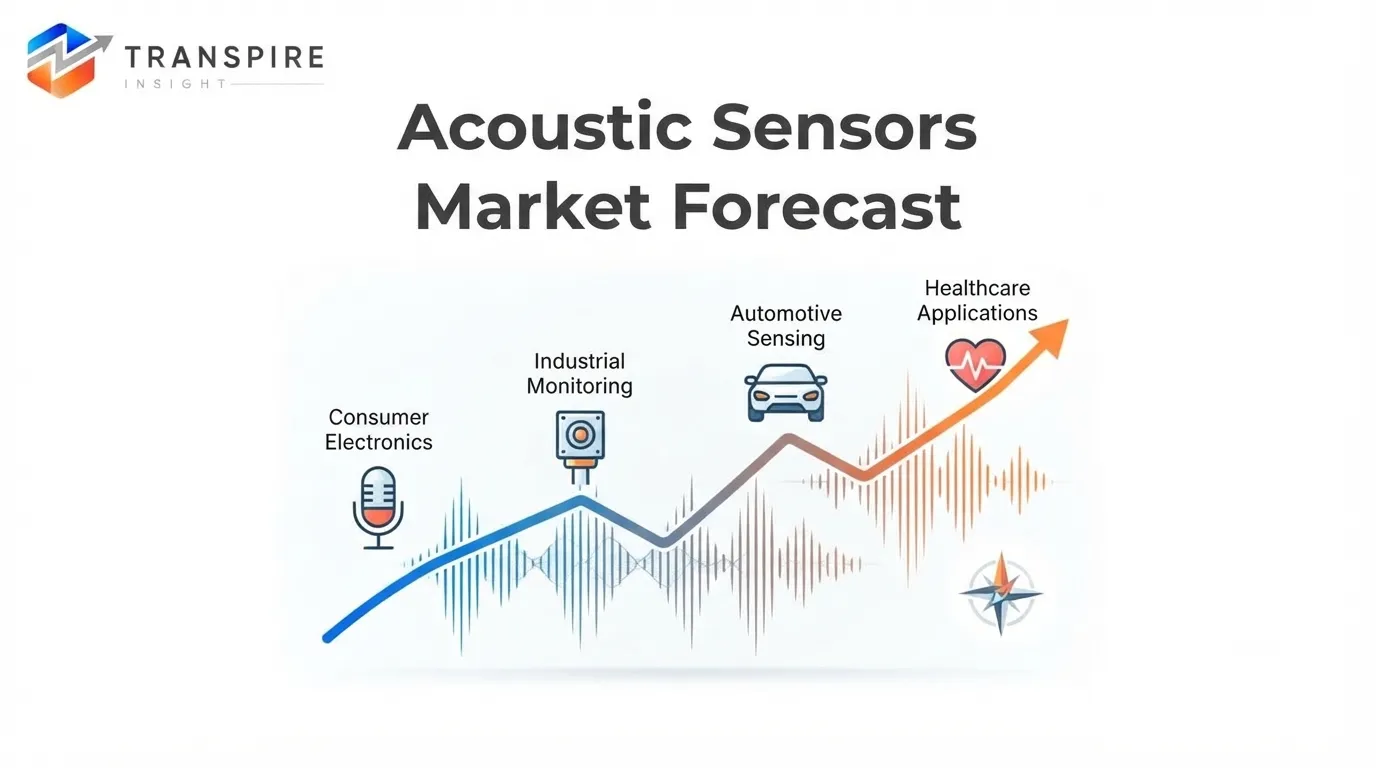
According to a research report published by Transpire Insight, the acoustic sensors market size is projected to grow from USD 2.3 billion in 2026 to USD 3.8 billion by 2035, at a CAGR of 8.9% during the forecast period 2027-2035. Market growth is driven by increasing demand for surface and bulk acoustic wave (SAW) devices in automotive tire monitoring, predictive industrial maintenance, and 5G communication filters, which are operating in harsh conditions.

Introduction

Acoustic sensors are devices that convert sound waves and elastic vibrations into electrical signals that can be read. They are flexible and can be used for temperature, pressure, torque, or structural health monitoring in industrial, defense, automotive, and medical applications. Acoustic sensors represent key components in smart monitoring infrastructure, industrial automation, and IoT systems, thanks to their wireless capabilities, cost-efficiency, and robustness in harsh environments.

Recent Development News

January 2026: Acoustic component makers ramped up surface acoustic wave (SAW) filter manufacturing lines to enable sub-6 GHz industrial Internet of Things (IoT) and automotive network applications.

May 2026: Ultra-high-temperature ceramic housings developed by sensor makers allow acoustic monitoring devices to operate above 250 °C in harsh oil environments.

Stay Ahead of Emerging Opportunities with Expert Market Insights by Transpire Insight

Transpire Insight provides comprehensive, data-driven market intelligence to support smarter business decisions. Our research is rooted in comprehensive analysis, authoritative predictions, and industry expertise, enabling organizations to make informed decisions in rapidly evolving markets. We provide in-depth analysis of market segmentation, competitive positioning, regional trends, and emerging investment opportunities in high-growth areas. We blend accuracy with actionable intelligence, helping companies uncover new growth avenues, strengthen strategic decision-making, and stay ahead in a dynamic market. 

Acoustic Sensors Market Size & Statistics

The Market Size for Acoustic Sensors Was Estimated to be Worth USD 2.3 Billion in 2026.

The Market Size is Going to Expand at a CAGR of 8.9% between 2026 and 2035.

The Acoustic Sensors Market Size is anticipated to reach USD 3.8 Billion by 2035.

North America is projected to drive the highest demand during the forecast period, accounting for 38% of the acoustic sensors market.

Asia-Pacific is projected to grow the fastest during the forecast period at a CAGR of 13.2% in the acoustic sensors market.

Regional Growth and Demand Analysis by Transpire Insight

North America's lead is anchored in defense and automotive demand. The U.S. Department of Defense has directed USD 120 million in Trusted Foundry awards to reshore critical sensor manufacturing for secure communications in the U.S. region, further emphasizing its push to reshore critical manufacturing. The automotive segment includes General Motors, which has embraced wireless torque probes for its Ultium electric vehicles, thus creating a new source of income for sensor manufacturers related to EV manufacturing. Still, consumer electronics continue to be a good draw, as acoustic sensors have become more and more integrated into autonomous-driving and parking-assistance systems as automakers advance toward increased levels of vehicle autonomy.

Aggressive domestic capacity building and consumer electronics scale are the main factors behind the Asia-Pacific's acceleration. The Chinese government has allocated approximately CNY 18 billion for achieving 40% self-sufficiency in filter manufacturing and TDK and Murata have fourteen S.A.W production lines delivering 2.4 billion filters with gross margins over 38%. The Production-Linked Incentive scheme has attracted USD 340 million for new assembly plants in India, while South Korea has invested USD 280 million in bulk acoustic wave research. Over half of all smartphones in the world now have components that sense acoustics, and the region's manufacturing strength provides it with a structural advantage in scaling up next-generation filter and sensor technology.

Top 15 Trends in the Acoustic Sensors Market

  • MEMS-based acoustic sensors shrinking in size and cost.
  • Growing automotive integration for ADAS and safety.
  • Rising demand from wearable health monitoring devices.
  • Surface acoustic wave filters supporting 5G expansion.
  • Smart city and infrastructure monitoring adoption growing.
  • IoT-enabled acoustic sensing driving predictive maintenance.
  • Bulk acoustic wave technology gaining ground in filters.
  • Distributed acoustic sensing expanding in energy pipelines.
  • Consumer electronics driving high-volume sensor integration.
  • AI-enabled acoustic signal processing improving accuracy.
  • Domestic semiconductor self-sufficiency initiatives reshaping supply chains
  • Fiber-optic sensing competing in infrastructure monitoring niches
  • Underwater and defense acoustic sensing applications growing.
  • Ultrasonic sensors expanding in robotics and industrial automation.
  • Environmental and structural health monitoring adoption rising.
  1. MEMS-Based Acoustic Sensors

MEMS-based acoustic sensors are shrinking in size and cost, enabling integration into smartphones, hearables, and wearables while improving sensitivity, battery efficiency, and device manufacturing scalability.

  1. Automotive Integration for ADAS

Automakers are embedding acoustic sensors across ADAS, parking assistance, and electric vehicle production lines, improving reliability testing and safety detection while cutting production line defects.

  1. SAW Filters Supporting 5G

Surface acoustic wave filters are essential to 5G network rollouts, enabling signal clarity across crowded frequency bands while manufacturers race to secure domestic supply chains.

  1. IoT-Enabled Predictive Maintenance

IoT-enabled acoustic sensors continuously monitor machinery vibration and sound signatures, feeding data into predictive maintenance systems that flag equipment failures early, significantly cutting unplanned downtime.

  1. Distributed Acoustic Sensing

Distributed acoustic sensing is expanding across pipelines, power grids, and telecom fiber networks, quickly transforming infrastructure into dense monitoring systems that detect leaks and intrusions.

  1. Domestic Semiconductor Self-Sufficiency

Governments and manufacturers are increasingly investing in domestic acoustic sensor and filter production, reducing reliance on imported components while securing supply chains for critical industries.

List of Top 25 Companies Leading the Acoustic Sensors Market

  • Murata Manufacturing Co., Ltd.
  • TDK Corporation
  • Kyocera Corporation
  • Honeywell International Inc.
  • Microchip Technology Inc.
  • Siemens AG
  • Qualcomm Incorporated
  • Qorvo, Inc.
  • Skyworks Solutions, Inc.
  • Infineon Technologies AG
  • STMicroelectronics N.V.
  • Knowles Corporation
  • MISTRAS Group, Inc.
  • Physical Acoustics Corporation
  • Vallen Systeme GmbH
  • Kistler Group
  • Hottinger Brüel & Kjær (HBK)
  • Transense Technologies plc
  • Pro-micron GmbH
  • Hawk Measurement Systems
  • API Technologies Corp.
  • Teledyne Resonance
  • Gras Sound & Vibration
  • Bürkert Fluid Control Systems
  • Sonotech GmbH

List of Top 10 Companies Leading the Acoustic Sensors Market

  1. Murata Manufacturing Co., Ltd.
    Produces massive volumes of Surface Acoustic Wave filters for wireless connectivity products.Founded: 1944 | HQ: Kyoto, Japan.Why It Ranks: Market leader in high-frequency acoustic wave components for consumer electronics.Regional Dominance: Strongest market footprint across Asia-Pacific and major electronics markets.Product Line: SAW filters, RF acoustic resonators, and ultrasonic acoustic proximity sensors.
  2. TDK Corporation
    Engineers specialized acoustic components, including MEMS microphones and piezoelectric sound transducers.Founded: 1935 | HQ: Tokyo, Japan.Why It Ranks: Dominates micro-acoustic sensor manufacturing with deep automotive and consumer reach.Regional Dominance: distribution networks with heavy manufacturing concentration across Asian industrial hubs.Product Line: Piezoelectric acoustic sensors, MEMS microphones, and ultrasonic transceivers.
  3. Kyocera Corporation
    Utilizes proprietary fine ceramic materials to engineer high-precision acoustic ceramic components.Founded: 1959 | HQ: Kyoto, Japan.Why It Ranks: Pioneers structural ceramic packaging for long-lasting acoustic wave sensor elements.Regional Dominance: Leading market share across Japan, North America, and European industrial sectors.Product Line: Piezoelectric acoustic elements, SAW substrate components, and ceramic resonators.
  4. Honeywell International Inc.
    Builds robust industrial-grade acoustic sensors used in harsh structural monitoring applications.Founded: 1906 | HQ: Charlotte, North Carolina, USA.Why It Ranks: Integrates industrial acoustic wave sensors into broad building and aerospace systems.Regional Dominance: Primary footprint in North America with extensive installations across Western Europe.Product Line: Surface acoustic wave pressure sensors, temperature sensors, and acoustic transmitters.
  5. Microchip Technology Inc.
    Designs integrated timing, frequency, and acoustic signal processing control microchips globally.Founded: 1989 | HQ: Chandler, Arizona, USA.Why It Ranks: Provides essential embedded control platforms for acoustic wave sensing sub-assemblies.Regional Dominance: Widespread commercial dominance across North American and European industrial technology sectors.Product Line: SAW-based delay lines, timing microchips, and signal processing controller ICs.
  6. Siemens AG
    Incorporates advanced acoustic monitoring sensors across massive industrial smart factory automation pipelines.Founded: 1847 | HQ: Munich, Germany.Why It Ranks: Drives enterprise adoption of acoustic predictive maintenance solutions across manufacturing.Regional Dominance: Established market leadership across Europe, with massive expansion into Asia-Pacific.Product Line: Industrial acoustic emission monitoring systems, wave sensors, and diagnostic tools.
  7. Qualcomm Incorporated
    Designs cutting-edge Bulk Acoustic Wave filters for modern mobile communication platforms.Founded: 1985 | HQ: San Diego, California, USA.Why It Ranks: Shapes next-generation mobile acoustic filter architectures required for high-frequency networks.Regional Dominance: market coverage with key operational strongholds in the Americas.Product Line: UltraBAW RF acoustic filters, micro-acoustic resonators, and front-end modules.
  8. Qorvo, Inc.
    Manufactures high-performance Bulk and Surface Acoustic Wave filters for wireless infrastructure.Founded: 2015 | HQ: Greensboro, North Carolina, USAWhy It Ranks: Top-tier supplier of specialized acoustic wave filtering technology to telecom giants.Regional Dominance: Substantial commercial reach across North America and East Asian electronics centers.Product Line: BAW filters, SAW duplexers, and integrated acoustic front-end solutions.
  9. Skyworks Solutions, Inc.
    Engineers specialized RF acoustic wave sensors and filters for mobile connectivity products.Founded: 2002 | HQ: Irvine, California, USA.Why It Ranks: Key supplier of miniaturized acoustic components to leading smartphone manufacturers.Regional Dominance: Massive revenue stream based in the United States and East Asia.Product Line: SAW filters, BAW filters, and integrated acoustic RF modules.
  10. Infineon Technologies AG
    Develops advanced silicon MEMS acoustic sensors designed for mobile and automotive platforms.Founded: 1999 | HQ: Neubiberg, GermanyWhy It Ranks: Premier manufacturer of ultra-low-noise acoustic MEMS microphones for automotive cabins.Regional Dominance: Deep market penetration across Germany, broader Europe, and Greater China.Product Line: XENSIV MEMS microphones, acoustic pressure sensors, and automotive radar sensors.

Conclusion

Acoustic sensors are still gaining ground on the market, as the technology of surface acoustic waves (SAW) and miniaturized MEMS devices is rapidly improving. Innovations in the wireless, high-temperature ceramic packaging, and 5G communication filters areas are enabling key industry players to gain a competitive edge within the industrial IoT, automotive, and defense sectors. To maintain market vitality in the future, continuous miniaturization and integration into smart monitoring systems will be necessary.

About the Authors


Chakradhar Khansole Author TI

Chakradhar Khansole

Chakradhar serves as the Research Director at Transpire Insight, bringing over 8 years of experience in technology, innovation, and strategic market intelligence. He specializes in transforming complex market data into actionable business insights that enable organizations to make informed, growth-oriented decisions. Recognized for his strategic vision and analytical expertise, Chakradhar leads high-impact research initiatives, delivering comprehensive market assessments, competitive intelligence, and forward-looking industry analysis.

Kartik Bhong Author TI

Kartik Bhong

Dr. Kartik bhong serves as the Senior Manager at Transpire Insight, bringing over 6+ years of experience in market research, strategic consulting, and business intelligence, complemented by a Ph.D. in Market Research and Strategic Management. With extensive expertise in primary and secondary research, quantitative and qualitative analysis, and industry forecasting, he has successfully led complex, multi-sector research engagements for global clients.

GET IN TOUCH

Ready to discuss your project?

Send us a brief description of your challenge and we'll get back to you within 24 hours.

Quick Response
Within 24 hours
Confidential
Your data is safe
Expert Support
Professional team

We respect your privacy. Information is never shared.