
Oct 19, 2026
By Transpire Insight
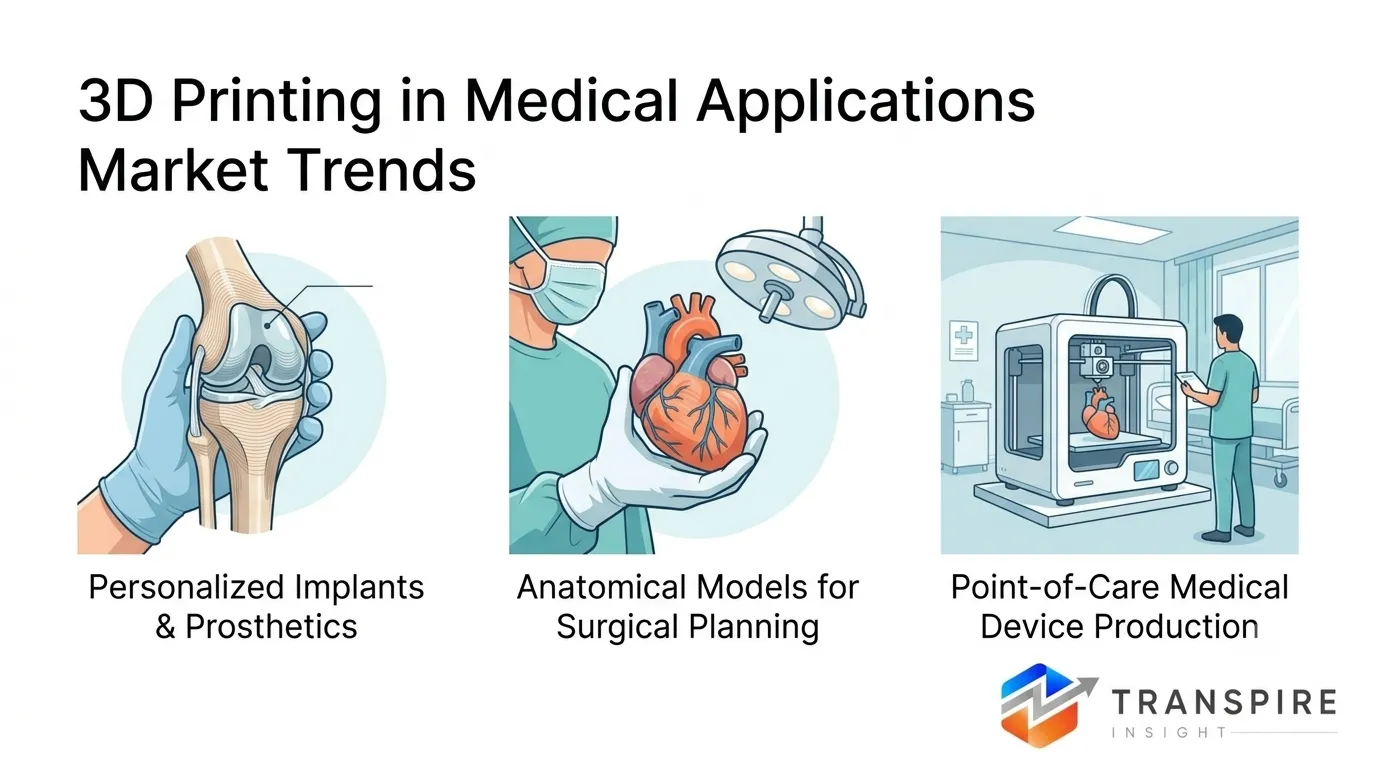
Description
According to a research report published by Transpire Insight, the 3D Printing in Medical Applications Market size is projected to grow from USD 3.56 billion in 2026 to USD 11.31 billion by 2035, at a CAGR of 18.21% during the forecast period 2027-2035. Surging demand for personalized, patient-specific medical implants, complex anatomical guides, and rapid prototyping in point-of-care surgical settings is accelerating market expansion.
Introduction
The 3D Printing in Medical Applications Market represents a transformational shift toward personalized, patient-centric healthcare, enabling precise custom prosthetics, complex implants, bioprinted tissue constructs, and tailored anatomical models. By leveraging advanced additive manufacturing techniques, such as stereolithography and powder bed fusion, clinicians can optimize surgical workflows and reduce patient recovery times. The market continues to experience accelerated adoption across major orthopedics, dental, and surgical centers worldwide.
Recent Development News
March 2026: 3D Systems achieved full-scope certification under the European Union Medical Device Regulation (EU MDR) 2017/745 for its comprehensive additive healthcare solutions.
May 2026: Open Bionics successfully fitted a full-length, 3D-printed multi-articulating bionic arm for an above-elbow amputee patient in the United Kingdom.
Stay Ahead of Emerging Opportunities with Expert Market Insights by Transpire Insight
Transpire Insight provides comprehensive, data-driven market intelligence to support smarter business decisions. Our research is rooted in comprehensive analysis, authoritative predictions, and industry expertise, enabling organizations to make informed decisions in rapidly evolving markets. We provide in-depth analysis of market segmentation, competitive positioning, regional trends, and emerging investment opportunities in high-growth areas. We blend accuracy with actionable intelligence, helping companies uncover new growth avenues, strengthen strategic decision-making, and stay ahead in a dynamic market.
3D Printing in Medical Applications Market Size & Statistics
The Market Size for 3D Printing in Medical Applications Was Estimated to be Worth USD 3.56 Billion in 2026.
The Market Size is Going to Expand at a CAGR of 18.21% between 2026 and 2035.
The 3D Printing in Medical Applications Market Size is anticipated to reach USD 11.31 Billion by 2035.
North America is projected to drive the highest demand during the forecast period, accounting for 48.02% of the 3D printing in medical applications market.
Asia-Pacific is projected to grow the fastest during the forecast period at a CAGR of 18.53% in the 3D printing in medical applications market.
Regional Growth and Demand Analysis by Transpire Insight
North America’s leadership rests on strong regulatory support and high clinical adoption, with hospitals treating 3D printing as routine care infrastructure rather than an experiment. The U.S. FDA classified software that creates patient-specific anatomical models for diagnostic use as a regulated Class II device, and Belgium-based Materialise became the first company to win clearance for such software through Mimics inPrint. This gave hospitals a clear route to build point-of-care print labs. Dental is another demand engine: Align Technology acquired Austria-based Cubicure to scale direct printing of custom orthodontic appliances, starting with the Invisalign Palatal Expander. Demand for implants, surgical guides, and anatomical models keeps rising, while Europe follows closely through its research hospitals and polymer printing specialists.
Asia-Pacific is scaling quickly because ageing populations, expanding hospital capacity, and supportive regulation are pulling additive manufacturing into mainstream orthopedics. In China, AK Medical became the first company to win NMPA approval for 3D-printed metal implants, then added eight GE Arcam EBM Q10plus printers to meet rising implant demand, and later secured registration for personalized 3D-printed pelvic defect implants. A joint NMPA and National Health Commission regulation on custom medical devices has further opened the path for patient-specific implants. China, Japan, and South Korea are also backing national additive manufacturing strategies, and growing procedure volumes and localized manufacturing are steadily narrowing the gap with Western markets.
Top 15 Trends in the 3D Printing in Medical Applications Market
Point-of-care 3D printing labs inside hospitals
Hospitals are building in-house print labs to produce anatomical models and guides on demand, cutting outsourcing delays, lowering costs, and giving surgeons faster, personalized preparation.
Patient-specific implants and prosthetics gaining mainstream clinical acceptance
Custom titanium and polymer implants matched to individual anatomy improve fit and recovery, encouraging orthopedic and spinal surgeons to choose printed solutions over mass-produced alternatives.
Bioprinting of tissues and organ models advancing
Researchers are printing living cells and biomaterials into tissue constructs and organ models, supporting drug testing, regenerative medicine, and the long-term goal of transplantable tissues.
AI-driven automated anatomical segmentation and design optimization
AI automates image segmentation and design optimization, converting CT and MRI scans into printable models faster, reducing manual engineering effort, improving consistency across patient-specific devices.
Direct-printed clear aligners and dental appliances scaling
Dental companies are shifting from mold-based workflows to direct printing of aligners and expanders, shortening production, reducing waste, and enabling mass customization at commercial scale.
Porous titanium implants improving bone integration
Lattice-structured titanium implants made by electron beam or laser melting mimic bone texture, promote osseointegration, and reduce implant weight in hip, knee, and spinal procedures.
List of Top 25 Companies Leading the Market
3D Systems
Industry pioneer delivering comprehensive additive manufacturing systems and patient-specific medical devices.
Founded: 1986 | HQ: Rock Hill, South Carolina, USA.
Why It Ranks: Market leader offering extensive FDA-cleared healthcare software, printers, and materials.
Regional Dominance: North America leads primary operations, expanding strongly across Western European healthcare markets.
Product Line: NextDent 3D printers, VSP surgical planning tools, and biocompatible resins.
Stratasys Ltd.
World leader in polymer 3D printing for anatomical models and dentures.
Founded: 1989 | HQ: Eden Prairie, Minnesota, USA / Rehovot, Israel.
Why It Ranks: Sets gold standard in full-color, multi-material anatomical modeling and dental solutions.
Regional Dominance: reach with strong market shares across North America and Europe.
Product Line: J750 Digital Anatomy printer, TrueDent monolithic denture resin, PolyJet materials.
Stryker Corporation
Orthopedic giant pioneering mass-customized and patient-matched 3D-printed titanium bone implants.
Founded: 1941 | HQ: Kalamazoo, Michigan, USA
Why It Ranks: High-volume commercial producer of additive orthopedic and joint reconstruction implant systems.
Regional Dominance: Dominates North American orthopedics with heavy clinical market expansion across Europe.
Product Line: Triathlon Total Knee System, Tritanium surgical cages, Mako SmartRobotics components.
Materialise NV
Backbone of medical 3D printing software, surgical guides, and planning tools.
Founded: 1990 | HQ: Leuven, Belgium.
Why It Ranks: Essential medical software suite used globally for converting patient CT data.
Regional Dominance: European powerhouse with extensive software footprint throughout Asia-Pacific and the Americas.
Product Line: Mimics Innovation Suite, Mimics Enlight, personalized craniomaxillofacial implants, bioresorbable splints.
Formlabs
Accessible stereolithography and SLS printer pioneer widely deployed in dental labs.
Founded: 2011 | HQ: Somerville, Massachusetts, USA.
Why It Ranks: Unmatched market adoption for desktop dental and surgical guide fabrication systems.
Regional Dominance: Rapidly growing footprint with dominant market share in point-of-care hospitals.
Product Line: Form 3B+, Fuse 1+ 30W, BioMed resins, surgical guide materials.
EOS GmbH
Industrial powder bed fusion leader supplying metal 3D printing for implants.
Founded: 1989 | HQ: Krailling, Germany.
Why It Ranks: Dominates high-end industrial titanium and cobalt-chrome orthopedic implant manufacturing worldwide.
Regional Dominance: European industrial stronghold with vast adoption across Asia-Pacific and North America.
Product Line: EOS M 290, EOS M 400 metal printers, medical-grade titanium powders.
SLM Solutions (Nikon SLM Solutions)
Pioneer in multi-laser selective laser melting technologies for medical metal production.
Founded: 2006 | HQ: Lübeck, Germany.
Why It Ranks: Unmatched build speeds for high-volume serial manufacturing of biocompatible implants.
Regional Dominance: Dominates European industrial sectors, rapidly gaining North American medical manufacturing clients.
Product Line: SLM 280, SLM 500, SLM 800 metal additive manufacturing systems.
GE Additive (Colibrium Additive)
Premier provider of Electron Beam Melting (EBM) technology for orthopedic implants.
Founded: 2016 | HQ: West Chester, Ohio, USA.
Why It Ranks: EBM technology creates porous surface textures ideal for biological bone ingrowth.
Regional Dominance: Strong presence across North America and Western Europe in orthopedic manufacturing.
Product Line: Arcam EBM Q10 plus, Spectra H, biocompatible titanium alloy powders.
Carbon, Inc.
Pioneer of Digital Light Synthesis technology for elastomeric and dental resin printing.
Founded: 2013 | HQ: Redwood City, California, USA.
Why It Ranks: Rapid production speeds for flexible partial dentures and custom patient hardware.
Regional Dominance: Heavy North American market concentration with growing European dental laboratory partnerships.
Product Line: M3 printer, FP3D flexible partial denture resin, biocompatible KeyPrint resins.
EnvisionTEC (Desktop Health)
Early innovator in high-precision DLP printing for dental models and hearing aids.
Founded: 2002 | HQ: Dearborn, Michigan, USA.
Why It Ranks: Decades of leadership in ultra-high-resolution dental and audiology 3D printing.
Regional Dominance: Widespread footprint across North America, Europe, and major Asian markets.
Product Line: Einstein 3D printer, Flexcera resins, SmileGuard, dental model polymers.
Conclusion
The 3D Printing in Medical Applications Market is experiencing rapid maturity, transitioning from early prototyping to standard point-of-care clinical manufacturing. Strategic regulatory approvals, material science innovations, and automated software workflows are driving widespread clinical integration. As key manufacturers expand production capabilities, patient-matched implants, custom prosthetics, and bioprinted tissues will redefine therapeutic precision, improve patient outcomes, and permanently reshape healthcare delivery models.


Send us a brief description of your challenge and we'll get back to you within 24 hours.

 inquiry@transpireinsight.com
 APAC:+91 7666513636
 Address


