
Sep 08, 2026
By Transpire Insight
Description
According to a research report published by Transpire Insight, the carbon-neutral Fuels market size is projected to grow from USD 234.6 billion in 2026 to USD 370.2 billion by 2035, at a CAGR of 8.3% during the forecast period 2027-2035. The market is expanding at an accelerated pace, with key regulatory and mandatory commitments, including net zero, aggressive corporate sustainability goals, and the introduction of blend quotas in aviation and shipping, as well as the technological developments of green hydrogen, DAC, and advanced biomass conversion.
Introduction
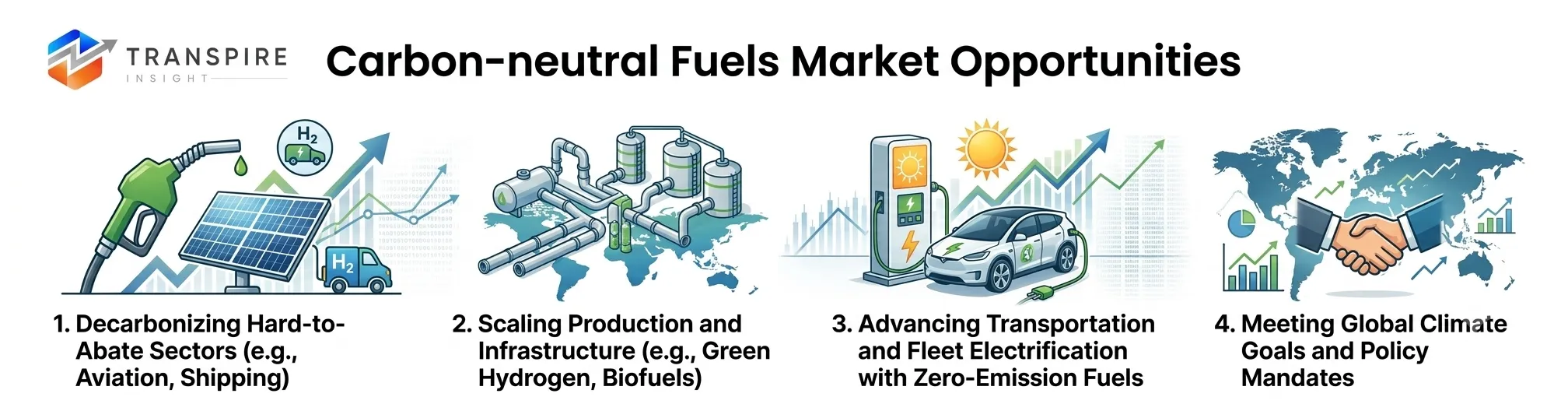
Fuels that are carbon neutral are all of the sustainable energy sources available, including biofuels, e-fuels, green synthetic hydrocarbons, and green hydrogen-based compounds. These drop-in fuels can leverage current combustion engine systems and infrastructure and play an important role as a transition fuel to decarbonize difficult-to-abate sectors such as aviation, shipping, and heavy transport. Strict climate rules and huge capital inflows have turned the market from pilot demonstration projects to commercial-scale deployment all over the world.
Recent Development News
Stay Ahead of Emerging Opportunities with Expert Market Insights by Transpire Insight
Transpire Insight provides comprehensive, data-driven market intelligence to support smarter business decisions. Our research is rooted in comprehensive analysis, authoritative predictions, and industry expertise, enabling organizations to make informed decisions in rapidly evolving markets. In-depth analysis of market segmentation, competitive positioning, regional trends, and emerging investment opportunities in high-growth areas. We blend accuracy with actionable intelligence, empowering companies to uncover new avenues for growth, bolster strategic decision-making, and stay ahead in a dynamic market.
Carbon-neutral Fuels Market Size & Statistics
Regional Growth and Demand Analysis by Transpire Insight
North America leads the carbon-neutral fuels market, anchored by strong policy support such as the U.S. The Low Carbon Fuel Standard in California gives additional momentum, and producers such as POET, plus Archer Daniels Midland, are increasing renewable diesel/ethanol production to keep up with the increasing demand in the transportation sector. In addition to the continued growth of industrial and power sector use, EIA has now reported increases in exports of renewable diesel and other biofuels in the region, reflecting the region's developing production base. Canada's concurrent efforts to develop hydrogen fuel further diversify the regional fuels portfolio, solidifying North America's position as a leader in hydrogen for transportation, industrial and power generation applications.
Asia Pacific is poised to grow at the fastest rate, driven by the aggressive decarbonization initiatives in China and the growing renewable fuel mandates in other parts of the region, including in Japan, South Korea and Australia. In Japan and South Korea, hydrogen economy roadmaps and research and development partnerships are progressing to make ammonia and green hydrogen viable fuels for the marine and power sectors, respectively, and Australia has a wide range of renewable resources to expand the production of green hydrogen for export markets. The biorefinery know-how is being introduced to the region by companies like Neste, while new blending mandates for bioethanol and biodiesel in emerging economies such as India expand feedstock options, but there remains a significant infrastructure shortfall. In Asia Pacific, investment in electrofuels and Power-to-Liquid plants continues to build momentum on an institutional, private, and public level, continuing to close the gap with conventional fuels and solidifying the region's growth trajectory as the center for the most incremental demand.
Top 15 Trends in the Carbon-neutral Fuels Market
Airlines and refiners are rapidly expanding sustainable aviation fuel capacity, driven by blending mandates, airline offtake agreements, and government incentives targeting aviation's hard-to-abate emissions worldwide.
Electrolyzer costs are falling as manufacturing scales, enabling green hydrogen to feed ammonia, methanol, and synthetic fuel pathways that decarbonize shipping, aviation, and heavy industry.
Power-to-Liquid plants are scaling rapidly from pilot to commercial size, converting renewable power and captured carbon into practical, engine-ready e-diesel, e-kerosene, and e-gasoline replacements today.
Expanding carbon pricing mechanisms and emissions trading schemes are raising the cost of fossil fuels, making carbon-neutral alternatives increasingly competitive across transportation and industrial sectors.
Corporate net-zero commitments are steadily driving long-term offtake agreements with carbon-neutral fuel producers, providing bankable demand certainty that unlocks financing for new production facilities worldwide.
Japan and South Korea are advancing national hydrogen economy roadmaps, pairing government-backed research partnerships with import infrastructure to secure long-term green hydrogen and ammonia supply.
Top 25 Companies Leading the Carbon-neutral Fuels Market
1. Neste
World’s largest producer of renewable diesel and sustainable aviation fuel today.
Founded: 1948 | HQ: Espoo, Finland.
Why It Ranks: Market pioneer in commercializing waste and residue transformation into low-carbon fuels.
Regional Dominance: Europe and North America through extensive refining and distribution networks.
Product Line: Neste MY Renewable Diesel and Neste MY Sustainable Aviation Fuel.
2. World Energy
Operates one of the world's first commercial sustainable aviation fuel plants.
Founded: 1998 | HQ: Boston, Massachusetts, USA.
Why It Ranks: Early mover with major long-term contracts across major commercial airlines.
Regional Dominance: North America with expanding export capabilities across transatlantic shipping networks.
Product Line: Sustainable Aviation Fuel (SAF), Renewable Diesel, and Renewable Naphtha.
3. Prometheus Fuels
Uses direct air capture photo-engineering to create zero-net-carbon liquid fuels directly.
Founded: 2019 | HQ: Santa Cruz, California, USA.
Why It Ranks: High disruption potential by eliminating traditional thermal processing steps in e-fuels.
Regional Dominance: North America, backed by major automotive and tech venture partnerships.
Product Line: Electro-gasoline, Electro-diesel, and Electro-jet fuel synthesized from ambient air.
4. Infinium
Produces ultra-low carbon electro-fuels using captured carbon dioxide and green hydrogen.
Founded: 2020 | HQ: Sacramento, California, USA.
Why It Ranks: Commercial-scale e-fuel facilities backed by major logistics and energy giants.
Regional Dominance: North America and Europe across key transportation and industrial decarbonization hubs.
Product Line: Infinium Electrofuels including e-SAF, e-Diesel, and clean eco-naphtha chemicals.
5. HIF (Highly Innovative Fuels)
Built the Haru Oni pilot e-fuel production facility in southern Chile.
Founded: 2021 | HQ: Houston, Texas, USA.
Why It Ranks: leader in scaling commercial-scale e-gasoline for automotive and transport markets.
Regional Dominance: Latin America and North America, with massive industrial project operations worldwide.
Product Line: Carbon-neutral synthetic gasoline, e-Methanol, and drop-in e-Fuels for mobility.
6. LanzaTech
Recycles industrial carbon emissions into valuable liquid drop-in fuels using gas fermentation.
Founded: 2005 | HQ: Skokie, Illinois, USA.
Why It Ranks: Revolutionary biological platform turning steel mill carbon waste into low-carbon jet fuel.
Regional Dominance: presence with commercial plants operating in China, Europe, and the USA.
Product Line: Carbon-recycled ethanol, synthetic aviation fuel (LanzaJet platform), and sustainable chemicals.
7. Synhelion
Solar-to-liquid technology pioneer leveraging high-temperature solar heat to synthesize carbon-neutral fuels.
Founded: 2016 | HQ: Zurich, Switzerland.
Why It Ranks: First company to scale solar thermal power generation for synthetic drop-in fuel production.
Regional Dominance: Europe with strategic scaling plans targeting high-insolation desert regions globally.
Product Line: Solar-derived kerosene, synthetic gasoline, and low-carbon diesel for aviation and freight.
8. Ceres Power
World-leading developer of high-efficiency solid oxide electrolysis for green hydrogen and fuels.
Founded: 2001 | HQ: Horsham, United Kingdom.
Why It Ranks: Core technology licensor empowering engineering giants to build clean synthetic fuel systems.
Regional Dominance: Europe and Asia through high-profile manufacturing licensing partnerships across markets.
Product Line: Steel Cell solid oxide electrolyzers (SOEC) and fuel cell technology platforms.
9. Climeworks
leader in Direct Air Capture (DAC) technology filtering atmospheric carbon dioxide.
Founded: 2009 | HQ: Zurich, Switzerland.
Why It Ranks: Essential feedstock supplier of pure atmospheric CO2 required for circular e-fuel synthesis.
Regional Dominance: Europe and North America, operating the world's largest commercial DAC installations.
Product Line: Direct Air Capture infrastructure and pure atmospheric carbon feedstock solutions.
10. LanzaJet
Dedicated sustainable fuels company commercializing alcohol-to-jet technology for aviation markets.
Founded: 2020 | HQ: Deerfield, Illinois, USA.
Why It Ranks: Operates a first-of-a-kind commercial plant turning low-carbon ethanol into sustainable aviation fuel.
Regional Dominance: North America with expansive technology deployment licensing agreements across Europe and Asia.
Product Line: LanzaJet Freedom Pines Sustainable Aviation Fuel (SAF) and Renewable Diesel.
Conclusion
The carbon-neutral fuels market is one of the key components of the energy transition. Drop-in solutions combine cutting-edge renewable production technologies with established distribution systems to provide a practical avenue for fast decarbonisation in aviation, marine and industrial applications. With rising international regulations, declining production expenses, and robust corporate investments, carbon-neutral synthetic fuels are set to transform the fuel supply landscape and push the pace of the net-zero journey.


Send us a brief description of your challenge and we'll get back to you within 24 hours.

 inquiry@transpireinsight.com
 APAC:+91 7666513636
 Address


