
Aug 28, 2026
By Transpire Insight
Description
According to a research report published by Transpire Insight, the blockchain in agriculture and food supply chain market size is projected to grow from USD 3.9 billion in 2026 to USD 18.23 billion by 2035, at a CAGR of 37.14% during the forecast period 2026-2035. Market growth is stimulated by increasing food fraud incidents, the need for end-to-end food traceability, and strict regulatory requirements such as the FDA FSMA Rule 204. Furthermore, IoT sensor connectivity and consumer preference for farm-to-fork transparency propel adoption into agrifood enterprises.
Introduction
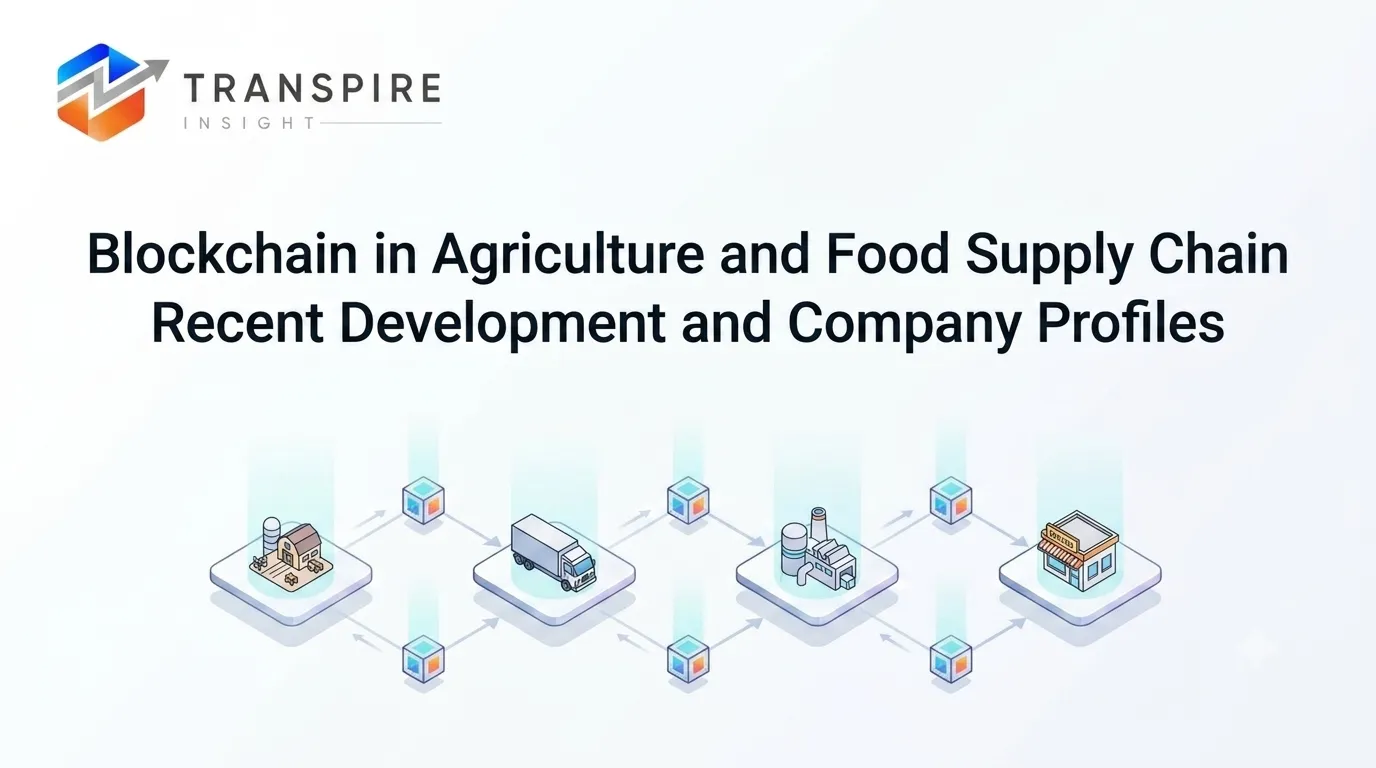
The adoption of blockchain in agriculture and the food supply chain is transforming the agrifood world, creating an immutable and decentralized ledger capable of providing full traceability. Blockchain tracks the necessary events from cultivation to retail sale, thereby reducing product recall response time and improving food safety by eliminating data tampering. With regulatory requirements becoming more stringent and consumer awareness of food origin growing, agribusinesses are moving from the pilot phase to enterprise deployments, establishing a very interconnected, efficient, and transparent food production world.
Recent Development News
Stay Ahead of Emerging Opportunities with Expert Market Insights by Transpire Insight
Transpire Insight provides comprehensive, data-driven market intelligence to support smarter business decisions. Our research is rooted in comprehensive analysis, authoritative predictions, and industry expertise, enabling organizations to make informed decisions in rapidly evolving markets. In-depth analysis of market segmentation, competitive positioning, regional trends, and emerging investment opportunities in high-growth areas. We blend accuracy with actionable intelligence, empowering companies to uncover new avenues for growth, bolster strategic decision-making, and stay ahead in a dynamic market.
Download the exclusive Blockchain in Agriculture and Food Supply Chain Market sample report today to explore expert insights, key trends, and emerging opportunities shaping the future of the industry.
Blockchain in Agriculture and Food Supply Chain Market Size & Statistics
Regional Growth and Demand Analysis by Transpire Insight
The North American region is projected to capture maximum market share in the blockchain in agriculture and food supply chain market with a 41% share in the forecast period. The U.S. and Canada remain the leaders of the region, with a significant ecosystem of agri-tech innovators, cloud infrastructure providers, and food companies like IBM, Microsoft, and SAP paving the way for enterprise-grade blockchain adoption. Agribusinesses are increasingly being held accountable for food safety and compliance and are already under pressure to move to product tracking and systems that comply with the ever-tightening regulations for traceability based on blockchain. The demand is still high, with the rate of IoT-AI integration on the rise and an increasing number of midscale U.S. farms implementing blockchain technology for traceability, as well as the widespread adoption of AI-based supply chain tracking tools and continued demand for these technologies in crop production, food processing, and retail distribution networks. The advantages of North America's leadership are that there is an advanced agri-tech ecosystem, early adoption of smart farming practices, and a strong foundation of blockchain solution providers and system integrators.
Asia Pacific is expected to witness the highest growth rate at an estimated 37% in the blockchain in agriculture and food supply chain market during the forecast period. The region's rapid growth is fuelled by large-scale agriculture production, digital agriculture projects supported by the governments of China, India, Japan and South Korea, and technology investment. The adoption of blockchain-based traceability platforms is gaining momentum across the region, aided by various factors like decreasing installed base, increasing penetration of smartphones and internet, and increasing export verification requirements for fair trade. This demand is further bolstered by the growing capacity of local food systems to make digital transactions and procure, the expansion of fair-trade and cold-chain verification services by regional consortia, and the growing use of smart contract-based transaction systems and IoT-enabled monitoring by enterprises. Asia Pacific is expected to continue to lead the digitalization of agriculture, with a marked increase in the modernization of food supply chains. The region of Asia Pacific is expected to lead the growth of the market for agriculture digitization, as digitization of agriculture and food supply chains is expected to grow at a higher pace.
Top 15 Trends in Blockchain in Agriculture and Food Supply Chain Market
Proceed to checkout to purchase the exclusive Blockchain in Agriculture and Food Supply Chain Market report and get instant access to detailed market insights, strategic analysis, and future growth opportunities.
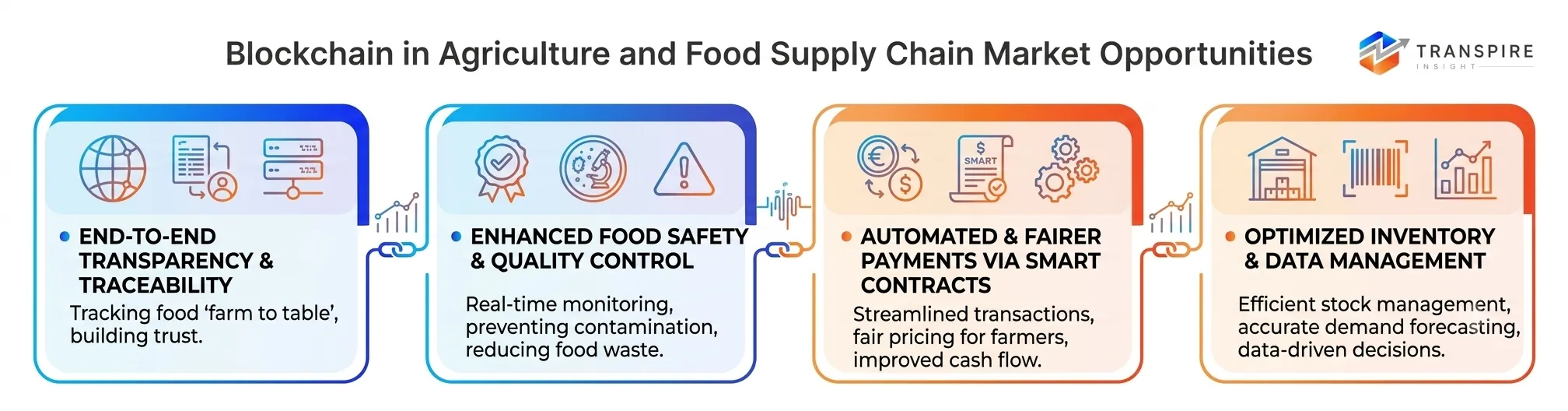
Combining IoT sensors with AI analytics enables continuous, real-time tracking of produce from farm to retail, improving accuracy and transparency significantly.
Retailers and brands increasingly use scannable QR codes so consumers can instantly verify origin, handling, and authenticity, boosting trust and purchase confidence.
Self-executing smart contracts automatically trigger payments and settlements once predefined supply chain conditions are met, reducing delays, disputes, and administrative overhead.
Startups are linking regenerative farming data to blockchain-verified carbon credit trading, letting farmers earn extra income while proving sustainable practices to buyers.
Blockchain-enabled visibility across checkpoints helps identify inefficiencies and spoilage points, directly targeting the substantial food loss occurring before products reach retail.
Public agencies are mandating or incentivizing blockchain-based digital agriculture standards to improve compliance, cross-border trade verification, and national food-safety data systems.
List of Top 25 Companies Leading the Blockchain in Agriculture and Food Supply Chain Market
Customize the exclusive Blockchain in Agriculture and Food Supply Chain Market report to receive insights tailored to your needs, including country-specific analysis and business-focused market intelligence.
IBM pioneers enterprise food tracking using immutable ledgers across retail networks.
Founded: 1911 | HQ: Armonk, New York, USA.
Why It Ranks: Dominates enterprise adoption through massive retail and supplier network platform integrations.
Regional Dominance: Maintains a commanding market footprint across North America and Western European regions.
Product Line: IBM Food Trust platform provides real-time provenance, certification, and inventory tracking solutions.
Microsoft integrates blockchain solutions with Azure IoT for smart agriculture operational visibility.
Founded: 1975 | HQ: Redmond, Washington, USA.
Why It Ranks: Delivers massive cloud infrastructure scale combined with enterprise supply chain ledger security.
Regional Dominance: Leads cloud-based agricultural blockchain deployments across North America and European commercial markets.
Product Line: Azure Confidential Ledger and Azure IoT Central drive end-to-end transparent traceability systems.
SAP embeds blockchain technology into enterprise ERP systems for food supply tracking.
Founded: 1972 | HQ: Walldorf, Germany.
Why It Ranks: Unmatched integration across corporate enterprise resource planning and logistics software networks.
Regional Dominance: Commands strong market presence throughout Western Europe and Latin American trade sectors.
Product Line: SAP Logistics Business Network provides transparent material traceability and order tracking functionality.
Oracle offers enterprise-grade blockchain tables and smart contracts for agrifood tracking workflows.
Founded: 1977 | HQ: Austin, Texas, USA.
Why It Ranks: Provides seamless database integration for food supply chain auditing and regulatory compliance.
Regional Dominance: Holds substantial enterprise market share across North America and Asia-Pacific trade regions.
Product Line: Oracle Blockchain Platform enables secure multi-party agrifood supply chain transaction verification workflows.
VeChain powers public enterprise blockchain infrastructure for sustainable food provenance systems.
Founded: 2015 | HQ: San Marino (Operations: Singapore).
Why It Ranks: Offers low-cost public ledger scalability with specialized IoT hardware tag device integration.
Regional Dominance: Dominates agricultural supply chain trace projects across China and East Asian markets.
Product Line: VeChain ToolChain delivers rapid turnkey blockchain integration for agrifood enterprise businesses.
TE-FOOD processes millions of food traceability transactions daily for livestock and crops.
Founded: 2016 | HQ: Darmstadt, Germany.
Why It Ranks: Specializes in end-to-end farm-to-table public verification for emerging and mature consumer markets.
Regional Dominance: Holds leading livestock and food tracking footprint across Europe and Southeast Asia.
Product Line: FoodChain ledger, B2B mobile applications, and consumer web verification software platform tools.
OriginTrail creates decentralized knowledge graphs connecting agricultural supply chain data asset streams.
Founded: 2013 | HQ: Ljubljana, Slovenia.
Why It Ranks: Blends knowledge graph architecture with blockchain verification for complex supply data networks.
Regional Dominance: Highly dominant across European Union agricultural cooperatives and retail supply chain networks.
Product Line: Decentralized Knowledge Graph platform for verified product provenance and ESG compliance tracking.
AgriDigital digitizes grain supply chains using smart contracts and commodity management technology.
Founded: 2015 | HQ: Sydney, Australia.
Why It Ranks: Leads real-time grain payment processing and digital inventory management for agricultural farmers.
Regional Dominance: Dominates bulk commodity and grain tracking operations across Australia and New Zealand.
Product Line: AgriDigital Cloud platform and Waypath digital grain inventory management technology software tools.
R3 Corda enables permissioned enterprise ledger operations for trade finance and agriculture.
Founded: 2014 | HQ: New York City, New York, USA
Why It Ranks: Preferred permissioned network infrastructure for institutional agricultural trade finance settlement transaction systems.
Regional Dominance: Strong market position across financial hubs in North America and Europe.
Product Line: Corda Enterprise platform for confidential agricultural commodity settlement and smart contract execution.
Ambrosus combines IoT hardware sensors with blockchain for food quality asset tracking.
Founded: 2017 | HQ: Zug, Switzerland.
Why It Ranks: Excels in high-precision temperature control and real-time perishable food logistics tracking solutions.
Regional Dominance: Prominent across European organic food distribution and pharmaceutical cold chain logistics sectors.
Product Line: AMB-NET decentralized protocol for supply chain sensor recording and product verification networks.
Schedule a meeting with our market experts to discuss the exclusive Blockchain in Agriculture and Food Supply Chain Market report and find the right research solution for your business.
Conclusion
In the agrifood supply chain market, the blockchain is making a structural paradigm shift: from a series of pilots to a key backbone for agrifood trade. A distributed ledger is being adopted at scale by market leaders, given several key growth drivers such as compulsory international food safety laws, integration of IoT sensors, and increasing demands for ESG compliance. The more transparent the tracking of food from farm to fork, the more food safety will be guaranteed for good, forever, and the ever-greater interoperability and low deployment cost of public, private, and hybrid blockchain architectures will contribute to consumer confidence.


Send us a brief description of your challenge and we'll get back to you within 24 hours.

 inquiry@transpireinsight.com
 APAC:+91 7666513636
 Address


