
Aug 19, 2026
By Transpire Insight
Description
According to a research report published by Transpire Insight, the battery energy storage system market size is projected to grow from USD 61.89 billion in 2026 to USD 140.26 billion by 2035, at a CAGR of 20.36% during the forecast period 2026-2035. Rapid grid integration of renewable energy, falling lithium-ion production costs, urgent grid-stabilization needs, and soaring demand for power backup in AI data centers are driving expansion.
Introduction
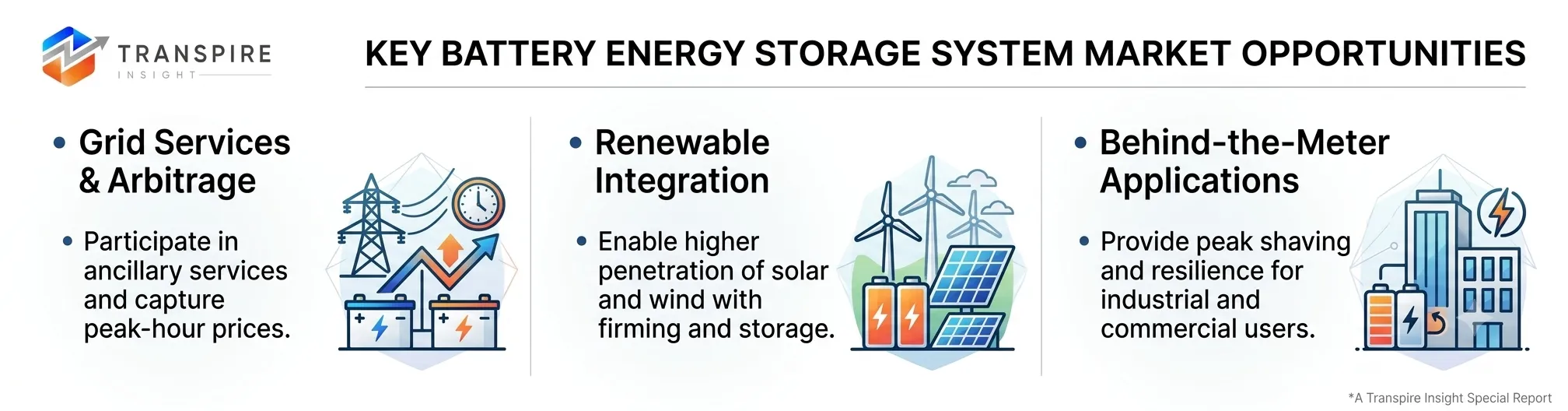
The Battery Energy Storage System (BESS) market is a significant foundation of the energy transition. BESS prevents power surges, stabilizes energy production, and increases overall energy system reliability by storing the electricity produced from solar and wind power sources, which are intermittent in nature. Technological progress and significant reductions in the cost of lithium-iron-phosphate (LFP) chemistry have driven rapid progress toward deployment of the technology globally in both utility and commercial applications. BESS allows for the implementation of utilities' strategy to deplete peak-load fossil fuel energy infrastructure and to seamlessly integrate clean energy into modern power grids.
Recent Development News
Stay Ahead of Emerging Opportunities with Expert Market Insights by Transpire Insight
Transpire Insight provides comprehensive, data-driven market intelligence to support smarter business decisions. Our research is rooted in comprehensive analysis, authoritative predictions, and industry expertise, enabling organizations to make informed decisions in rapidly evolving markets. In-depth analysis of market segmentation, competitive positioning, regional trends, and emerging investment opportunities in high-growth areas. We blend accuracy with actionable intelligence, empowering companies to uncover new avenues for growth, bolster strategic decision-making, and stay ahead in a dynamic market.
Download the exclusive Battery Energy Storage System Market sample report today to uncover expert insights, emerging trends, and the opportunities defining the future of the industry.
Battery Energy Storage System Market Size & Statistics
Regional Growth and Demand Analysis by Transpire Insight
The battery energy storage system market is estimated to witness the highest demand during the forecast period in Asia Pacific. Asia Pacific leads in regional demand as this growth is supported by manufacturing output and cumulative deployments, anchored by China's dominant cell production and large domestic procurements. The region's leadership is further reinforced by aggressive government-backed procurement: China's grid storage mandate has created the world's largest systematic BESS procurement, combined with CATL and BYD manufacturing dominance, driving the world's largest BESS market, while expanding electrification goals to power remote areas, coupled with significant grid enhancement efforts in Japan, Australia, South Korea, and India, are boosting demand further.
North America is expected to witness the highest growth in the battery energy storage system market during the forecast period. North America is growing at the fastest pace, with a CAGR of 27.12%, fueled by U.S. federal incentives and state-level grid reliability targets. This is echoed elsewhere in the market, where North America is projected to register the highest CAGR in the market through the forecast period. Growth in the region is also being driven at the sub-regional level, as Mexico is expected to register the highest CAGR of any country from 2025 to 2030, supported by industrial applications, the most lucrative and fastest-growing segment during the forecast period.
Top 15 Trends in the BESS Market
Proceed to Checkout to purchase the exclusive Battery Energy Storage System Market report and gain instant access to in-depth market intelligence, strategic analysis, and future growth opportunities.
Annual long-duration storage additions are set to quadruple to 2 gigawatts in 2026, mostly via non-lithium-ion technologies concentrated in China.
Sodium-ion capital costs currently range $55-70/kWh, projected to fall to $40-55/kWh by 2028, undercutting lithium-ion baseline costs significantly.
2026's leading trends include AI-driven power demand management alongside grid-forming controls and performance-based procurement approaches for smarter storage operation.
Rapid utility-scale deployment continues as a top 2026 trend, with buyers increasingly evaluating longer four-to-eight-hour discharge systems for evening peaks.
The industry is shifting from lithium-ion toward specialized chemistries including sodium-ion, redox flow, metal-air, liquid metal, and metal-hydrogen systems.
Supply-chain localization and stronger safety requirements are reshaping sourcing strategies as manufacturers reduce dependence on concentrated raw-material regions.
List of Top 25 Companies Leading the Battery Energy Storage System Market
Customize the exclusive Battery Energy Storage System Market report today to receive tailored insights, country-specific analysis, and business-focused market intelligence.
1. CATL (Contemporary Amperex Technology Co., Ltd.)
World’s largest battery manufacturer supplying grid-scale energy storage projects.
Founded: 2011 | HQ: Ningde, China.
Why It Ranks: Unrivaled cell manufacturing capacity and cutting-edge sodium-ion BESS innovations.
Regional Dominance: Dominates Asia-Pacific while heavily capturing European utility storage market shares.
Product Line: EnerOne outdoor liquid-cooling systems and high-density TENER containerized platforms.
2. BYD Company Ltd.
Vertically integrated manufacturer covering every step from battery chemistry to systems.
Founded: 1995 | HQ: Shenzhen, China.
Why It Ranks: Pioneer of safety-focused LFP Blade battery technology for utility systems.
Regional Dominance: Leads domestic Chinese infrastructure while expanding across Latin America and Europe.
Product Line: BYD Cube T28, MC Cube-T, and residential EnergyPod storage systems.
3. Tesla, Inc.
Fastest-growing utility-scale energy storage integrator with massive Megafactory production sites.
Founded: 2003 | HQ: Austin, Texas, USA.
Why It Ranks: Market benchmark for utility-scale Megapack systems paired with proprietary software.
Regional Dominance: Holds leading market share across North American and Australian grid deployments.
Product Line: Megapack 2 XL utility systems, Powerwall 3, and Autobidder software.
4. Fluence Energy, Inc.
Pure-play storage joint venture formed by industry giants Siemens and AES.
Founded: 2018 | HQ: Arlington, Virginia, USA.
Why It Ranks: Top system integrator offering software-driven asset optimization and monitoring.
Regional Dominance: Dominates North American and European grid stability and ancillary service markets.
Product Line: Gridstack utility systems, Sunstack solar-plus-storage, and Fluence OS cloud software.
5. LG Energy Solution
South Korean energy giant supplying high-density lithium-ion cells globally.
Founded: 2020 (spin-off) | HQ: Seoul, South Korea.
Why It Ranks: Leading provider of integrated storage enclosures and high-nickel cell chemistries.
Regional Dominance: Strong market presence across North America, South Korea, and Western Europe.
Product Line: JF1 LFP containerized utility systems and RESU residential battery series.
6. Samsung SDI Co., Ltd.
Premium battery maker specializing in advanced thermal propagation protection design.
Founded: 1970 | HQ: Yongin, South Korea.
Why It Ranks: Industry leader in safety engineering with advanced liquid-cooled cabinet designs.
Regional Dominance: Captures significant market share in North American and European utility projects.
Product Line: Samsung Battery Box (SBB) liquid-cooled containers and commercial ESS modules.
7. Powin Energy
Leading utility-scale battery management system innovator and complete hardware integrator.
Founded: 1989 | HQ: Tualatin, Oregon, USA.
Why It Ranks: Proprietary StackOS platform delivers long-duration energy storage integration and efficiency.
Regional Dominance: Strong core footprints throughout the United States, Canada, and Latin America.
Product Line: Centrax energy platforms, Stack750 utility systems, and StackOS control software.
8. Saft (TotalEnergies)
Specialized industrial battery subsidiary delivering ruggedized energy storage for harsh environments.
Founded: 1918 | HQ: Levallois-Perret, France.
Why It Ranks: Backed by TotalEnergies to deliver customizable, highly reliable containerized solutions.
Regional Dominance: Dominates Western European grid-scale markets and off-grid remote mining operations.
Product Line: Intensium Shift lithium-ion containers and modular cold-weather battery systems.
9. Sungrow Power Supply Co., Ltd.
inverter titan that successfully transitioned into an energy storage powerhouse.
Founded: 1997 | HQ: Hefei, China.
Why It Ranks: Seamless hardware integration combining central inverters directly with liquid-cooled storage.
Regional Dominance: Leads key installations across Asia-Pacific, the Middle East, and Australia.
Product Line: PowerTitan liquid-cooled utility systems and PowerStack commercial battery storage platforms.
10. Envision Energy
Greentech pioneer integrating wind turbines, smart storage, and artificial intelligence.
Founded: 2007 | HQ: Shanghai, China.
Why It Ranks: Multi-pillar cleantech leader recognized globally for software-integrated smart grid storage.
Regional Dominance: Dominant footprint across Asia-Pacific with rapid grid expansion into Europe.
Product Line: EnOS smart storage software, high-capacity BESS containers, and cell technologies.
Schedule a meeting with our market experts to discuss the exclusive Battery Energy Storage System Market report and identify the best research solution for your organization.
Conclusion
The Battery Energy Storage System market is moving from a fledgling technology to the foundation of today's power grid. BESS provides resilience and flexibility to deliver a continuous power supply to utilities as they transition away from aging fossil fuel generation towards intermittent renewables. Cost barriers are still coming down thanks to cell innovations, such as sodium-ion and LFP chemistries, and the software that runs on AI. Future investments in BESS will continue to play a vital role in the decarbonization of grids and supporting the next-generation digital infrastructure globally, while also helping to achieve power system stability.


Send us a brief description of your challenge and we'll get back to you within 24 hours.

 inquiry@transpireinsight.com
 APAC:+91 7666513636
 Address


