
Sep 02, 2026
By Transpire Insight
Description
According to a research report published by Transpire Insight, the autotransfusion devices market size is projected to grow from USD 576.2 billion in 2026 to USD 839.6 billion by 2035, at a CAGR of 9.8% during the forecast period 2026-2035. Rising surgical procedure volumes, severe donor blood shortages, and heightened concerns over allogeneic transfusion risks drive market adoption. Advanced intraoperative cell salvage technologies and growing hospital focus on patient blood management cost savings further accelerate autotransfusion device demand worldwide.
Introduction
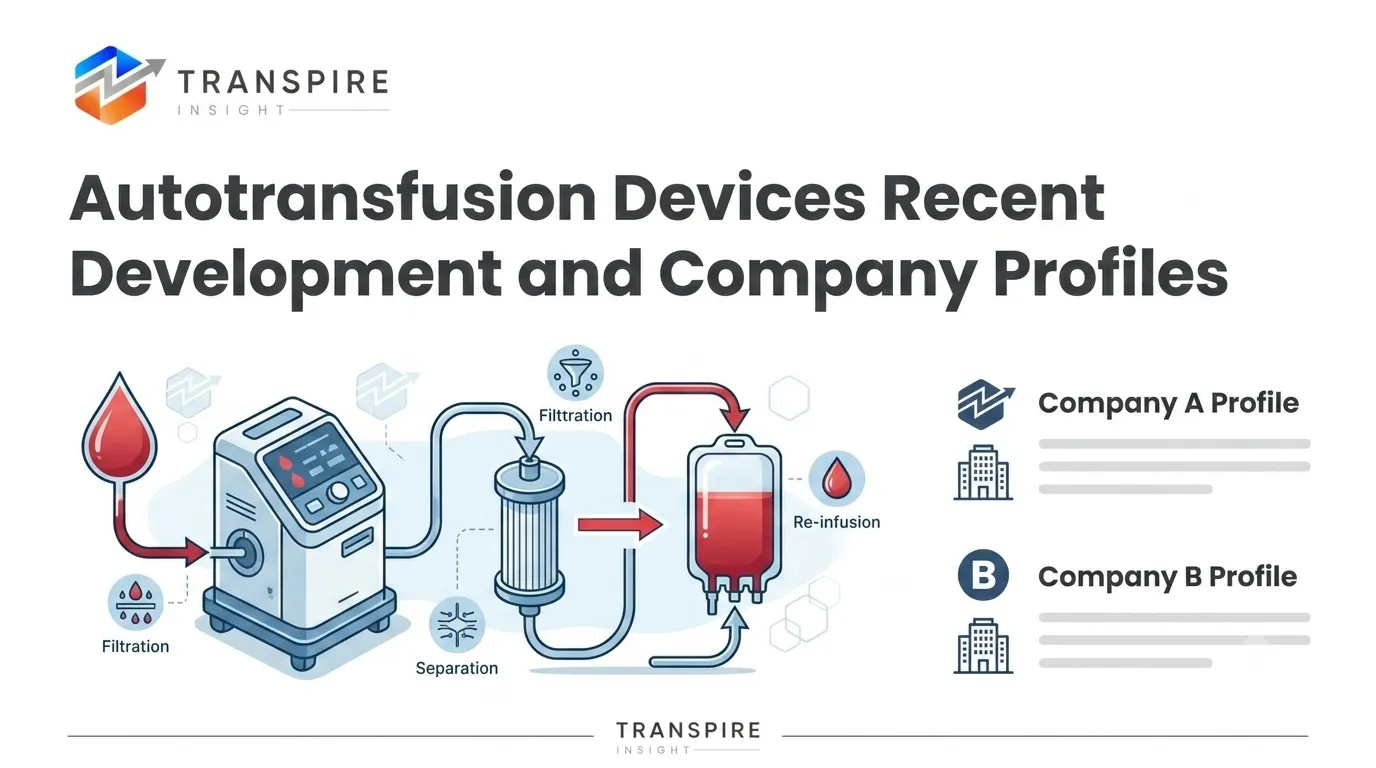
The autotransfusion devices market is expanding rapidly as healthcare facilities prioritize patient safety and blood conservation strategies during complex surgical procedures. Autotransfusion systems collect, process, and reinfuse a patient’s own blood lost during surgery, significantly mitigating infection risks, immunological reactions, and reliance on donor blood banks. Driven by rising prevalence of cardiovascular, orthopedic, and trauma surgeries alongside continuous technological advancements in automated cell salvage equipment, these devices play a vital role in modern perioperative care, enhancing clinical outcomes while reducing overall hospital operational expenditure.
Recent Development News
Stay Ahead of Emerging Opportunities with Expert Market Insights by Transpire Insight
Transpire Insight provides comprehensive, data-driven market intelligence to support smarter business decisions. Our research is rooted in comprehensive analysis, authoritative predictions, and industry expertise, enabling organizations to make informed decisions in rapidly evolving markets. In-depth analysis of market segmentation, competitive positioning, regional trends, and emerging investment opportunities in high-growth areas. We blend accuracy with actionable intelligence, empowering companies to uncover new avenues for growth, bolster strategic decision-making, and stay ahead in a dynamic market.
AutotransfusionDevices Market Size & Statistics
Regional Growth and Demand Analysis by Transpire Insight
North America's dominance rests on a mature surgical ecosystem, with cardiovascular, orthopedic, transplant, and trauma procedures occurring at high volumes across the United States and Canada. Hospitals in the region have moved early to adopt blood conservation protocols, spurred by concerns around transfusion-transmitted infection risk and chronic donor shortages. Favorable reimbursement frameworks, a dense concentration of established device manufacturers such as Haemonetics, LivaNova, and Medtronic, and continuous rollout of compact, ambulatory-compatible cell salvage systems have reinforced this lead. Regulatory clarity from bodies like the FDA has also encouraged faster uptake of next-generation autotransfusion platforms in acute-care and outpatient settings alike.
Asia Pacific's rapid ascent is being driven by a different set of forces. Countries including China, India, and Japan are witnessing a steep rise in surgical case volumes tied to cardiovascular disease burden, an aging population, and expanding hospital infrastructure. Government-backed healthcare modernization programs and growing insurance penetration are making advanced blood management technology more accessible outside metropolitan hospitals. Local manufacturers are also entering the space with lower-cost device variants, while multinational players are establishing regional manufacturing and distribution tie-ups to capture this underpenetrated demand base, positioning the region as the market's clearest growth frontier.
Top 15 Trends in the Autotransfusion Devices Market
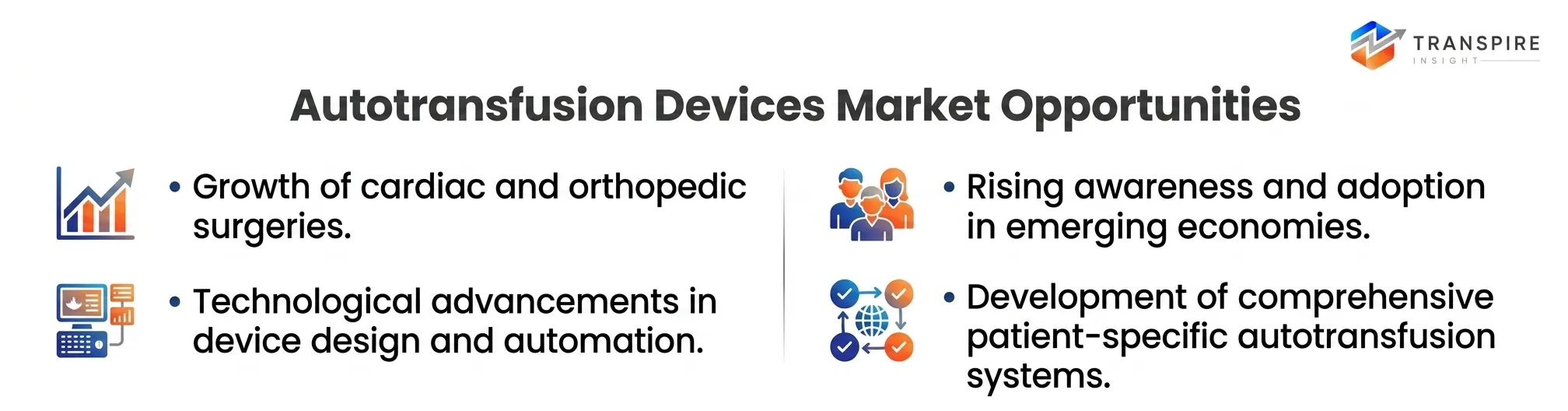
Smaller, mobile devices are gaining traction as ambulatory surgical centers and outpatient facilities seek efficient blood conservation tools without the footprint of traditional hospital-grade equipment.
ASCs are handling a growing share of orthopedic, ophthalmic, and general surgeries, creating steady demand for autotransfusion devices suited to faster-turnaround, cost-conscious surgical settings.
Rising incidence of heart disease and joint disorders worldwide is increasing the frequency of blood-loss-intensive procedures, directly lifting demand for intraoperative cell salvage technology.
Hospitals are institutionalizing blood conservation protocols to cut donor-blood dependency, reduce transfusion risk, and control costs, embedding autotransfusion devices into standard surgical workflow.
Persistent gaps between donor supply and clinical need are pushing healthcare systems toward autologous blood recovery technologies as a dependable, infection-risk-reducing alternative.
Closed systems minimize contamination exposure and processing steps, appealing to surgical teams prioritizing safety, procedural efficiency, and compliance with sterile-technique standards.
Top 25 Companies Leading the Autotransfusion Devices Market
1. Haemonetics Corporation
medical technology provider focusing on innovative blood management and processing solutions.
Founded: 1971 | HQ: Boston, Massachusetts, USA.
Why It Ranks: Market leader in automated intraoperative cell salvage systems and perioperative software.
Regional Dominance: North America leads primary market share, with expanding presence across Europe.
Product Line: Cell Saver Elite systems, blood processing disposables, and diagnostic software suites.
2. Medtronic plc
World's largest medical technology firm delivering comprehensive cardiovascular and surgical solutions.
Founded: 1949 | HQ: Dublin, Ireland.
Why It Ranks: High reliability in cardiac surgery autotransfusion and extensive distribution network.
Regional Dominance: reach spanning North America, Western Europe, and key Asian markets.
Product Line: autoLog IQ autotransfusion systems, cell salvage reservoirs, and surgical tubing sets.
3. Fresenius SE & Co. KGaA
Diversified healthcare group providing essential medicines, dialysis, and surgical infusion equipment.
Founded: 1912 | HQ: Bad Homburg, Germany.
Why It Ranks: Industry benchmark for advanced filtration technology and high-volume blood conservation devices.
Regional Dominance: Strong market presence in Europe, Latin America, and expanding Asian regions.
Product Line: CATS continuous autotransfusion systems, leukocyte filters, and postoperative drainage kits.
4. LivaNova PLC
Leading medical technology pioneer specializing in cardiac surgery and neuromodulation devices.
Founded: 2015 | HQ: London, United Kingdom.
Why It Ranks: Major innovator in cardiopulmonary bypass technologies and integrated intraoperative cell salvage.
Regional Dominance: Strong commercial foothold across North America, Europe, and major South American centers.
Product Line: Electa autotransfusion systems, intraoperative cell salvage consumables, and venous reservoirs.
5. Terumo Corporation
Japanese medical device manufacturer renowned for high-quality cardiovascular and transfusion instruments.
Founded: 1921 | HQ: Tokyo, Japan.
Why It Ranks: Renowned for compact centrifugal cell salvage designs and exceptional product reliability.
Regional Dominance: Dominates the Asia-Pacific region with significant growth across European healthcare networks.
Product Line: Electa cell salvage systems, centrifugal processing kits, and blood conservation accessories.
6. Stryker Corporation
Leading orthopedic and surgical equipment provider focusing on advanced healthcare technology solutions.
Founded: 1941 | HQ: Kalamazoo, Michigan, USA.
Why It Ranks: Dominates postoperative blood salvage in major joint replacement and spine surgeries.
Regional Dominance: Unmatched operational scale in North America and expanding footprint in Europe.
Product Line: ConstaVac CBC autotransfusion systems, wound drainage reservoirs, and reinfusion accessories.
7. Nipro Corporation
Major healthcare manufacturer producing hemodialysis, medical device, and pharmaceutical packaging products.
Founded: 1954 | HQ: Osaka, Japan.
Why It Ranks: Delivers versatile, cost-effective autotransfusion sets adaptable for adult and pediatric procedures.
Regional Dominance: Dominates Asian markets while maintaining active commercial presence in North America.
Product Line: Cell processing tubing sets, blood bag systems, and suction collection reservoirs.
8. Macopharma SAS
European transfusion specialist manufacturing innovative blood component preparation and processing solutions.
Founded: 1977 | HQ: Tourcoing, France.
Why It Ranks: Premier manufacturer of high-efficiency leukocyte depletion filters and blood preservation consumables.
Regional Dominance: Strong market presence across Europe, the Middle East, and expanding South American hubs.
Product Line: Leukocyte filters, cell recovery bags, and specialized perioperative blood conservation sets.
9. Getinge AB (Atrium Medical)
provider of surgical, cardiovascular, and intensive care medical technology equipment.
Founded: 1904 | HQ: Gothenburg, Sweden.
Why It Ranks: Robust integration of chest drainage autotransfusion devices within cardiothoracic surgical suites.
Regional Dominance: Widespread footprint across North America, Europe, and major trauma centers.
Product Line: Express chest drainage systems, autotransfusion accessory bags, and cardiothoracic drainage kits.
10. Advancis Surgical
Specialized medical supplier focused on advanced surgical consumables and blood conservation systems.
Founded: 2002 | HQ: Nottingham, United Kingdom.
Why It Ranks: Offers customizable, ultra-reliable blood recovery disposables for specialized operating room setups.
Regional Dominance: Primary focus on the United Kingdom, Western Europe, and select Commonwealth markets.
Product Line: Intraoperative suction lines, cell salvage filter sets, and surgical collection reservoirs.
Conclusion
The autotransfusion devices market is an integral part of modern blood management during the perioperative period that provides significant clinical and economic benefits when compared with donor blood transfusion. Automated cell salvage technologies offer a safe, reliable, and cost-effective approach to ensuring a chronic shortage of blood donors within healthcare systems worldwide as surgical procedure volumes continue to rise. The continued innovations in real-time monitoring software, low-volume washing systems, and automated disposables will further drive adoption. In conclusion, autotransfusion devices will continue to enhance surgical practice, ensuring safer and more efficient patient care in healthcare facilities worldwide.


Send us a brief description of your challenge and we'll get back to you within 24 hours.

 inquiry@transpireinsight.com
 APAC:+91 7666513636
 Address


