
Sep 08, 2026
By Transpire Insight
Description
According to a research report published by Transpire Insight, the automotive transmission market size is projected to grow from USD 190.6 billion in 2026 to USD 312.45 billion by 2035, at a CAGR of 8.11% during the forecast period 2027-2035. Rapid electric vehicle adoption, stricter CO₂ emission regulations, consumer demand for smoother automatic shifts, and rapid growth in commercial transport fleet efficiency drive market expansion.
Introduction
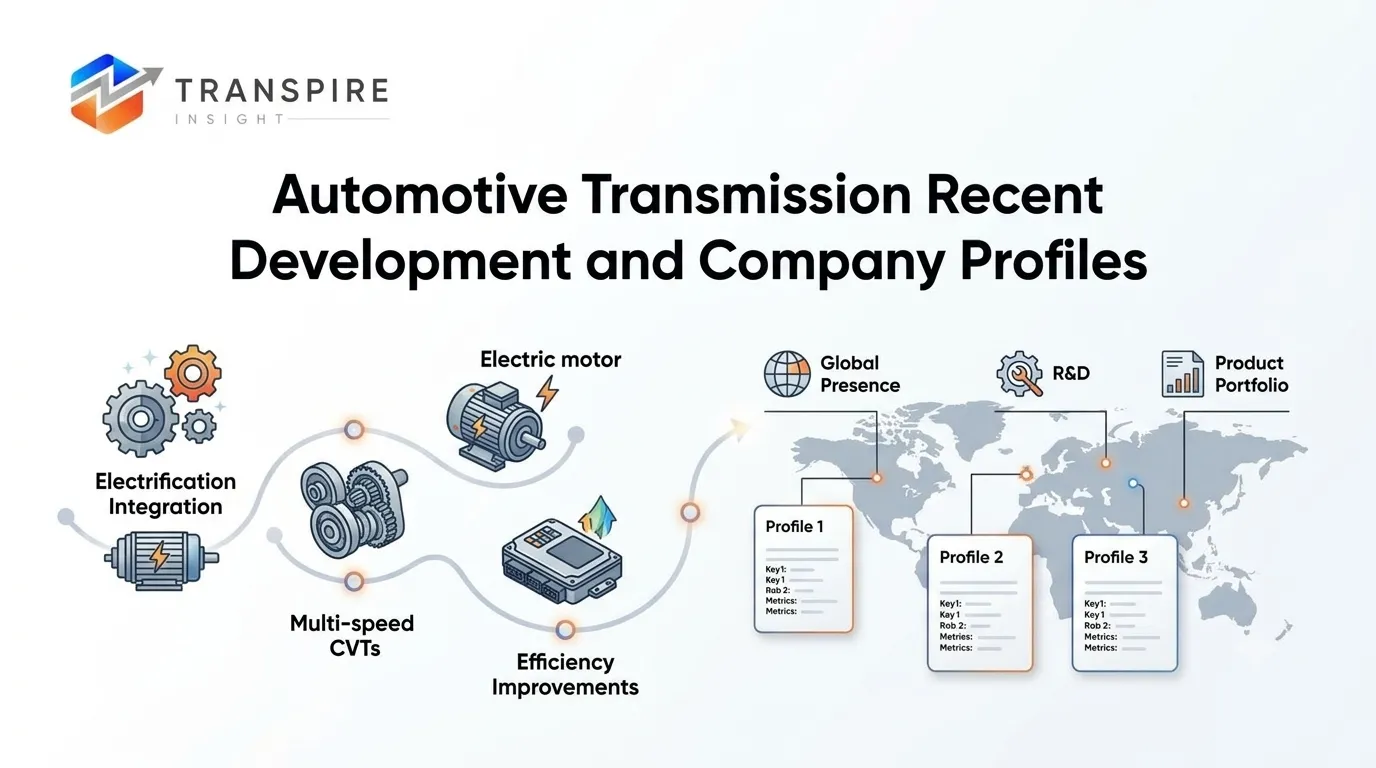
The automotive transmission market is undergoing a rapid evolution driven by changing consumer preferences, technological breakthroughs, and strict environmental mandates. Valued at over $189 billion, the sector connects vehicle power to driving motion across passenger cars and commercial fleets. As automotive architectures shift from traditional internal combustion engines toward hybrid and fully electric drivetrains, transmission manufacturers are adapting by developing multi-speed e-transmissions and ultra-efficient automatic systems.
Recent Development News
Stay Ahead of Emerging Opportunities with Expert Market Insights by Transpire Insight
Transpire Insight provides comprehensive, data-driven market intelligence to support smarter business decisions. Our research is rooted in comprehensive analysis, authoritative predictions, and industry expertise, enabling organizations to make informed decisions in rapidly evolving markets. In-depth analysis of market segmentation, competitive positioning, regional trends, and emerging investment opportunities in high-growth areas. We blend accuracy with actionable intelligence, empowering companies to uncover new avenues for growth, bolster strategic decision-making, and stay ahead in a dynamic market.
Automotive Transmission Market Size & Statistics
Regional Growth and Demand Analysis by Transpire Insight
Asia-Pacific's lead rests on scale and policy support rather than any single technology bet. The two biggest volume players, China and Japan, are still supporting volume, while India is gradually moving away from being a low-cost sourcing base to producing high-tech modules in the country via its Production-Linked Incentive scheme, with automatic and CVT increasingly becoming part of mainstream local production. The recent developments clearly show that this is the direction they are going in: JSW Motors broke into the Indian passenger-vehicle market with an SUV based on the JSW Motors-developed and designed Jetour T2 platform, and Škoda took a leap with the release of the updated Kushaq, which had already been provided with Indian-specific features, and with continued investment in Indian-specific product lines. The introduction by Japanese suppliers of a lightweight transmission line designed specifically for electric vehicles (EVs) demonstrates that Japanese suppliers are pursuing the same regional demand curve as AMT systems are making headway in commercial vehicles in the region's logistics fleets.
The movement in North America is going in a different direction: replacement cycles, regulation, and electrification cost, not unit growth. Automatic and dual clutch transmissions remain the standard due to robust demand for light trucks/SUVs, and stringent CAFE fuel economy standards are encouraging suppliers to work on parasitic-loss minimization and gear-ratio improvement. This is BorgWarner's first completed purchase of an EV component supplier, and it shows how longstanding transmission makers are hedging their bets on electrified powertrains but refusing to abandon combustion-era priorities. This is compounded by a strong aftermarket, serving the luxury and sports vehicle market in the region, which continually drives demand for repair, remanufacturing, and performance upgrades for transmissions provided by suppliers, in addition to OEM contracts.
Top 15 Trends in the Automotive Transmission Market
Multi-Speed EV Transmissions
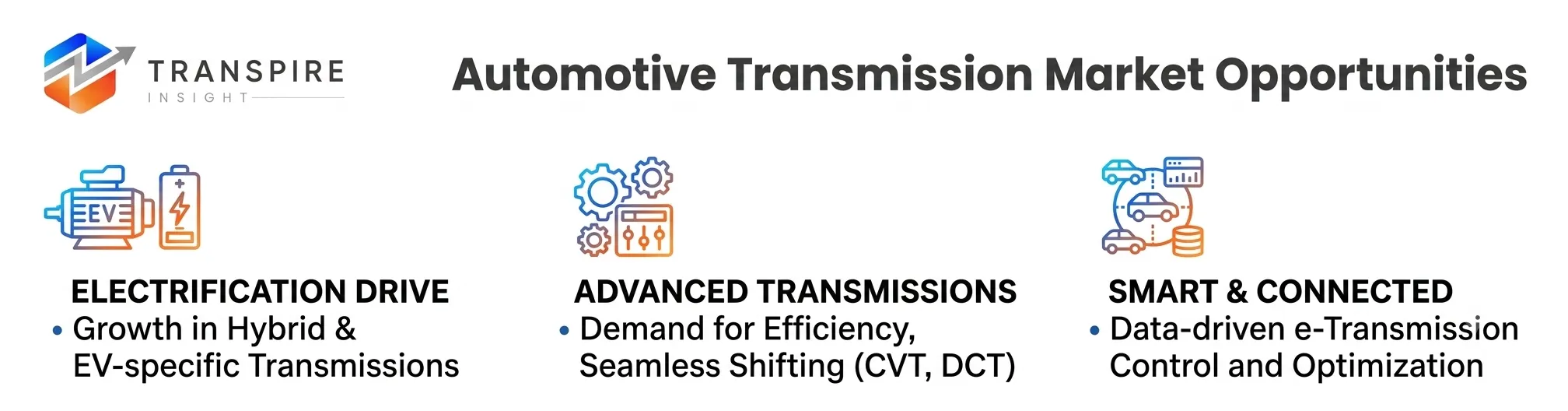
Automakers are shifting from single-speed EV drivetrains toward multi-speed gearboxes that widen efficiency bands, extend driving range, and sharpen acceleration under varying loads and terrain.
AI-Based Gear Optimization
AI-powered transmission controllers analyze driving patterns and road conditions in real time, automatically adjusting gear shifts to boost efficiency, reduce wear, and sharpen overall handling.
Shift-by-Wire Systems
Shift-by-wire systems replace mechanical linkages with electronic signals, streamlining transmission integration, reducing failure points, cutting weight, and enabling software-based gear-shift customization across vehicle platforms worldwide.
Predictive Maintenance Via IoT
Embedded sensors and IoT connectivity now track fluid health and gear wear continuously, letting fleets predict transmission failures before breakdown, cutting downtime and repair costs.
Hybrid-Compatible DCT Development
German and Japanese manufacturers are advancing hybrid-compatible 8-speed and 9-speed dual-clutch transmissions, pairing software-defined shift controls with electrified powertrains for smoother, more efficient performance overall.
OTA Software Monetization
Transmission makers are shifting toward recurring revenue by monetizing over-the-air software updates, letting automakers sell shift-map recalibrations and performance upgrades long after a vehicle's sale.
List of Top 25 Companies Leading the Automotive Transmission Market
Leading supplier of premium automatic transmissions and multi-speed electric drivelines.
Founded: 1915 | HQ: Friedrichshafen, Germany.
Why It Ranks: Dominates modern 8-speed automatic drivetrain delivery to major vehicle brands.
Regional Dominance: Holds massive market leadership across European and North American automotive markets.
Product Line: 8-speed automatics, dual-clutch systems, and modular electric vehicle drivelines.
Pioneer in continuously variable transmission systems and hybrid e-CVT drivetrain architectures.
Founded: 1965 | HQ: Kariya, Aichi, Japan.
Why It Ranks: World's top volume manufacturer of automatic and hybrid vehicle transmission units.
Regional Dominance: Strongest structural dominance across Asian and North American vehicle manufacturing hubs.
Product Line: Automatic transmissions, e-CVTs, manual gearboxes, and integrated electric axle systems.
Engineering innovator specializing in dual-clutch transmissions and high-voltage electric drive modules.
Founded: 1928 | HQ: Auburn Hills, Michigan, USA.
Why It Ranks: Key innovator powering advanced high-efficiency dual-clutch and electric drive platforms.
Regional Dominance: Major market influence in North America and expanding across European markets.
Product Line: Dual-clutch modules, torque transfer units, e-transmissions, and differential systems.
World leader in continuously variable transmissions supplying top international Japanese automakers.
Founded: 1999 | HQ: Fuji, Shizuoka, Japan.
Why It Ranks: Unrivaled market share in passenger car Continuously Variable Transmission (CVT) production.
Regional Dominance: Unmatched presence across Japan, China, and North American light vehicle segments.
Product Line: CVT7, CVT8 series, automatic gearboxes, and hybrid vehicle step-transmissions.
Tier-1 giant providing comprehensive powertrain, dual-clutch, and mechanical gear systems.
Founded: 1957 | HQ: Aurora, Ontario, Canada.
Why It Ranks: Exceptional capabilities in complete vehicle engineering and scalable powertrain transmission integration.
Regional Dominance: Heavily rooted across European and North American car assembly infrastructure.
Product Line: Dual-clutch gearboxes, 4WD/AWD transfer cases, and eDS e-drive transmissions.
Core Hyundai Motor Group supplier specializing in advanced automated and manual gearboxes.
Founded: 1994 | HQ: Hwaseong, South Korea.
Why It Ranks: High-volume output powering millions of Hyundai, Kia, and Genesis brand vehicles.
Regional Dominance: Strong operational presence in South Korea, China, India, and the USA.
Product Line: 8-speed automatics, dual-clutch gearboxes, manual transmissions, and EV reduction gearboxes.
Dominant designer and manufacturer of heavy-duty commercial vehicle automatic transmission systems.
Founded: 1915 | HQ: Indianapolis, Indiana, USA.
Why It Ranks: Undisputed leader in medium and heavy-duty commercial, military, and vocational automatics.
Regional Dominance: Supreme footprint in North America with growing commercial presence globally.
Product Line: Fully automatic commercial transmissions, hybrid propulsion systems, and electric axles.
Industrial powerhouse delivering heavy-duty automated manual transmissions and truck powertrain solutions.
Founded: 1911 | HQ: Dublin, Ireland.
Why It Ranks: Premium choice for heavy truck fleet efficiency and reliable torque handling.
Regional Dominance: Deep penetration in North American and South American commercial transport sectors.
Product Line: UltraShift automated manual transmissions, commercial clutches, and specialized heavy gearboxes.
Drivetrain specialist delivering precision transmission components, hybrid modules, and double-clutch systems.
Founded: 1946 | HQ: Herzogenaurach, Germany.
Why It Ranks: Essential tier supplier of critical bearings, dampeners, and clutch actuation technologies.
Regional Dominance: Massive supply chain footprint spanning Western Europe and Asia-Pacific regions.
Product Line: Double-clutch assemblies, torque converters, hybrid modules, and transmission dampeners.
leader in all-wheel drive architectures, e-drive systems, and sideshaft transmission systems.
Founded: 1759 | HQ: London, United Kingdom.
Why It Ranks: Pioneer in AWD technology and compact e-Beam electric transmission systems.
Regional Dominance: Broad operational footprint across European, Asian, and North American auto assembly.
Product Line: e-Drive gearboxes, sideshafts, all-wheel drive disconnect systems, and torque vectoring.
Conclusion
As mechanical gearboxes give way to electronic, hybrid, and multi-speed drive units for EVs, the automotive transmission industry is facing a structural shift. manufacturers are struggling to meet the demands of existing internal combustion products while making significant investments in future electric architectures. Advanced transmission technologies will continue to play a pivotal role in the mobility transformation as regional regulations for the environment become more stringent around the world, with software control, light materials, and high-efficiency gear design being the key factors in the future market.


Send us a brief description of your challenge and we'll get back to you within 24 hours.

 inquiry@transpireinsight.com
 APAC:+91 7666513636
 Address


