
Sep 03, 2026
By Transpire Insight
Description
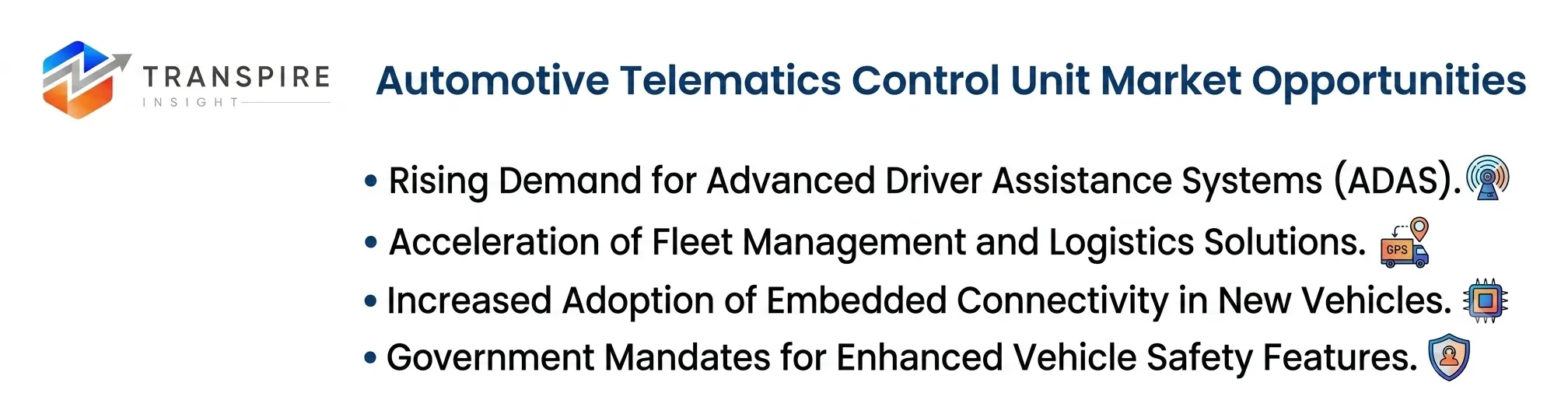
According to a research report published by Transpire Insight, the Automotive Telematics Control Unit (TCU) market size is projected to grow from USD 12.35 billion in 2026 to USD 36.42 billion by 2035, at a CAGR of 16.3% during the forecast period 2027-2035. The market is growing rapidly due to connected vehicles, 5G network infrastructure expansion, and tough government safety regulations, along with the increased need for real-time fleet management. As automakers are increasingly deploying high-tech telematics control units to facilitate predictive diagnostics, software updates, autonomous features, and more.
Introduction
The Automotive Telematics Control Unit (TCU) is the central communication system in today's vehicles, connecting various controllers within the vehicle to the cloud, navigation, and cellular networks. Through real-time transmission of operational data, TCUs enable remote diagnostics, over-the-air software updates, emergency help, and intelligent navigation for the automaker and fleet operators. The TCU market is growing at a rapid pace, with the growing trend of software-defined vehicles, electric mobility, and automated driving. Tier-one suppliers and tech companies are constantly developing new 5G automotive connectivity solutions that are both fast and secure.
Recent Development News
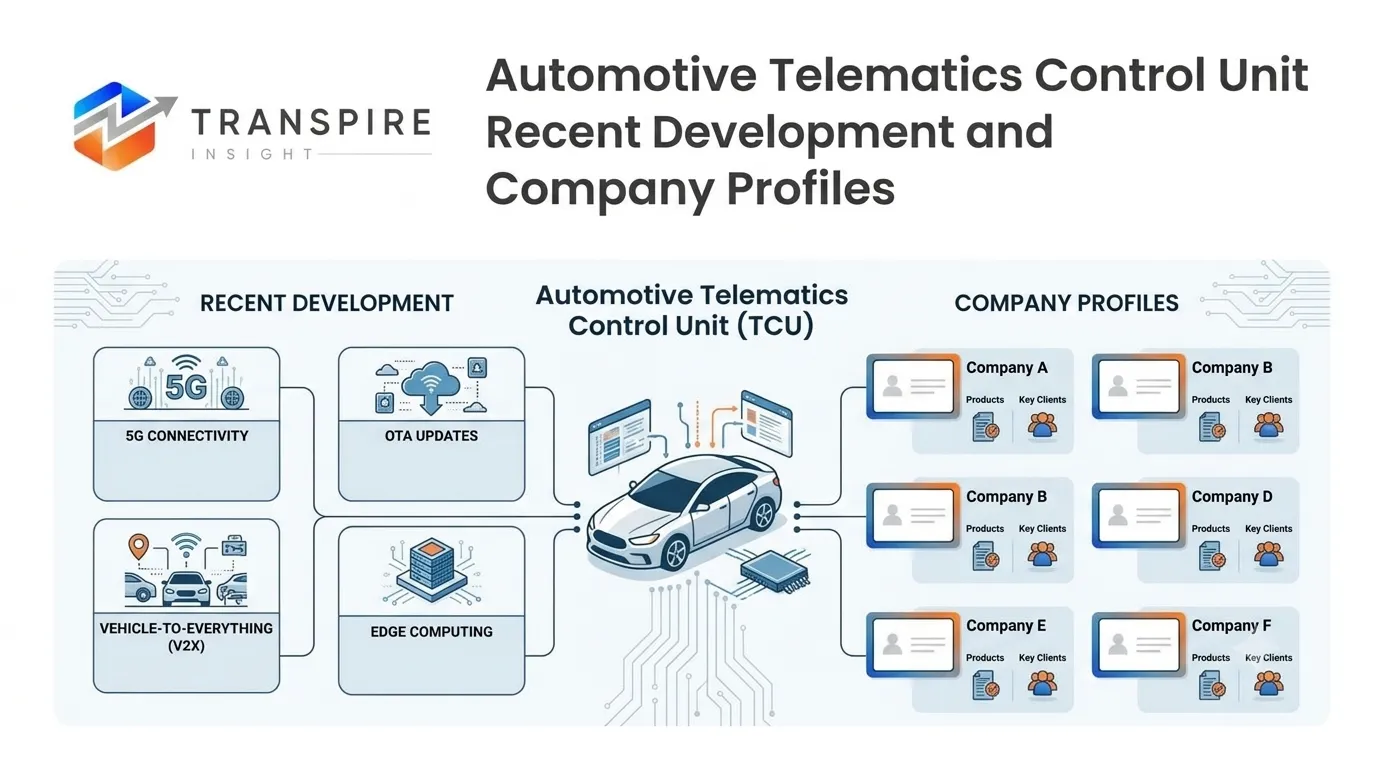
February 2026: LG Electronics unveiled its next-generation smart telematics solution at Mobile World Congress (MWC) Barcelona 2026. The integrated module merges a Telematics Control Unit (TCU) with an advanced antenna system to enhance 5G, V2X, and satellite connectivity for software-defined vehicles.
January 2026: Hyundai Mobis announced the development of a 5G-based antenna-integrated telematics control unit (MTCU). Engineered for autonomous driving and software-defined mobility platforms, it improves real-time vehicle positioning, high-precision mapping, and remote fleet management.
Stay Ahead of Emerging Opportunities with Expert Market Insights by Transpire Insight
Transpire Insight provides comprehensive, data-driven market intelligence to support smarter business decisions. Our research is rooted in comprehensive analysis, authoritative predictions, and industry expertise, enabling organizations to make informed decisions in rapidly evolving markets. In-depth analysis of market segmentation, competitive positioning, regional trends, and emerging investment opportunities in high-growth areas. We blend accuracy with actionable intelligence, empowering companies to uncover new avenues for growth, bolster strategic decision-making, and stay ahead in a dynamic market.
Automotive Telematics Control Unit (TCU) Market Size & Statistics
The market size for Automotive Telematics Control Unit (TCU) is estimated at USD 12.35 billion in 2026.
The market is going to expand at a CAGR of 16.3% between 2026 and 2035.
The Automotive Telematics Control Unit (TCU) market size is anticipated to reach USD 36.42 billion by 2035.
North America is projected to drive the highest demand during the forecast period, accounting for 41% of the Automotive Telematics Control Unit (TCU) market.
Asia Pacific is projected to grow the fastest during the forecast period at a CAGR of 9.5% in the Automotive Telematics Control Unit (TCU) market.
Regional Growth and Demand Analysis by Transpire Insight
Asia Pacific's leadership is anchored in China, where mandatory telematics reporting for new energy vehicles has pushed domestic OEMs such as BYD, SAIC, and Geely to standardize connected hardware across their lineups, while a dense regional semiconductor base built around Samsung Electronics, NXP, and Infineon gives local TCU assembly a strong cost advantage. Japan and South Korea add further depth through their focus on precision electronics and rapid 5G rollout, and rising urban incomes across the region are pushing embedded TCUs deeper into mid-tier passenger vehicles, not just premium segments. North America and Europe, by contrast, lean on maturity rather than scale: US fleets built around embedded telematics for real-time diagnostics and predictive maintenance keep North America a close second, while Europe's growth tracks regulatory compliance, particularly eCall-style safety mandates and connected-manufacturing initiatives from players like Continental and Bosch.
Meanwhile, Middle East & Africa and Latin America are the markets to watch for pace rather than size. GCC countries are folding TCU adoption into broader smart-city and infrastructure programs, while expanding commercial vehicle fleets across Saudi Arabia and the UAE are pulling telematics into logistics operations that previously ran unconnected. Sub-Saharan Africa's growth is coming from a different angle entirely — rising smartphone and 4G penetration is making cost-effective aftermarket and tethered telematics viable for the first time, letting fleet operators retrofit older vehicles rather than wait for OEM-embedded systems. Latin America is following a similar retrofit-led curve, with emerging local vehicle manufacturing and early electrification programs adding incremental demand on top of that aftermarket base.
Top 15 Trends in the Automotive TCU Market
Automakers are rapidly replacing 3G and 4G telematics hardware with 5G-enabled control units, enabling faster data transfer, low-latency communication, and support for autonomous driving features.
TCUs now embed AI accelerators that analyze real-time sensor data onboard, enabling predictive maintenance alerts, fault detection, and proactive servicing recommendations before mechanical failures occur.
Rising connectivity has heightened concerns around hacking and data breaches, pushing manufacturers to embed encryption, intrusion detection, and secure boot mechanisms into TCU hardware design.
Embedded TCUs, factory-installed and hardwired into vehicle electronics, continue outpacing tethered and smartphone-based alternatives due to better reliability, deeper integration, and stronger OEM-level control performance.
Electric vehicle adoption is driving demand for telematics units that monitor battery health, charging status, range estimation, and remote diagnostics, tailored specifically for EV powertrains.
TCU data increasingly flows into cloud-based platforms, enabling fleet analytics, over-the-air updates, driver behavior insights, and centralized management across manufacturers' growing connected vehicle service networks.
List of Top 25 Companies Leading the Automotive Telematics Control Unit (TCU) Market
1. Robert Bosch GmbH
Bosch supplies advanced connected vehicle components and intelligent automotive telemetry systems globally.
Founded: 1886 | HQ: Gerlingen, Germany.
Why It Ranks: Massive market presence and deep engineering expertise in automotive electronics systems.
Regional Dominance: Europe leads market deployment with strong operations across North America and Asia.
Product Line: Integrated telematics control units, cybersecurity modules, and central vehicle gateway units.
2. Continental AG
Continental delivers pioneering connectivity modules for next-generation connected automotive mobility solutions.
Founded: 1871 | HQ: Hanover, Germany.
Why It Ranks: Industry leadership in high-speed cellular vehicle telematics and network gateway platforms.
Regional Dominance: Strong market share in European automotive manufacturing hubs and American vehicle markets.
Product Line: Smart telematics control units, 5G V2X gateways, and high-performance computers.
3. Denso Corporation
Denso manufactures high-reliability automotive electronics and connected telemetry systems for OEMs.
Founded: 1949 | HQ: Kariya, Aichi, Japan.
Why It Ranks: Extensive supply contracts with major Asian automakers and cutting-edge sensor integration.
Regional Dominance: Unmatched dominance across Japan and expanding footprints in Asian commercial automotive markets.
Product Line: Compact telematics control units, vehicle communication gateways, and embedded antenna modules.
4. LG Electronics
LG Electronics produces state-of-the-art 5G telematics control solutions globally.
Founded: 1958 | HQ: Seoul, South Korea.
Why It Ranks: Market leader in integrated antenna telematics units for software-defined vehicles.
Regional Dominance: Powerful market share across Asia Pacific and major North American automotive OEMs.
Product Line: Smart 5G telematics control units, integrated antenna modules, and infotainment hardware.
5. Hyundai Mobis
Hyundai Mobis engineers advanced modular telematics systems for modern connected passenger vehicles.
Founded: 1977 | HQ: Seoul, South Korea.
Why It Ranks: Direct supply integration with Hyundai Kia vehicle lines and rapid 5G development.
Regional Dominance: Dominates the South Korean domestic market while expanding across North American markets.
Product Line: Integrated telematics control units, 5G antenna modules, and autonomous driving controllers.
6. Harman International (Samsung)
Harman produces connected car solutions integrating telematics hardware with advanced cloud architectures.
Founded: 1953 | HQ: Stamford, Connecticut, USA.
Why It Ranks: Powerful combined hardware-software synergy driven by Samsung semiconductor technology backbone.
Regional Dominance: Strong leadership in North American luxury automotive sectors and European vehicle production.
Product Line: Smart telematics control units, digital cockpit platforms, and over-the-air solutions.
7. Marelli Holdings
Marelli supplies innovative automotive electronic control units and telematics solutions worldwide.
Founded: 1919 | HQ: Saitama, Japan.
Why It Ranks: manufacturing footprint providing custom automotive connectivity modules for major OEMs.
Regional Dominance: Deeply rooted in European and Asian automotive supply chains and commercial markets.
Product Line: Telematics communication boxes, wireless gateway modules, and electronic control unit architecture.
8. Aptiv PLC
Aptiv designs brain and nervous system hardware for connected electric vehicles.
Founded: 2017 | HQ: Dublin, Ireland.
Why It Ranks: Leader in advanced electrical architecture and software-defined vehicle connectivity units.
Regional Dominance: Widespread presence across North American OEM assembly plants and European car markets.
Product Line: Telematics control units, domain controllers, and smart vehicle gateway system architecture.
9. Valeo
Valeo provides smart driving assistance systems and connected vehicle electronic architectures.
Founded: 1923 | HQ: Paris, France.
Why It Ranks: Strong expertise in sensor fusion, connectivity modules, and environmental driving intelligence.
Regional Dominance: Dominant position in Western European automotive production and Chinese electric vehicle markets.
Product Line: Smart telematics control boxes, vehicle communication nodes, and connected sensor systems.
10. ZF Friedrichshafen AG
ZF delivers comprehensive mobility solutions including commercial fleet telematics hardware platforms.
Founded: 1915 | HQ: Friedrichshafen, Germany.
Why It Ranks: Dominant position in commercial vehicle systems and integrated vehicle telemetry hardware.
Regional Dominance: Strong foothold in European commercial vehicle fleets and logistics transit operations.
Product Line: Commercial telematics control units, fleet management devices, and smart connectivity gateways.
Conclusion
As technology continues to reshape the landscape of modern transportation with software-defined vehicles, 5G connectivity, and autonomous driving architectures taking center stage, the Automotive Telematics Control Unit (TCU) market is undergoing a transformational shift. Leading tier-one suppliers and technology providers are continuing to develop new features and functions, such as high-speed wireless modules, cybersecurity solutions, and intelligent antenna systems in small TCU packages. TCUs will continue to play a key role in the automotive electronics industry as regulations push for greater vehicle safety and fleet tracking. Thus, next-generation TCU technology investments will drive the future of connected mobility, predictive vehicle analytics, and autonomous transport.


Send us a brief description of your challenge and we'll get back to you within 24 hours.

 inquiry@transpireinsight.com
 APAC:+91 7666513636
 Address


