Top 25 Companies in the Automotive Regenerative Braking Market: Company Profile by Transpire Insight
By Transpire Insight
Description
According to a research report published by Transpire Insight, the automotive regenerative braking market size is projected to grow from USD 9.20 billion in 2026 to USD 28.35 billion by 2035, at a CAGR of 13.26% during the forecast period 2027-2035. Demand for advanced kinetic energy recovery and extended driving range is generated by the rapid adoption of EVs, the increasingly critical corporate fuel economy requirements, increased battery capacity, and the move toward brake-by-wire architectures.
Introduction
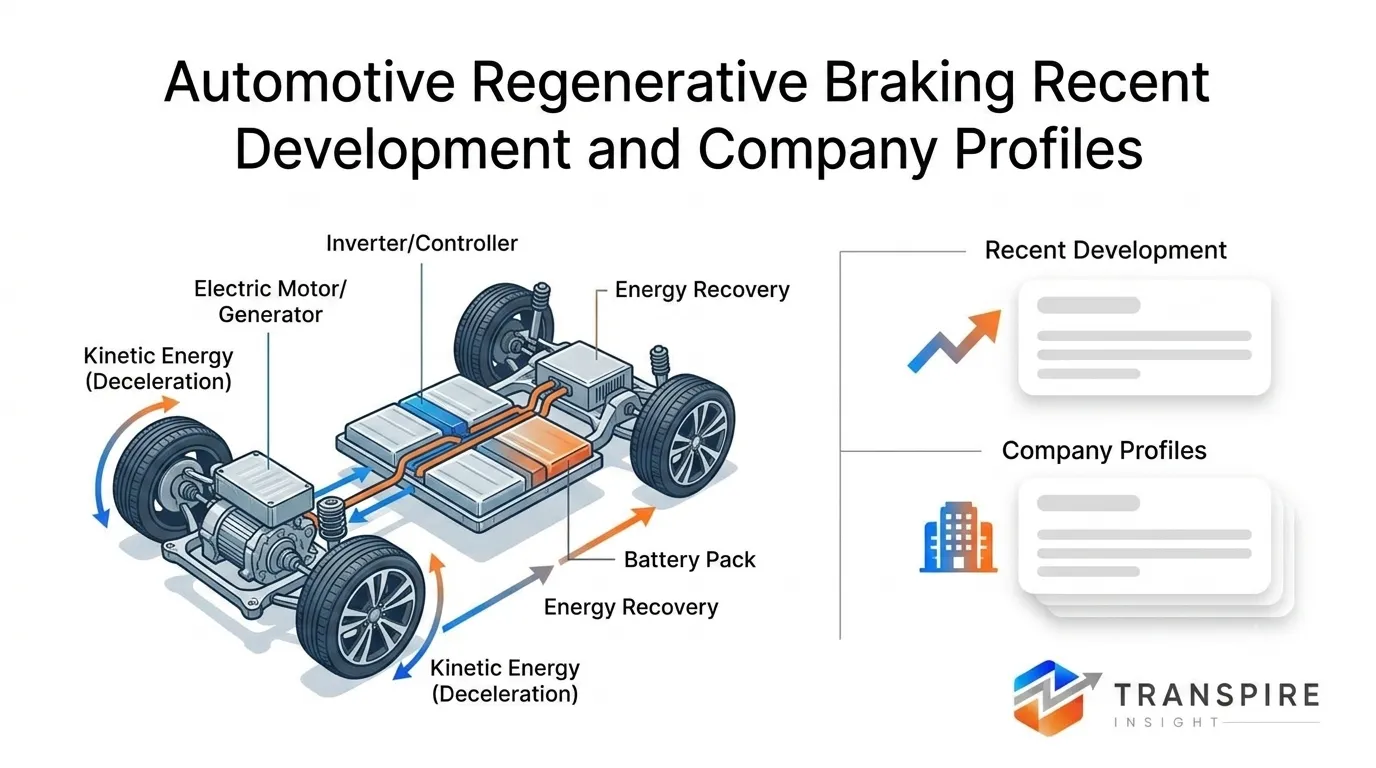
Regenerative braking systems in automobiles harness kinetic energy while braking and store it as electrical energy, which minimizes brake pad wear and enhances overall vehicle efficiency. These systems are widely used in hybrid, plug-in hybrid, and fully electric cars, combining the power electronics, motors, and intelligent brake control units. Government carbon goals, fuel prices, and consumer demand for extended driving ranges are all important drivers for the market in today's powertrain engineering and sustainable mobility platform landscape globally.
Recent Development News
- March 2026: Continental expanded its brake-by-wire system portfolio to support multi-level regenerative braking integrated directly into autonomous EV drive architectures.
- May 2026: ZF Group introduced its next-generation integrated brake control unit (IBC), with an improved regeneration efficiency of 12% over urban delivery fleets.
Stay Ahead of Emerging Opportunities with Expert Market Insights by Transpire Insight
Transpire Insight provides comprehensive, data-driven market intelligence to support smarter business decisions. Our research is rooted in comprehensive analysis, authoritative predictions, and industry expertise, enabling organizations to make informed decisions in rapidly evolving markets. In-depth analysis of market segmentation, competitive positioning, regional trends, and emerging investment opportunities in high-growth areas. We blend accuracy with actionable intelligence, empowering companies to uncover new avenues for growth, bolster strategic decision-making, and stay ahead in a dynamic market.
Download the exclusive Automotive Regenerative Braking Market sample report today to explore expert insights, key trends, and emerging opportunities shaping the future of the industry.
Automotive Regenerative Braking Market Size & Statistics
- The Market Size for the Automotive Regenerative Braking Market Was Estimated to be Worth USD 9.20 Billion in 2026.
- The Market Size is Going to Expand at a CAGR of 13.26% between 2026 and 2035.
- The Automotive Regenerative Braking Market Size is anticipated to reach USD 28.35 Billion by 2035.
- North America is projected to drive the highest demand during the forecast period, accounting for 38% of the automotive regenerative braking market.
- Asia Pacific is projected to grow the fastest during the forecast period at a CAGR of 7% in the automotive regenerative braking market.
Regional Growth and Demand Analysis by Transpire Insight
The U.S. market is the base for North America's lead, as it's already more mature and well-established automakers with a solid charging network infrastructure are getting it to become a common feature rather than an added option. Advanced energy-recovery systems are finding their way into the range of passenger and commercial vehicles increasingly as stricter fuel-efficiency and emission laws push OEMs to incorporate the technology, and consolidation efforts like AEQUITA's buying of Bosch's Brake Components business are bolstering the region's next-generation regenerative technology supply base. Mexico too is becoming an important growth area in the region, as assembly of vehicles to North American markets grows.
The momentum in Asia-Pacific is powered by sheer volume of production and not market maturity. As China's EV market keeps on growing, battery and motor manufacturers are increasingly involved in the regenerative braking value chain, and Toyota and Honda are working on regenerative systems to comply with Japan's national carbon neutrality goals. While demand for EVs is growing more rapidly than ever for passenger vehicles, India's individual market growth is remarkable, as is the adoption of energy-recovery braking in public transit in cities such as Delhi, and state-level policies that mandate that a greater percentage of new vehicles be electric in states like Maharashtra.
Top 15 Trends in the Automotive Regenerative Braking Market
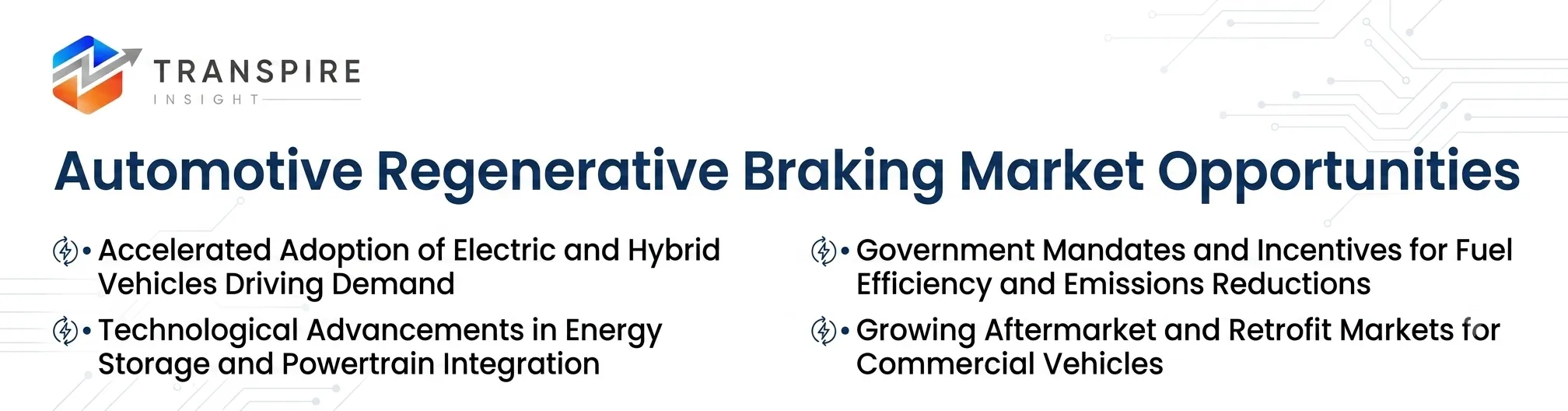
- Rising EV and hybrid vehicle adoption worldwide.
- Blended braking systems balancing regenerative and hydraulic force.
- AI-based braking control and predictive deceleration algorithms.
- Battery segment dominance within regenerative braking components.
- Two-wheeler and micromobility regenerative braking integration.
- Brake-by-wire and electromechanical braking system adoption.
- Integration with ADAS and autonomous driving features.
- Stricter emission and fuel-efficiency regulations globally.
- Growing regenerative braking use in commercial vehicles.
- Semiconductor and power electronics supply chain investment.
- OEM partnerships with battery and software firms.
- Flywheel-based kinetic energy recovery system innovation.
- Localized manufacturing amid tariff and trade pressures.
- Expansion of regenerative braking across China's EV fleet.
- Rising demand for energy-efficient, sustainable vehicle technologies.
Proceed to checkout to purchase the exclusive Automotive Regenerative Braking Market report and get instant access to detailed market insights, strategic analysis, and future growth opportunities.
Rising EV and Hybrid Vehicle Adoption Worldwide
Growing sales of electric and hybrid vehicles are driving OEMs to standardize regenerative braking as a core energy-recovery feature across new vehicle platforms today.
Blended Braking Systems Balancing Regenerative and Hydraulic Force
Blended braking systems combine regenerative and hydraulic force smoothly, letting automakers maximize energy recovery while preserving consistent pedal feel and reliable stopping performance for drivers.
AI-Based Braking Control and Predictive Deceleration Algorithms
AI-enabled control algorithms analyze speed, road gradient, and battery status to optimize the split between regenerative and hydraulic braking, improving efficiency, safety, and pedal feel.
Integration with ADAS and Autonomous Driving Features
Regenerative braking increasingly integrates with ADAS and autonomous driving systems, enabling predictive, route-aware deceleration that recovers more energy while supporting smoother, safer automated driving experiences.
Growing Regenerative Braking Use in Commercial Vehicles
Commercial vehicle fleets, including buses and delivery trucks, are adopting regenerative braking to cut fuel and energy costs while extending brake component life across routes.
Localized Manufacturing Amid Tariff and Tariff Pressures
Rising tariffs on imported power electronics and motors are pushing automakers to localize regenerative braking component manufacturing across North America, Europe, and Asia-Pacific supply chains.
List of Top 25 Companies Leading the Automotive Regenerative Braking Market
- Robert Bosch GmbH
- Continental AG
- ZF Friedrichshafen AG
- Denso Corporation
- Hyundai Mobis Co., Ltd.
- Aisin Corporation
- Brembo S.p.A.
- Magna International Inc.
- BorgWarner Inc.
- Hitachi Astemo, Ltd.
- Advics Co., Ltd.
- Mando Corporation (HL Mando)
- Eaton Corporation plc
- Tesla, Inc.
- BYD Company Ltd.
- Nidec Corporation
- Valeo SA
- Dana Incorporated
- BWI Group
- Toshiba Corporation
- Schaeffler AG
- NXP Semiconductors N.V.
- Infineon Technologies AG
- Knorr-Bremse AG
- ZF TRW Automotive
Customize the exclusive Automotive Regenerative Braking Market report to receive insights tailored to your needs, including country-specific analysis and business-focused market intelligence.
- Robert Bosch GmbH
Pioneers integrated brake control systems optimizing kinetic energy capture for EVs.Founded: 1886 | HQ: Gerlingen, Germany.Why It Ranks: Holds market leadership with comprehensive brake-by-wire system integration capabilities.Regional Dominance: Europe due to direct supply contracts with leading continental vehicle manufacturers.Product Line: iBooster, ESP electronic stability control, and regenerative brake control units.
- Continental AG
Engineers advanced electro-hydraulic braking solutions enabling seamless one-pedal EV driving.Founded: 1871 | HQ: Hanover, Germany.Why It Ranks: Dominates European OEM supply chains through high-performance brake system technologies.Regional Dominance: Europe driven by strong relationships with major German automotive manufacturing hubs.Product Line: MK C2 one-box brake system and electronic braking control units.
- ZF Friedrichshafen AG
Develops intelligent drive and deceleration modules tailored for electrified commercial platforms.Founded: 1915 | HQ: Friedrichshafen, Germany.Why It Ranks: Captures top-tier position with scalable brake control across vehicle platforms.Regional Dominance: Europe supported by heavy industrial deployment in commercial and passenger vehicles.Product Line: Integrated Brake Control (IBC) systems and e-motor regenerative controllers.
- Denso Corporation
Supplies high-efficiency power electronics and energy recovery systems to automakers.Founded: 1949 | HQ: Kariya, Aichi, Japan.Why It Ranks: Commands strong market share through long-standing partnerships with leading Asian automakers.Regional Dominance: Asia-Pacific, leveraging deep integration within Japan's major hybrid manufacturing plants.Product Line: Regenerative braking actuators, inverters, and high-efficiency motor control units.
- Hyundai Mobis Co., Ltd.
Manufactures electronic braking systems and motor controllers for Korean automotive platforms.Founded: 1977 | HQ: Seoul, South Korea.Why It Ranks: Ranks high via captive supply to Hyundai-Kia EV manufacturing platforms.Regional Dominance: Asia-Pacific driven by expanding electric vehicle production across South Korea.Product Line: Integrated Electric Brake (iMEB) and regenerative energy control modules.
- Aisin Corporation
Produces specialized hybrid transmissions and regenerative brake actuators for vehicles.Founded: 1965 | HQ: Kariya, Aichi, Japan.Why It Ranks: Key player in hybrid powertrain energy recovery and electro-hydraulic braking.Regional Dominance: Asia-Pacific supported by massive regional hybrid electric vehicle manufacturing operations.Product Line: Cooperative regenerative brake systems and eAxle drive power units.
- Brembo S.p.A.
High-performance brake manufacturer integrating regenerative software into premium braking systems.Founded: 1961 | HQ: Stezzano, Italy.Why It Ranks: Leads premium segment in blending friction and electro-hydraulic regenerative stopping.Regional Dominance: Europe backed by strong partnerships with luxury and performance automakers.Product Line: SENSIFY intelligent braking system and custom electro-hydraulic brake actuators.
- Magna International Inc.
mobility technology supplier manufacturing integrated electric powertrain and braking systems.Founded: 1957 | HQ: Aurora, Ontario, Canada.Why It Ranks: High ranking backed by complete vehicle engineering and powertrain electrification capabilities.Regional Dominance: North America driven by large-scale contract assembly and component manufacturing.Product Line: eDS electric drive systems and integrated brake torque controllers.
- BorgWarner Inc.
Engineers advanced electric drive motors and integrated software for energy recovery.Founded: 1928 | HQ: Auburn Hills, Michigan, USA.Why It Ranks: Strong market presence through rapid expansion in electric drive e-propulsion.Regional Dominance: North America supported by robust supply deals with domestic commercial automakers.Product Line: Integrated Drive Modules (iDM) and high-voltage regenerative inverter electronics.
- Hitachi Astemo, Ltd.
Specializes in electric vehicle powertrains, chassis systems, and regenerative brake control.Founded: 2021 | HQ: Tokyo, Japan.Why It Ranks: Combines advanced chassis controls with high-voltage motor energy recovery technology.Regional Dominance: Asia-Pacific leveraging major Japanese and Chinese passenger car production networks.Product Line: Electronic stability control systems and regenerative power management modules.
Schedule a meeting with our market experts to discuss the exclusive Automotive Regenerative Braking Market report and find the right research solution for your business.
Conclusion
As a pillar of the efficiency of today's electric and hybrid cars, the automotive regenerative braking market continues to shape the mobility landscape around the world. The key players are making strides in energy recovery, silicon carbide power electronics, and in the development of intelligent torque-vectoring software. Suppliers who champion safety redundancies, pedal feel, and seamless energy storage integration will enjoy long-term market domination in transport applications as international carbon mandates become more stringent and battery technology advances.



 inquiry@transpireinsight.com
 APAC:+91 7666513636
 Address


