
Aug 27, 2026
By Transpire Insight
Description
According to a research report published by Transpire Insight, the Artificial Intelligence in drug discovery market size is projected to grow from USD 6.80 billion in 2026 to USD 42.37 billion by 2035, at a CAGR of 31.29% during the forecast period 2026-2035. AI is expected to be a game-changer in drug discovery, given the increasing costs of R&D, significant dropout rates during clinical trials, and growing biomedical data. The workflows of target identification, lead optimization, and candidate selection are accelerated using high-performance compute, machine learning algorithms, and strategic big pharma collaborations.
Introduction
Traditional pharmaceutical research and development (R&D) is undergoing a dramatic change due to the advent of the AI in drug discovery market, which is significantly shrinking the early-stage discovery process and enhancing the selection of drug candidates. AI platforms harness the capabilities of deep learning, generative chemistry, and extensive multi-omics data sets, allowing scientists to virtually screen billions of molecules and gain unparalleled accuracy in predicting how targets interact with these molecules. The industry is shifting away from exploratory pilot projects and moving toward complete AI pipelines as major pharmaceutical companies turn to technology vendors to lower ever-increasing R&D costs, making the market a key pillar of the biopharmaceutical innovation ecosystem.
Recent Development News
Stay Ahead of Emerging Opportunities with Expert Market Insights by Transpire Insight
Transpire Insight provides comprehensive, data-driven market intelligence to support smarter business decisions. Our research is rooted in comprehensive analysis, authoritative predictions, and industry expertise, enabling organizations to make informed decisions in rapidly evolving markets. In-depth analysis of market segmentation, competitive positioning, regional trends, and emerging investment opportunities in high-growth areas. We blend accuracy with actionable intelligence, empowering companies to uncover new avenues for growth, bolster strategic decision-making, and stay ahead in a dynamic market.
Download the exclusive Artificial Intelligence in Drug Discovery Market sample report today to explore expert insights, key trends, and emerging opportunities shaping the future of the industry.
Artificial Intelligence in Drug Discovery Market Size & Statistics
Regional Growth and Demand Analysis by Transpire Insight
North America is the market with the greatest need for AI in drug discovery. Despite the growth in other markets, the region continues to be the largest market, fueled by major investment in health technology and the presence of large pharmaceutical and biotechnology companies. Adoption is rapidly gaining momentum as more pharmaceutical players have high adoption rates for AI platforms and growing investments in AI infrastructure and R&D are driving generative chemistry and protein-design tools from the pilot phase to the R&D workflow. The formal consideration of AI/ML as a software as a medical device by regulatory bodies like the FDA is just the first step in recognizing AI in drug development and is likely to further normalize the enterprise-wide use of AI. North America's leadership is further bolstered by total investment in AI drug development companies, which reached USD 60.2 billion, and a continued flow of groundbreaking science, such as the 2024 Nobel Prize in Chemistry for AlphaFold3, an extension of structure prediction to molecular interactions, which enhanced the scientific validity of the field.
Asia Pacific is expected to witness the highest growth rate from 2016 to 2021. China, Japan, South Korea and India have experienced a surge in biotechnology investments, the growth of pharmaceutical R&D, robust adoption of AI by the government and rapid urbanisation, which are changing the competitive landscape in the region. Driving growth are fast-paced developments in AI infrastructure, as well as the adoption of national AI strategies like China's "Made in China 2025" plan and India's National Strategy for Artificial Intelligence, along with significant public and private funding for big data infrastructure and the integration of massive, diverse patient datasets. Asia-Pacific pharma and biotech companies are also using AI to help identify targets more quickly and to optimise lead compounds and cut down on development expenses, while start-ups are now starting to combine robotics, lab automation, and AI-powered analytics into single discovery pipelines, leading to a faster pace of clinical-stage development in the region over the coming years.
Top 15 Trends in the AI in Drug Discovery Market
Proceed to checkout to purchase the exclusive Artificial Intelligence in Drug Discovery Market report and get instant access to detailed market insights, strategic analysis, and future growth opportunities.
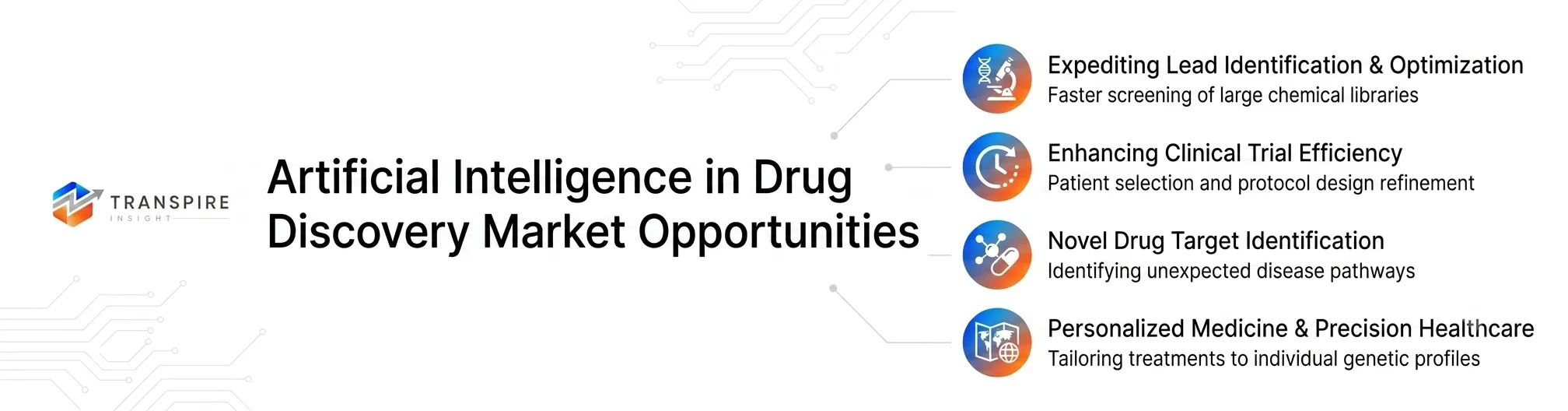
Generative AI for Molecule Design
Generative AI enables AI-augmented molecular docking and end-to-end binding affinity prediction, compressing years of chemical exploration into computationally guided design cycles.
Protein structure prediction
Over 50% of AI drug discovery programs now use AlphaFold-predicted structures, enabling structure-based design for targets lacking experimental data.
Foundation Models for Genomics
Genomic foundation models like Evo 2 are trained on trillions of DNA base pairs to predict functional genetic variation impacts across biology.
Big Pharma-AI Collaborations
Multi-year partnerships like Takeda's expanded deal with Nabla Bio build reusable AI infrastructure where insights compound across therapeutic programs.
AI-driven Biologics Design
Startups like Generate Biomedicines pioneer "generative biology," proposing entirely new protein sequences with desired functions beyond small-molecule chemistry.
Clinical Validation Milestones
Generative protein-design platforms are progressing from lab-validated proteins toward actual clinical candidates, broadening AI's commercial reach into biologics.
List of Top 25 Companies Leading the AI in Drug Discovery Market
Customize the exclusive Artificial Intelligence in Drug Discovery Market report to receive insights tailored to your needs, including country-specific analysis and business-focused market intelligence.
1. Exscientia
Pioneer in bringing fully AI-designed molecules into human clinical trial phases.
Founded: 2012 | HQ: Oxford, United Kingdom.
Why It Ranks: Integrates patient tissue data with generative AI for precise drug design.
Regional Dominance: Dominates Europe while expanding strategic partnerships across major North American hubs.
Product Line: DesignStudio platform, Centaur Chem generative chemistry tools, and precision oncology pipelines.
2. Recursion Pharmaceuticals
Operates massive automated wet-lab robotics paired with petabyte-scale biological data modeling.
Founded: 2013 | HQ: Salt Lake City, Utah, USA.
Why It Ranks: Leads automated high-throughput phenomics for discovering novel disease target mechanisms.
Regional Dominance: Strong market hold across North America with expanding European research collaborations.
Product Line: Recursion OS platform, phenomics screening libraries, and clinical oncology candidates.
3. Insilico Medicine
Utilizes generative adversarial networks to accelerate novel target and compound discovery.
Founded: 2014 | HQ: Hong Kong, China.
Why It Ranks: End-to-end generative AI platform delivering clinical-stage pipeline assets efficiently.
Regional Dominance: Dominates Asia-Pacific market while maintaining deep enterprise reach in North America.
Product Line: PandaOmics target discovery, Chemistry42 generative chemistry, and InClinico trial design.
4. Schrödinger
Combines physics-based computational software with advanced machine learning for molecular design.
Founded: 1990 | HQ: New York City, New York, USA.
Why It Ranks: Industry standard for physics-informed molecular modeling integrated into R&D.
Regional Dominance: Widespread presence across North American, European, and Asian pharmaceutical markets.
Product Line: LiveDesign collaborative enterprise platform, PyMOL visualization software, and internal therapeutics.
5. Atomwise
Pioneered convolutional neural networks for structure-based virtual screening of massive compounds.
Founded: 2012 | HQ: San Francisco, California, USA.
Why It Ranks: Exceptional high-throughput virtual screening capable of sifting through billions of molecules.
Regional Dominance: Strong North American presence backed by extensive academic research alliances.
Product Line: AtomNet predictive platform, virtual screening tools, and small-molecule target discovery.
6. BenevolentAI
Deploys biomedical knowledge graphs to extract hidden insights from complex biological data.
Founded: 2013 | HQ: London, United Kingdom.
Why It Ranks: Combines target identification with clinical trial optimization to maximize pipeline success.
Regional Dominance: Leading player in Europe with established enterprise licensing across biopharmas.
Product Line: Benevolent Platform, target identification suites, and neurodegenerative disease therapeutic programs.
7. Deep Genomics
Applies deep learning to decode RNA biology and develop precision genetic medicines.
Founded: 2015 | HQ: Toronto, Ontario, Canada.
Why It Ranks: Specialized focus on RNA targeting and genetic disease alteration models.
Regional Dominance: Strong North American presence with key strategic ties in Canadian biotechnology.
Product Line: The Big RNA engine, oligonucleotide design suites, and rare disease pipelines.
8. Relay Therapeutics
Uses motion-based computer modeling to discover drug candidates for protein targets.
Founded: 2016 | HQ: Cambridge, Massachusetts, USA.
Why It Ranks: Leading pioneer in dynamic protein visualization and structure-based drug design.
Regional Dominance: Dominates key North American biotech hubs with extensive U.S. clinical operations.
Product Line: Dynamo platform, protein dynamics modeling tools, and targeted oncology therapies.
9. Insitro
Merges high-throughput functional genomics with machine learning to transform medicine creation.
Founded: 2018 | HQ: South San Francisco, California, USA.
Why It Ranks: Combines cell modeling with machine learning to identify novel disease targets.
Regional Dominance: Major footprint in North America with extensive biopharmaceutical co-development programs.
Product Line: Insitro Engine platform, pooled genetic screens, and metabolic therapeutic candidates.
10. Valo Health
Integrates human-centric datasets and AI across the entire drug development lifecycle.
Founded: 2019 | HQ: Boston, Massachusetts, USA.
Why It Ranks: Full lifecycle platform reducing patient risk through real-world clinical data integration.
Regional Dominance: Commands significant North American market share across clinical technology ecosystems.
Product Line: Opal Computational Platform, real-world biological datasets, and cardiovascular pipeline assets.
Schedule a meeting with our market experts to discuss the exclusive Artificial Intelligence in Drug Discovery Market report and find the right research solution for your business.
Conclusion
The AI in drug discovery market is a paradigm shift in the pharmaceutical industry, changing the way candidates are conceptualized, screened, and validated. AI platforms offer significant economic and clinical benefits by streamlining preclinical timelines and reducing the high failure rates. The multi-billion-dollar agreements between technology companies and pharmaceutical behemoths are growing in number and are spreading around the world; data integration and regulatory standardization will be the key to long-term success in these partnerships. In the end, AI workflows will be the industry standard and will help reach patients around the world with lifesaving precision therapeutics.


Send us a brief description of your challenge and we'll get back to you within 24 hours.

 inquiry@transpireinsight.com
 APAC:+91 7666513636
 Address


