
Aug 19, 2026
By Transpire Insight
Description
According to a research report published by Transpire Insight, the Artificial Intelligence (AI) in manufacturing market size is projected to grow from USD 40.11 billion in 2026 to USD 368.19 billion by 2035, at a CAGR of 38.4% during the forecast period 2026-2035. The increasing need for factory automation, real-time predictive asset maintenance, and zero-defect quality control solutions forces extreme operational cost reduction measures. At the same time, the world's chronic skilled worker shortage forces industrial facilities to adopt AI-driven robotics, computer vision and workflow automation.
Introduction
In the manufacturing sector, Artificial Intelligence (AI) has been the driving force behind the evolution of industrial processes into smart factory environments with extensive autonomy and driven by data. Artificial Intelligence (AI) in manufacturing is reshaping manufacturing processes into highly autonomous and data-driven smart factory environments. Manufacturers can enable real-time operational visibility and predictive capabilities by embedding machine learning algorithms, edge computing, computer vision, and industrial Internet of Things (IoT) sensors into shop-floor hardware. This change ensures better use of resources, minimizes downtime, and improves quality assurance in intricate assembly lines. In conclusion, AI serves as the underlying infrastructure for Industry 4.0, fostering sustainable and flexible manufacturing processes.
Recent Development News
Stay Ahead of Emerging Opportunities with Expert Market Insights by Transpire Insight
Transpire Insight provides comprehensive, data-driven market intelligence to support smarter business decisions. Our research is rooted in comprehensive analysis, authoritative predictions, and industry expertise, enabling organizations to make informed decisions in rapidly evolving markets. In-depth analysis of market segmentation, competitive positioning, regional trends, and emerging investment opportunities in high-growth areas. We blend accuracy with actionable intelligence, empowering companies to uncover new avenues for growth, bolster strategic decision-making, and stay ahead in a dynamic market.
Download the exclusive Artificial Intelligence (AI) in Manufacturing Market sample report today to uncover expert insights, emerging trends, and the opportunities defining the future of the industry.
Artificial Intelligence (AI) in Manufacturing Market Size & Statistics
Regional Growth and Demand Analysis by Transpire Insight
Leading demand for AI in manufacturing remains in North America, led by U.S. manufacturing. The region is seeing strong growth, supported by pioneering investments in predictive maintenance and AI-powered visual inspection by automotive and aerospace OEMs, a well-established industrial ecosystem with a robust ability to rapidly pilot and scale smart-factory projects, and robust public-private partnerships, such as NIST's AI Manufacturing Initiative. As manufacturers in the region begin to leverage AI in production systems more and more as part of a larger system – not as a separate system – they are seeking vendors that can provide close integration with their legacy MES and ERP systems, speedy deployments, and dependable technical support for high-volume production lines. The most apparent use cases are predictive maintenance and AI quality control/computer vision inspection in industries such as automotive, aerospace, and electronics, where they directly help minimize downtime and scrap rates. North America's smart-factory market is maturing compared to faster-growing emerging markets, but its steady growth will be maintained by the presence of a skilled tech workforce.
Asia-Pacific is projected to be the fastest-growing region, with key growth drivers including China, Japan, South Korea, and India, paving the way for the growth of AI in manufacturing. China is the leader in scale in the region, with a focus on the use of AI in smart factories in the automotive, electronics, and heavy machinery industries, and on export-based manufacturing. The fast-paced industrial digitisation and expansion of home manufacturing are driving India to become one of the fastest-growing markets in the world. South Korea and Japan are focused on robotics, automation, and AI-driven predictive analytics, characteristic of their leading manufacturing base. Efficiency and precision benefits are driving the rapid adoption of automated, AI-enabled production lines in East Asian markets, which are cost-sensitive, while cost-effective cloud-based AI platforms that reduce initial investment are attracting more players to the Southeast Asian region increasingly. Asia-Pacific is likely to remain the leading source of market growth in the forecast period due to the growing adoption of robotics and the industrial policy based on technology across the region.
Top 15 Trends in AI in Manufacturing Market
Proceed to Checkout to purchase the exclusive Artificial Intelligence (AI) in Manufacturing Market report and gain instant access to in-depth market intelligence, strategic analysis, and future growth opportunities.
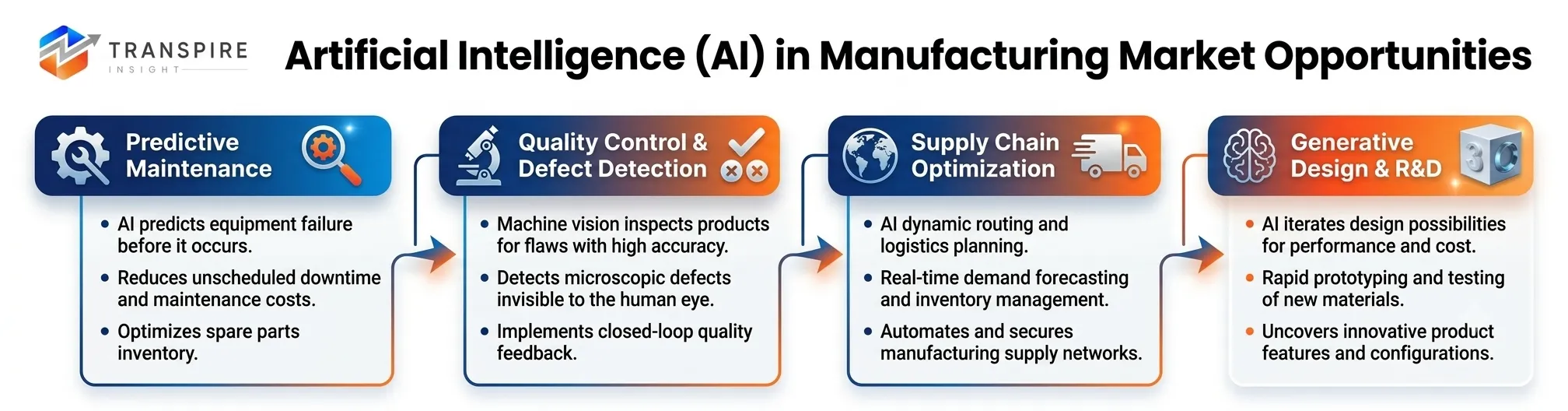
List of Top 25 Companies Leading the Artificial Intelligence (AI) in Manufacturing Market
Customize the exclusive Artificial Intelligence (AI) in Manufacturing Market report today to receive tailored insights, country-specific analysis, and business-focused market intelligence.
1. NVIDIA Corporation
Dominates industrial AI acceleration through specialized hardware chipsets and Omniverse simulation.
Founded: 1993 | HQ: Santa Clara, California, USA.
Why It Ranks: Provides essential computing hardware and digital twin ecosystems powering smart factories.
Regional Dominance: North America leads revenue, expanding aggressively into Asia-Pacific industrial markets.
Product Line: NVIDIA Omniverse Enterprise, Jetson Edge AI, Metropolis vision platform, GPUs.
2. Siemens AG
Integrates generative AI directly into industrial automation platforms and control systems.
Founded: 1847 | HQ: Munich, Germany.
Why It Ranks: Unrivaled footprint in programmable logic controllers and factory digital twins globally.
Regional Dominance: Dominates Europe, holding huge market share in North America and Asia.
Product Line: Industrial Copilot, Xcelerator Portfolio, MindSphere IoT, SIMATIC automation hardware.
3. Microsoft Corporation
Powers enterprise manufacturing operations using cloud-scale Azure Industrial AI capabilities.
Founded: 1975 | HQ: Redmond, Washington, USA.
Why It Ranks: Leads cloud software infrastructure connecting shop floors with enterprise supply chains.
Regional Dominance: reach with massive enterprise footprints across North America and Europe.
Product Line: Azure IoT Operations, Cloud for Manufacturing, Azure AI vision tools.
4. IBM Corporation
Pioneers predictive maintenance software and generative AI tools for industrial assets.
Founded: 1911 | HQ: Armonk, New York, USA.
Why It Ranks: Deep penetration in enterprise asset management across heavy manufacturing sectors.
Regional Dominance: Strong enterprise presence anchored primarily throughout North America and Europe.
Product Line: IBM Maximo Application Suite, watsonx.ai, Environmental Intelligence Suite.
5. Rockwell Automation
Delivers end-to-end industrial automation and AI-driven factory edge analytics solutions.
Founded: 1903 | HQ: Milwaukee, Wisconsin, USA.
Why It Ranks: Premier pure-play provider of industrial control systems and manufacturing software.
Regional Dominance: Holds leading market share across North American discrete manufacturing operations.
Product Line: FactoryTalk Analytics, GuardLogix PLCs, Plex Smart Manufacturing Platform.
6. GE Vernova (General Electric)
Optimizes heavy industrial asset performance and power generation through predictive modeling.
Founded: 1892 | HQ: Cambridge, Massachusetts, USA.
Why It Ranks: Crucial vendor for high-stakes manufacturing, energy management, and heavy equipment.
Regional Dominance: Established market footprint throughout North America and major European energy hubs.
Product Line: Proficy Smart Factory software, APM (Asset Performance Management) platform.
7. SAP SE
Embeds AI into enterprise resource planning to optimize shop-floor logistics.
Founded: 1972 | HQ: Walldorf, Germany.
Why It Ranks: Backbone of supply chain management and production planning for manufacturers.
Regional Dominance: Commands Europe while maintaining expansive deployments across North America and Asia.
Product Line: SAP Digital Manufacturing, S/4HANA Supply Chain, SAP Business AI.
8. Robert Bosch GmbH
Combines internal automotive manufacturing expertise with commercialized industrial AI platforms.
Founded: 1886 | HQ: Gerlingen, Germany.
Why It Ranks: World-class scale in industrial Internet of Things implementation and robotics.
Regional Dominance: Dominates European automotive production with huge operational reach in Asia.
Product Line: Bosch Manufacturing Solutions, Nexeed Industrial Application System, IoT Suite.
9. ABB Ltd
Advances physical AI and collaborative robotics for highly precise automated assembly.
Founded: 1988 | HQ: Zurich, Switzerland.
Why It Ranks: leader in industrial robotics, process automation, and digital twins.
Regional Dominance: Extensive operations across Europe, North America, and rapidly growing Asian markets.
Product Line: RobotStudio HyperReality, Ability Genix platform, OmniCore robot controllers.
10. Schneider Electric
Focuses on AI-driven energy optimization and sustainable operational controls for smart factories.
Founded: 1836 | HQ: Rueil-Malmaison, France.
Why It Ranks: Essential provider of intelligent energy infrastructure and automation software for manufacturing.
Regional Dominance: Robust presence spanning European, North American, and Asia-Pacific industrial sectors.
Product Line: EcoStruxure Automation Expert, AVEVA System Platform, Resource Advisor.
Schedule a meeting with our market experts to discuss the exclusive Artificial Intelligence (AI) in Manufacturing Market report and identify the best research solution for your organization.
Conclusion
AI in manufacturing represents a significant evolution from standard automated machinery towards a fully automated, self-optimized manufacturing environment. While edges are becoming more common, the new technologies of real-time edge processing, predictive analytics, and computer vision are growing in significance for companies moving from small-scale pilot projects to widespread operational deployments. With strong support from the innovation of powerful hardware and leading industrial technology vendors from around the world, AI-powered smart manufacturing will further significantly reduce production downtime, waste, and, in general, profoundly redefine supply chain resilience for decades to come.


Send us a brief description of your challenge and we'll get back to you within 24 hours.

 inquiry@transpireinsight.com
 APAC:+91 7666513636
 Address


