
Sep 03, 2026
By Transpire Insight
Description
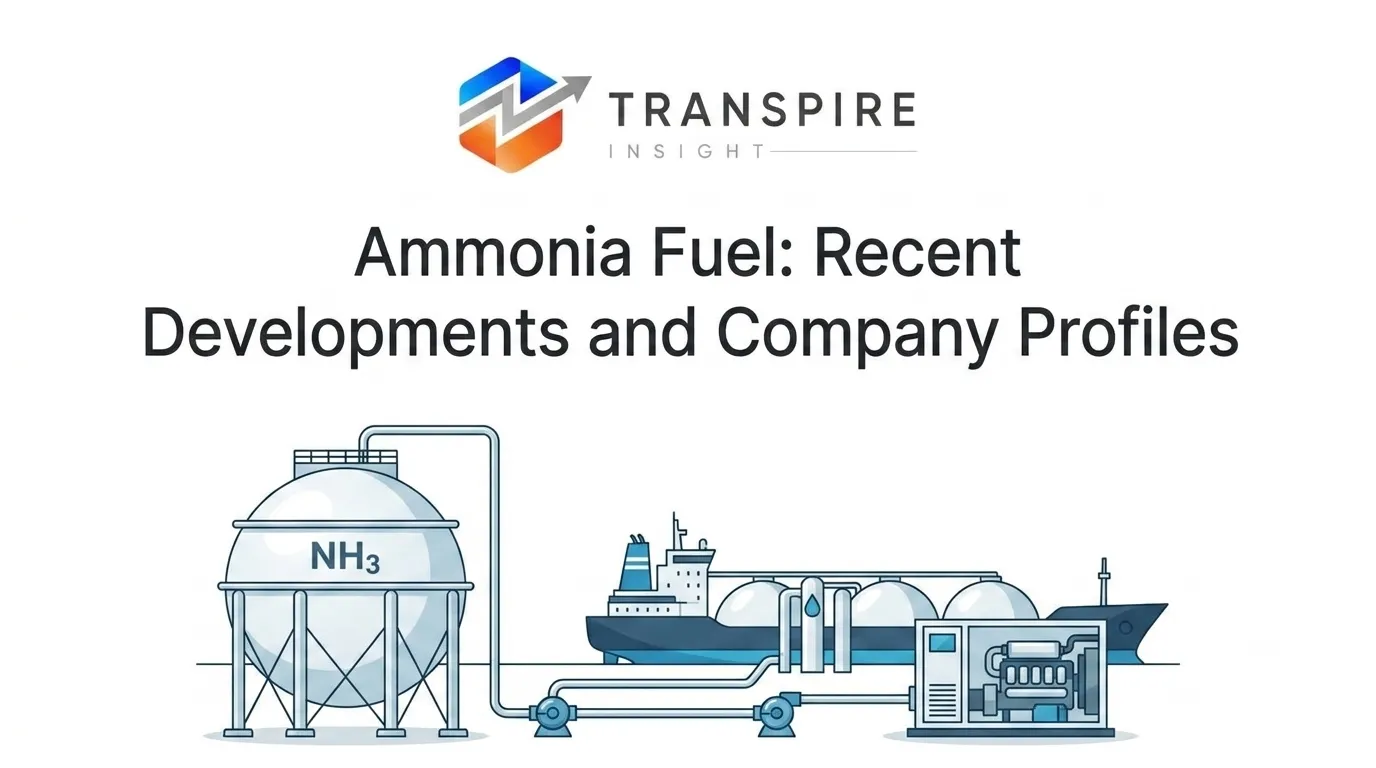
According to a research report published by Transpire Insight, the ammonia fuel market size is projected to grow from USD 5.60 billion in 2026 to USD 20.32 billion by 2035, at a CAGR of 22.4% during the forecast period 2027-2035. International maritime emission regulations, growing co-firing power generation projects, and technological advances in zero-carbon dual-fuel engines are key drivers. Furthermore, the ease with which ammonia can be transported as a hydrogen carrier makes its use in industry with a great demand for hydrogen more prevalent.
Introduction
The ammonia fuel market is in the midst of a transformation from agricultural chemical to high-density, zero-carbon energy carrier. Clean ammonia includes both blue and green ammonia and is becoming an increasingly favored option for the deep-sea shipping and power utility sectors as they look for energy-efficient alternative fuels, thanks to its higher energy density and existing distribution network. The market is a key enabler towards the journey to sustainable, zero-emission industrial and maritime energy ecosystems, with the strict international decarbonization regulations and development of dual-fuel combustion technologies driving its evolution.
Recent Development News
Stay Ahead of Emerging Opportunities with Expert Market Insights by Transpire Insight
Transpire Insight provides comprehensive, data-driven market intelligence to support smarter business decisions. Our research is rooted in comprehensive analysis, authoritative predictions, and industry expertise, enabling organizations to make informed decisions in rapidly evolving markets. In-depth analysis of market segmentation, competitive positioning, regional trends, and emerging investment opportunities in high-growth areas. We blend accuracy with actionable intelligence, empowering companies to uncover new avenues for growth, bolster strategic decision-making, and stay ahead in a dynamic market.
Ammonia Fuel Market Size & Statistics
Regional Growth and Demand Analysis by Transpire Insight
Asia Pacific's dominance is attributed to scale and policy alignment, where China remains the world's largest ammonia producer and energy consumer, while the nations of Japan and South Korea have been the quickest to put policies in place that allow current coal and gas plants to add ammonia to their fuel portfolio. The region has taken a big step toward commercial power generation through a more recent test hub launched by GE Vernova and IHI Corporation in Japan designed to test F-class gas turbines using 100% ammonia. India, which remains the smaller player when it comes to green ammonia and hydrogen production, is adding to the momentum by continued viability-gap funding under multiple ministries that continues to keep the Indian production base growing.
North America's fast expansion has another rationale, instead of being a top producer, the US is becoming a home for technical and investment opportunities, with utilities conducting co-firing trials and blue ammonia projects for carbon-capture-enabled thermal power stations to provide a short-term decarbonization strategy. In contrast, Europe is becoming a demand-side market, with Germany building port facilities and import capacity to ensure access to green ammonia for industry decarbonisation. These regional trends suggest that there will be two thrusts in the market: Asia Pacific ahead in production, ahead in power sector adoption; North America and Europe in the competition for technology integration, capital investment and import infrastructure to catch up.
Top 15 Trends in the Ammonia Fuel Market
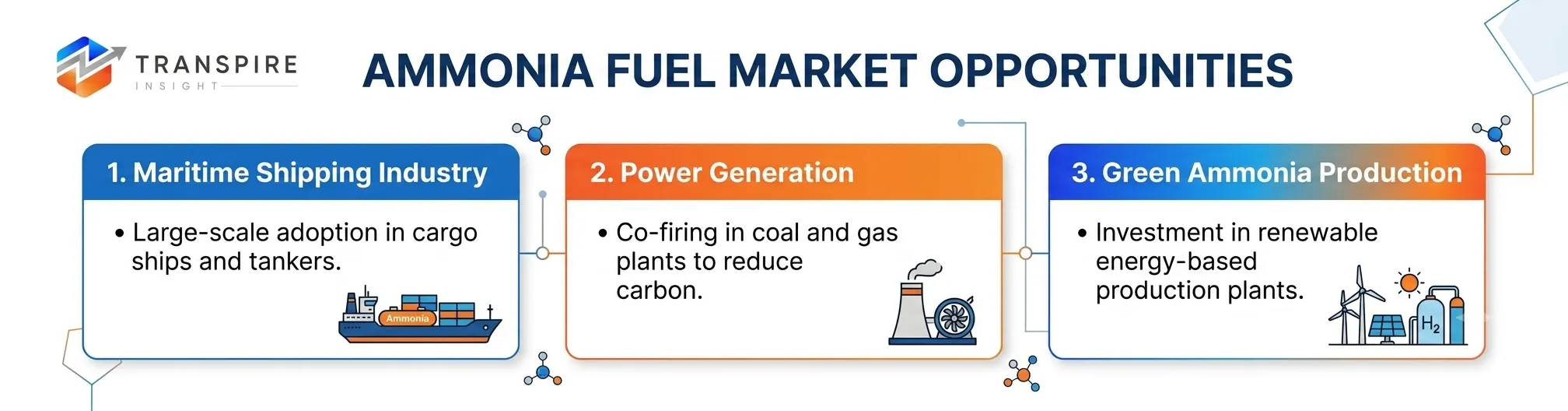
Shipping firms are testing ammonia-fueled vessels and dual-fuel engines to meet strict IMO emission targets, positioning ammonia as a zero-carbon alternative to heavy fuel oil.
Utilities in Japan, South Korea, and the US are trialing ammonia co-firing with coal and gas to cut power-sector carbon emissions without replacing existing infrastructure.
Producers are pairing renewable electricity with electrolysis to scale green ammonia output, cutting production costs and strengthening export-oriented supply chains across Australia and the Gulf.
Blue ammonia projects integrating carbon capture and storage are gaining investment as producers seek near-term decarbonization pathways without waiting for renewable electrolysis capacity to mature.
Ammonia's high energy density and existing storage infrastructure make it an efficient carrier for transporting hydrogen over long distances, supporting cross-border clean energy trade routes.
International Maritime Organization regulations targeting net-zero shipping emissions are pushing carriers and shipbuilders toward ammonia as a viable long-term, scalable, zero-carbon marine fuel choice today.
List of Top 25 Companies Leading the Ammonia Fuel Market
1. Yara International
Operates the world's largest ammonia transportation and logistics network infrastructure.
Founded: 1905 | HQ: Oslo, Norway.
Why It Ranks: Leads clean ammonia distribution through extensive marine shipping supply networks.
Regional Dominance: Holds massive market presence across European, South American, and Asian markets.
Product Line: Green ammonia, blue ammonia, industrial chemicals, and clean maritime bunkering.
2. CF Industries Holdings, Inc.
World's largest nitrogen producer advancing massive low-carbon blue ammonia production facilities.
Founded: 1946 | HQ: Deerfield, Illinois, USA.
Why It Ranks: Controls immense North American manufacturing capacity with carbon capture integration projects.
Regional Dominance: Dominates North American markets while expanding export hubs to international customers.
Product Line: Anhydrous ammonia, green ammonia, blue fuel grade, and nitrogen derivatives.
3. Nutrien Ltd.
Major agricultural fertilizer giant expanding into low-carbon clean ammonia fuel technologies.
Founded: 2018 | HQ: Saskatoon, Saskatchewan, Canada.
Why It Ranks: Leverages unmatched North American production scale for emerging low-carbon energy applications.
Regional Dominance: Commands strong market power across North America, South America, and Australia.
Product Line: Anhydrous clean ammonia, industrial nitrogen solutions, and low-carbon energy feedstocks.
4. OCI Global
Pioneer in commercializing hydrogen-based clean fuels for maritime and industrial usage.
Founded: 1950 | HQ: Amsterdam, Netherlands.
Why It Ranks: Early market mover supplying zero-carbon shipping fuels and clean industrial energy.
Regional Dominance: Maintains strong commercial operations across Europe, Middle East, and North America.
Product Line: Low-carbon green ammonia, bio-methanol, and clean power generation solutions.
5. SABIC
Saudi chemical leader shipping world's first certified low-carbon blue ammonia cargoes.
Founded: 1976 | HQ: Riyadh, Saudi Arabia.
Why It Ranks: Drives clean energy export supply chains using vast hydrocarbon resources.
Regional Dominance: Dominates Middle Eastern production while exporting heavily to Asia and Europe.
Product Line: Certified blue ammonia, green ammonia, urea, and specialty industrial chemicals.
6. BASF SE
Chemical giant developing innovative catalytic processes for efficient sustainable ammonia synthesis.
Founded: 1865 | HQ: Ludwigshafen, Germany.
Why It Ranks: Integrates advanced chemical synthesis technologies with European industrial decarbonization targets.
Regional Dominance: Holds a dominant market position across European and North American sectors.
Product Line: Industrial-grade ammonia, synthesis catalysts, and sustainable chemical intermediate feedstocks.
7. Air Liquide S.A.
industrial gas leader providing advanced cracking technology for hydrogen recovery.
Founded: 1902 | HQ: Paris, France.
Why It Ranks: Offers end-to-end expertise in hydrogen cracking and clean fuel distribution networks.
Regional Dominance: Maintains expansive supply operations across Europe, Asia-Pacific, and Americas markets.
Product Line: Ammonia cracking systems, green hydrogen supply, and industrial energy solutions.
8. Linde plc
World's largest industrial gas supplier, engineering turnkey green ammonia plant facilities.
Founded: 1879 | HQ: Guildford, United Kingdom
Why It Ranks: Delivers cutting-edge engineering, procurement, and construction for green fuel projects globally.
Regional Dominance: Controls massive market infrastructure across Europe, North America, and Asia-Pacific.
Product Line: Turnkey ammonia synthesis plants, cracking technology, and renewable hydrogen systems.
9. Thyssenkrupp AG
Industrial engineering leader offering gigawatt-scale green ammonia production technology and plants.
Founded: 1999 | HQ: Essen, Germany.
Why It Ranks: Controls proprietary electrolysis and synthesis technology critical for clean energy projects.
Regional Dominance: Leads technology deployment across Europe, the Middle East, and Australian renewable hubs.
Product Line: Uhde green ammonia plants, water electrolyzers, and clean chemical processes.
10. Siemens Energy
Energy technology innovator driving green ammonia production through dynamic renewable integration.
Founded: 2020 | HQ: Munich, Germany.
Why It Ranks: Supplies advanced power electronics and electrolysis systems for zero-carbon fuel generation.
Regional Dominance: Strongly established in Europe, Latin America, and Middle East transition projects.
Product Line: Electrolyzers, green ammonia synthesis systems, and power-to-X energy solutions.
Conclusion
The ammonia fuel market is evolving quickly from conceptual pilot projects to commercialization along supply chains. Green and blue ammonia are becoming increasingly important decarbonization vectors, with major developments in marine propulsion engines, commercial marine port bunkering, and government subsidies for power plant co-firing. While high production costs and NOx emissions still pose challenges, ammonia continues to grow as its technology advances, and strategic international consortia will enable significant growth, making it a pillar of the zero-carbon energy landscape in the next decade.


Send us a brief description of your challenge and we'll get back to you within 24 hours.

 inquiry@transpireinsight.com
 APAC:+91 7666513636
 Address


