
Sep 03, 2026
By Transpire Insight

Description
According to a research report published by Transpire Insight, the AI in industrial automation market size is projected to grow from USD 27.23 billion in 2026 to USD 95.13 billion by 2035, at a CAGR of 19.3% during the forecast period 2027-2035. The adoption of platforms for real-time operational efficiency, predictive maintenance, and edge computing integration is unprecedented. AI-powered smart industrial factories' deployment is accelerating worldwide due to severe labor shortages, increased energy costs, and the quick enterprise transition to agentic AI and physics-aware digital twins. The high pace of enterprises transitioning towards agentic AI and physics-aware digital twins, severe labor shortages, and rising energy costs drive smart industrial factory deployment worldwide.
Introduction
The incorporation of AI in industrial automation represents a paradigm shift, shifting today's factories from traditional automated systems to hyper-connected and autonomous ones. When combined with machine learning, computer vision, and generative small language models, embedded in edge controllers and robotics, manufacturers can benefit from predictive maintenance, supply chain optimization, and no downtime in operations. The technological fusion allows real-time decision-making on the shop floor, resulting in unprecedented precision, energy efficiency, and worker safety in various industrial fields and laying the essential backbone for the next generation of smart manufacturing operations worldwide.
Recent Development News
Stay Ahead of Emerging Opportunities with Expert Market Insights by Transpire Insight
Transpire Insight provides comprehensive, data-driven market intelligence to support smarter business decisions. Our research is rooted in comprehensive analysis, authoritative predictions, and industry expertise, enabling organizations to make informed decisions in rapidly evolving markets. In-depth analysis of market segmentation, competitive positioning, regional trends, and emerging investment opportunities in high-growth areas. We blend accuracy with actionable intelligence, empowering companies to uncover new avenues for growth, bolster strategic decision-making, and stay ahead in a dynamic market.
AI in Industrial Automation Market Size & Statistics
Regional Growth and Demand Analysis by Transpire Insight
North America's leadership is grounded in the manufacturing sector that continues to drive AI into the daily workflows of plants instead of showcasing it as a pilot project. Rockwell Automation has introduced AI-based improvements to its FactoryTalk Optix platform that enable edge analytics and more comprehensive visualization capabilities to boost the productivity of smart manufacturing on the shop floor. AI-powered robotics and predictive-maintenance software are proliferating on the factory floor, helping automotive, aerospace, and electronics manufacturers in the region reduce unplanned downtime, and cloud and chipmaker alliances continue to bring more computing power to the factory floor. Strict data-governance regulations that incentivize auditability of AI systems and manufacturing centers updating quality-control and production lines for sustainability also help propel Europe close behind. European demand is also being driven by the cross-border flow of trade, which is increasing demand for AI-powered logistics and documentation automation, whereas the demand in other parts of the world is more associated with the rate of adoption.
Asia Pacific's dynamism is quite different. Not only is there a lot of factory expansion going on, but there is also an unusual level of support for intelligent manufacturing from the government. ABB Robotics' vision intelligence technology has been expanded from inspection stations to distributed use on production lines, to monitor and assist mid-market plants across the region. Kawasaki Robotics launches the 8-axis Kawasaki Robotics physical-AI robot for adaptive motion and obstacle avoidance, setting a new trend among the region's manufacturers from fixed-path automation to learning robots. China, India, and Japan continue to expand their electronics and automotive manufacturing capabilities, and public digital-economic initiatives are funding AI-driven supply-chain and transaction-management solutions, especially those in e-commerce integrated manufacturing. Multinational suppliers are entering Latin America and the Middle East and Africa, and automation in the energy sector is providing a steady, though modest, boost of incremental growth to both areas.
Top 15 Trends in the AI in Industrial Automation Market
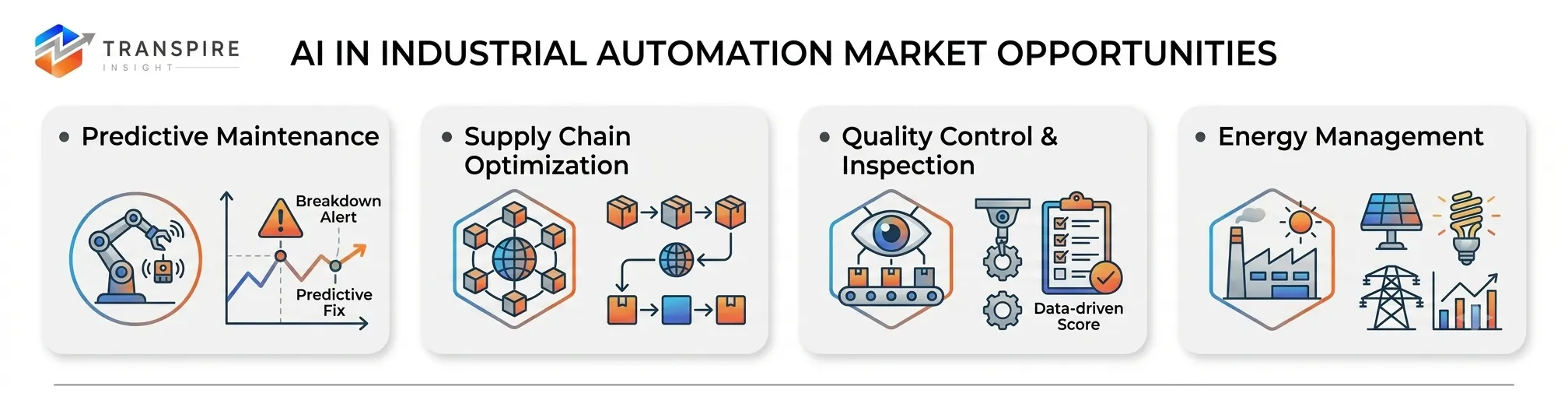
Predictive Maintenance
AI algorithms analyze sensor and vibration data to forecast equipment failures before they occur, letting manufacturers schedule repairs proactively and avoid costly unplanned production downtime.
Machine Vision
Camera-based AI vision systems inspect products at high speed, spotting defects invisible to the human eye and ensuring consistent quality across large-scale manufacturing operations worldwide.
Digital Twins
Virtual replicas of physical production lines let engineers simulate changes, test scenarios, and optimize workflows digitally before implementing costly modifications on actual factory floors worldwide.
Edge AI
Edge AI lets factories process data directly on local devices, cutting latency and enabling robotic control, safety alerts, and quality decisions without relying on the cloud.
Generative AI
Generative AI tools help engineers design optimized production layouts, generate process improvements, and simulate alternative manufacturing scenarios faster than traditional trial-and-error engineering approaches allow today.
Collaborative Robots
AI-equipped collaborative robots work safely alongside human operators, adapting movements in real time to handle flexible assembly, packaging, and material-handling tasks efficiently across plants today.
List of Top 25 Companies Leading the AI in Industrial Automation Market
1. Siemens AG
Powers manufacturing using industrial copilots and physics-based digital twin software solutions.
Founded: 1847 | HQ: Munich, Germany.
Why It Ranks: Dominates industrial software, programmable logic controllers, and enterprise digital twin technologies.
Regional Dominance: Strong market presence across Western Europe, North America, and key Asia-Pacific hubs.
Product Line: Industrial Copilot, MindSphere software, SIMATIC PLCs, and Tecnomatix digital twin software.
2. Schneider Electric
Integrates agentic AI into EcoStruxure architecture for optimized factory energy management.
Founded: 1836 | HQ: Rueil-Malmaison, France.
Why It Ranks: Leads energy management automation alongside cloud-connected industrial edge intelligence systems.
Regional Dominance: Holds massive market leadership across Western Europe, North America, and Asia.
Product Line: EcoStruxure Copilot, AVEVA System Platform, Modicon PLCs, and Altivar drives.
3. Rockwell Automation
Deploys small language models on edge devices through FactoryTalk Design Studio.
Founded: 1903 | HQ: Milwaukee, Wisconsin, USA.
Why It Ranks: Premier provider of industrial control systems, robotics software, and telemetry analytics.
Regional Dominance: Commanding leadership position across the United States, Canada, and Latin America.
Product Line: FactoryTalk Design Studio, ControlLogix PLCs, OptixPanel, and Plex Smart Manufacturing.
4. ABB
Combines collaborative robotics with artificial intelligence for autonomous material handling workflows.
Founded: 1988 | HQ: Zurich, Switzerland.
Why It Ranks: Pioneering industrial robot manufacturer integrating machine learning into automated robotic cells.
Regional Dominance: Widespread adoption across European manufacturing bases, China, and North American plants.
Product Line: Ability System 800xA, YuMi cobots, RobotStudio, and PickMaster vision systems.
5. NVIDIA
Accelerates industrial digital twins using Omniverse and physics-grounded artificial intelligence frameworks.
Founded: 1993 | HQ: Santa Clara, California, USA.
Why It Ranks: Supplies foundational GPU hardware and simulation platforms for factory physical AI.
Regional Dominance: supremacy in enterprise AI compute infrastructure across all major regions.
Product Line: Omniverse Enterprise, Isaac Autonomous Mobile Robot platform, Metropolis, and Jetson.
6. Honeywell
Delivers AI-driven process control systems optimizing refinery, chemical, and manufacturing performance.
Founded: 1906 | HQ: Charlotte, North Carolina, USA.
Why It Ranks: Unmatched pedigree in distributed control systems and industrial safety automation tools.
Regional Dominance: Strong operational footprint throughout North America, the Middle East, and Asia.
Product Line: Experion Process Knowledge System, Forge IoT, and Honeywell Autonomous Operations.
7. Emerson Electric
Empowers process industries with automated valve diagnostics and AI predictive health monitors.
Founded: 1890 | HQ: St. Louis, Missouri, USA.
Why It Ranks: World leader in process automation, measurement instrumentation, and software telemetry analytics.
Regional Dominance: Dominates North American heavy industry, process manufacturing, and energy sector.
Product Line: DeltaV Automation System, Ovation, AMS Device Manager, and Plantweb digital ecosystem.
8. Mitsubishi Electric
Implements Maisart proprietary artificial intelligence across factory automation hardware and controllers.
Founded: 1921 | HQ: Tokyo, Japan.
Why It Ranks: Key developer of high-precision industrial robotics, PLCs, and servo motors.
Regional Dominance: Major dominance in Japan, East Asia, and expanding European industrial sectors.
Product Line: MELSEC Series PLCs, MELFA Robots, e-F@ctory, and Maisart AI solution suite.
9. OMRON Corporation
Pioneer in harmonized automation combining computer vision, robotics, and safety sensing technologies.
Founded: 1933 | HQ: Kyoto, Japan.
Why It Ranks: Innovative leader in integrated factory floor sensing, mobile manipulation, and control.
Regional Dominance: Strong market share in Japan, broader Asia-Pacific, and European electronics manufacturing.
Product Line: Sysmac Automation Platform, Mobile Autonomous Robots, FH-Series Vision, and AI Controllers.
10. FANUC Corporation
Integrates deep learning into industrial articulated arm robots for automated bin picking.
Founded: 1972 | HQ: Oshino, Yamanashi, Japan.
Why It Ranks: Premier manufacturer of computer numerical control machines and industrial robots.
Regional Dominance: Dominates automotive manufacturing facilities across Asia, the Americas, and the European continent.
Product Line: FIELD system platform, ROBOGUIDE simulation software, CNC controls, and R-2000 robots.
Conclusion
The adoption of AI in industrial automation is transforming industrial facilities into intelligent, self-optimizing, and automated enterprises, redefining the future of manufacturing globally. Industrial leaders are seeing substantial gains in operational uptime, energy efficiency, and product quality with the emergence of edge AI, agentic systems, and physics-aware digital twins. Businesses that manage to connect the IT and OT infrastructure and pay extra attention to data contextualization will stay competitive. In the end, AI-driven automation is the essential pillar for sustainable, resilient, and very resilient manufacturing enterprise operations worldwide.


Send us a brief description of your challenge and we'll get back to you within 24 hours.

 inquiry@transpireinsight.com
 APAC:+91 7666513636
 Address


