
Aug 19, 2026
By Transpire Insight
Description
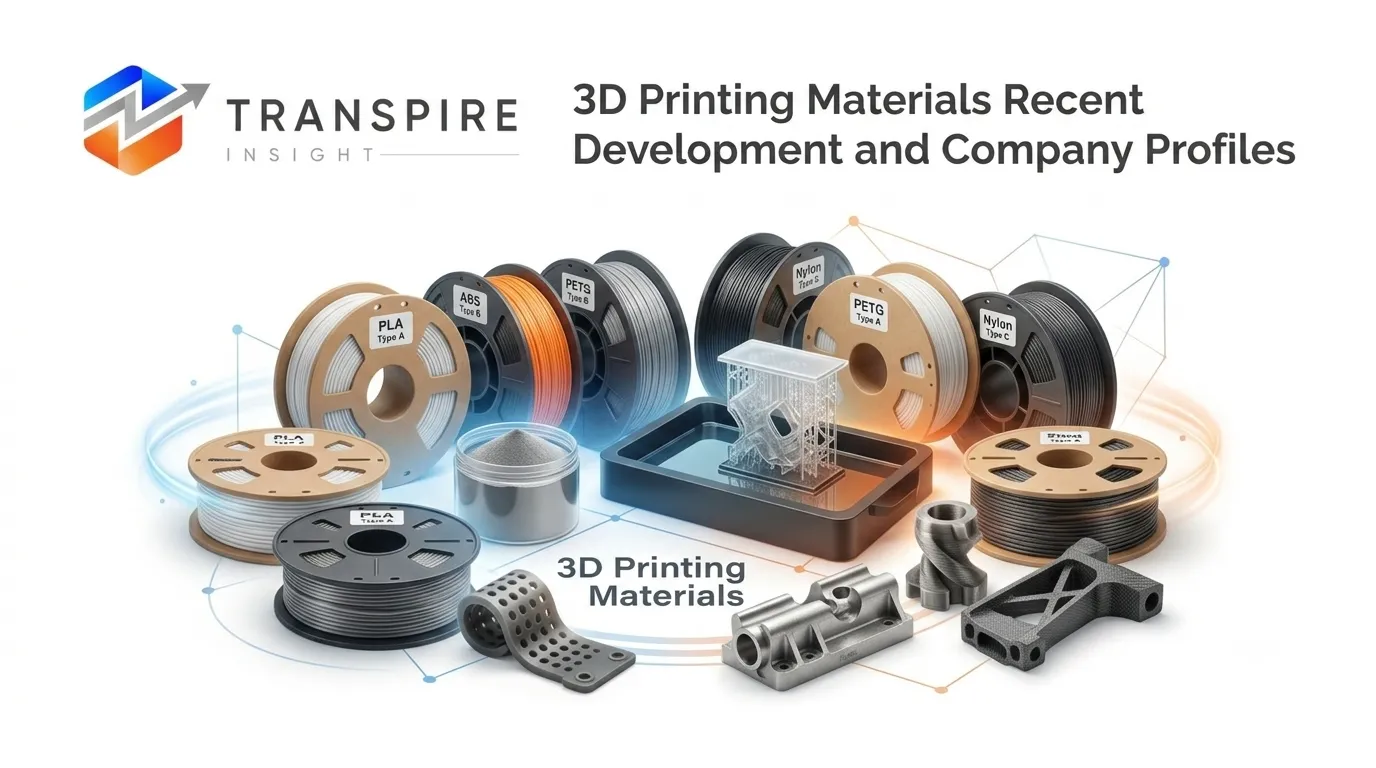
According to a research report published by Transpire Insight, The 3D Printing Materials Market size is projected to Grow from USD 4.22 Billion in 2025 to USD 19.78 Billion by 2035, at a CAGR of 22% during the forecast period 2026-2035. The market is growing very fast as additive manufacturing is progressing from prototype to large scale manufacturing applications in sectors such as aerospace, automotive, healthcare, electronics and industrial manufacturing. The growth in demand for customized parts, lightweight structures, complex designs, faster product development and minimal wastage of materials is leading to increased use of advanced polymers, metal powders, ceramics, composite materials and special resins.
Introduction
The 3D Printing Materials Market refers to the specific type of materials required for additive manufacturing technologies that create an object through a process that involves depositing or forming material layer by layer based on a digital design. It encompasses polymers, metals, ceramics, composite materials and others that come in different forms, including filament, powder, liquid resin, pellet form, etc. The market evolution has moved away from simple prototyping to actual manufacturing where material properties become crucial in terms of strength, heat resistance, flexibility, durability, light weight, finish, biocompatibility and others. The increasing adoption of additive manufacturing in aerospace, automotive, medical, dental, electronic devices, industrial machinery and consumer goods industries has encouraged the development of application specific formulations, recyclable options, high-performance alloys, engineering plastics, and composite materials among others.
Recent Development News
Stay Ahead of Emerging Opportunities with Expert Market Insights by Transpire Insight
The insights that have been shared through this blog are based on intensive market research carried out by Transpire Insight, an advisor that works with many organizations. Thanks to the analysis of extensive data, forecasts made by our specialists, and industry intelligence, our reports allow clients to find strategic growth opportunities in dynamically developing industries. For all those who would like to get more detailed information regarding market segmentation, competitive analysis, regional outlooks, and future investment tendencies, there is no doubt that our full report will be of great value.
Download the exclusive 3D Printing Materials Market sample report today to uncover expert insights, emerging trends, and the opportunities defining the future of the industry.
3D Printing Materials Market Size & Statistics
Regional Growth and Demand Analysis by Transpire Insight:
North America is the leading region in the 3D Printing Materials Market, which accounts for about 41.2% of revenue generated in this market in 2025. The dominant position of the region is attributed to the early implementation of additive manufacturing technologies, development of aerospace and defense manufacturing industry, effective applications in the automotive and healthcare sectors, and availability of large numbers of 3D-printing technology and materials firms in the region. North America owes its dominance to the United States, where manufacturers are increasingly using metal powders, engineering polymers, composite materials, and advanced resins for prototyping and production of parts.
North America has a well-established system that involves interaction between material developers, printer manufacturers, R&D organizations, aerospace manufacturers, automotive companies, healthcare firms, and industrial manufacturers.
Asia-Pacific will grow at the fastest pace, driven by China's substantial manufacturing industry, rising levels of industrial automation, more use of additive manufacturing in the electronics and automotive sectors, and investments in new materials and 3D printing technology in China, Japan, South Korea, and India.
Top 15 Trends in the 3D Printing Materials Market
Proceed to Checkout to purchase the exclusive 3D Printing Materials Market report and gain instant access to in-depth market intelligence, strategic analysis, and future growth opportunities.
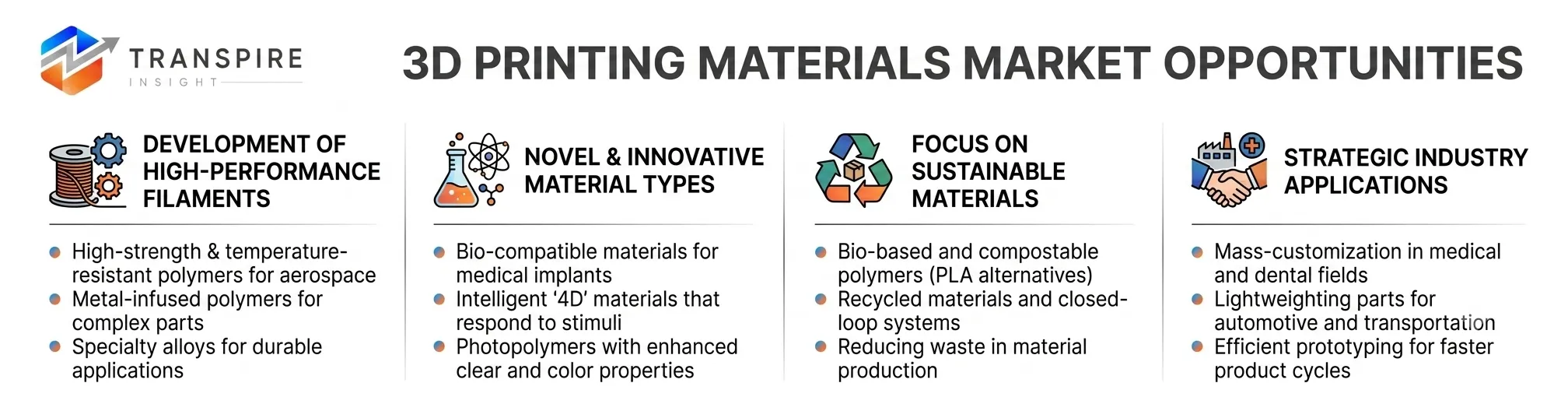
The 3D printing sector is gradually shifting its focus to the use of engineering grade polymers, which provide strength, durability, chemical resistance, thermal stability, and precision. Polymers like PEEK, PEKK, ULTEM, nylon, and high-end photopolymers are being considered as there is a gradual change in the use of additive manufacturing from prototype manufacturing to functional parts manufacturing.
The field of metal additive manufacturing has generated an increasing need for advanced powders and alloys that can help in making parts that are light weight and strong and have a complex geometrical shape. The stainless steel, titanium, aluminum, nickel based alloys and cobalt chromium are being used extensively for the purposes of aerospace, automotive, medical and energy related applications.
Sustainability has become a growing factor in the choice of materials as manufacturers try to minimize waste and their effect on the environment. Manufacturers are coming up with recyclable thermoplastics, bio-derived polymers, recycled raw materials, and materials that can allow for efficient manufacturing processes. The fact that additive manufacturing deposits materials only where necessary also helps in this regard.
Composite materials that utilize carbon fiber, glass fiber, or other reinforcements have become increasingly popular since they offer an advantage in terms of enhanced strength and stiffness without adding significantly to the weight of the parts. They offer significant benefits for use in aerospace, automotive, robotics, tooling, and industrial sectors among others. Innovations in material orientation, bonding, and manufacturing are contributing to improved performance of the printed parts.
In material development, there is currently a lot of interest in bio-based polymers and degradable feedstocks as an alternative to regular petroleum-based materials. Materials such as PLA and other bio-based materials are commonly used in a variety of printing processes, while more materials that have superior mechanical properties and eco-friendliness are being researched and developed.
There is growing interest in 3D printing using ceramics where resistance to high temperatures, hardness, resistance to corrosion, insulation of electrical properties, and biocompatibility are essential. Technical ceramics like alumina, zirconia, silicon carbide, and others are being researched for use in aerospace, electronics, medicine, energy, and industry. Increased printing accuracy and post-printing processes have overcome some limitations in ceramic production.
Top 25 Companies Leading the 3D Printing Materials Market
Customize the exclusive 3D Printing Materials Market report today to receive tailored insights, country-specific analysis, and business-focused market intelligence.
1. BASF SE
BASF SE is a German multinational chemical company with a broad materials portfolio serving industrial, automotive, healthcare, electronics, and additive manufacturing applications.
Founded: 1865 | Headquarters: Ludwigshafen, Germany
Why It Ranks: BASF ranks among the leading companies due to its expertise in polymers, specialty chemicals, and additive manufacturing materials, including solutions developed for different 3D printing processes.
Regional Dominance: Europe is its core region, while BASF maintains extensive operations across North America and Asia-Pacific.
Product Line: Its additive manufacturing materials include Ultrafuse filaments, metal-polymer feedstocks, engineering polymers, thermoplastic materials, and specialized materials for industrial 3D printing.
Recent Development: BASF has continued expanding its additive manufacturing materials portfolio with an emphasis on high-performance polymers, metal systems, and application-specific 3D printing solutions.
2. Evonik Industries AG
Evonik is a German specialty chemicals company that develops advanced materials and chemical solutions for healthcare, automotive, aerospace, and additive manufacturing.
Founded: 2007 | Headquarters: Essen, Germany
Why It Ranks: Evonik is a major 3D printing materials supplier because of its expertise in high-performance polymers and its long-standing development of materials specifically designed for additive manufacturing.
Regional Dominance: Europe is a major market, supported by strong activities across North America and Asia-Pacific.
Product Line: Its portfolio includes INFINAM® thermoplastic powders, filaments, and photopolymer materials, along with high-performance polymers such as PA 12 and specialty materials.
Recent Development: Evonik continues to develop INFINAM® materials and application-specific polymer solutions, with emphasis on improving processing performance and enabling industrial-scale additive manufacturing.
3. Arkema S.A.
Arkema is a French specialty materials company producing advanced polymers and high-performance materials for industrial, automotive, aerospace, electronics, and additive manufacturing applications.
Founded: 2004 | Headquarters: Colombes, France
Why It Ranks: Arkema ranks highly due to its expertise in advanced polymers, photopolymers, and specialty materials that support demanding additive manufacturing applications.
Regional Dominance: Europe is a key region, while the company also has significant operations in North America and Asia-Pacific.
Product Line: Its 3D printing materials include Nylon-11 powders, specialty polymers, liquid resins, photopolymer materials, and high-performance polymer solutions marketed through its advanced materials businesses.
Recent Development: Arkema continues to expand its advanced polymer and resin offerings for additive manufacturing, focusing on materials that provide improved mechanical performance, durability, and design flexibility.
4. Stratasys Ltd.
Stratasys is a additive manufacturing company specializing in polymer 3D printers, production systems, software, and materials for industrial applications.
Founded: 1989 | Headquarters: Eden Prairie, Minnesota, USA & Rehovot, Israel
Why It Ranks: Stratasys is a major market participant because it combines 3D printing hardware with a broad portfolio of proprietary materials, enabling customers to develop prototypes, tooling, and production components.
Regional Dominance: North America and Europe are major markets, with a growing presence throughout Asia-Pacific.
Product Line: Its materials portfolio includes FDM thermoplastics, PolyJet photopolymers, SAF powders, stereolithography materials, engineering-grade polymers, and specialty production materials.
Recent Development: Stratasys has continued expanding its SAF, FDM, and PolyJet material ecosystems, including development of materials aimed at production-grade applications and improved sustainability.
5. 3D Systems Corporation
3D Systems is a U.S.-based additive manufacturing company providing 3D printers, materials, software, and manufacturing services across healthcare, aerospace, automotive, and industrial sectors.
Founded: 1986 | Headquarters: Rock Hill, South Carolina, USA
Why It Ranks: The company ranks among the leading players because of its extensive experience in additive manufacturing and broad materials portfolio spanning polymer, resin, metal, and specialized healthcare applications.
Regional Dominance: North America is a major market, complemented by strong operations in Europe and Asia-Pacific.
Product Line: Its materials include SLA resins, Figure 4 materials, SLS powders, DMP metal powders, casting materials, dental materials, and biocompatible materials.
Recent Development: 3D Systems has continued developing application-specific materials for healthcare, aerospace, dental, and industrial production, with an increasing focus on high-performance and regulated applications.
6. Materialise NV
Materialise is a Belgian additive manufacturing company providing 3D printing software, manufacturing services, and material solutions for healthcare and industrial applications.
Founded: 1990 | Headquarters: Leuven, Belgium
Why It Ranks: Materialise ranks strongly because it combines additive manufacturing software expertise with production services and specialized materials, particularly for complex industrial and medical applications.
Regional Dominance: Europe is its core region, with significant activities in North America and Asia-Pacific.
Product Line: Its portfolio includes polyamide powders, titanium materials, medical-grade materials, resins, and other materials used across industrial and healthcare 3D printing.
Recent Development: Materialise continues to expand its medical 3D printing and industrial manufacturing capabilities, while integrating software, materials, and production services to support end-to-end additive manufacturing workflows.
7. EOS GmbH
EOS is a German additive manufacturing company specializing in industrial polymer and metal 3D printing systems, materials, and process technologies.
Founded: 1989 | Headquarters: Krailling, Germany
Why It Ranks: EOS is a leading player due to its expertise in industrial powder-bed fusion and its extensive portfolio of validated polymer and metal materials for demanding production environments.
Regional Dominance: Europe is its strongest region, with significant presence in North America and Asia-Pacific.
Product Line: Its materials include PA 12, PA 11, high-temperature polymers, aluminum, titanium, stainless steel, nickel alloys, cobalt-chrome, and other metal powders.
Recent Development: EOS continues to introduce new metal and polymer materials designed to improve productivity, mechanical performance, sustainability, and application flexibility in industrial additive manufacturing.
8. HP Inc.
HP is a technology company that has established a major presence in industrial additive manufacturing through its Multi Jet Fusion and Metal Jet platforms.
Founded: 1939 | Headquarters: Palo Alto, California, USA
Why It Ranks: HP ranks among the leading companies because its additive manufacturing ecosystem combines high-productivity printing platforms with specialized polymer and metal materials designed for production applications.
Regional Dominance: North America is a major market, with extensive adoption across Europe and Asia-Pacific.
Product Line: Its materials portfolio includes PA 12, PA 11, polypropylene, glass-bead-filled materials, BASF-powered materials, and Metal Jet metal feedstocks.
Recent Development: In April 2026, HP introduced new additive manufacturing capabilities and materials at RAPID+TCT 2026, strengthening its focus on industrial-scale polymer and metal 3D printing.
9. Henkel AG & Co. KGaA
Henkel is a German chemical and consumer goods company with a major advanced materials business serving electronics, automotive, aerospace, healthcare, and additive manufacturing.
Founded: 1876 | Headquarters: Düsseldorf, Germany
Why It Ranks: Henkel ranks strongly because of its expertise in photopolymer chemistry and its ability to develop specialized materials for industrial additive manufacturing applications.
Regional Dominance:Europe is a core region, with broad operations throughout North America and Asia-Pacific.
Product Line: Its 3D printing portfolio includes LOCTITE® 3D photopolymer resins, elastomeric materials, high-temperature materials, rigid resins, medical-grade materials, and other application-specific formulations.
Recent Development: Henkel continues to expand its LOCTITE 3D materials portfolio, focusing on high-performance resins and materials tailored to production tooling, functional prototypes, healthcare, and industrial applications.
10. Covestro AG
Covestro is a German materials manufacturer specializing in high-performance polymers and specialty chemicals used across automotive, construction, electronics, healthcare, and additive manufacturing.
Founded: 2015 | Headquarters: Leverkusen, Germany
Why It Ranks: Covestro has been an important participant in the 3D printing materials ecosystem because of its expertise in polyurethane and polycarbonate chemistry and development of advanced additive manufacturing materials.
Regional Dominance:Europe is a key market, alongside strong operations across North America and Asia-Pacific.
Product Line: Its additive manufacturing materials have included thermoplastic polyurethane (TPU), polycarbonate, photopolymer resins, and other high-performance polymer materials.
Recent Development: Covestro's former additive manufacturing materials business has undergone strategic changes following the sale of its Additive Manufacturing business to Stratasys, allowing Stratasys to integrate Covestro's relevant materials capabilities into its broader additive manufacturing portfolio.
Schedule a meeting with our market experts to discuss the exclusive 3D Printing Materials Market report and identify the best research solution for your organization.
Conclusion
The 3D Printing Materials Market is witnessing rapid advancements as the shift towards production rather than prototyping is taking place. Leading companies such as BASF SE, Evonik Industries AG, Arkema S.A., Stratasys Ltd., 3D Systems Corporation, Materialise NV, EOS GmbH, HP Inc., Henkel AG & Co. KGaA, and Covestro AG are contributing to the growth of the market with advanced polymers, metal powders, photopolymer resins, composites, and specialty materials. Growing demand from the aerospace, automotive, healthcare, dental, electronics, and industrial manufacturing industries is prompting innovations in materials which include lightweight, strong, heat resistant, sustainable, and application specific. In the future, there is a likelihood that high performance polymers, advanced metal alloys, sustainable feedstocks, multi-material printing, material innovation through artificial intelligence, and recycled materials would continue to dominate the area of research.


Send us a brief description of your challenge and we'll get back to you within 24 hours.

 inquiry@transpireinsight.com
 APAC:+91 7666513636
 Address


