
Sep 24, 2026
By Transpire Insight
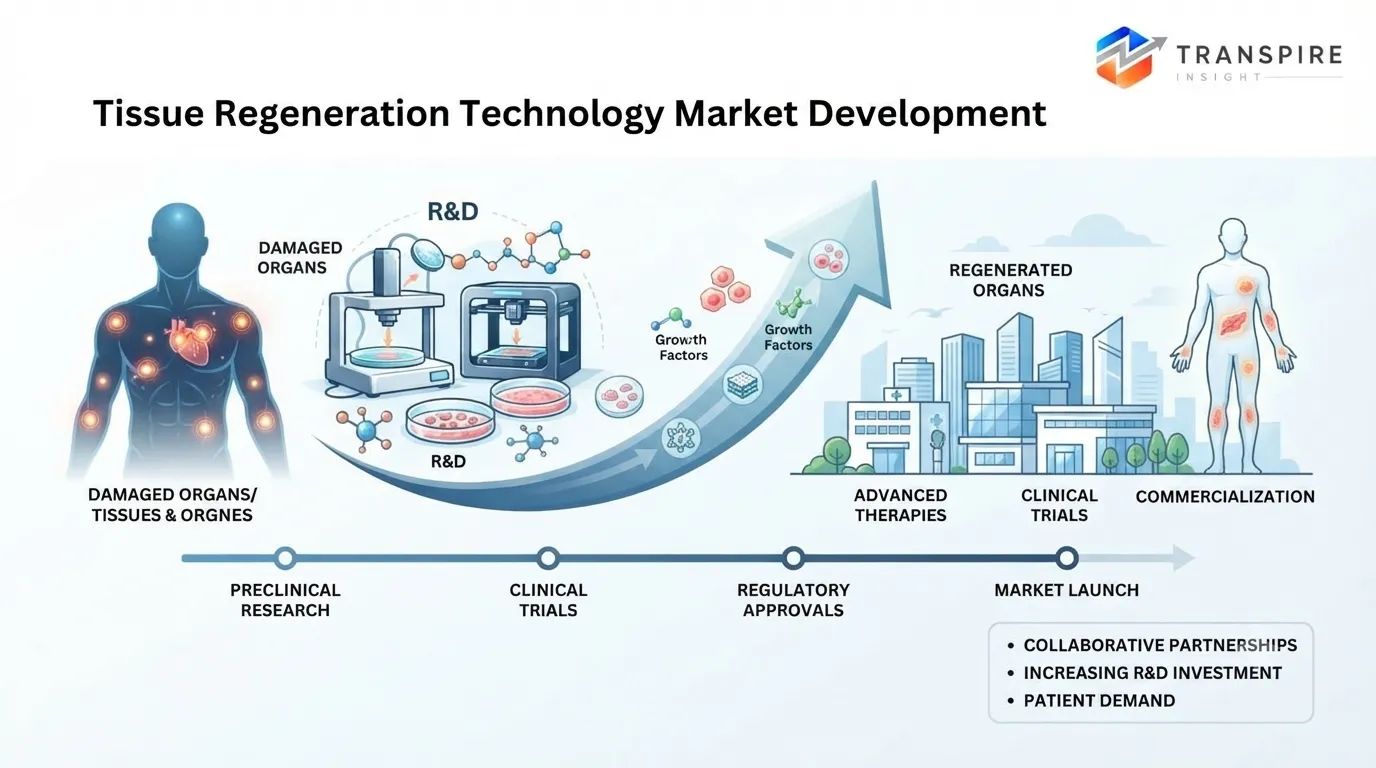
Healthcare is moving beyond conventional repair toward technologies designed to encourage the body to regenerate damaged tissues. Advances in biomaterials, scaffolds, cell-based therapies and tissue-engineering techniques are creating new possibilities across wound healing, orthopedics and reconstructive medicine.
The growing burden of chronic wounds, aging populations, sports injuries and complex surgical procedures is increasing demand for technologies capable of supporting more effective tissue restoration.
September 2026: Tissue regeneration technology represents a broad group of medical approaches designed to restore damaged or lost tissue.
The field combines biomaterials, cell biology, tissue engineering, growth factors and advanced manufacturing.
Applications range from skin and wound regeneration to bone, cartilage, dental tissue, soft-tissue repair and reconstructive surgery.
Unlike conventional implants that primarily replace damaged structures, regenerative approaches aim to support biological healing and functional restoration.
Market Size
The global tissue regeneration technology market was estimated at approximately USD 8.9 billion in 2025 and is projected to reach around USD 16.9 billion by 2034, expanding at a CAGR of approximately 7.4% during 2026–2034.
Fortune Business Insight currently estimates the market at USD 8.70 billion in 2025 and USD 16.51 billion by 2034. Research and Markets' broader tissue-engineering and regeneration category estimates USD 5.4 billion in 2025 and USD 9.8 billion by 2030. The difference illustrates how strongly market size depends on the technologies included in the definition.
Aging Populations Drive Regenerative Medicine
Population aging is one of the most important long-term drivers.
Older adults are more likely to experience chronic wounds, degenerative bone conditions, joint problems and delayed healing.
Traditional treatment methods may not always provide complete restoration.
Regenerative technologies can support the body's healing mechanisms and potentially improve clinical outcomes.
The growing number of elderly patients is therefore expanding the addressable market for tissue-regeneration products.
Chronic Wounds Create Significant Demand
Chronic wounds are a major healthcare challenge.
Diabetes, vascular disease, pressure injuries and other conditions can prevent wounds from healing normally.
Tissue-regeneration products can support wound closure by providing scaffolds, biological signals or regenerative materials.
Skin and wound regeneration represents one of the most commercially developed areas of the market.
Companies are increasingly developing advanced wound-care products designed to create favorable conditions for tissue growth.
Biomaterials Remain Fundamental
Biomaterials are central to tissue regeneration.
Collagen, hyaluronic acid, synthetic polymers, ceramics and other materials can provide structures that support cellular growth.
The choice of material depends on the target tissue.
Bone regeneration may require materials capable of supporting mineralization, while skin regeneration may require flexible materials that maintain moisture and support cell migration.
Advances in biomaterial science are therefore directly influencing product development.
Scaffolds Support Tissue Formation
Scaffolds provide three-dimensional structures that can guide tissue growth.
They can be designed to mimic aspects of the natural extracellular matrix.
Modern scaffold technologies can be engineered for different porosities, degradation rates and mechanical properties.
3D printing is creating additional possibilities because manufacturers can produce patient-specific structures.
This could become particularly important in bone and cartilage reconstruction.
Cell-Based Technologies Create New Opportunities
Stem cells and other cell-based approaches are expanding the regenerative-medicine landscape.
Cells can potentially contribute to tissue repair through differentiation and signaling mechanisms.
However, cell-based products face complex manufacturing, safety and regulatory requirements.
Commercialization therefore requires substantial clinical validation.
As manufacturing processes become more standardized, cell-based regeneration could represent an increasingly important long-term market opportunity.
Skin and Wound Regeneration Leads Applications
Skin and wound regeneration is one of the leading application areas.
Products include advanced wound dressings, biological matrices, cellular therapies and tissue substitutes.
These products can be used in burn treatment, diabetic wounds, surgical wounds and other difficult-to-heal injuries.
The increasing prevalence of diabetes is particularly important because diabetic ulcers can become chronic and require advanced interventions.
Bone and Dental Regeneration Expands
Bone regeneration technologies are increasingly used in orthopedic, dental and reconstructive procedures.
Materials such as collagen, hydroxyapatite and other biomaterials can support bone formation.
Dental applications include bone grafting and ridge augmentation.
Recent industry developments include new dental bone allograft products and advanced scaffold technologies.
Cartilage Regeneration Represents a High-Value Opportunity
Cartilage damage can be difficult to repair because cartilage has limited natural regenerative capacity.
Sports injuries and degenerative joint conditions create significant demand for improved treatments.
Cell-based cartilage products and tissue-engineering approaches are being developed to restore damaged cartilage.
Vericel's MACI technology is an example of commercial development in this area.
3D Bioprinting Could Transform the Industry
3D bioprinting is one of the most promising emerging technologies.
It allows researchers to deposit cells and biomaterials in controlled patterns.
Over time, this could enable the production of increasingly complex tissue structures.
Commercial applications remain at different stages of development, but continued progress in biomaterials, printing precision and cell viability could accelerate adoption.
North America Remains a Major Market
North America is an important region for tissue regeneration technologies because of its advanced healthcare infrastructure, strong biotechnology sector and substantial research investment.
The United States is home to many leading regenerative-medicine companies and academic institutions.
Europe also has a strong research ecosystem, while Asia Pacific is becoming increasingly important as healthcare investment expands.
Asia Pacific Provides Long-Term Growth
Japan, China, South Korea and India are expanding their regenerative-medicine capabilities.
Japan has significant expertise in regenerative medicine and cell-based technologies.
China is investing heavily in biotechnology and advanced medical technologies.
India provides growth opportunities because of its large patient population, expanding hospital infrastructure and increasing adoption of advanced medical products.
Competitive Landscape
The tissue regeneration market is moderately fragmented.
Fortune Business Insight identifies Integra LifeSciences, Vericel, Smith+Nephew and MIMEDX among significant market participants, with additional companies including Organogenesis, Geistlich Pharma, Tissue Regenix, VIVEX Biologics, Bioiberica and LifeNet Health.
Top 10 Companies in Tissue Regeneration Technology Market
1. Integra LifeSciences
Headquarters: Princeton, New Jersey, USA
Integra LifeSciences develops medical technologies for tissue repair, wound management, neurosurgery and reconstructive applications.
2. Vericel
Headquarters: Cambridge, Massachusetts, USA
Vericel specializes in advanced cell-based therapies. Its portfolio includes regenerative products for cartilage repair and severe burn treatment.
3. Smith+Nephew
Headquarters: Watford, United Kingdom
Smith+Nephew is a major medical-technology company with significant capabilities in wound management, orthopedics and sports medicine.
4. MIMEDX
Headquarters: Marietta, Georgia, USA
MIMEDX develops regenerative biologic products, particularly for wound-care applications.
5. Organogenesis
Headquarters: Canton, Massachusetts, USA
Organogenesis specializes in advanced wound care and regenerative medicine products used in clinical settings.
Outlook: Could Regenerative Technologies Shift Healthcare From Repair to Restoration?
Tissue regeneration is moving toward increasingly sophisticated combinations of biomaterials, cells, biological signals and digital manufacturing.
The long-term opportunity is substantial because regenerative technologies could potentially improve outcomes for conditions that are difficult to treat using conventional methods.
However, commercialization will depend on clinical evidence, manufacturing scalability, regulatory approval and reimbursement.
The next generation of tissue-regeneration technologies is likely to focus on personalized scaffolds, cell-based therapies, 3D bioprinting and combination products.
As these technologies mature, tissue regeneration could become an increasingly important component of modern surgical and therapeutic medicine.


Send us a brief description of your challenge and we'll get back to you within 24 hours.

 inquiry@transpireinsight.com
 APAC:+91 7666513636
 Address


