
Oct 13, 2026
By Transpire Insight
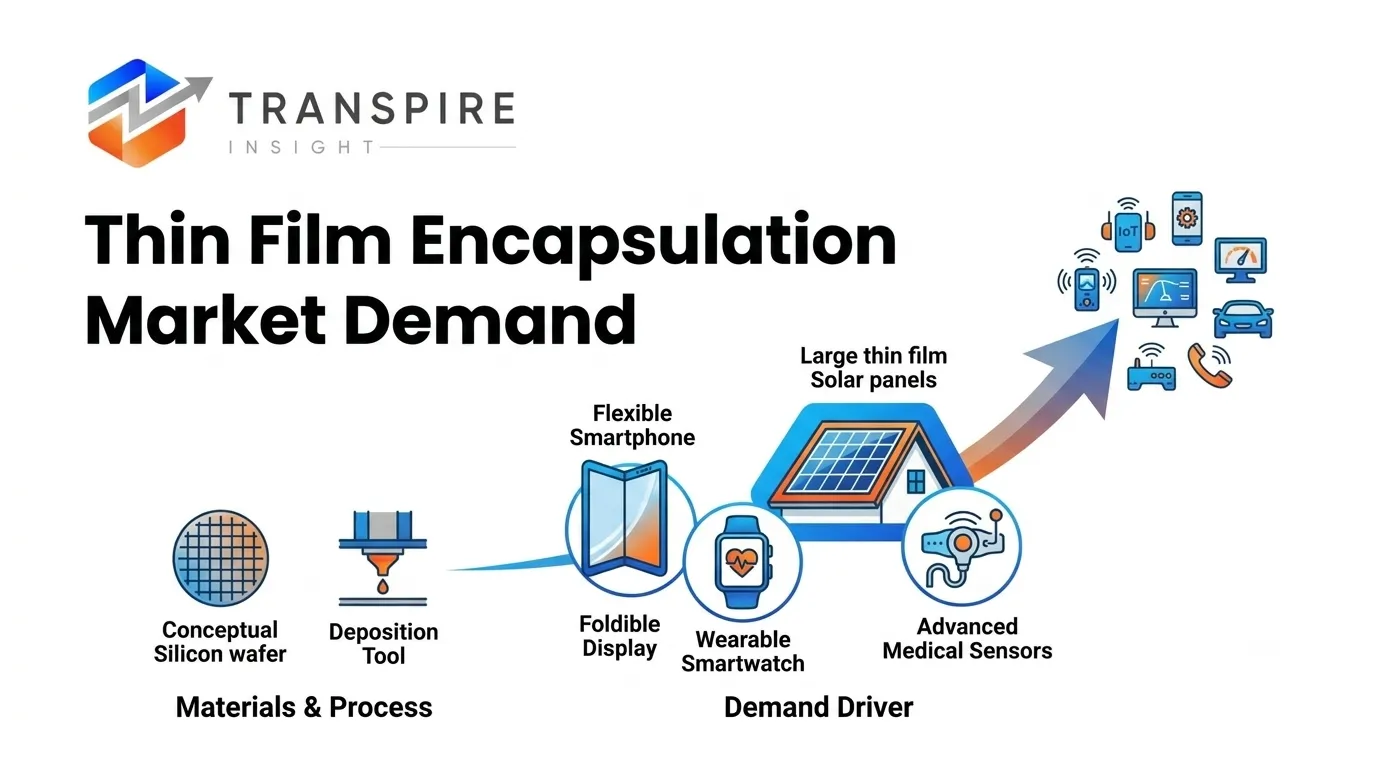
The global Thin Film Encapsulation Market is expanding rapidly as manufacturers seek highly effective barrier technologies for flexible OLED displays, foldable electronics, wearable devices, automotive displays, and emerging flexible electronic applications. Improvements in atomic layer deposition, plasma-enhanced deposition, hybrid barrier structures, and low-temperature processing are increasing the commercial importance of thin film encapsulation.
Thin Film Encapsulation Market Overview
Thin film encapsulation (TFE) is an advanced protective technology designed to prevent sensitive electronic materials from degradation caused by moisture, oxygen, particles, and other environmental conditions.
The technology is particularly important for OLED devices because organic light-emitting materials can be highly sensitive to environmental exposure. Modern TFE systems combine inorganic barrier layers with organic or buffer layers to improve flexibility and reduce defects.
Major applications include:
Transpire Insight estimates that the global Thin Film Encapsulation Market was valued at approximately USD 350.8 million in 2025, increased to around USD 421.6 million in 2026, and could reach nearly USD 1.56 billion by 2033, representing an estimated CAGR of 20.55% from 2026 to 2033.
Latest Global Market Developments
Flexible OLED displays continue to represent the core application for TFE because the encapsulation layer must provide strong environmental protection without preventing bending or folding.
Atomic layer deposition is receiving increasing attention because it can produce extremely thin and uniform barrier layers. Current industry analysis identifies ALD as one of the fastest-growing deposition technologies.
Combining inorganic and organic layers can improve flexibility, reduce defect propagation, and provide stronger protection than relying on a single barrier layer.
Foldable displays require encapsulation systems that can withstand repeated mechanical movement while maintaining very low moisture and oxygen transmission.
Curved and flexible OLED displays are increasingly being considered for automotive instrument clusters, infotainment systems, and interior applications.
TFE deposition technologies must operate at temperatures compatible with sensitive OLED materials. Applied Materials notes that its TFE systems use low-temperature multilayer barrier structures specifically designed for flexible AMOLED applications.
Asia Pacific accounted for approximately 69% of the market in 2025 according to one current industry assessment, supported by major display manufacturing capacity across China, South Korea, and Japan.
Wearables, medical electronics, automotive displays, flexible sensors, and other emerging electronics applications are broadening the addressable market.
Why Thin Film Encapsulation Matters?
TFE is more than a protective coating. It directly influences the reliability, lifetime, flexibility, and commercial viability of advanced OLED products.
Effective encapsulation can support:
For manufacturers, the challenge is balancing barrier performance, flexibility, deposition speed, production yield, and manufacturing cost.
Key Factors Driving the Market
1. Expansion of Flexible OLED
Flexible OLED adoption in smartphones, tablets, laptops, wearables, and automotive displays is generating demand for sophisticated encapsulation.
2. Foldable Electronics
Foldable devices require encapsulation technologies that maintain barrier performance under repeated mechanical stress.
3. Automotive Display Innovation
Automakers are increasingly integrating larger, curved, and higher-performance displays into vehicle interiors.
4. Advanced Deposition Technologies
ALD, PECVD, and hybrid deposition technologies are improving barrier quality and manufacturing flexibility.
5. Growth of Wearable Electronics
Smartwatches, medical wearables, flexible sensors, and other compact electronics create additional applications for thin and flexible protection.
Five High-Potential Markets
1. South Korea
South Korea remains strategically important because of its strong OLED ecosystem and major display manufacturers.
2. China
China's expanding display manufacturing capacity is creating significant opportunities for encapsulation equipment, materials, and process technologies.
3. Japan
Japan contributes through advanced materials, deposition technologies, electronics manufacturing, and specialty-component development.
4. United States
The U.S. remains important for semiconductor technologies, display research, advanced materials, equipment, and emerging flexible-electronics applications.
5. Taiwan
Taiwan's semiconductor and display ecosystem provides opportunities for precision deposition equipment and advanced electronic-material suppliers.
Competitive Landscape
Top 5 Companies
Other notable participants include Universal Display Corporation, 3M, Toray Industries, BASF, Aixtron, Beneq, Picosun, Canon Tokki, and AP Systems.
Opportunities for Small Investors
Challenges & Restraints
High equipment costs, complex deposition processes, stringent moisture-barrier requirements, production yield challenges, material compatibility, and the need for extremely low defect rates can restrict market entry.
Display manufacturers must also balance encapsulation performance with throughput because even minor process inefficiencies can become significant at large production volumes.
Conclusion
The Thin Film Encapsulation Market is positioned at the intersection of OLED manufacturing, flexible electronics, advanced deposition, and next-generation display technology.
Current industry data indicate that flexible OLED remains the dominant application while ALD and advanced hybrid structures are gaining importance.
As foldable smartphones, automotive OLED displays, wearable electronics, and flexible medical devices develop further, demand will increasingly focus on encapsulation systems that deliver ultra-low moisture transmission, mechanical durability, low-temperature processing, and high production efficiency.


Send us a brief description of your challenge and we'll get back to you within 24 hours.

 inquiry@transpireinsight.com
 APAC:+91 7666513636
 Address


