
Sep 18, 2026
By Transpire Insight
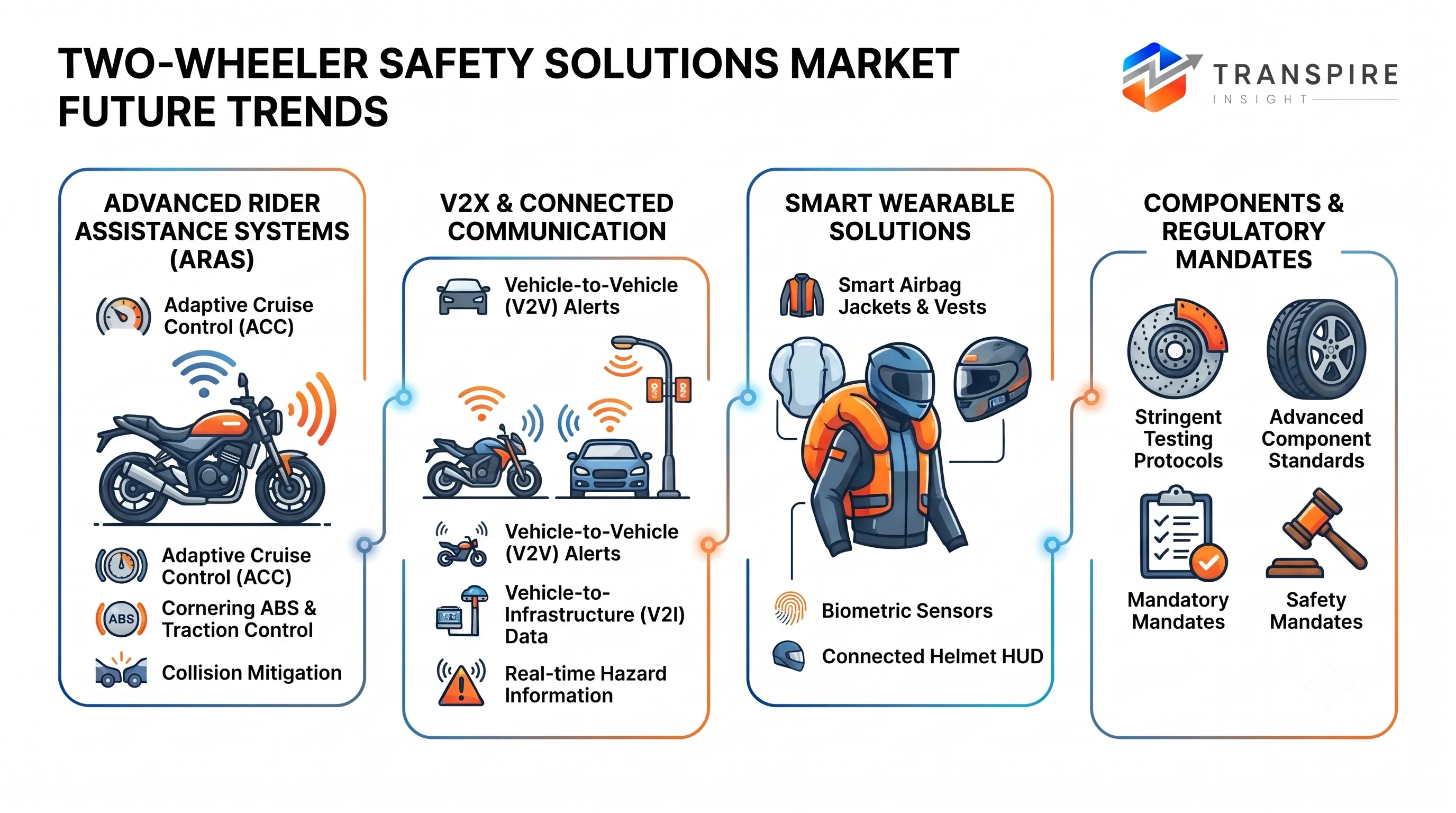
Two-wheeler safety is entering a technology-driven phase. As motorcycles and scooters become increasingly connected, safety is moving beyond conventional helmets and braking systems toward integrated electronics, rider assistance, sensors and intelligent crash-protection technologies.
The expansion of ABS, traction control, connected safety systems and advanced rider-assistance technologies could create a broader market for integrated two-wheeler protection.
September 2026: Motorcycles and scooters remain essential forms of transportation across many parts of the world. Their affordability, maneuverability and relatively low operating costs make them particularly important in Asia Pacific and other emerging markets.
At the same time, rider safety is becoming a stronger priority for governments, manufacturers and consumers.
This is creating demand for both active safety technologies designed to prevent accidents and passive systems designed to reduce injury severity.
Market Size
The global two-wheeler safety solutions market was valued at USD 8.3 billion in 2025 and is projected to reach approximately USD 14.8 billion by 2035, expanding at a CAGR of about 6.2% during 2026–2035. Asia Pacific represents the largest regional market and is also projected to be the fastest-growing region.
Active Safety Is Becoming the Market's Main Growth Engine
Active safety systems represented approximately USD 4.89 billion in 2024 and were projected to reach around USD 5.18 billion in 2025, expanding at a 6.57% CAGR through 2035.
ABS remains the foundational technology because it directly improves braking control and is increasingly supported by regulation.
Beyond ABS, manufacturers are adding traction control, motorcycle stability control, inertial measurement systems and advanced rider-assistance technologies.
These systems can help riders maintain control in changing road and weather conditions.
The Rise of Advanced Rider Assistance
Radar and sensor technologies are gradually moving into higher-end motorcycles.
Advanced rider-assistance systems can provide functions such as blind-spot monitoring, adaptive cruise control and collision warnings.
Although these technologies remain more common in premium motorcycles, their long-term development could eventually bring selected functions to broader vehicle categories.
The challenge is cost. Two-wheelers are often purchased specifically because they are affordable, meaning suppliers must develop safety systems that provide meaningful benefits without significantly increasing vehicle prices.
Passive Safety Remains Essential
Passive safety systems generated approximately USD 2.94 billion in 2024 and were projected to reach around USD 3.09 billion in 2025.
Helmets remain the most important form of personal protection, while airbags, protective clothing and other equipment can reduce injury severity.
Smart helmets and connected protective products are also expanding the definition of two-wheeler safety.
These products can potentially combine impact protection with communication, navigation, emergency alerts and connected services.
Electric Scooters Are Creating New Safety Opportunities
The growth of electric scooters is changing vehicle architecture.
Electric platforms provide manufacturers with greater electronic integration, creating opportunities to incorporate sensors, connectivity and electronic safety systems during vehicle development.
Scooters accounted for approximately USD 3.09 billion in 2024 and were projected to reach around USD 3.28 billion in 2025, growing at the highest vehicle-segment CAGR of approximately 6.98%.
This creates an important opportunity for safety suppliers because new electric platforms can be designed around integrated electronics rather than retrofitting safety technologies into older architectures.
Asia Pacific Will Remain the Critical Market
Asia Pacific was the largest regional market at approximately USD 3.16 billion in 2024 and was projected to reach around USD 3.37 billion in 2025, growing at approximately 6.98%.
China and India are particularly important because of their large two-wheeler populations.
India sold approximately 19.54 million two-wheelers in calendar year 2024, including motorcycles and scooters. The scale of this vehicle base creates a major opportunity for safety-system suppliers as regulations and consumer expectations develop.
Regulation Could Accelerate Adoption
Government safety regulations remain one of the strongest market drivers.
Mandatory or increasingly stringent requirements for braking systems can accelerate adoption of technologies such as ABS.
Regulation also creates a baseline level of demand that is less dependent on premium consumer preferences.
As governments seek to reduce road injuries, safety requirements may gradually expand to cover additional electronic and rider-protection technologies.
Competitive Landscape Is Becoming More Integrated
Bosch led the market with more than 11% share in 2025. Bosch, ZF, Continental, Denso and NXP collectively represented approximately 36% of market revenue.
Competition is increasingly based on the ability to integrate braking, sensors, electronics, connectivity and software.
Suppliers that can provide complete safety architectures may therefore gain an advantage over companies focused on individual components.
Top 10 Companies in Two-Wheeler Safety Solutions Market
Headquarters: Stuttgart, Germany
Bosch is a major supplier of two-wheeler braking and safety technologies. Its portfolio includes ABS and advanced electronic systems designed to improve rider control and vehicle stability.
Headquarters: Friedrichshafen, Germany
ZF provides mobility technologies spanning braking, electronics and vehicle-control systems. Its expertise in active safety supports its participation in the evolving two-wheeler safety market.
Headquarters: Hanover, Germany
Continental develops braking, electronics and rider-assistance technologies for two-wheelers. Its focus on connected and sensor-driven systems positions it for future safety-system integration.
Headquarters: Kariya, Japan
Denso provides electronic and vehicle technologies and is increasingly involved in sensor and control solutions relevant to two-wheeler safety.
Headquarters: Eindhoven, Netherlands
NXP supplies semiconductor technologies used in automotive and mobility electronics. Its expertise in processing, sensing, connectivity and secure systems supports the increasing electronic content of two-wheeler safety architectures.
Outlook: Could Integrated Safety Become Standard on Two-Wheelers?
The two-wheeler safety solutions market is moving from basic mechanical protection toward increasingly integrated electronic safety.
ABS will remain an important foundation, but future systems are likely to combine braking control, sensors, radar, connectivity and rider-assistance technologies.
Asia Pacific will remain the most important growth region because of its enormous two-wheeler population, while regulatory developments will continue to influence adoption.
If suppliers can reduce the cost of advanced safety technologies, features that are currently concentrated in premium motorcycles could gradually reach mainstream scooters and motorcycles, creating a larger global market for intelligent rider protection.


Send us a brief description of your challenge and we'll get back to you within 24 hours.

 inquiry@transpireinsight.com
 APAC:+91 7666513636
 Address


