Global Two-Wheeler Safety Solutions Market Size & Forecast:
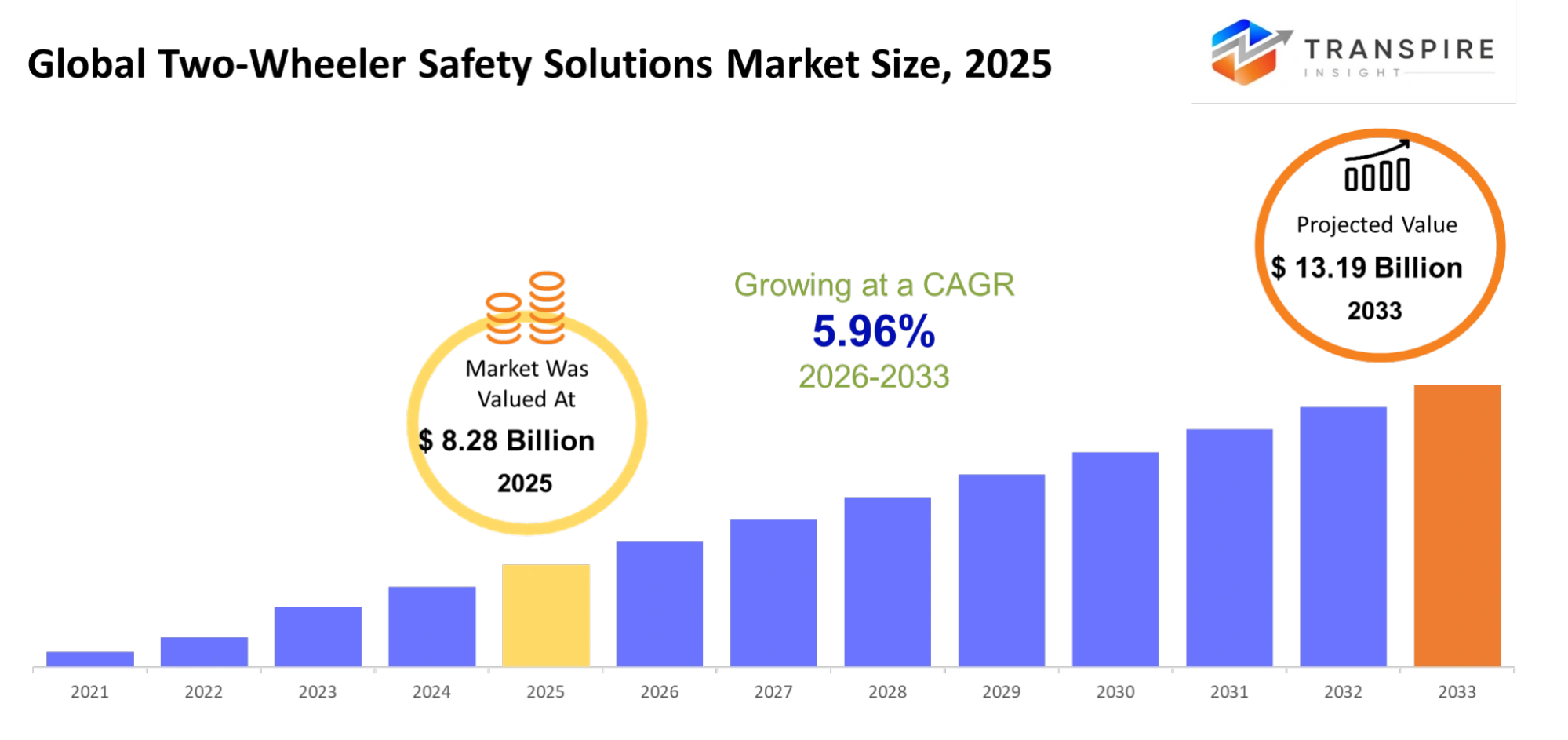
Global Two-Wheeler Safety Solutions Market Size 2025: USD 8.28 Billion
Global Two-Wheeler Safety Solutions Market Size 2033: USD 13.19 Billion
Global Two-Wheeler Safety Solutions Market CAGR: 5.96%
Global Two-Wheeler Safety Solutions Market Segments: By Product Type (Anti-lock Braking System, Traction Control System, Airbags, Tire Pressure Monitoring System), By Vehicle Type (Motorcycles, Scooters, Mopeds), By Sales Channel (OEM, Aftermarket).
To learn more about this report,  Download Free Sample Report
Global Two-Wheeler Safety Solutions Market Summary:
The Global Two-Wheeler Safety Solutions Market was valued at USD 8.28 billion in 2025 and is forecast to reach USD 13.19 billion by 2033, at a CAGR of 5.96% from 2026 to 2033. The market covers the active and passive safety systems fitted to motorcycles, scooters, and mopeds: anti-lock braking systems, traction control, airbag modules, and tire pressure monitoring. These are not optional comfort features. In most of the markets where they are becoming standard, they are there because a regulator mandated them, a fatality statistic made the policy case, or both.
The European Union has made Anti-lock Braking Systems (ABS) obligatory on all new motorcycles above 125cc since 2016. India presented phased ABS mandates starting in 2019, covering first higher-displacement bikes - then widening the requirement even further down the displacement scale. Many other markets in Southeast Asia and Latin America have either mandated ABS or have regulatory plans underway. Once governments set a base standard for safety content via law, the systems that law regulates automatically dominate the market by default.
The two-wheeler market isn't very uniform. A high-end 1,000cc sport motorcycle and an 110cc urban scooter - they both fall under this market's scope, yet they have very little in common when it comes to the rider type, usage pattern, price sensitivity, or even the safety systems that are relevant, effective, and affordable enough to be fitted. Almost all of the world's two-wheeler production lies at the smaller end: everyday motorcycles and scooters in the 100cc to 200cc range, mainly sold in India, Southeast Asia, and Latin America - where two-wheelers are mostly used for transportation rather than recreation. Safety system fitment rates in this group are notably lower - but this is also where regulation is starting to extend, and where the majority of our forecasted volume growth in the market will take place over the next several years.
The Original Equipment Manufacturers (OEM) channel generates the lion's share of revenue since safety systems pre-installed at the factory are sold at very large scales through vehicle model contracts. Installing ABS and traction control in the aftermarket on most two-wheelers isn't a simple process - thus limiting the aftermarket channel largely to TPMS sensors and add-on alerts - rather than the more valuable active safety systems that really make up the majority of market revenue.
Key Market Trends & Insights:
- Regulatory expansion into lower-displacement vehicle categories in South and Southeast Asia is the most direct growth driver over the forecast period, as these markets have large two-wheeler fleets but historically low safety system penetration.
- Traction control and combined braking systems are moving from premium motorcycle segments into mid-range machines, driven partly by consumer expectations formed by ABS fitment becoming normal, and partly by OEM platform decisions to share safety electronics across vehicle lines.
- Two-wheeler airbags remain a niche system fitted primarily to premium motorcycles, with Honda's Gold Wing being the longest-running production example. The cost-to-benefit calculation for airbags on smaller commuter machines has not yet reached the point where broad OEM adoption is likely without regulatory intervention.
- Tire pressure monitoring systems have a more straightforward aftermarket business than other safety technologies because they can be added to existing vehicles without integration into the braking or engine management systems, which supports a separate and more fragmented aftermarket channel.
Global Two-Wheeler Safety Solutions Market Segmentation
By Product Type
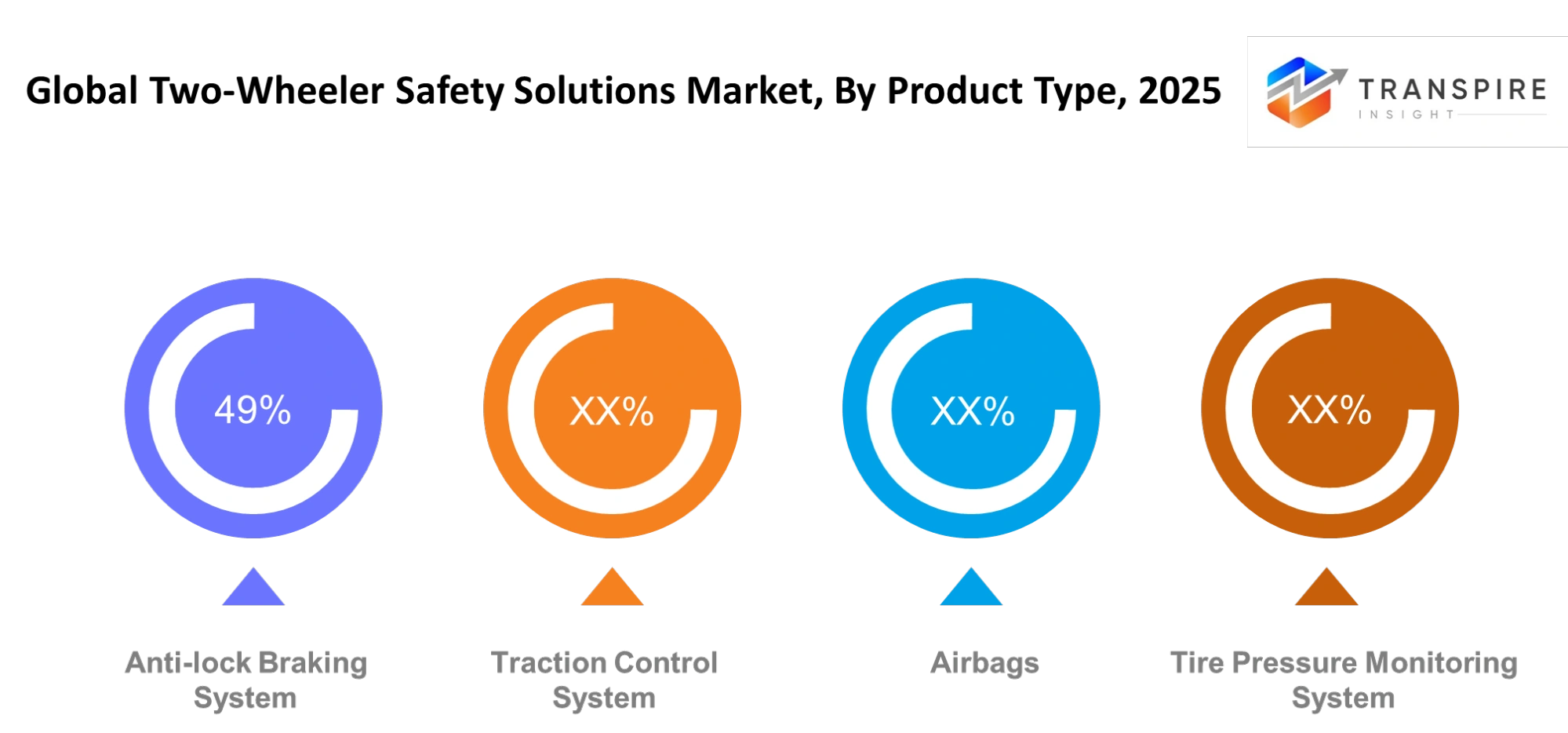
- Anti-lock Braking System: Anti-lock braking systems are really the biggest product sector in the Global Two-Wheeler Safety Solutions Market - they hold about 49% of all revenue. ABS prevents wheel lock-up under hard braking by adjusting brake pressure at every wheel much quicker than even the best riders could do manually. On a two-wheeler, a locked front wheel instantly causes to lose steering control; a locked rear wheel makes the rear of the bike swing way out of line. ABS addresses both these problem scenarios. The revenue focus in this area comes mainly from regulatory demands: the EU's 2016 mandate for ABS on motorcycles larger than 125cc, India's phase-by-phase mandates starting in 2019, and similar requirements in Taiwan, Brazil, and several other markets have really made ABS the default safety system on new two-wheelers in a very wide range of displacements and price points. Combined ABS, which connects the front and rear brake circuits and distributes braking power between them - as well as prevents wheel lock-up - is another step forward that is pretty common on some platforms and optional on others.
- Traction Control System: Traction control systems for two-wheelers detect rear wheel spin while accelerating and either reduces engine torque or apply the rear brake to get the wheel back in contact with the road. This system really matters most on high-performance motorcycles - especially if they have a wet or loose surface, where the rear tire can break traction unexpectedly under very hard acceleration. Traction control has actually been standard on many large-displacement performance motorcycles for more than a decade and has slowly migrated toward mid-range bikes as the ECU and sensor hardware prices decreased. The segment is smaller than ABS in the Global Two-Wheeler Safety Solutions Market because traction control mandates aren't as widely spread as ABS requirements are, and the cost-benefit calculation for installing it on smaller commuter bikes isn't as clear-cut as it is for ABS - where the braking safety benefit is relevant at any displacement.
- Airbags: The smallest and technologically constrained segment in the global two-wheeler safety solutions market by revenue is two-wheeler airbags. Honda introduced an airbag system in the Gold Wing back in 2006 - and it still remains one of the very few production motorcycles that have the system as standard equipment. The challenge comes with deployment geometry: unlike a car, where the occupant is enclosed by a vehicle structure that really sets the limits for the airbag's operation, a motorcyclist separates from the bike on impact - so the timing and direction of an effective airbag deployment really relies on a collision geometry that is quite difficult to predict and will vary quite a lot between different crash types. Research projects and prototype systems do exist for sport motorcycle airbags, and Honda continues to develop and improve its system - yet the cost and engineering complexity have kept airbag installation largely limited to high-end machines. Regulatory requirements that demand motorcycle airbags are nowhere to be found in any big market - which is basically the main reason why the segment remains so small.
- Tire Pressure Monitoring System: Tire pressure monitoring systems for two-wheelers detect low pressure and alert the driver, mostly via a dashboard warning light or display. Under-inflated tires on a two-wheeler can affect handling, increase the braking distance, and lead to excessive tire wear - and may even result in a blowout at higher speeds. TPMS on two-wheelers uses either direct sensors in the wheel valve or indirect monitoring via wheel-speed sensor data to detect a pressure drop. The direct sensor method is slightly more accurate but would require special hardware in each wheel; the indirect method uses the existing ABS wheel speed sensors to calculate a substitute for pressure from changes in rolling radius, making it a somewhat lower-cost option for vehicles that already have ABS fitted. TPMS has a relatively easier-to-access aftermarket than ABS or traction control systems, mainly because standalone sensor kits can be installed without integrating with the vehicle's primary control systems.
To learn more about this report, Download Free Sample Report
By Vehicle Type
- Motorcycles: Motorcycles dominate the Global Two-Wheeler Safety Solutions Market as the biggest vehicle segment, both since they make up a substantial part of the world's two-wheeler production - and since they have much more average safety equipment than scooters or mopeds do. Displacement-based ABS requirements have been implemented initially - and also most broadly - on motorcycles over 125cc, covering all models - from entry-level commuter bikes right to high-performance touring and sports machines. High-end and mid-range motorcycles are primarily fitted with traction control systems, and they're the sole category where airbag systems have started being produced in significant quantities. Revenue per vehicle is a lot higher in this segment than in scooters or mopeds - showing not just the safety equipment content but also the greater base cost of the motorcycles themselves.
- Scooters: Scooters make up a very large proportion of global two-wheeler production volumes but represent a relatively smaller proportion of the total safety system revenue - than one would expect from the sheer number of units made. Most scooters sold worldwide are in the 50cc to 150cc class, typically used for urban commuting in markets throughout Asia, Europe, and Latin America. ABS fitment has begun expanding into the scooter sector as regulatory standards have reduced, mainly in Europe where ABS is now mandatory on machines above 125cc no matter what the design - and also in India where the requirement has increased progressively through different displacement categories. The scooter segment is expected to see another surge in ABS volume growth in Asia as regulations tighten further - and it will be quite a big market for TPMS, thanks to the existing massive numbers of urban scooters whose owners change out or add TPMS sensors via after-market channels.
- Mopeds:Mopeds are the smallest vehicle type segment in the Global Two-Wheeler Safety Solutions Market. Defined generally as machines with engine displacements below 50cc or with pedals plus a small motor, mopeds are used primarily for short urban trips in markets where they are legal to operate without a motorcycle license. Safety system penetration in this segment is low. ABS is technically feasible on mopeds but is not mandated in most markets at this vehicle category, and the low retail price of mopeds limits what safety content OEMs can add without pricing the vehicle out of its market. TPMS is the most accessible safety technology in this segment given its lower cost and aftermarket availability, but the moped segment as a whole contributes a small fraction of Global Two-Wheeler Safety Solutions Market revenue.
By Sales Channel
- OEM: The OEM channel holds the major share of the Global Two-Wheeler Safety Solutions Market. Safety systems fitted during vehicle assembly come from Tier 1 supplier relationships, specified at the platform development stage, and sold in large quantities - precisely matching the output of every vehicle program. ABS and traction control systems really can't be added to most two-wheelers after manufacturing without doing quite a bit of integration work into the braking and engine management systems, so the OEM channel remains the only reasonable way to do this at scale. Tier 1 suppliers like Bosch, Continental, Denso, and Nissin Kogyo secure very long-term program supply agreements with two-wheeler OEMs, and the revenue generated from those agreements goes for the entire lifecycle of the vehicle platform - usually several years. Price negotiations happen right at the program award stage, and suppliers are supposed to support reducing costs throughout the life of the contract while still maintaining system performance and quality standards.
- Aftermarket: The aftermarket channel in the Global Two-Wheeler Safety Solutions Market is slightly smaller than OEM and mostly focused on products that can be installed without deeply integrating them into pre-existing vehicle control systems. TPMS sensors and display units are probably the most common aftermarket safety product, sold by motorcycle accessory retailers, e-commerce platforms, and very skilled fitment workshops. Some aftermarket ABS retrofit kits are available for certain vehicle models - although they're a small niche and often need special calibration to match the vehicle's existing brake geometry. Aftermarket revenue also comes from replacement parts for OEM-fitted safety systems, especially ABS sensors and wheel speed rings that wear out or get damaged in an accident. The aftermarket channel is less organized than OEM, with even more brands and price points, and it primarily serves a different customer - the owner of an existing vehicle rather than the buyer of a brand new one.
Regional Insights
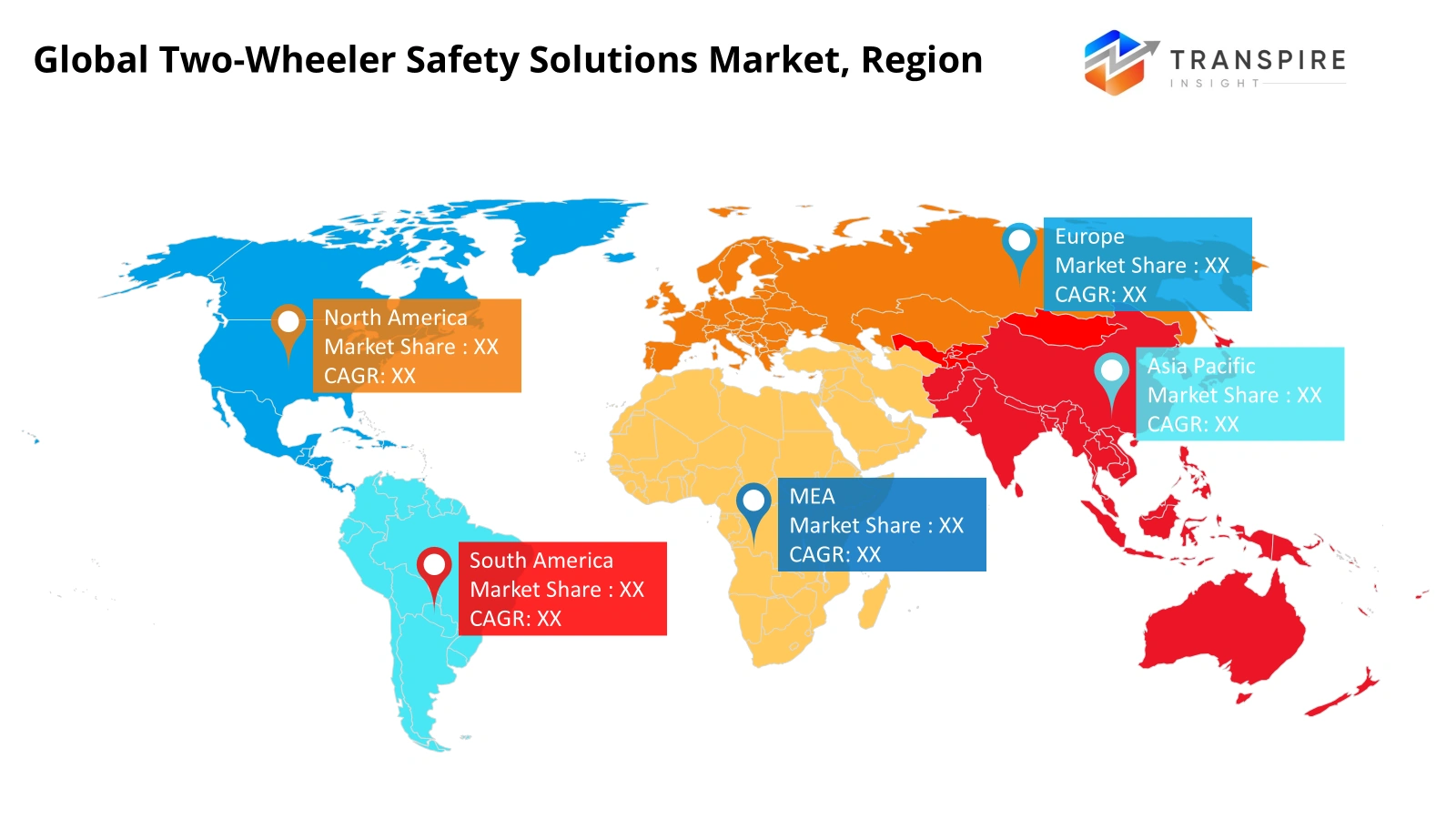
India is actually the biggest country market in the entire Global Two-Wheeler Safety Solutions Market - when we're looking at volume, that is - because it holds the top spot as both the world's largest motorcycle producer and consumer. The Indian government put forward its phased ABS mandate, so that starting in April 2019 ABS was required on motorbikes over 125cc and later the requirement moved towards smaller engines. This regulation effectively transformed a big chunk of Indian two-wheeler production from non-ABS to ABS-equipped vehicles. This change led to a sharp and quite lasting growth in ABS unit volumes from Indian OEs (Original Equipment Manufacturers) and their Tier 1 suppliers. Hero MotoCorp, Honda Motorcycle and Scooter India, TVS Motor, and Bajaj Auto really make up most of the volume in this market - and their decisions about what safety system to fit on their bikes really have huge effects further down the line on supplier revenue.
Europe has a much more mature market in regulatory terms. The EU's 2016 ABS mandate for motorcycles above 125cc has already been fully implemented, so safety system fitment rates in Europe are relatively high compared to average global numbers. The European market generates a lot of revenue in premium safety system categories, such as high-performance ABS systems with cornering capabilities, traction control systems with multiple riding modes, and the early adoption of airbag-equipped models. Germany, Italy, France, and Spain are actually the largest individual European markets for two-wheelers - and for the safety systems fitted to them.
Southeast Asia - covering countries like Indonesia, Vietnam, Thailand, the Philippines, and Malaysia - is really a region with enormous two-wheeler fleets and historically low safety system penetration. Regulatory frameworks for ABS mandates are at all different levels of development across these markets. Thailand and Vietnam were among the first to show progress towards ABS requirements, and Indonesia, because it's the largest two-wheeler market in the region, is really a key thing to watch. When ABS mandates finally take effect in these markets, it'll be a big impact on the Global Two-Wheeler Safety Solutions Market since there's such a large production volume involved.
Japan hosts several of the largest two-wheeler OEMs, including Honda, Yamaha, Kawasaki, and Suzuki, and is a technically advanced market for safety systems. Japanese OEMs have been early developers and adopters of advanced safety technologies for two-wheelers, and their domestic market is a proving ground for systems that subsequently appear on models sold globally. China has a large domestic two-wheeler market with its own regulatory environment and a significant base of domestic two-wheeler manufacturers that operate somewhat separately from the global Tier 1 supplier ecosystem.
To learn more about this report, Download Free Sample Report
Recent Development News
In mm yyyy, Bosch and Continental, the two largest suppliers of two-wheeler ABS systems globally, have both been developing cornering ABS variants that adjust braking force based on lean angle sensor data, preventing the wheel lock-up patterns that conventional ABS cannot fully address when a motorcycle is mid-corner. These systems are now fitted on a growing number of premium sport and touring motorcycles and are gradually being offered on mid-range platforms as the sensor and ECU hardware costs decline.
Regulatory activity in India and Southeast Asia continues to be the most commercially significant near-term development for the Global Two-Wheeler Safety Solutions Market. India's timeline for extending ABS requirements to vehicles below 125cc, and the pace at which ASEAN markets progress their own mandates, will determine how much of the forecast period growth materializes at the projected rate. Supplier investment in capacity for high-volume, cost-optimized ABS systems suited to the Indian and Southeast Asian commuter segment has been visible at both Bosch and Nissin Kogyo over the past several years.
Report Metrics
|
Report Metrics |
Details |
|
Market size value in 2025 |
USD 8.28 Billion |
|
Market size value in 2026 |
USD 8.793 Billion |
|
Revenue forecast in 2033 |
USD 13.19 Billion |
|
Growth rate |
CAGR of 5.96% from 2026 to 2033 |
|
Base year |
2025 |
|
Historical data |
2021 - 2024 |
|
Forecast period |
2026 - 2033 |
|
Report coverage |
Revenue forecast, competitive landscape, growth factors, and trends |
|
Country scope |
Global |
|
Key company profiled |
Bosch GmbH, Continental AG, ZF Friedrichshafen AG, Denso Corporation, Brembo S.p.A., Nissin Kogyo Co. Ltd., Hitachi Astemo Ltd., Aisin Corporation, Valeo SA, Autoliv Inc., Delphi Technologies plc, TVS Motor Company, Hero MotoCorp Ltd., Honda Motor Co. Ltd., Yamaha Motor Co. Ltd. |
|
Customization scope |
Free report customization (country, regional & segment scope). Avail customized purchase options to meet your exact research needs. |
|
Report Segmentation |
By Product Type (Anti-lock Braking System, Traction Control System, Airbags, Tire Pressure Monitoring System), By Vehicle Type (Motorcycles, Scooters, Mopeds), By Sales Channel (OEM, Aftermarket). |
Key Global Two-Wheeler Safety Solutions Company Insights
Global two-wheeler safety solutions market is really split between automotive Tier 1 suppliers - who have developed very specific two-wheeler safety product lines - and the two-wheeler OEMs themselves, who show up on the list because of their impact on system specs and their own in-house safety technology development programs. Bosch and Continental are sort of the two dominant independent suppliers of ABS and traction control systems for two-wheelers all over the globe. Both companies had already secured early spots in the European motorcycle ABS market when EU mandates really started generating volume demand, developed cost-optimized versions for the Indian market when mandates came into force, and are quite well-positioned to supply Southeast Asia as their regulatory frameworks get more stable.
Nissin Kogyo, now part of the Hitachi Astemo group after the merger of Honda's automotive parts subsidiaries, has a very strong standing in two-wheeler braking systems through its long-standing relationship with Honda and its broader OEM customer base both in Japan and globally. Brembo takes a somewhat different approach in this market: its products are selected for premium and performance motorcycles where braking performance really matters more than just meeting the minimum regulatory requirements - and its brand holds significant value in the premium sector that Tier 1 commodity suppliers often find difficult to match. Autoliv is actually the primary supplier in terms of airbags, given its status as the biggest global supplier of automotive passive safety systems and its involvement in motorcycle airbag development programs.
Company List
- Bosch GmbH
- Continental AG
- ZF Friedrichshafen AG
- Denso Corporation
- Brembo S.p.A.
- Nissin Kogyo Co. Ltd.
- Hitachi Astemo Ltd.
- Aisin Corporation
- Valeo SA
- Autoliv Inc.
- Delphi Technologies plc
- TVS Motor Company
- Hero MotoCorp Ltd.
- Honda Motor Co. Ltd.
- Yamaha Motor Co. Ltd.
Global Two-Wheeler Safety Solutions Market Report Segmentation
By Product Type
- Anti-lock Braking System
- Traction Control System
- Airbags
- Tire Pressure Monitoring System
By Vehicle Type
- Motorcycles
- Scooters
- Mopeds
By Sales Channel
- OEM
- Aftermarket
Frequently Asked Questions
Find quick answers to common questions.
The Global Two-Wheeler Safety Solutions Market is expected to reach approximately USD 13.19 billion by 2033.
Key segments include Product Type (Anti-lock Braking System, Traction Control System, Airbags, Tire Pressure Monitoring System), Vehicle Type (Motorcycles, Scooters, Mopeds), and Sales Channel (OEM, Aftermarket).
Major players include Bosch GmbH, Continental AG, ZF Friedrichshafen AG, Denso Corporation, Brembo S.p.A., Nissin Kogyo Co. Ltd., Hitachi Astemo Ltd., Aisin Corporation, Valeo SA, Autoliv Inc., Delphi Technologies plc, TVS Motor Company, Hero MotoCorp Ltd., Honda Motor Co. Ltd., and Yamaha Motor Co. Ltd.
The Global Two-Wheeler Safety Solutions Market size is approximately USD 8.28 billion in 2025.
The Global Two-Wheeler Safety Solutions Market is expected to grow at a CAGR of 5.96% from 2026 to 2033.
- Bosch GmbH
- Continental AG
- ZF Friedrichshafen AG
- Denso Corporation
- Brembo S.p.A.
- Nissin Kogyo Co. Ltd.
- Hitachi Astemo Ltd.
- Aisin Corporation
- Valeo SA
- Autoliv Inc.
- Delphi Technologies plc
- TVS Motor Company
- Hero MotoCorp Ltd.
- Honda Motor Co. Ltd.
- Yamaha Motor Co. Ltd.
Recently Published Reports
-
Apr 2026
ATV & UTV Market
ATV & UTV Market Size, Share & Analysis Report By Type (ATV, and UTV), By Variants (Less Than 400 CC, 400 CC To 800 CC, and More Than 800 CC), and Geography (North America, Europe, Asia-Pacific, Middle East and Africa, South and Central America), 2021 - 2031
-
Apr 2026
Automotive Central Gateway Module Market
Automotive Central Gateway Module Market Size, Share & Analysis Report By Type (Ethernet Central Gateway Module, CAN Central Gateway Module, LIN Central Gateway Module, and FlexRay), By Application (Powertrain Control, Body Control, Infotainment System, Advanced Driver Assistance Systems (ADAS), and Others), By End User (Passenger Vehicles, and Commercial Vehicles), and Geography (North America, Europe, Asia-Pacific, Middle East and Africa, South and Central America), 2021 - 2031
-
Apr 2026
Automotive Engine Oil Filter Market
Automotive Engine Oil Filter Market Size, Share & Analysis Report By Filter Type (Fuel Filter, Engine Oil Filter, Hydraulic Oil Filter, and Others), By Filter Media (Cellulose, Synthetic, and Micro), By Sales Channel (OEMs, and Aftermarket), By Vehicle Type (Passenger Cars, Light Commercial Vehicles, Heavy Duty Trucks, Buses and Coaches, and Off-road Vehicles), and Geography (North America, Europe, Asia-Pacific, Middle East and Africa, South and Central America), 2021 - 2031
-
Apr 2026
Automotive Parts Aluminium Die Casting Market
Automotive Parts Aluminium Die Casting Market Size, Share & Analysis Report By Production Process (Pressure Die Casting, Vacuum Die Casting, Squeeze Die Casting, Gravity Die Casting), By Application (Body Parts, Engine Parts, Transmission Parts, Battery And Related Components, Other Application Types), and Geography (North America, Europe, Asia-Pacific, Middle East and Africa, South and Central America), 2021 - 2031
Our Clients