
Oct 05, 2026
By Transpire Insight
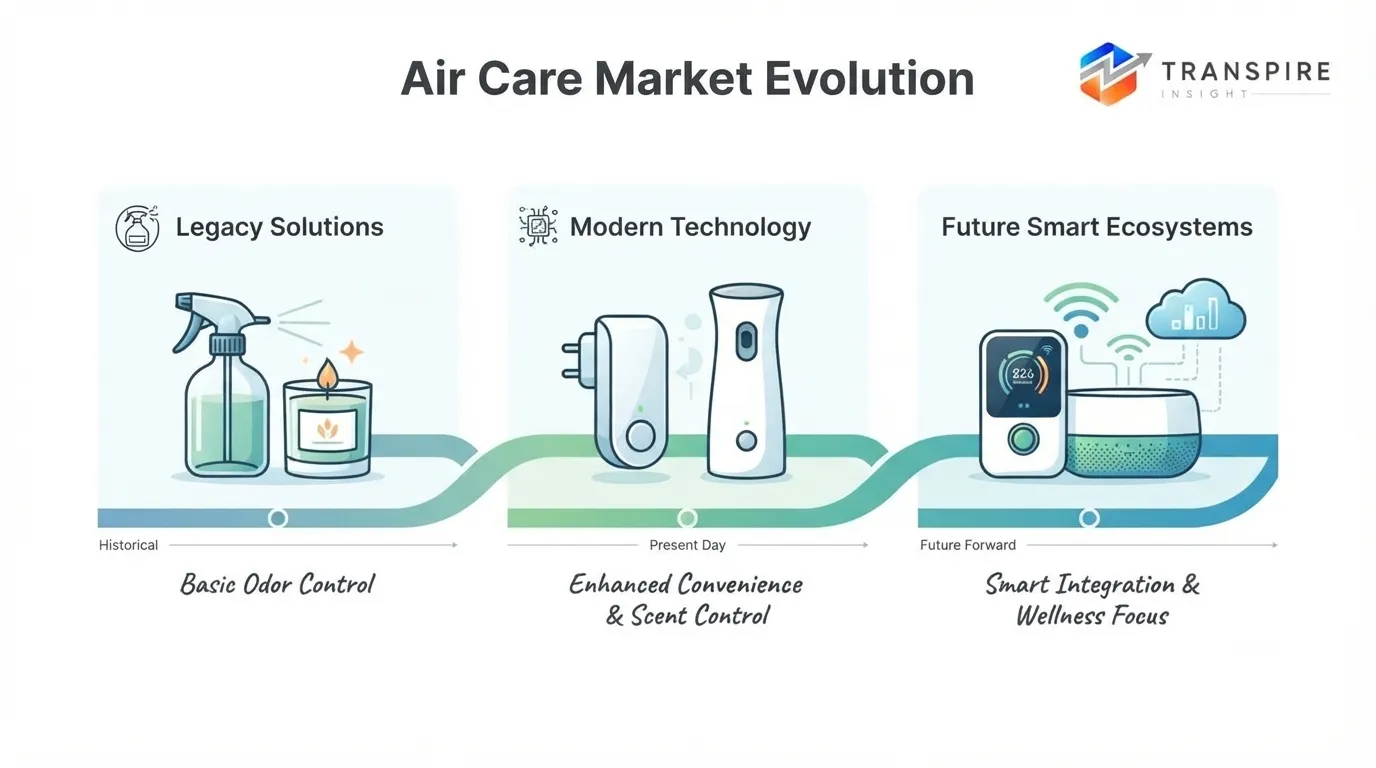
The global Air Care Market is evolving beyond conventional air fresheners as consumers increasingly seek products that combine pleasant fragrances, odor control, convenience, wellness, and improved indoor experiences. Air care products are becoming part of everyday home and lifestyle routines across residential spaces, vehicles, offices, hospitality facilities, retail environments, and other commercial settings.
The category is also experiencing a technology-led transformation. Electric diffusers, plug-in devices, automated dispensers, smart fragrance systems, concentrated liquid formats, refillable products, premium candles, reed diffusers, and fragrance-based wellness products are expanding the range of choices available to consumers. At the same time, sustainability, ingredient transparency, natural fragrance preferences, packaging reduction, and e-commerce are influencing product development and purchasing decisions.
September 2026: The global Air Care Market is estimated at approximately USD 20.61 billion in 2025 and is projected to reach approximately USD 39.06 billion by 2034, expanding at a CAGR of around 7.30% during 2026–2034. North America accounted for approximately 32% of global revenue in 2025, while Asia Pacific represented around 30%, highlighting the importance of both mature consumer markets and rapidly developing economies.
Market Size
The global Air Care Market was valued at approximately USD 20.61 billion in 2025 and is projected to reach approximately USD 39.06 billion by 2034, growing at a CAGR of 7.30% from 2026 to 2034. The market includes products designed to provide fragrance, odor management, and atmospheric enhancement across residential and institutional environments.
Air care products include aerosol and spray fresheners, electric air fresheners, plug-in systems, liquid fresheners, gels, scented candles, reed diffusers, car fresheners, automated dispensers, and other fragrance delivery formats.
Growth is being supported by increasing household spending on home-care and lifestyle products, rising awareness of indoor environments, urbanization, premiumization, product innovation, and the increasing availability of fragrance products through online retail channels.
The market is also moving toward multifunctionality. Consumers are increasingly looking for products that do more than mask unwanted odors. Fragrance systems are being positioned around mood, relaxation, freshness, ambience, and lifestyle experiences, helping air care become a broader home-wellness category.
Air Care Is Moving Beyond Basic Odor Control
Traditional air fresheners were primarily designed to mask unpleasant odors. Modern products are increasingly designed around continuous fragrance release, odor neutralization, fragrance personalization, decorative appearance, and convenience.
This transition is changing the competitive landscape.
Consumers can now choose between instant sprays, continuous-release plug-ins, battery-powered systems, automatic dispensers, scented candles, reed diffusers, essential-oil products, gels, and concentrated refills.
Product selection is increasingly influenced by room size, fragrance intensity, duration, convenience, appearance, sustainability, and price.
The development of premium home-fragrance products has also blurred the boundary between air care and personal lifestyle categories. High-end candles, fragrance oils, diffusers, and decorative scent systems are increasingly marketed as elements of interior design rather than simple odor-control products.
Aerosol and Spray Products Maintain Strong Demand
Spray and aerosol air fresheners remain a major product category because they provide immediate fragrance delivery and are relatively easy to use.
Mordor Intelligence estimates that spray and aerosol air fresheners are expected to account for approximately 26.25% of global air care revenue in 2025, supported by convenience, affordability, broad retail availability, and their ability to provide rapid odor control.
These products are commonly used in bathrooms, kitchens, bedrooms, living rooms, offices, hospitality facilities, and other locations where consumers want immediate freshness.
Manufacturers are also developing new aerosol and non-aerosol delivery systems in response to consumer expectations around convenience and sustainability.
The development of aerosol-free automatic products demonstrates how established formats are being redesigned around changing environmental preferences.
Electric Air Fresheners Are Creating Recurring Revenue Opportunities
Electric air fresheners are becoming increasingly important because they provide continuous fragrance delivery.
Plug-in systems can operate for extended periods and allow consumers to replace fragrance refills without replacing the primary device.
This creates a recurring purchase model for manufacturers while providing consumers with greater convenience.
Modern electric systems are also becoming more sophisticated. Adjustable intensity settings, compact designs, replaceable fragrance cartridges, timed operation, and sensor-enabled systems are expanding their functionality.
Reckitt's Air Wick portfolio illustrates this shift. The company has expanded its electrical fragrance offerings, including scented oils and Essential Mist diffusers, while continuing to introduce new fragrance systems.
Liquid Formats Are Supporting Premiumization
Liquid air fresheners are becoming increasingly attractive to consumers who prefer longer-lasting fragrance and continuous-release systems.
Mordor Intelligence identifies liquid air fresheners as a rapidly growing product category, with the segment projected to expand at an estimated 8.16% CAGR over its forecast period. Refillable products, plug-in systems, diffusers, and premium fragrance experiences are contributing to demand.
Liquid formats can also support premium positioning because manufacturers can combine fragrance oils, decorative packaging, sophisticated dispensers, and refill systems.
This is creating opportunities for both mass-market brands and premium home-fragrance companies.
Scented Candles Expand the Lifestyle Dimension
Scented candles are increasingly positioned as lifestyle and home-decor products.
Consumers often purchase candles for ambience, relaxation, gifting, seasonal occasions, interior decoration, and fragrance.
According to Fortune Business Insight, candles accounted for approximately 26% of the global air care market in 2025, illustrating the significance of the format within the broader category.
Premium candle brands are investing in sophisticated fragrance combinations, decorative vessels, natural wax formulations, and premium packaging.
Newell Brands, through Yankee Candle, has continued developing higher-end home-fragrance products. Its YC Collection emphasizes fine-fragrance-inspired scents, premium design, and carefully selected materials.
This demonstrates how the air care category is increasingly intersecting with home décor, gifting, and personal lifestyle.
Natural and Sustainable Fragrance Products Gain Attention
Sustainability is becoming an important factor in air care product development.
Consumers are increasingly interested in packaging reduction, refillable systems, natural fragrance ingredients, renewable materials, recyclable packaging, and reduced use of certain chemical inputs.
This does not mean that conventional formats are disappearing. Instead, manufacturers are increasingly developing multiple product options to address different consumer preferences.
Reckitt has introduced air-care products designed around reduced packaging and alternative delivery mechanisms. Its Air Wick 24/7 Active Fresh product, for example, was positioned as an aerosol-free automatic spray and uses a bottle containing recycled plastic.
Such developments indicate that environmental positioning is becoming part of product innovation and brand differentiation.
Indoor Air Quality Awareness Supports Market Expansion
Greater consumer awareness of indoor environments is supporting demand for air-care solutions.
People spend substantial amounts of time indoors, increasing interest in products that contribute to comfortable and pleasant indoor spaces.
Air care should not be treated as synonymous with air purification, however. Fragrance products primarily address odor and ambience, whereas air purifiers and filtration systems are designed for particulate and other air-quality concerns.
The broader consumer conversation around indoor air quality nevertheless creates an environment in which consumers are paying more attention to the quality and experience of indoor spaces.
The Business Research Company identifies pollution and growing awareness of air-quality concerns as factors supporting broader air-care demand.
Wellness and Mood-Based Fragrances Are Emerging Trends
Fragrance is increasingly associated with emotional experiences.
Consumers may select fragrances according to relaxation, concentration, freshness, sleep routines, seasonal preferences, or personal mood.
This trend is creating opportunities for fragrance manufacturers to position air-care products around experiences rather than simply odor removal.
P&G's Febreze has used mood-oriented fragrance marketing, including its Mood Collection, demonstrating the growing connection between air care, scent preferences, and lifestyle experiences.
Essential oils, botanical fragrances, floral combinations, citrus blends, woody scents, and seasonal fragrance collections are contributing to product diversification.
Smart Air Care Products Could Reshape the Category
Technology is becoming increasingly important in premium air-care systems.
Smart fragrance devices can potentially provide programmable operation, adjustable fragrance intensity, remote control, consumption monitoring, and automated refill notifications.
Sensor technology could also enable products to respond to environmental conditions or usage patterns.
The integration of air care with smart-home ecosystems could allow fragrance devices to become part of broader home-automation routines.
For example, a consumer could potentially configure fragrance intensity according to time of day or room occupancy.
Although smart air care remains a developing segment, technology provides manufacturers with opportunities to differentiate premium products and develop recurring digital and refill-based revenue models.
E-Commerce Is Changing Air Care Distribution
Online retail is becoming increasingly important for air-care products.
E-commerce enables consumers to compare fragrances, product formats, reviews, refill options, prices, and premium brands without relying solely on physical stores.
Online channels are particularly valuable for niche fragrances and premium products that may have limited physical distribution.
Research on the Indian market indicates that retail e-commerce is gaining traction for premium and niche air-care products, while smaller local grocers continue to play an important role in overall category distribution.
Subscription models may further strengthen online sales because many air-care products require regular replacement or refilling.
Offline Retail Remains Essential
Despite rapid e-commerce growth, supermarkets, hypermarkets, convenience stores, pharmacies, specialty retailers, department stores, and local shops remain important air-care channels.
Physical retail allows consumers to view packaging, compare products, and purchase fragrances immediately.
Large FMCG companies benefit from established distribution systems and strong shelf presence.
The combination of offline and online channels is therefore likely to remain important rather than one channel completely replacing the other.
Automotive Air Care Is a Significant Submarket
Air care demand extends beyond residential environments.
Car air fresheners represent an important category, supported by rising vehicle ownership, longer commuting times, consumer interest in vehicle interiors, and growing demand for premium automotive experiences.
Products include hanging fresheners, vent clips, gels, liquid systems, sprays, and electronic fragrance devices.
Automotive fragrance products also offer manufacturers an opportunity to introduce smaller-format products with frequent replacement cycles.
The category is particularly relevant in densely populated urban markets where consumers spend significant time in vehicles.
Commercial Applications Create Additional Demand
Air care products are increasingly used in commercial environments.
Hotels, restaurants, offices, healthcare facilities, retail stores, airports, entertainment venues, gyms, and other commercial locations use fragrance systems to influence the environment experienced by customers and employees.
Commercial air-care systems can differ from consumer products because they often require centralized dispensing, programmable operation, larger fragrance cartridges, and maintenance services.
Scent marketing is another developing area in which businesses use controlled fragrance environments as part of their customer experience strategies.
This creates opportunities for specialized providers alongside consumer air-care brands.
Hospitality Is Supporting Premium Scent Systems
Hotels and hospitality businesses increasingly view fragrance as part of the overall guest experience.
Large hospitality properties may use scent systems in lobbies, reception areas, corridors, spas, restaurants, and other public spaces.
These applications often require consistent fragrance intensity and professional equipment.
Specialized companies such as ScentAir have developed commercial scent solutions targeting businesses and hospitality environments, demonstrating the expansion of air care into professional scent-management services.
The growth of hospitality, tourism, luxury retail, and experiential businesses can therefore support demand for commercial fragrance systems.
Product Personalization Is Becoming More Important
Fragrance preference is highly individual, encouraging manufacturers to provide broader scent portfolios.
Instead of offering only a few traditional floral or citrus fragrances, companies are introducing sophisticated combinations inspired by fine fragrance, nature, food, travel, seasonal events, and wellness.
Consumers can increasingly select fragrance intensity and delivery format.
This product diversity allows manufacturers to target different demographic groups and price segments.
Personalization also supports premiumization because consumers may be willing to pay more for distinctive fragrances, attractive packaging, refill systems, and sophisticated dispensing technology.
Regional Outlook
North America
North America represents a major air-care market, supported by high household penetration, strong consumer spending, established brands, premium home-fragrance demand, and extensive retail infrastructure.
Fortune Business Insight estimates that North America accounted for approximately 32% of global air-care revenue in 2025, making it the largest regional market in that assessment.
The United States represents the region's principal market.
Euromonitor's 2025 U.S. analysis shows a concentrated competitive environment, with Bath & Body Works, SC Johnson, Procter & Gamble, Newell Brands, and Reckitt among the leading companies by value share.
Premium fragrance, candles, electric diffusers, refillable systems, and wellness-oriented products are important growth areas.
Europe
Europe represents another established market with strong consumer interest in premium fragrance and sustainable products.
Consumers in Western Europe increasingly seek products with sophisticated fragrances, attractive packaging, and sustainability credentials.
The region is also home to major air-care manufacturers, including Reckitt, Henkel, and other international consumer-goods companies.
European demand is increasingly influenced by environmental considerations, refill systems, packaging efficiency, and product transparency.
Asia Pacific
Asia Pacific is an important growth region because of urbanization, rising disposable income, expanding middle-class populations, retail modernization, and increasing awareness of home-care products.
China, Japan, India, South Korea, Australia, and Southeast Asian countries represent important markets.
Fortune Business Insight estimates that Asia Pacific represented approximately 30% of global air-care revenue in 2025.
India is particularly important because rising incomes, urbanization, expanding organized retail, e-commerce, quick-commerce services, and increasing vehicle ownership are creating new opportunities.
India's air-freshener market also demonstrates strong interest in sprays and aerosols, while electric air fresheners are projected to experience comparatively rapid growth.
Latin America
Latin America offers significant opportunities because of expanding urban populations, increasing household consumption, rising retail penetration, and demand for affordable fragrance products.
Brazil and Mexico are particularly important markets.
Manufacturers are developing products across different price points to accommodate value-conscious consumers while also introducing premium fragrance products in major urban centers.
Middle East and Africa
The Middle East and Africa represent developing opportunities for air-care manufacturers.
Hospitality, tourism, commercial construction, retail development, and rising household consumption are supporting demand.
The Middle East is particularly relevant for premium fragrances and hospitality scent systems because fragrance has a strong cultural and commercial presence in several markets.
Africa provides longer-term opportunities as urbanization and modern retail penetration increase.
Competitive Landscape
The global Air Care Market contains a combination of large multinational consumer-goods companies, home-fragrance specialists, regional brands, and emerging niche manufacturers.
Competition increasingly revolves around fragrance innovation, brand recognition, distribution strength, refill ecosystems, sustainability, premium packaging, technological features, and product variety.
Major companies profiled across current market research include Procter & Gamble, Reckitt, SC Johnson, Unilever, Henkel, Church & Dwight, Clorox, Kao Corporation, Newell Brands, ScentAir, and other regional and specialist companies.
The competitive landscape is also becoming more fragmented at the premium end as independent fragrance companies and boutique home-fragrance brands enter the category.
Top 10 Companies in Air Care Market
1. Procter & Gamble Company
Procter & Gamble is one of the largest consumer-goods companies participating in the global air-care market through its Febreze brand.
Febreze has established a strong position around odor elimination and fragrance, with products spanning sprays, plug-in systems, fabric-related odor management, and other formats.
P&G continues to emphasize fragrance innovation and consumer segmentation. The company's Mood Collection demonstrates how air care is increasingly being connected with emotional experiences and lifestyle positioning.
2. Reckitt
Reckitt is a major global participant in air care through its Air Wick brand.
Air Wick's portfolio includes scented oils, diffusers, sprays, automatic fragrance systems, and other products.
Reckitt has continued investing in fragrance innovation, including its Vibrant scented-oil range and Essential Mist diffuser systems. Its Air Wick portfolio also includes aerosol-free automatic fragrance technology.
The company's global distribution network provides significant reach across mature and emerging markets.
3. SC Johnson & Son, Inc.
SC Johnson is a major household-products company with a strong air-care presence through Glade.
The company identifies Air Care as a dedicated product category within its portfolio and offers Glade products designed around different fragrances, moods, and occasions.
SC Johnson's strength lies in its established consumer brands, extensive distribution, product innovation, and broad household-care portfolio.
4. Henkel AG & Co. KGaA
Henkel participates in the home-care and fragrance ecosystem through products and brands serving consumers in multiple global markets.
Its broad household-products expertise provides opportunities across air freshening, cleaning, laundry, and related categories.
Henkel's established European presence and international distribution network support its participation in the global air-care industry.
5. Unilever PLC
Unilever is a major global consumer-goods company with extensive home-care and household-product operations.
Its global distribution network and expertise in consumer marketing provide a platform for participating in home-fragrance and air-care categories across different markets.
The company's focus on sustainability, product innovation, and changing consumer preferences also aligns with important trends affecting the air-care sector.
6. Church & Dwight Co., Inc.
Church & Dwight is a diversified consumer-products company with expertise in odor-control and household-care products.
The company is particularly associated with the ARM & HAMMER brand, whose product portfolio includes odor-management applications.
Its baking-soda-based brand equity provides a differentiated positioning around freshness and odor control.
7. The Clorox Company
The Clorox Company participates in the broader home-care and odor-management ecosystem.
Its consumer portfolio includes household products designed around cleaning, freshness, and odor management.
The company's established distribution infrastructure and household brand recognition support opportunities in adjacent air-care categories.
8. Newell Brands Inc.
Newell Brands has a strong presence in home fragrance through Yankee Candle.
Yankee Candle is particularly important in the scented-candle and premium home-fragrance segment.
Newell's recent YC Collection emphasizes elevated fragrance experiences, sophisticated packaging, and premium positioning, illustrating the continued movement of air care toward lifestyle and home décor.
9. Kao Corporation
Kao Corporation is a major Japanese consumer-products company with extensive expertise across household and personal-care categories.
Its presence in Asian consumer markets provides opportunities within air care and related home-care segments.
Kao benefits from established research capabilities, brand development expertise, and strong distribution across Japan and other Asian markets.
10. ScentAir Technologies, LLC
ScentAir is a specialist in commercial scent solutions rather than a conventional mass-market air-freshener manufacturer.
The company focuses on scent systems for businesses and commercial environments.
Its presence illustrates the growing importance of professional scent management in hospitality, retail, corporate environments, healthcare facilities, and other commercial spaces.
The expansion of experiential retail and hospitality is creating additional opportunities for specialized scent providers.
Market Challenges
Despite strong growth opportunities, the Air Care Market faces several challenges.
Consumer concerns regarding ingredients are increasing, particularly around fragrances, propellants, allergens, and chemical components.
Manufacturers must therefore pay greater attention to product transparency, formulation standards, labeling requirements, and consumer communication.
Environmental concerns surrounding packaging waste and aerosol products are also influencing product development.
Refillable systems, concentrated formulations, recyclable packaging, and aerosol-free technologies are becoming increasingly important responses.
Price sensitivity remains another challenge. Premium products can command higher margins, but consumers in emerging economies may prioritize affordability.
Fragrance preferences are highly subjective, creating challenges for global manufacturers attempting to develop products that appeal across cultures and demographic groups.
The industry must also manage competition from low-cost regional brands and private-label products.
Future Outlook
The Air Care Market is moving toward a more diversified and technology-enabled future.
Traditional sprays and gels will continue serving consumers who prioritize affordability and immediate odor control, while electric diffusers, plug-in systems, premium candles, reed diffusers, liquid fragrances, and smart dispensers will support higher-value opportunities.
The most important development is likely to be the transformation of air care from a simple household-consumable category into a broader home fragrance, wellness, lifestyle, and experience market.
Consumers are increasingly choosing products based on fragrance identity, aesthetics, convenience, sustainability, and emotional experience.
Manufacturers are responding with more sophisticated delivery technologies, premium fragrance collections, refillable formats, smart systems, and environmentally focused product designs.
Digital commerce will continue increasing access to premium and niche products, while physical retail will remain essential for mass-market distribution.
Asia Pacific is expected to remain an important growth engine as urbanization, disposable income, modern retail, and e-commerce expand. North America and Europe will continue to provide strong opportunities for premiumization, innovation, sustainability, and technologically advanced fragrance systems.
The global market's projected increase from approximately USD 20.61 billion in 2025 to USD 39.06 billion by 2034 highlights the scale of the opportunity.
The companies that successfully combine fragrance innovation, convenient delivery systems, sustainability, digital distribution, product personalization, and strong brand identity will play an important role in shaping the next phase of the global Air Care Market.
As consumers increasingly view their indoor environments as extensions of personal lifestyle and well-being, air care is expected to remain an important and increasingly sophisticated category within the global consumer-products industry.


Send us a brief description of your challenge and we'll get back to you within 24 hours.

 inquiry@transpireinsight.com
 APAC:+91 7666513636
 Address


