
Sep 24, 2026
By Transpire Insight
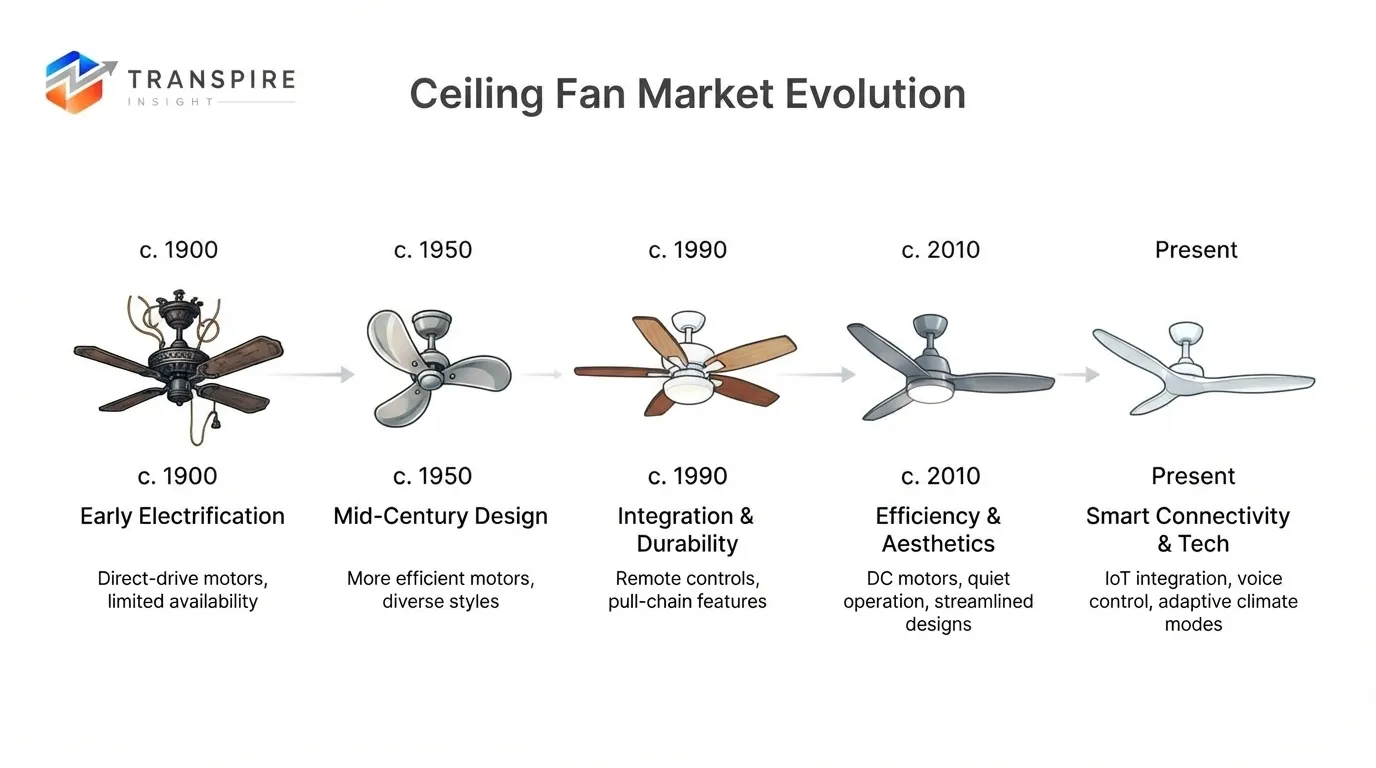
Ceiling fans remain one of the most accessible cooling technologies worldwide, particularly in regions where consumers need affordable air circulation without the electricity consumption associated with full-time air conditioning.
Rising temperatures, expanding residential construction, energy-efficiency requirements and growing adoption of BLDC and smart fan technologies are creating new opportunities for manufacturers to modernize a mature appliance category.
September 2026: Ceiling fans have remained an important household and commercial appliance for decades. Their basic function is simple: circulate air to improve comfort and ventilation.
However, the category is undergoing significant technological change.
Modern ceiling fans increasingly include brushless DC motors, remote controls, timers, smart-home connectivity, voice control, lighting systems and improved aerodynamic blade designs.
This evolution is helping manufacturers reposition ceiling fans from basic appliances into energy-efficient and connected home products.
Market Size
The global ceiling fan market was estimated at approximately USD 12.1 billion in 2025 and is projected to reach around USD 18.4 billion by 2034, expanding at a CAGR of approximately 4.9% during 2026–2034.
Current estimates vary by methodology. Fortune Business Insight values the market at USD 11.83 billion in 2025 and forecasts USD 17.98 billion by 2034, while Global Market Insight estimates approximately USD 12.9 billion in 2025 and USD 18.1 billion by 2035.
Asia Pacific remains the largest regional market in terms of product sales, while other research identifies North America as a major high-value market depending on market definition.
Rising Temperatures Support Demand
Increasing temperatures are becoming an important driver for cooling-appliance demand.
Longer and hotter summers are encouraging consumers to invest in cooling products.
Ceiling fans can provide a relatively low-cost method of improving thermal comfort.
They are also frequently used alongside air conditioners.
Rather than replacing air conditioning entirely, fans can improve air circulation and allow consumers to use air conditioning more efficiently.
This creates a complementary relationship between ceiling fans and air-conditioning systems.
Energy Efficiency Is Becoming a Key Differentiator
Electricity costs are encouraging consumers and businesses to evaluate appliance efficiency.
Traditional AC-motor fans remain widely used, but BLDC motor technology is gaining attention because it can significantly reduce electricity consumption.
BLDC fans are increasingly positioned as premium energy-saving products.
Manufacturers are investing in improved motor control, aerodynamic blade designs and electronic speed regulation.
This transition is particularly important in countries where energy-efficiency labeling programs influence consumer purchasing decisions.
BLDC Technology Gains Momentum
BLDC motors represent one of the most important technological developments in the ceiling-fan industry.
These motors can provide high efficiency, lower energy consumption and more precise speed control.
The technology is especially attractive for customers who use ceiling fans for many hours each day.
Although BLDC fans can carry a higher upfront price, the potential reduction in electricity consumption can improve the total cost of ownership.
As manufacturing costs decline, BLDC technology is expected to become more accessible across mid-range product categories.
Smart Ceiling Fans Create Premium Opportunities
Smart-home adoption is expanding the functionality of ceiling fans.
Modern products can connect with smartphones, Wi-Fi networks and voice assistants.
Users can remotely control speed, lighting and operating schedules.
Some systems can also integrate with sensors and home-automation platforms.
Smart functionality allows manufacturers to differentiate products beyond traditional design and motor performance.
Current industry research identifies smart and energy-efficient fans as important future growth areas.
Decorative Fans Expand the Premium Segment
Ceiling fans are increasingly becoming part of interior design.
Consumers are paying greater attention to blade shape, finish, lighting integration and overall aesthetics.
Decorative fans can therefore command higher prices than conventional models.
This trend is particularly visible in urban apartments, hotels, restaurants and premium residential projects.
Manufacturers are introducing models that combine airflow with integrated LED lighting and contemporary designs.
Residential Construction Remains a Major Application
Residential buildings represent one of the largest applications for ceiling fans.
Population growth, urbanization and housing construction all contribute to long-term demand.
Emerging markets are particularly important because ceiling fans remain a practical cooling solution for middle-income households.
India, China, Southeast Asia, Latin America and parts of Africa offer significant opportunities.
The replacement market is also important because households periodically upgrade older fans to improve energy efficiency and aesthetics.
Commercial Applications Expand
Commercial buildings also use ceiling fans across offices, retail stores, restaurants, warehouses and hospitality facilities.
Large-diameter and high-volume-low-speed fans are particularly useful in industrial and commercial environments.
The use of energy-efficient fans can help businesses manage cooling costs.
As green-building requirements become more common, efficient air-circulation technologies could receive greater attention from architects and developers.
Online Distribution Is Changing Purchasing Behavior
E-commerce is becoming increasingly important for ceiling-fan sales.
Consumers can compare specifications, energy ratings, reviews and designs without visiting multiple stores.
Online sales are particularly attractive to younger consumers and urban households.
However, offline retail remains important because customers may want to physically inspect products before purchase.
This is creating an omnichannel market in which manufacturers need strong digital and physical distribution strategies.
Asia Pacific Dominates Demand
Asia Pacific is one of the most important ceiling-fan markets globally.
Fortune Business Insight estimates that the region accounted for approximately 63.82% of global market share in 2025.
India represents a major market because of its warm climate, large population and established ceiling-fan culture.
China is also important because of its manufacturing capabilities and large domestic market.
Southeast Asian countries provide additional growth opportunities because of high temperatures and increasing household incomes.
North America Supports Premium Growth
North America is a mature but valuable market.
Consumers in the United States increasingly seek premium fans with smart controls, decorative designs and high-efficiency motors.
Large industrial and commercial spaces also provide opportunities for high-volume fans.
Premiumization can therefore support market revenue even where unit-volume growth is moderate.
Competitive Landscape
The ceiling fan market is relatively fragmented, with major appliance companies competing alongside specialist fan manufacturers.
Competition is based on efficiency, airflow, design, pricing, brand reputation, smart functionality and distribution.
Global Market Insight identifies Hunter Fan Company as a market leader and notes that Hunter, Big Ass Fans, Crompton Greaves, Orient Electric and Panasonic collectively represented around 20% of the market in 2025.
Top 10 Companies in Ceiling Fan Market
1. Hunter Fan Company
Headquarters: Memphis, Tennessee, USA
Hunter Fan Company is one of the established names in the global ceiling-fan industry. Its portfolio combines traditional and modern designs with increasingly advanced control technologies.
2. Crompton Greaves Consumer Electricals
Headquarters: Mumbai, India
Crompton has a strong presence in India's consumer electrical market. Its ceiling-fan portfolio covers conventional, energy-efficient and premium designs.
3. Orient Electric
Headquarters: New Delhi, India
Orient Electric offers ceiling fans across mass-market and premium categories. Its strategy increasingly emphasizes design, energy efficiency and smart features.
4. Havells India
Headquarters: Noida, India
Havells is a major Indian electrical-products company with a broad fan portfolio. The company focuses on energy efficiency, modern designs and technology-driven appliances.
5. Emerson Electric
Headquarters: St. Louis, Missouri, USA
Emerson has longstanding expertise in fans and air-movement technologies. Its portfolio includes residential and commercial applications.
Outlook: Could Smart and BLDC Fans Become the New Standard?
The ceiling-fan market is shifting from simple mechanical appliances toward efficient, connected and aesthetically designed products.
Traditional fans will continue to dominate price-sensitive markets, but BLDC technology is likely to gain share as production costs decline.
Smart connectivity will also expand as consumers increasingly expect household appliances to integrate with digital ecosystems.
Future ceiling fans could combine motion sensors, environmental monitoring, adaptive speed control, lighting and voice assistance.
The market is therefore expected to remain resilient while gradually transitioning toward energy-efficient and connected cooling solutions.


Send us a brief description of your challenge and we'll get back to you within 24 hours.

 inquiry@transpireinsight.com
 APAC:+91 7666513636
 Address


