
Aug 17, 2026
By Transpire Insight
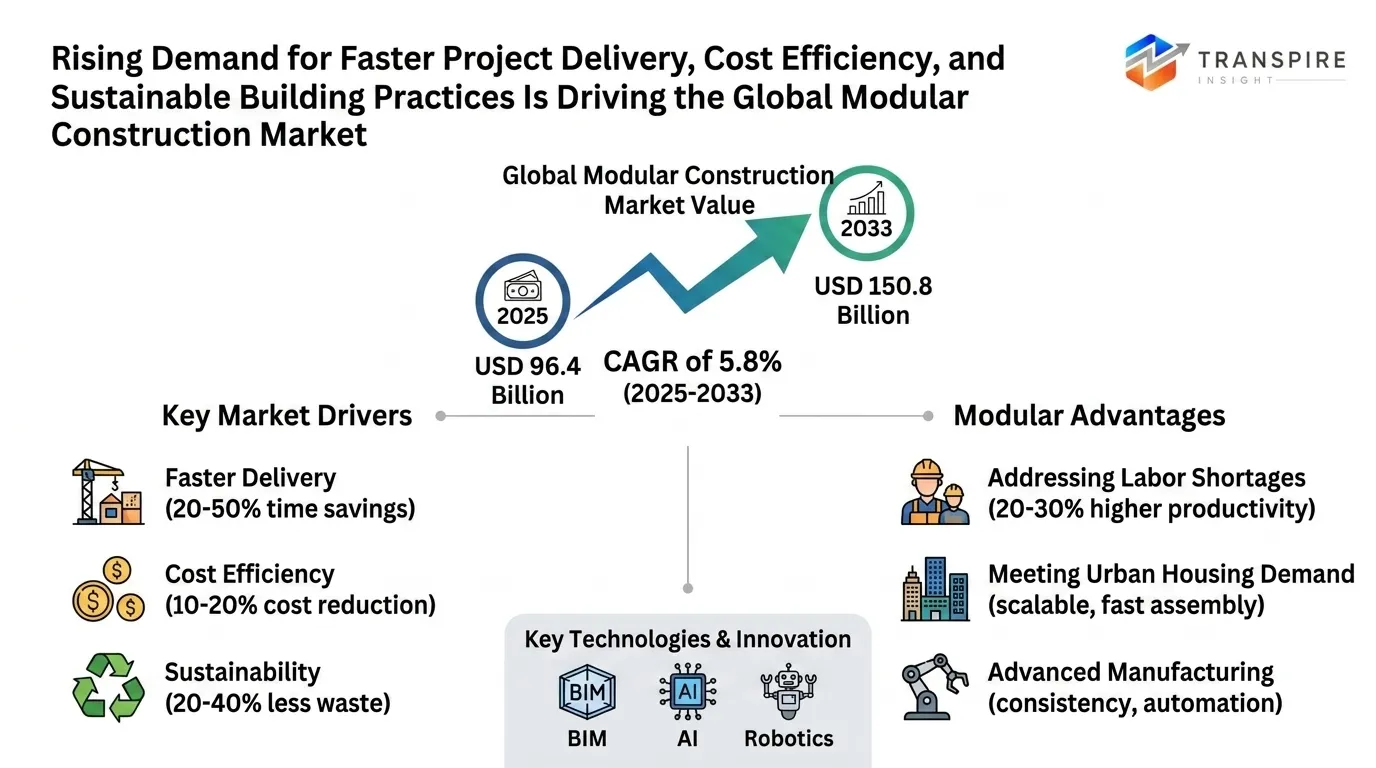
The Modular Construction Market is undergoing a significant transformation as the construction industry increasingly shifts from conventional on-site building methods toward factory-controlled, prefabricated, and digitally managed construction processes. Modular construction involves manufacturing complete building modules or major structural components in controlled factory environments and subsequently transporting and assembling them at the final project location. According to Transpire Insights, growing urbanization, construction labor shortages, rising demand for affordable housing, shorter project schedules, and increasing emphasis on sustainable building practices are creating strong opportunities for modular construction across residential, commercial, healthcare, education, hospitality, and industrial applications.
According to Transpire Insights, the Global Modular Construction Market was valued at approximately USD 96.4 billion in 2025 and is projected to reach around USD 150.8 billion by 2033, expanding at a CAGR of approximately 5.8% during the forecast period. The market is being supported by increasing adoption of prefabricated building systems, volumetric modular construction, panelized structures, prefabricated bathrooms and kitchens, modular healthcare facilities, and temporary accommodation solutions.
One of the most important advantages of modular construction is its ability to significantly shorten project completion timelines. Since modules can be manufactured in factories while site preparation and foundation work occur simultaneously, the overall construction schedule can be reduced substantially compared with conventional construction. Depending on project complexity, modular methods can reduce total project timelines by approximately 20–50%. This advantage is particularly valuable for hospitals, schools, hotels, workforce accommodation, and residential developments where early occupancy directly influences project revenue.
The growing shortage of skilled construction labor is another major market driver. Construction industries across North America, Europe, Australia, and parts of Asia are experiencing difficulty recruiting qualified workers for electrical, plumbing, carpentry, masonry, welding, and finishing activities. Factory-based modular construction transfers a significant proportion of work from construction sites to controlled manufacturing environments, allowing companies to standardize tasks and improve workforce productivity. Factory production can increase labor efficiency by approximately 20–30% for repetitive building components.
Urban housing shortages are further accelerating adoption. Rapid urbanization is increasing demand for affordable residential buildings while land availability and construction costs continue rising. Modular construction enables developers to produce standardized housing units at scale while maintaining consistent quality. In high-density urban markets, modular apartment components can be manufactured away from congested construction sites and transported for rapid assembly, reducing disruption to surrounding communities.
Affordable housing represents one of the most promising application areas. Governments and private developers are increasingly evaluating modular construction to address housing shortages and reduce development timelines. Standardized modules can be produced repeatedly using optimized manufacturing processes, reducing material waste and improving purchasing efficiency. Depending on project design and local conditions, modular approaches can reduce construction costs by approximately 10–20% compared with traditional construction methods.
Sustainability is also becoming increasingly important. Conventional construction generates substantial quantities of material waste because cutting, modification, and material handling occur directly at project sites. Factory-controlled manufacturing enables more accurate material planning and reuse of offcuts. Modular construction projects can reduce material waste by approximately 20–40%, depending on the manufacturing process and building design. Reduced transportation of workers and improved material utilization can further contribute to lower project-level environmental impacts.
Energy efficiency is another area where modular construction is evolving. Factory-built components can incorporate high-performance insulation, energy-efficient windows, airtight building envelopes, and pre-installed mechanical systems. These features improve building performance while reducing long-term heating and cooling requirements. Integration of renewable energy systems such as rooftop solar panels, heat pumps, battery storage, and smart building controls is also becoming more common within advanced modular projects.
Advanced manufacturing automation is further improving consistency. Robotic welding, automated panel cutting, CNC machining, machine-controlled fastening, and automated quality inspection systems allow factories to produce modules with repeatable dimensions and tolerances. In highly automated facilities, production-line efficiency can improve by approximately 15–25%, particularly for standardized building designs.
The healthcare sector represents an important growth opportunity. Hospitals and healthcare providers require additional capacity for patient rooms, operating facilities, diagnostic centers, laboratories, and emergency treatment areas. Modular healthcare buildings can be manufactured under controlled conditions and installed rapidly, allowing healthcare organizations to expand capacity without prolonged construction activity around operational facilities. Certain modular healthcare projects can achieve installation within weeks or several months, depending on scale and complexity.
Download the exclusive Modular Construction Market sample report today to uncover expert insights, emerging trends, and the opportunities defining the future of the industry.
Industrialized Building Systems, Housing Demand, and Construction Productivity Are Reshaping the Global Modular Construction Market
The global Modular Construction Market is increasingly moving toward an industrialized construction model, where building activities are divided between controlled manufacturing facilities and project sites. According to Transpire Insights, this shift is being supported by the need for faster construction cycles, improved quality control, predictable project costs, and reduced dependence on conventional site-based labor. Modular construction is particularly attractive where projects require repetitive designs, rapid deployment, standardized components, or construction in locations with limited skilled labor availability.
A major advantage of modular construction is the ability to perform several activities simultaneously. While foundations, utilities, and site infrastructure are prepared at the project location, building modules can be manufactured in a factory. This parallel workflow can shorten overall schedules by approximately 20–50%, depending on project complexity, transportation requirements, permitting, and the level of factory completion.
Market Analysis
The market is developing across several construction formats, including volumetric modular construction, panelized construction, prefabricated components, hybrid modular systems, and relocatable structures. Volumetric systems generally command higher technological value because entire three-dimensional modules can leave the factory with electrical, plumbing, flooring, fixtures, and interior finishes already installed.
Volumetric modular construction represents approximately 35–40% of demand in applications where rapid deployment and repeatable room configurations are important. Panelized construction accounts for roughly 25–30%, particularly in residential and commercial buildings, while prefabricated structural components and other modular systems represent the remaining share.
Residential construction remains one of the largest application areas. Housing shortages, urban population growth, affordability concerns, and increasing construction costs are encouraging developers to investigate factory-built housing. In some projects, modular techniques can reduce on-site labor requirements by approximately 30–50%, particularly when modules arrive substantially completed.
Healthcare is particularly attractive because construction frequently needs to occur near functioning hospitals. Off-site manufacturing reduces disruption around existing medical facilities and allows components to be installed rapidly. Modular healthcare rooms can incorporate specialized electrical systems, medical gases, HVAC equipment, and infection-control requirements before delivery.
The hospitality sector is similarly benefiting from modular methods. Hotel rooms typically follow standardized designs, making them suitable for factory production. Developers can manufacture dozens or hundreds of identical room modules while site preparation takes place. Depending on the project, modular construction may reduce hotel development timelines by approximately 30–40%, allowing earlier opening and revenue generation.
Regional Analysis
Asia-Pacific
Asia-Pacific is emerging as one of the most important markets for modular construction because of rapid urbanization, infrastructure development, housing requirements, and large-scale public investment.
China, Japan, Australia, Singapore, South Korea, and India are increasingly adopting prefabrication and industrialized construction approaches, although the maturity of the market differs considerably between countries.
Japan has particularly strong experience with factory-built housing, with major residential manufacturers producing highly standardized building systems. Japan's aging population and labor constraints are encouraging greater automation and factory-based construction.
Singapore has also become an important example of government-supported prefabricated construction. The country's limited land availability and high construction costs have encouraged adoption of Prefabricated Prefinished Volumetric Construction (PPVC). Some projects can achieve substantial reductions in on-site construction activities because a large proportion of finishing work is completed before modules reach the site.
India represents a significant long-term opportunity because of its rapidly expanding urban population and large affordable housing requirement. Government infrastructure programs, industrialization, and increasing acceptance of prefabricated building systems are supporting adoption. Modular construction can be particularly valuable for projects requiring standardized residential units, worker accommodation, schools, and healthcare infrastructure.
North America
North America remains a technologically advanced modular construction market, supported by housing shortages, skilled labor constraints, high construction wages, and increasing interest in construction automation.
The United States accounts for a substantial proportion of regional demand, particularly in residential, healthcare, hospitality, education, and workforce accommodation applications. Construction labor costs can represent approximately 30–40% of total project costs in labor-intensive building projects, making factory-based production increasingly attractive.
Canada is also expanding modular construction adoption because of housing affordability challenges, remote community development, and infrastructure requirements. Modular systems are particularly useful in locations where transporting a large construction workforce is expensive or logistically difficult.
Europe
Europe represents another major market due to strong sustainability requirements, energy-efficiency standards, urban housing shortages, and growing interest in circular construction.
Countries such as Germany, the United Kingdom, Sweden, Denmark, the Netherlands, and France are increasingly evaluating industrialized construction models. Northern European markets have particularly strong acceptance of prefabricated timber and energy-efficient modular buildings.
European sustainability regulations are encouraging manufacturers to reduce material waste and improve building energy performance. Factory-controlled manufacturing can reduce material waste by approximately 20–40%, depending on the building system and production process.
Customize the exclusive Modular Construction Market report today to receive tailored insights, country-specific analysis, and business-focused market intelligence.
Technology and Digitalization
Building Information Modeling (BIM) allows architects, engineers, manufacturers, contractors, and developers to work from a shared digital representation of a building. BIM reduces design conflicts before manufacturing begins and helps manufacturers determine precisely where electrical, plumbing, structural, and mechanical components must be positioned.
Advanced BIM workflows can reduce design coordination errors by approximately 20–30% in complex projects. When BIM is integrated with automated manufacturing equipment, digital designs can be transferred directly into production workflows.
Digital twins are also gaining attention. A digital twin can represent a physical building or module digitally throughout its lifecycle, providing information about components, maintenance schedules, energy consumption, and modifications.
Robotics is another area of development. Automated cutting, welding, fastening, painting, inspection, and material handling systems improve factory productivity. Highly automated modular manufacturing facilities can potentially increase production efficiency by 15–25% compared with less standardized operations.
Computer vision is increasingly used for quality inspection. Cameras and AI-based systems can identify dimensional inconsistencies, surface defects, missing components, and installation errors before modules leave the factory.
Cost and Financial Impact
Because modules are produced in controlled factory environments, companies can reduce weather-related delays, improve material inventory management, and minimize rework. Factory production also enables greater purchasing efficiency because materials can be ordered in standardized quantities.
Depending on project characteristics, modular construction can reduce total construction costs by approximately 10–20%, although savings vary significantly according to transportation distance, building design, local labor costs, regulatory requirements, and factory utilization.
The economic benefit of earlier project completion can be equally important. For hotels, rental housing, hospitals, and commercial buildings, opening a facility several months earlier can generate additional revenue while reducing financing and carrying costs.
For example, if a commercial development generates USD 500,000 per month in potential operating revenue, completing the project three months earlier could theoretically bring forward approximately USD 1.5 million in revenue, before accounting for operating expenses and other financial factors.
Supply Chain and Manufacturing Transformation
Modular construction is encouraging construction companies to adopt manufacturing-style supply chains. Instead of purchasing materials separately for each project, manufacturers can establish standardized procurement systems for steel, timber, concrete, insulation, electrical components, plumbing systems, windows, doors, and interior fixtures.
However, logistics remains a critical challenge. Modules can be significantly larger than conventional building components and may require specialized transportation, route planning, lifting equipment, and permits. Transportation costs can represent approximately 5–15% of module-related project costs, depending heavily on distance, module dimensions, road infrastructure, and regional regulations.
This makes factory location strategically important. Manufacturers need to establish production facilities close enough to major markets to control transportation expenses while maintaining sufficient production volume to achieve economies of scale.
The strongest companies will not simply manufacture modules; they will create integrated construction platforms capable of managing design, procurement, manufacturing, transportation, installation, and lifecycle maintenance through connected digital systems.
As labor shortages, urban housing requirements, sustainability regulations, and demand for faster construction continue increasing, modular construction is expected to become an increasingly important component of the global transition toward industrialized and technology-enabled construction.
Schedule a meeting with our market experts to discuss the exclusive Modular Construction Market report and identify the best research solution for your organization.
Artificial Intelligence Is Improving Design and Production Decisions
Artificial Intelligence is emerging as an important technology within modular construction, particularly for design optimization, production planning, quality control, and logistics.
AI algorithms can analyze previous projects, material requirements, labor productivity, production schedules, transportation routes, and construction costs to identify more efficient approaches. Generative design systems can evaluate hundreds or even thousands of potential building configurations before selecting designs that meet structural, architectural, energy, and cost requirements.
In factory environments, AI-powered production planning can improve scheduling efficiency by approximately 10–20%, particularly where manufacturers are producing several different module types simultaneously.
AI is also being used for predictive maintenance of manufacturing equipment. Sensors monitor vibration, temperature, energy consumption, and machine operating conditions to identify potential failures before equipment stops production. Predictive maintenance can reduce unplanned equipment downtime by approximately 20–30%, improving factory utilization.
Another emerging application is AI-powered quality inspection. Computer vision systems can inspect walls, flooring, windows, electrical installations, and structural connections faster than manual inspection. Automated inspection can identify certain manufacturing defects with accuracy exceeding 90% when systems are properly trained for specific components.
Competitive Landscape, Investment Trends, Regional Opportunities, and Strategic Analysis of the Global Modular Construction Market
The competitive landscape of the global Modular Construction Market is evolving from a traditional construction-oriented structure toward a more integrated industrial manufacturing ecosystem. According to Transpire Insights, competition is no longer determined solely by a company's ability to manufacture prefabricated structures. Increasingly, market participants are being evaluated on their ability to combine architectural design, engineering, digital modeling, manufacturing automation, procurement, transportation, installation, and post-construction services into a coordinated delivery model. This transformation is encouraging conventional construction companies, specialist modular manufacturers, real-estate developers, engineering firms, and technology providers to expand their capabilities across multiple stages of the building lifecycle.
Large companies such as Sekisui House Ltd., Clayton Homes, Modulaire Group, Skanska AB, Bouygues Construction, Lendlease Corporation, Laing O'Rourke, ATCO Ltd., Daiwa House Industry Co., Ltd., and Guerdon LLC have established significant capabilities in prefabricated, manufactured, volumetric, or industrialized construction. However, the competitive environment remains highly fragmented because modular construction requirements differ considerably between residential housing, healthcare, hospitality, education, industrial facilities, workforce accommodation, and commercial infrastructure. A manufacturer specializing in standardized residential modules may therefore compete according to different parameters than a company supplying highly engineered healthcare or data-center modules.
The growing importance of manufacturing scale is one of the most significant developments influencing competition. Traditional construction companies can increase capacity primarily by adding contractors, labor, equipment, and project-management resources. Modular construction requires a different economic model because manufacturers must invest in factories, automated equipment, material-handling systems, production software, quality-control infrastructure, and specialized transportation. Establishing a large-scale modular manufacturing facility can require investment ranging from tens of millions to several hundred million dollars, depending on the degree of automation, geographic location, production capacity, and type of modules being manufactured. Consequently, companies that can maintain consistently high factory utilization are better positioned to distribute fixed manufacturing costs across a larger number of modules.
This shift is particularly important because modular construction economics are strongly influenced by production volume. A factory producing a small number of highly customized units may not achieve the same efficiency as a facility producing hundreds or thousands of standardized modules annually. When designs are repetitive, manufacturers can establish dedicated production stations, optimize material procurement, automate repetitive operations, and reduce manufacturing variability. Factory utilization levels approaching 70–80% or higher can therefore become strategically important for manufacturers seeking attractive unit economics, although the optimal utilization rate differs by product category and production model.
Sekisui House provides an important example of how industrialized construction can combine standardized manufacturing with customer customization. Rather than treating every building as a completely unique construction project, industrialized housing companies can standardize structural systems, production methods, and component interfaces while allowing variation in layouts, finishes, and architectural elements. This approach demonstrates that modular construction does not necessarily require uniform buildings. Instead, digital design and flexible manufacturing allow companies to achieve economies of scale while still providing differentiated products.
The competitive importance of digitalization is increasing at the same time. Building Information Modeling (BIM) is becoming an essential component of modular construction because modules must be designed with considerably greater coordination before entering manufacturing. Electrical systems, plumbing, HVAC, structural components, windows, doors, insulation, and interior finishes must often be positioned precisely within the factory-produced unit. Design errors that might be corrected relatively easily on a conventional construction site can become significantly more expensive once a module has entered production.
The Modular Construction Market is therefore moving toward a model in which construction companies increasingly operate like advanced manufacturing organizations. The strongest participants will not simply sell prefabricated structures; they will provide integrated construction platforms capable of managing the complete process from digital design and procurement through factory production, logistics, installation, and lifecycle management. This transition is expected to create substantial opportunities across affordable housing, healthcare, hospitality, education, workforce accommodation, data centers, and specialized infrastructure as global construction increasingly moves toward industrialized and technology-enabled delivery.
Proceed to Checkout to purchase the exclusive Modular Construction Market report and gain instant access to in-depth market intelligence, strategic analysis, and future growth opportunities.
Conclusion
The Global Modular Construction Market is positioned for sustained development as the construction industry responds to housing shortages, labor constraints, rising project costs, environmental requirements, and demand for faster infrastructure delivery. Modular construction provides a practical mechanism for transferring work from unpredictable construction sites into controlled manufacturing environments, where standardization, automation, quality control, and digital coordination can be applied more effectively.
The next stage of market development will be driven by the convergence of BIM, artificial intelligence, robotics, IoT, digital twins, advanced materials, sustainable building systems, and automated manufacturing. These technologies will progressively improve the economic and operational attractiveness of modular construction while expanding its applications beyond residential buildings into healthcare, hospitality, education, industrial facilities, workforce accommodation, and digital infrastructure.


Send us a brief description of your challenge and we'll get back to you within 24 hours.

 inquiry@transpireinsight.com
 APAC:+91 7666513636
 Address


