
Market Summary
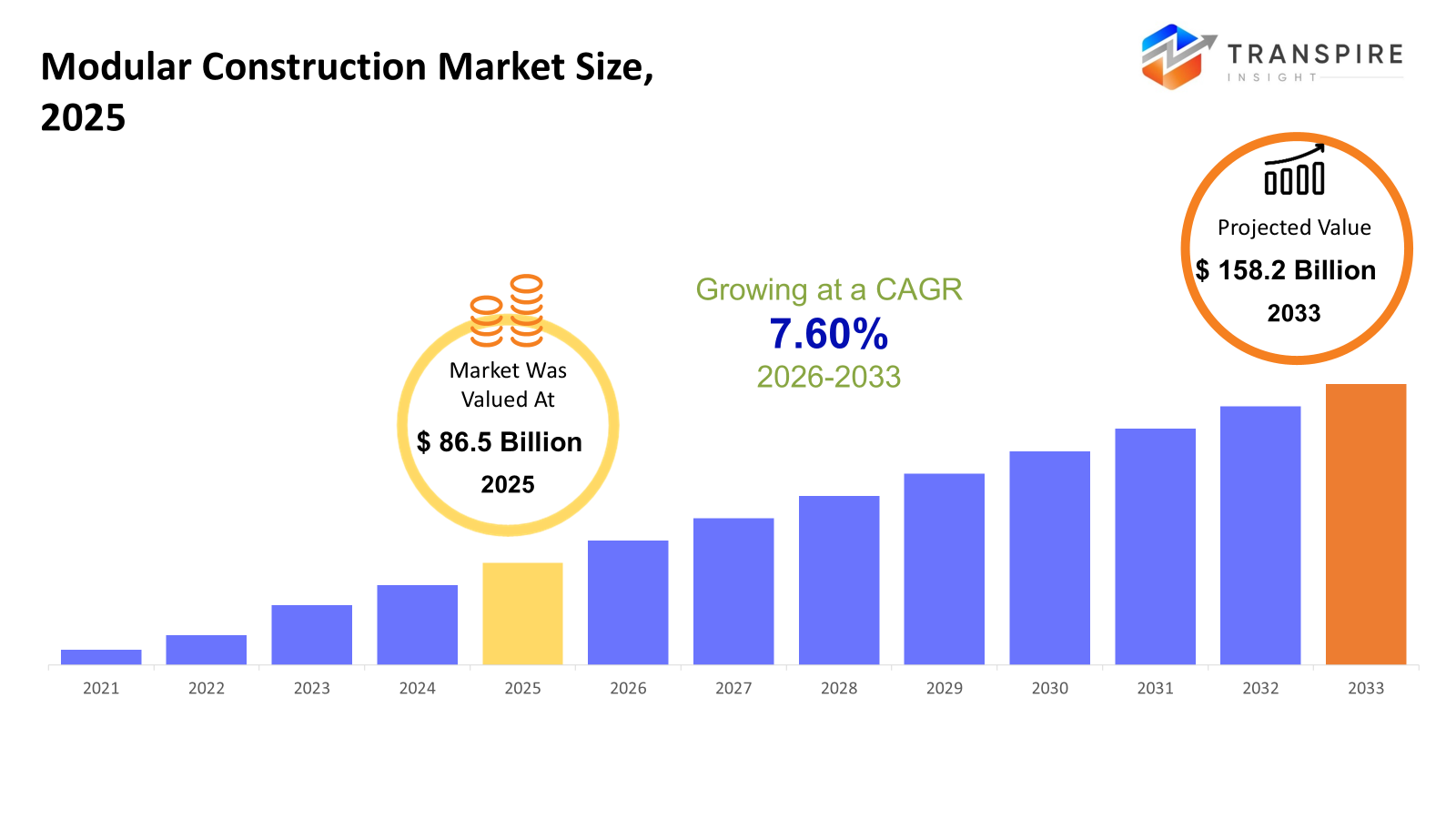
The global Modular Construction market size was valued at USD 86.5 billion in 2025 and is projected to reach USD 158.2 billion by 2033, growing at a CAGR of 7.60% from 2026 to 2033. The market of modular construction is growing at a steady pace of CAGR due to accelerated urbanization, labor scarcity in traditional methods of construction, and focus on cost and time optimization. Rising acceptance of sustainable methods of construction and government-aided affordable housing programs are adding to the pace of market expansion.
Market Size & Forecast
- 2025 Market Size: USD 86.5 Billion
- 2033 Projected Market Size: USD 158.2 Billion
- CAGR (2026-2033): 7.60%
- North America: Largest Market in 2026
- Asia Pacific: Fastest Growing Market
To learn more about this report,  Download Free Sample Report
Key Market Trends Analysis
- In North America there are a high number of adopters of the technology because of the labor shortages, as well as high construction costs. The region has seen high adopter rates because of the evolving trend of prefabrication. Additionally, the United States of America, Canada, and Mexico are at the forefront of supporting the technology because of the ongoing home and
- In the Asia Pacific region, there is speedy growth in modular construction owing to urbanization and the increasing population. Volume growth is driven by China and India, and precision and seismic-resistant designs by Japan and South Korea.
- The market for relocatable modular buildings continues to grow with increasing demand from various industries for modular buildings for educational, industrial, and temporary housing purposes due to factors such as ease of installation and setup, and cost savings over traditional construction methods.
- Steel based modular buildings are leading the current trend due to their strength and adaptability. There is an increasing demand for them in commercial and industrial buildings because of their fire-resistance properties and adaptability to heavy loads.
- The demand for modular buildings for residential purposes has remained paramount, and this has been caused by a lack of affordable housings and the need for fast construction project completion. Modular housings have recently gained popularity among developers as they allow for fast project completion and meet all sustainability standards.
- Four-sided modular units come to be preferred types of module designs owing to their malleability, transportability, and capabilities of expansion. Such malleability enhances their adaptability, resulting in their extensive use in residential, commercial, and institutional applications.
So, The construction market for modules is the process of adopting the construction of prefabricated modules in controlled factories and assembling them at the construction site. This speeds up the construction process, aids in the saving of materials, and overflows the construction process due to weather changes. Market growth is driven by growing urban density, enhanced infrastructure spending, and an inability to find skilled workers in the construction business. Modest construction addresses these challenges by allowing for mass scalability, thereby allowing for swift project delivery. Government and private developers turn to modest construction methods for housing, healthcare, and education needs.
Advancements made through technology regarding building information modeling, automation, and materials add to the attraction offered by the modular market. The logistics and sustainability offered by the market make it an alternative to conventional methods and help to drive the market as an emerging trend in developed as well as developing regions.
Modular Construction Market Segmentation
By Type
- Relocatable
Relocatable modular buildings will be moved from place to place, perfect for temporary classrooms, site offices, or emergency housing. They are easy to set up and cost-effective, especially when flexibility is of utmost importance.
- Permanent
Permanent modular construction is designed to last providing the same longevity as traditional construction, yet within a fraction of the time and without many of the waste issues. The units can blend harmoniously into long-term infrastructure projects such as schools, hospitals, and high-rise buildings.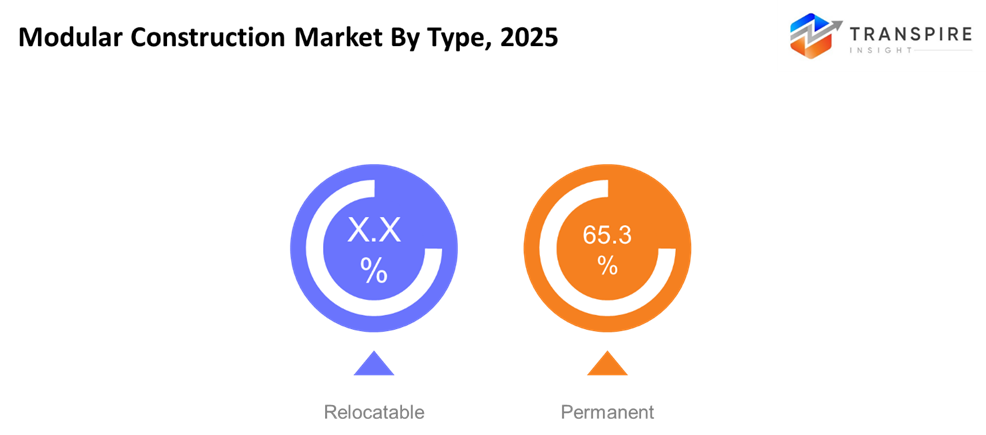
To learn more about this report, Download Free Sample Report
By Material
- Wood
Wood has been in high demand in residential and low-rise modular construction due to its warmth, eco-friendliness, and assembly simplicity. It is also lightweight and eco-friendly but not often desired in high-pressure applications.
- Steel
Strengths and durability offered by steel enable it to be the best choice for commercial and industrial modules. It is capable of supporting heavy loads and can withstand harsh environments.
- Concrete
Concrete modules boast excellent durability, thermal mass, and fire resistance. They have a wide application in structures where stability and longevity are central, such as in hospitals, schools, and urban buildings.
- Others
This encompasses composite panels, fiberglass, and hybrid composites, which combine desired properties such as light weight, toughness, and insulating qualities. These composites come in handy in situations where particular property profiles are desired, such as corrosion resistance and harsh environments.
By Application
- Residential
Whether it is a single-family dwelling or an apartment building, modular is changing the way homes are constructed with speed, minimal disruption, and a high degree of customization, and residents are enjoying the best of all worlds with quality and predictability.
- Commercial
In the retail, office, and hospitality sectors, modular buildings mean fast occupancy and flexibility in terms of expansion without waiting long to complete the structure. They are currently in high demand as pop-up stores, coworking offices, and temporary additions to a facility.
- Industrial
The use of these units for industries involves fabrication units, storage units, and site offices that require functional and robust space to be delivered quickly. Such units are able to perform in challenging environments and enable companies to begin business operations rapidly.
- Healthcare
Modular healthcare installations, such as clinics or testing laboratories, serve well during demand spikes because of their rapid installation. These centers meet the challenge of healthcare quality with their speed.
- Educational
Modular schools and training facilities solve the problem of overcrowding. The fast construction time and flexibility that comes with modular buildings are an added advantage. This type of structure would be best for areas that have growing school enrollment.
By Module
- Four- Sided
Made as self-contained modules in the shape of a box, which can be stacked and connected. Offer the greatest degree of flexibility. Also used for residential, commercial, and institutional applications.
- Open-sided
Designed to have one side open and can be joined with ease to neighboring buildings or used on canopies, open offices, and retail displays. They optimize use and save on materials.
- Partially Open-sided
These modules, incorporating strategic openings such as those for balconies and walkways, merge the requirements of enclosure and openness to provide design flexibility for building architecture.
- Mixed modules & floor cassettes
The mixing of various module types or pre-assembled floor sections facilitates complex designs. The hybrid technique allows versatile and precise design of buildings of varying sizes and shapes. The resultant structure could be of varied shapes like long and thin or complex.
- Modules supported by a primary structure
In this case, the lightweight modularity units are erected on a basic structural framework, which is most suited for high-rise buildings and those with large interior spaces (such as auditoriums, atriums).
- Others
This ranges from specialized units or customized modular layouts designed for specific purposes or niches – for instance, utility modules, tech labs, and hospitality modules.
Regional Insights
North America, fueled by the United States, has an established market for modular construction, which gets stimulated due to labor scarcity, high construction costs, and demand for residential and commercial buildings. The key focus in Canada is sustainable housing, while there is an increase in the adoption of industrial and affordable housing solutions in Mexico. Europe is focusing more on energy efficiency and meeting the requirements in a regulated manner, and Germany and the United Kingdom are leading in innovative technologies in modules. France, Spain, and Italy are using modules for their infrastructure projects, and tier-2 countries in Europe are using modules in education and healthcare sectors.
The most rapidly growing markets are in the Asia Pacific, which are fuelled by the large-scale urbanization and infrastructure buildup projects in China and India. A key emphasis in the Japanese and Korean markets is high-quality and earthquake-resistant modular designs, whereas the Australian and New Zealand markets favor sustainable and remote modular construction. The market in South America is an emerging market. The adoption of modular buildings has started in Brazil because of its demand for housing and industrial expansion. The modular industry has started gaining pace in Argentina and other countries as they have become keen on adopting this method for assembling cheaper public infrastructure. The Middle East & Africa region reports steady growth due to the fast pace of urbanization. The countries of Saudi Arabia and the UAE focus on large scale projects and South Africa and other countries use the concept of modular construction to develop healthcare, educational and housing infrastructure.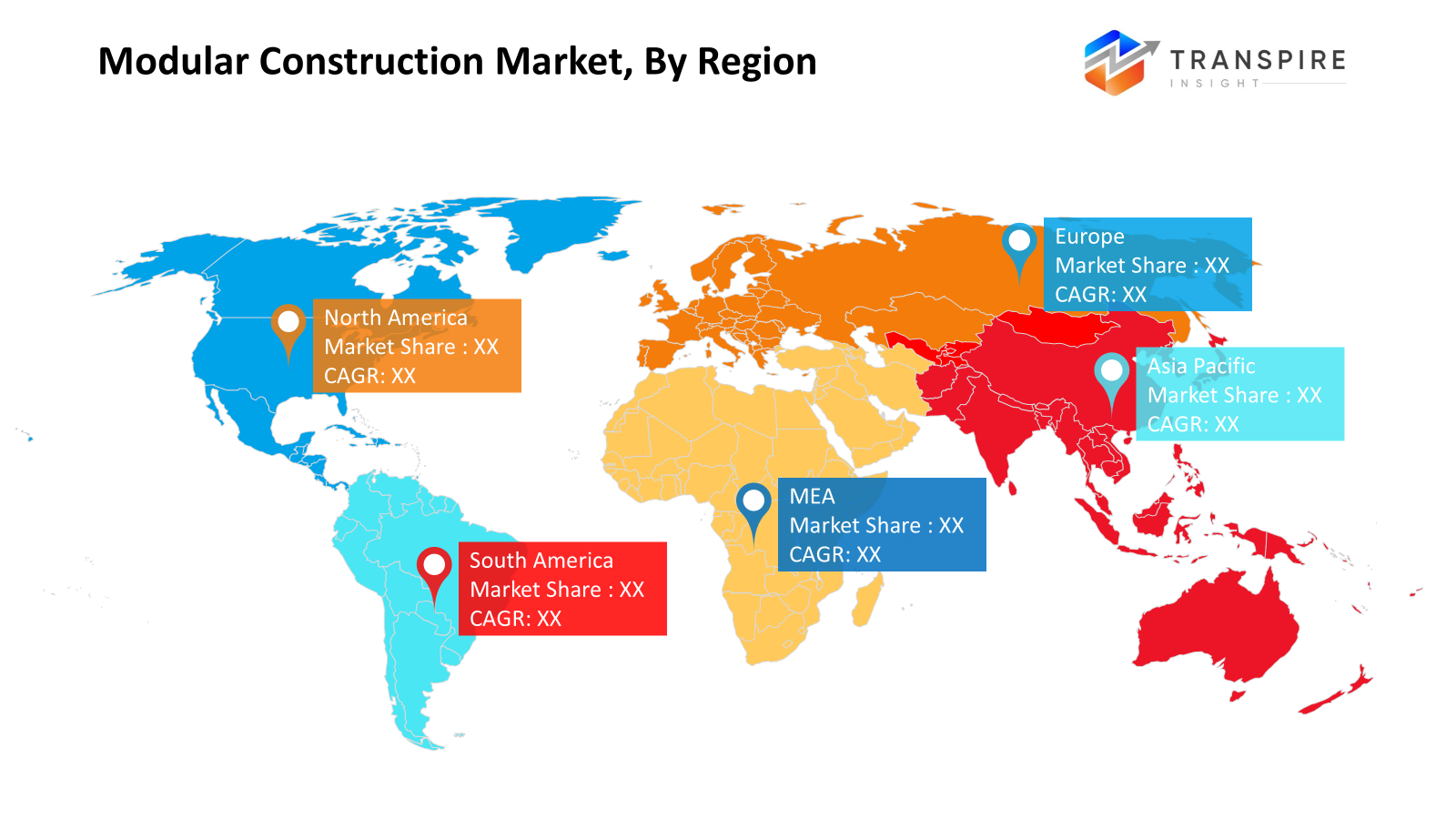
To learn more about this report, Download Free Sample Report
Recent Development News
- October 2025, The various modular construction methods, whether it be manufactured parts or volumetric modules, solve a variety of problems in this industry. This ranges from improving productivity in this industry, cutting down personnel needs up to 40 percent, and speeding up a project up to 50 percent. Canada is actually one of the late bloomers when it comes to residential modular buildings, because of several systemic problems. However, the moves of the Canadian government are bringing positivity to the future of residential modular building.
- In May 2025, Gwinnett Walton Habitat for Humanity launched this new program last month and marked an important milestone within the community regarding affordable housing. The two customized modular homes were donated and placed around Lake Carleton inside the city of Loganville, GA.
|
Report Metrics |
Details |
|
Market size value in 2025 |
USD 86.5 Billion |
|
Market size value in 2026 |
USD 95 Billion |
|
Revenue forecast in 2033 |
USD 158.2 Billion |
|
Growth rate |
CAGR of 7.60% from 2026 to 2033 |
|
Base year |
2025 |
|
Historical data |
2021 – 2024 |
|
Forecast period |
2026 – 2033 |
|
Report coverage |
Revenue forecast, competitive landscape, growth factors, and trends |
|
Regional scope |
North America; Europe; Asia Pacific; Latin America; Middle East & Africa |
|
Country scope |
United States; Canada; Mexico; United Kingdom; Germany; France; Italy; Spain; Denmark; Sweden; Norway; China; Japan; India; Australia; South Korea; Thailand; Brazil; Argentina; South Africa; Saudi Arabia; United Arab Emirates |
|
Key company profiled |
Sekisui House Ltd., Laing O’Rourke, Red Sea International, Skanska AB, Bouygues Construction, Premier Modular Limited, KLEUSBERG GmbH & Co. KG, CIMC Modular Building Systems Holdings Co., Ltd. (CIMC-MBS), DuBox, Wernick Group, Lendlease Corporation, Modulaire Group, Guerdon, LLC, Hickory Group, ATCO Ltd |
|
Customization scope |
Free report customization (country, regional & segment scope). Avail customized purchase options to meet your exact research needs. |
|
Report Segmentation |
By Type (Relocatable, Permanent), By Material (Wood, Steel, Concrete, Others), By Application (Residential, Commercial, Industrial, Healthcare, Educational), By Module (Four-sided, Open-sided, Partially open-sided, Mixed modules & floor cassettes, Modules supported by a primary structure, Others |
Key Modular Construction Company Insights
Skanska AB is one of the global leaders in construction and development, with headquarters in Sweden, that has expanded its modular construction capacity greatly in response to the challenges of efficiency, sustainability, and quality in construction projects. The firm employs advanced prefabrication methods and BIM software for engineering, such as BIM, in creating standardized modules for residential, healthcare, and office buildings, which speeds up construction and saves costs as well. Skanska’s global reach in Europe and North America helps increase its market and, simultaneously, emphasizes and commits itself to adhering strictly to green construction practices and principles as well.
Key Modular Construction Companies:
- Sekisui House Ltd.
- Laing O’Rourke
- Red Sea International
- Skanska AB
- Bouygues Construction
- Premier Modular Limited
- KLEUSBERG GmbH & Co. KG
- CIMC Modular Building Systems Holdings Co., Ltd. (CIMC-MBS)
- DuBox
- Wernick Group
- Lendlease Corporation
- Modulaire Group
- Guerdon, LLC
- Hickory Group
- ATCO Ltd
Global Modular Construction Market Report Segmentation
By Type
- Relocatable
- Permanent
By Material
- Wood
- Steel
- Concrete
- Others
By Application
- Residential
- Commercial
- Industrial
- Healthcare
- Educational
By Module
- Four-sided
- Open-sided
- Partially open-sided
- Mixed modules & floor cassettes
- Modules supported by a primary structure
- Others
Regional Outlook
- North America
- United States
- Canada
- Mexico
- Europe
- Germany
- United Kingdom
- France
- Spain
- Italy
- Rest of Europe
- Asia Pacific
- Japan
- China
- Australia & New Zealand
- South Korea
- India
- Rest of Asia Pacific
- South America
- Brazil
- Argentina
- Rest of South America
- Middle East & Africa
- Saudi Arabia
- United Arab Emirates
- South Africa
- Rest of the Middle East & Africa
Frequently Asked Questions
Find quick answers to common questions.
The approximate Modular Construction Market size for the market will be USD 158.2 billion in 2033.
Key segments for the Modular Construction Market are By Type (Relocatable, Permanent), By Material (Wood, Steel, Concrete, Others), By Application (Residential, Commercial, Industrial, Healthcare, Educational), By Module (Four-sided, Open-sided, Partially open-sided, Mixed modules & floor cassettes, Modules supported by a primary structure, Others)
Major Modular Construction Market players are Sekisui House Ltd., Laing O’Rourke, Skanska AB, Bouygues Construction, Lendlease Corporation.
The North America region is leading the Modular Construction Market.
The CAGR of the Modular Construction Market is 7.60%.
- Sekisui House Ltd.
- Laing O’Rourke
- Red Sea International
- Skanska AB
- Bouygues Construction
- Premier Modular Limited
- KLEUSBERG GmbH & Co. KG
- CIMC Modular Building Systems Holdings Co., Ltd. (CIMC-MBS)
- DuBox
- Wernick Group
- Lendlease Corporation
- Modulaire Group
- Guerdon, LLC
- Hickory Group
- ATCO Ltd
Recently Published Reports
-
Dec 2024
Handling and Lifting Equipment Market
Handling and Lifting Equipment Market Size, Share & Analysis Report By Product (Cranes and Hoists, Forklifts, Conveyor Systems, Aerial Work Platforms, Others), By Application (E-Commerce, Automotive and Railway, Food and Beverages, Aviation, Others), and Geography (North America, Europe, Asia-Pacific, Middle East and Africa, South and Central America), 2021 - 2031
-
Feb 2025
HVAC Equipment Market
HVAC Equipment Market Size, Share & Analysis Report By Heating Equipment Type (Boilers and Furnaces, Heat Pumps, and Unitary Heaters), By Ventilation Equipment (Air Handling Units, Humidifiers and Dehumidifiers, Air Filters, and Fan Coiling Units), By Air Conditioning Equipment (Unitary Air Conditioners, Room Air Conditioners, Packaged Terminal Air Conditioners, and Chillers), By End User (Commercial, Residential, Industrial, and others), and Geography (North America, Europe, Asia-Pacific, Middle East and Africa, South and Central America), 2021 – 2031
-
Feb 2025
Refrigeration Valves Market
Refrigeration Valves Market Size, Share & Analysis Report By Type (Solenoid Valves, Expansion Valves, Check Valves, Service Valves, Others), By Application (Commercial Refrigeration, Industrial Refrigeration, Transport Refrigeration, Residential Refrigeration, Air Conditioning Systems), By End User (Food and Beverage Industry, Pharmaceutical Industry, HVAC Industry, Chemical Industry, Others), and Geography (North America, Europe, Asia-Pacific, Middle East and Africa, South and Central America), 2021 – 2031
-
Dec 2025
E-Commerce Packaging Materials Market
E-Commerce Packaging Materials Market By Material Type (Corrugated Boxes, Paper & Paperboard, Foam & Cushioning Materials, Plastic Packaging, Flexible Packaging, Protective Packaging, Others), By Product(Primary Packaging, Secondary Packaging, Tertiary Packaging), By Packaging Function (Protective Packaging, Branding & Presentation Packaging, Transit & Logistic Packaging, Sustainable Packaging, Tamper Evidence Packaging), By End-User (Retail & Consumer Goods, Electronic Appliances, Food & Beverages, Healthcare & Pharmaceutical, Fashion & Apparel, Home & Furnishing, Others); By Industry Analysis, Size, Share, Growth, Trends, and Forecasts 2021-2033